Benefits and Risks of Genetically Modified Crops
Complete GM guide • Biotechnology
GM Crops:
Assess GM ImpactGenetically modified (GM) crops are plants whose DNA has been altered using genetic engineering techniques. These modifications can introduce new traits or enhance existing ones, such as resistance to pests, diseases, or herbicides. GM crops represent a significant advancement in agricultural biotechnology, offering potential solutions to food security challenges while raising important questions about safety and sustainability.
Common GM traits include:
- Herbicide Resistance: Allows crops to survive herbicide applications
- Insect Resistance: Protects crops from specific pests using Bt genes
- Golden Rice: Enhanced nutritional content (vitamin A)
- Drought Tolerance: Improved survival under water stress
- Roundup Ready: Resistance to glyphosate herbicide
GM crops are grown on over 190 million hectares globally, with significant impacts on agriculture, food security, and environmental sustainability.
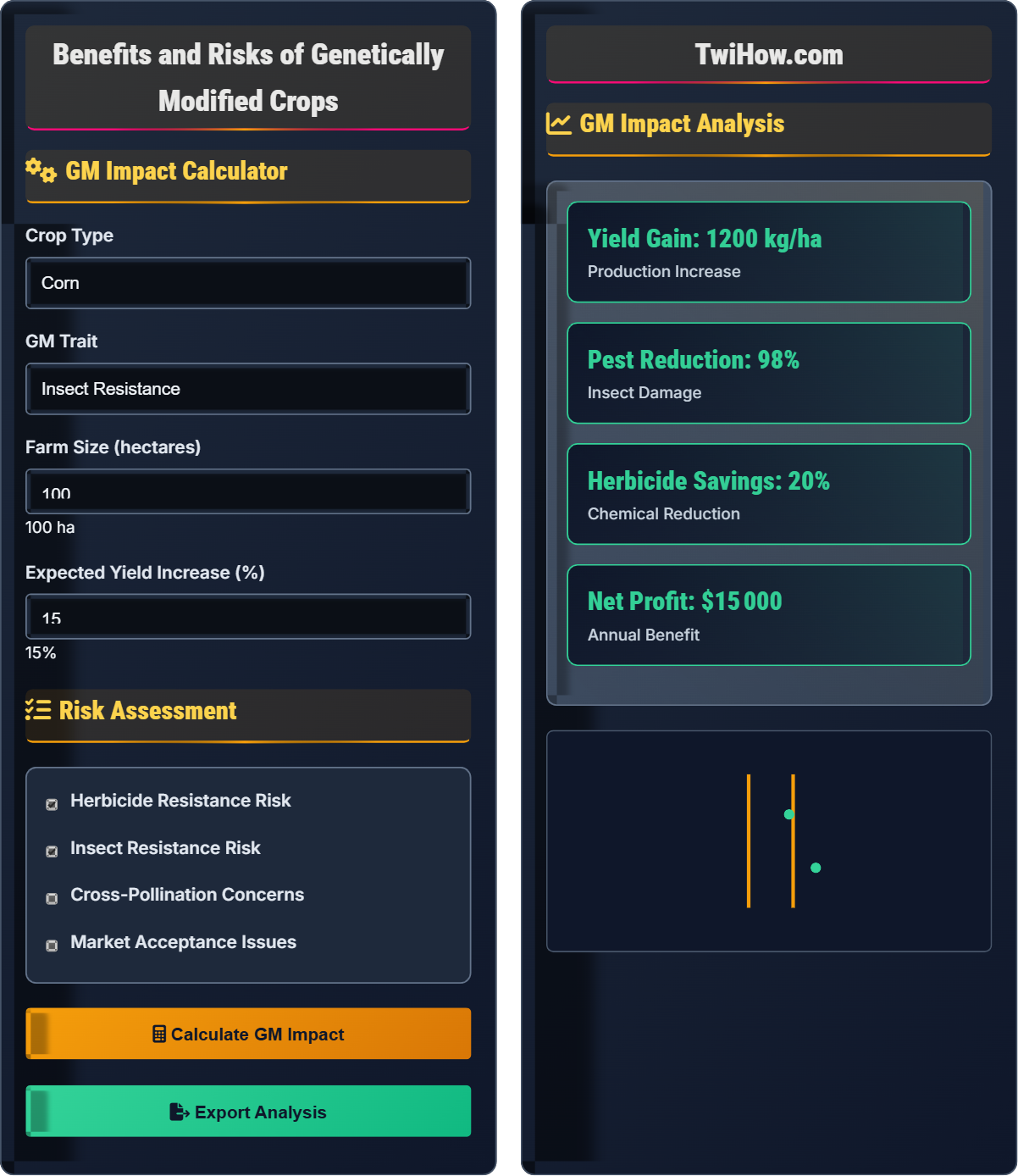
GM Impact Calculator
Risk Assessment
GM Impact Analysis
GM Crop Benefits
GM crops often produce higher yields due to reduced pest damage and improved stress tolerance. Studies show yield increases of 10-30% compared to conventional varieties.
Insect-resistant GM crops reduce the need for chemical insecticides. Herbicide-resistant crops allow for more targeted herbicide applications.
Biofortified GM crops like Golden Rice provide essential nutrients to address malnutrition in developing countries.
Reduced input costs and higher yields typically result in increased net profits for farmers adopting GM technology.
GM Crop Risks
Overuse of herbicide-tolerant GM crops can lead to the evolution of herbicide-resistant weeds, requiring new management strategies.
Pests may develop resistance to Bt toxins over time, reducing the effectiveness of insect-resistant GM crops.
GM genes may spread to wild relatives or conventional crops through cross-pollination, raising ecological and economic concerns.
Consumer concerns about GM crops may limit market access in certain regions, affecting export opportunities.
Scientific Evidence
GM crops are created using recombinant DNA technology, where specific genes are inserted into plant genomes. This allows for precise trait modification.
GM crops undergo extensive safety testing including compositional analysis, allergenicity assessment, and animal feeding studies.
GM crops are regulated by multiple agencies including FDA, EPA, and USDA in the US, with similar systems in other countries.
Major scientific organizations including NAS, AAAS, and WHO conclude that approved GM crops are safe for consumption.
Genetically Modified Crops Explained
Genetically modified (GM) crops are plants whose genetic material has been altered using biotechnology techniques. Unlike traditional breeding methods that shuffle existing genes, genetic engineering allows scientists to insert specific genes from different organisms to confer desired traits. This technology enables precise modifications that would be impossible through conventional breeding.
This process involves multiple stages of research, testing, and regulatory approval.
GM crops are developed with various beneficial traits:
- Herbicide Resistance: Allows farmers to control weeds without damaging crops
- Insect Resistance: Protects crops from specific pests using Bt genes
- Disease Resistance: Provides protection against plant diseases
- Drought Tolerance: Helps crops survive water stress
- Nutritional Enhancement: Improves nutritional content of crops
- Improved Shelf Life: Extends storage and transport time
- Food Safety: Major scientific organizations agree approved GM crops are safe
- Environmental Impact: Mixed evidence with some benefits and risks
- Yield Benefits: Documented increases in many cases
- Regulatory Oversight: Robust safety assessment systems exist
GM Crop Benefits
Increased yields, reduced pesticide use, enhanced nutrition, improved farmer income, reduced environmental impact, improved food security.
Net Benefit = (Yield Increase × Price per Unit) - (Technology Cost + Additional Inputs)
Where Benefit = economic gain, Yield = production improvement.
- Benefits vary by crop and region
- Technology costs must be considered
- Environmental benefits are significant
- Yield increases are well-documented
Potential Risks
Herbicide resistance evolution, insect resistance development, gene flow, market acceptance, regulatory challenges, ethical concerns.
- Identify potential hazards
- Assess exposure pathways
- Characterize risk level
- Implement management strategies
- Monitor and reassess
- Risks are manageable with proper oversight
- Similar to risks of conventional breeding
- Regulatory systems address safety concerns
- Ongoing monitoring is essential
GM Crop Benefits
GM crops often demonstrate higher yields due to reduced losses from pests, diseases, and herbicide applications. Studies indicate yield increases of 10-30% compared to conventional varieties, particularly beneficial for smallholder farmers in developing countries.
Insect-resistant GM crops significantly reduce the need for chemical insecticide applications. Herbicide-tolerant crops allow for more targeted herbicide use, reducing overall chemical inputs and environmental impact.
Biofortified GM crops like Golden Rice provide essential nutrients such as vitamin A to address malnutrition in developing countries. Other examples include iron-enhanced rice and omega-3 enriched soybeans.
GM crops typically result in increased net profits for farmers through higher yields and reduced input costs. Studies show average profit increases of 68% for farmers adopting GM technology.
Potential Risks and Concerns
Overuse of herbicide-tolerant GM crops with glyphosate can lead to the evolution of herbicide-resistant weeds. This requires new management strategies and may increase herbicide use over time.
Pests may develop resistance to Bt toxins over time, reducing the effectiveness of insect-resistant GM crops. This necessitates resistance management strategies and rotation of different Bt proteins.
GM genes may spread to wild relatives or conventional crops through cross-pollination, raising ecological and economic concerns. This can affect organic certification and export markets.
Consumer acceptance varies globally, with some regions imposing restrictions on GM crops. This can limit market access and create trade barriers for GM products.
GM vs Conventional Crops Comparison
| Metric | GM Crops | Conventional Crops |
|---|---|---|
| Yield | +10-30% | Baseline |
| Insecticide Use | -40-60% | Baseline |
| Herbicide Use | Variable | Baseline |
| Farmer Income | +68% avg | Baseline |
| Development Time | 10-15 years | 5-10 years |
| Regulatory Approval | Extensive | Less |
Historical Timeline
Scientific Evidence and Consensus
Major scientific organizations worldwide have reviewed the evidence and concluded that approved GM crops are safe for consumption and the environment.
GM Crops Quiz
What is the scientific consensus regarding the safety of approved GM crops?
The scientific consensus is that approved GM crops are safe for consumption. Major scientific organizations including the US National Academy of Sciences, American Association for the Advancement of Science, World Health Organization, and European Food Safety Authority have reviewed the evidence and reached this conclusion.
The answer is B) Major scientific organizations consider them safe.
Scientific consensus is reached through rigorous evaluation of peer-reviewed research. When multiple independent scientific organizations review the same evidence and reach similar conclusions, it indicates a strong consensus. The safety assessment of GM crops involves extensive testing and regulatory oversight.
Scientific Consensus: Agreement among scientific experts
Peer Review: Evaluation by independent experts
Regulatory Oversight: Government safety evaluation
• Consensus based on evidence
• Multiple organizations agree
• Ongoing safety evaluation
• Check multiple scientific sources
• Look for peer-reviewed research
• Consider regulatory assessments
• Confusing public opinion with scientific consensus
• Not distinguishing between concerns and evidence
• Overlooking regulatory processes
Explain how GM crops can increase agricultural yields and what factors influence the magnitude of yield gains.
Yield Mechanisms: GM crops increase yields primarily by reducing losses from pests, diseases, and herbicide applications. Insect-resistant crops protect against yield-robbing insects, while herbicide-resistant crops allow for better weed control without crop damage.
Factors Influencing Gains: The magnitude of yield increases depends on pest pressure, farming practices, climate conditions, and crop genetics. In areas with high pest pressure, GM crops may show 20-30% yield increases, while in areas with low pressure, gains may be minimal.
Regional Variations: Developing countries often show higher yield gains due to less developed pest management systems. Smallholder farmers particularly benefit from reduced labor requirements for pest control.
Long-term Considerations: Yield gains may diminish over time as pests develop resistance, requiring integrated pest management strategies.
Yield benefits from GM crops are not universal but depend on local conditions and pest pressure. The technology works by reducing losses rather than increasing inherent productivity, which is why benefits vary by region and situation.
Yield Gain: Increase in production compared to baseline
Pest Pressure: Intensity of pest infestation
Integrated Pest Management: Comprehensive pest control approach
• Benefits vary by location
• Context-specific impacts
• Management affects outcomes
• Consider local pest pressure
• Evaluate management practices
• Account for temporal changes
• Assuming universal benefits
• Not considering local conditions
• Ignoring pest resistance
A farmer grows 100 hectares of corn. Conventional corn yields 8 tons/hectare with $300/hectare insecticide costs. GM corn yields 9.5 tons/hectare with $450/hectare technology fee but $100/hectare insecticide costs. Corn sells for $200/ton. Calculate the economic impact of switching to GM corn.
Conventional Corn:
Revenue: 100 ha × 8 tons/ha × $200/ton = $160,000
Costs: 100 ha × $300/ha = $30,000
Net Income: $160,000 - $30,000 = $130,000
GM Corn:
Revenue: 100 ha × 9.5 tons/ha × $200/ton = $190,000
Costs: (100 ha × $450/ha) + (100 ha × $100/ha) = $55,000
Net Income: $190,000 - $55,000 = $135,000
Economic Impact: Switching to GM corn increases net income by $5,000 (3.8% increase).
This example demonstrates how yield increases and cost reductions can offset technology fees. The net benefit depends on the balance between higher yields, reduced input costs, and technology fees. Economic benefits vary based on local conditions and market prices.
Technology Fee: Payment for GM seed technology
Net Income: Revenue minus all costs
Economic Impact: Change in profitability
• Calculate all costs and benefits
• Consider yield changes
• Account for technology fees
• Include all relevant costs
• Consider local conditions
• Account for price fluctuations
• Forgetting technology fees
• Not considering yield changes
• Ignoring input cost changes
You are developing a risk management strategy for Bt corn to prevent insect resistance. Design a comprehensive approach that addresses the main resistance development concerns.
Refuge Strategy: Require farmers to plant 20% non-Bt corn as a refuge to maintain susceptible insects in the population.
Pyramided Toxins: Develop corn varieties with multiple Bt proteins targeting the same pest through different mechanisms.
Rotation Practices: Encourage crop rotation to break pest life cycles and reduce selection pressure.
Monitoring Programs: Implement surveillance to detect early signs of resistance development.
Alternative Controls: Promote integrated pest management combining biological, cultural, and chemical controls.
Stewardship Programs: Educate farmers on proper resistance management practices and compliance requirements.
Resistance management requires a multi-faceted approach combining biological, agronomic, and regulatory strategies. The goal is to slow resistance development while maintaining the effectiveness of the technology for future generations.
Refuge Strategy: Non-GM area to maintain susceptible insects
Pyramided Toxins: Multiple resistance mechanisms
Integrated Pest Management: Comprehensive pest control
• Combine multiple strategies
• Monitor continuously
• Ensure compliance
• Use multiple resistance mechanisms
• Educate stakeholders
• Monitor and adapt
• Relying on single strategies
• Not monitoring effectively
• Poor farmer compliance
What is the primary environmental benefit of insect-resistant GM crops?
The primary environmental benefit of insect-resistant GM crops is reduced chemical insecticide applications. These crops protect themselves against specific pests, eliminating or reducing the need for broad-spectrum insecticide sprays that can harm beneficial insects and contaminate the environment.
The answer is B) Reduced chemical insecticide applications.
Insect-resistant GM crops work by producing proteins toxic to specific pests, typically derived from Bacillus thuringiensis (Bt). This targeted approach reduces the need for chemical insecticides, which is beneficial for the environment and non-target organisms.
Bt Protein: Natural insecticide from bacteria
Targeted Approach: Specific to particular pests
Broad-spectrum: Affects many organisms
• Targeted reduces environmental impact
• Less chemical use is better
• Protects beneficial insects
• Consider pest specificity
• Think about non-target effects
• Evaluate chemical reduction
• Assuming all GM crops increase chemical use
• Not distinguishing between types of pesticides
• Ignoring targeted benefits
FAQ
Q: Are GM crops safe for my family to eat?
A: Yes, major scientific organizations including the US National Academy of Sciences, WHO, and FAO have concluded that approved GM crops are as safe as conventional crops. GM crops undergo extensive safety testing including compositional analysis, allergenicity assessment, and animal feeding studies before approval.
Q: Do GM crops increase pesticide use?
A: The impact varies by trait. Insect-resistant GM crops (like Bt corn) significantly reduce insecticide use. Herbicide-resistant crops initially reduced overall herbicide use but may lead to herbicide-resistant weeds over time. Overall, GM crops have reduced pesticide applications by about 37% globally.