What are the Considerations for Food Storage and Preservation at Community Scale?
Complete food security guide • Step-by-step explanations
Community Food Storage:
Show Storage PlannerCommunity-scale food storage and preservation involves strategic planning for food security, emergency preparedness, and resource management. Effective systems must balance accessibility, safety, sustainability, and community needs while considering infrastructure, technology, and governance requirements.
Key considerations for community food storage:
- Infrastructure: Storage facilities, equipment, utilities, and maintenance
- Preservation Methods: Drying, canning, freezing, fermentation, root cellaring
- Food Safety: Temperature control, pest management, contamination prevention
- Emergency Preparedness: Disaster resilience, backup systems, supply chains
- Community Access: Distribution systems, equity, and local engagement
Successful community food storage systems require comprehensive planning, stakeholder engagement, and sustainable practices.
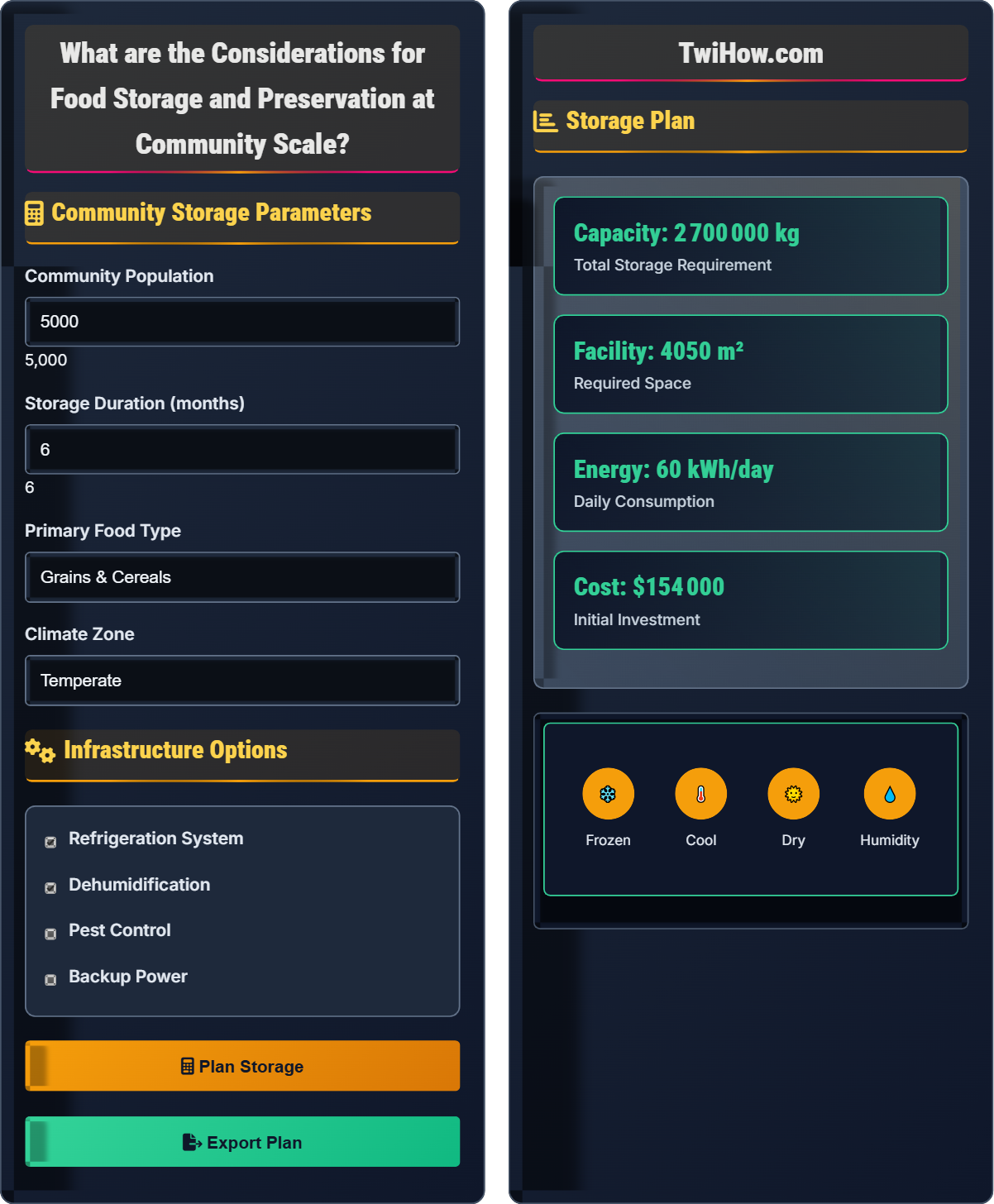
Community Storage Parameters
Infrastructure Options
Storage Plan
| Method | Applicability | Duration | Cost |
|---|---|---|---|
| Drying | Grains, vegetables | 1-2 years | Low |
| Canning | Acidic foods | 1-3 years | Medium |
| Freezing | Proteins, fruits | 6-12 months | High |
| Fermentation | Vegetables, dairy | 3-12 months | Low |
Community-Scale Food Storage and Preservation
Community-scale food storage involves planning and managing food reserves for groups ranging from small neighborhoods to entire cities. These systems serve multiple purposes including emergency preparedness, seasonal food security, and food access for vulnerable populations.
Key components of community food storage:
- Infrastructure: Warehouses, cold storage, processing facilities
- Equipment: Shelving, containers, preservation tools, monitoring systems
- Processes: Inventory management, rotation systems, quality control
- Personnel: Staff training, volunteer coordination, management
- Protocols: Safety standards, distribution procedures, emergency response
The required storage capacity can be calculated as:
Where Daily Consumption is typically 2-3 kg per person per day, and Safety Factor accounts for variations and emergencies (usually 1.2-1.5).
For example: 5,000 people × 2.5 kg/day × 180 days × 1.3 = 2,925,000 kg required storage capacity.
Effective community food storage requires substantial infrastructure investments:
- Facilities: Warehouses, cold storage rooms, processing areas
- Utilities: Electricity, water, drainage, ventilation systems
- Equipment: Shelves, containers, forklifts, monitoring systems
- Technology: Inventory management software, climate control
- Safety: Fire suppression, pest control, security systems
Community food storage systems must incorporate emergency preparedness measures:
- Redundancy: Multiple storage locations to prevent total loss
- Accessibility: Distribution networks for rapid deployment
- Communication: Alert systems and coordination protocols
- Backup Systems: Generator power, alternative cooling
- Training: Staff preparedness and community education
Food Safety Considerations
Temperature control, humidity management, pest prevention, contamination prevention, quality monitoring.
Food Safety Index = (Temperature Control + Humidity Control + Pest Management) / 3
Where each factor is rated on a 0-10 scale, with 10 being optimal control.
- Temperature should remain below 21°C for dry storage
- Relative humidity should be between 50-60% for most foods
- Regular inspection schedules are essential
- First-in-first-out rotation prevents spoilage
Community Access and Equity
Equitable distribution, culturally appropriate foods, accessibility accommodations, community engagement.
- Identify vulnerable populations
- Establish distribution points
- Create fair allocation systems
- Provide transportation assistance
- Monitor access outcomes
- Distribution should prioritize most vulnerable
- Cultural food preferences must be respected
- Accessibility for disabled individuals is required
- Community feedback mechanisms are essential
Community Food Storage Quiz
For a community of 10,000 people planning to store food for 3 months, with an average daily consumption of 2.2 kg per person, how much total storage capacity is needed (including a 20% safety factor)?
Using the formula: Storage Capacity = Population × Daily Consumption × Storage Duration × Safety Factor
Storage Capacity = 10,000 × 2.2 kg × 90 days × 1.2
Storage Capacity = 2,376,000 kg
This calculation ensures adequate food supply while accounting for variations in consumption and potential emergencies.
The answer is B) 2,376,000 kg.
Community food storage planning requires precise calculations to ensure adequate supplies. The safety factor accounts for unexpected events, population fluctuations, and emergency needs. This formula provides a foundation for infrastructure planning and budgeting.
Safety Factor: Extra capacity added to account for uncertainties
Daily Consumption: Average food intake per person per day
Storage Duration: Planned length of food storage period
• Safety factors typically range from 1.1 to 1.5
Explain the most appropriate preservation methods for different types of foods in a community storage system. Include specific techniques, duration expectations, and infrastructure requirements.
Grains and Cereals:
• Method: Dry storage in sealed containers
• Duration: 1-2 years with proper conditions
• Requirements: Low humidity (below 14%), cool temperatures, pest control
Fresh Vegetables:
• Method: Cold storage or root cellaring
• Duration: 1-6 months depending on type
• Requirements: Temperature control (0-10°C), humidity control (85-95%)
Fruits:
• Method: Cold storage or canning
• Duration: 2-8 months fresh, 1-2 years canned
• Requirements: Controlled atmosphere or sealing equipment
Proteins:
• Method: Freezing, canning, or dehydration
• Duration: 6-12 months frozen, 2-5 years canned
• Requirements: Refrigeration or sealing equipment
The choice of preservation method depends on food type, available infrastructure, and community needs.
Different food types require specific preservation methods to maintain quality and safety. The choice of method depends on available infrastructure, energy resources, and community preferences. Understanding these requirements helps planners design appropriate storage systems.
Preservation Method: Technique to extend food shelf life
Shelf Life: Period food remains safe and palatable
Infrastructure: Physical systems and equipment needed
• Match preservation method to food type
• Consider energy requirements
• Plan for infrastructure maintenance
• Use multiple preservation methods for diversity
• Prioritize local food preservation techniques
• Plan for seasonal food storage cycles
• Using inappropriate methods for food types
• Not considering energy requirements
• Ignoring maintenance needs
A community food storage facility serves 8,000 people with 6 months of food reserves. During a natural disaster, 20% more people seek assistance, and the facility needs to last 2 months longer than planned. Calculate the new demand and determine if the existing storage is adequate. If not, how much additional storage is needed?
Original Capacity:
8,000 people × 2.5 kg/day × 180 days = 3,600,000 kg
New Demand:
Population increase: 8,000 × 1.20 = 9,600 people
Duration increase: 180 + 60 = 240 days
New demand: 9,600 × 2.5 kg/day × 240 days = 5,760,000 kg
Shortfall Calculation:
Additional storage needed: 5,760,000 - 3,600,000 = 2,160,000 kg
The existing storage is inadequate by 2,160,000 kg, representing a 60% shortage. This demonstrates the importance of planning for surge capacity during emergencies.
This example illustrates why emergency preparedness requires significant additional capacity beyond normal needs. Disasters often increase both the number of people needing assistance and the duration of assistance required. Planning for these scenarios is crucial for community resilience.
Surge Capacity: Additional capacity needed during emergencies
Emergency Preparedness: Planning for disaster response
Community Resilience: Ability to withstand and recover from disruptions
• Emergency demand often exceeds normal capacity
• Plan for population surges during disasters
• Extend storage duration for emergency scenarios
A community food storage facility experiences a temperature spike to 28°C and humidity increase to 75% for 48 hours due to equipment failure. Calculate the potential impact on different food types and recommend immediate actions. Assume the facility contains 50% grains, 30% canned goods, and 20% dried fruits.
Impact Assessment:
Grains (50%): At 28°C and 75% humidity, grains may begin to germinate or develop mold after 48 hours. Risk level: High
Canned Goods (30%): Sealed cans are generally unaffected by temperature/humidity changes. Risk level: Low
Dried Fruits (20%): May absorb moisture and develop mold. Risk level: High
Immediate Actions:
1. Restore temperature control to below 21°C
2. Reduce humidity to 50-60%
3. Inspect all grain and dried fruit stocks for signs of spoilage
4. Separate potentially affected items
5. Increase monitoring frequency
6. Review backup systems and maintenance schedules
About 70% of the inventory (grains and dried fruits) may be at risk and requires careful inspection.
Food safety depends critically on maintaining proper storage conditions. Even short-term deviations can compromise food quality and safety. Regular monitoring and backup systems are essential for preventing widespread spoilage.
Food Safety: Prevention of foodborne illness and spoilage
Storage Conditions: Temperature, humidity, and air quality parameters
Monitoring: Regular checking of storage parameters
• Maintain temperature below 21°C for dry storage
• Keep humidity between 50-60% for most foods
• Inspect food regularly for signs of spoilage
• Install automatic monitoring systems
• Maintain backup power for critical systems
• Train staff on food safety protocols
• Not monitoring storage conditions continuously
• Lacking backup systems
• Insufficient staff training
Which of the following is the most critical consideration for ensuring equitable access to community food storage during emergencies?
During emergencies, the most critical factor is ensuring that food can reach those who need it most. This requires strategically located distribution points that are accessible to all community members, including those with mobility limitations, and systems that prioritize the most vulnerable populations. Physical accessibility and distribution logistics are more important than storage capacity or quality standards during crisis situations.
The answer is B) Distribution point locations and accessibility.
Food security isn't just about having enough food stored—it's about getting that food to people who need it, especially during emergencies. Distribution infrastructure and accessibility planning are often overlooked but critical components of community food security systems.
Food Access: Physical and economic ability to obtain food
Equitable Distribution: Fair allocation based on need
Emergency Distribution: Rapid food delivery during crises
• Distribution points must be accessible to all
FAQ
Q: What are the key challenges in establishing a community food storage system?
A: Key challenges include:
1. Funding: Initial infrastructure costs and ongoing operational expenses
2. Space: Securing appropriate facilities with proper climate control
3. Expertise: Staffing with qualified personnel for food safety and logistics
4. Coordination: Managing multiple stakeholders and distribution networks
5. Maintenance: Equipment upkeep and regular inspections
6. Community Buy-in: Ensuring sustained support and participation
Successful projects typically start with pilot programs and gradually scale up while building community capacity.
Q: How can community food storage systems integrate with existing food assistance programs?
A: Integration strategies include:
1. Shared Infrastructure: Using existing warehouses and distribution networks
2. Coordinated Procurement: Bulk purchasing to reduce costs
3>Staff Cross-Training: Building expertise across organizations
4. Unified Systems: Shared inventory management and tracking
5. Emergency Protocols: Joint response to disasters and crises
6. Community Mapping: Identifying gaps and overlapping services
This integration maximizes resources and avoids duplication while ensuring comprehensive coverage.