Food System Adaptation to Climate Variability
Complete climate adaptation guide • Step-by-step explanations
Climate Adaptation Fundamentals:
Show Climate Adaptation SimulatorFood systems face unprecedented challenges from climate variability, including extreme weather events, shifting precipitation patterns, temperature fluctuations, and changing growing seasons. Effective adaptation requires comprehensive strategies that enhance resilience while maintaining productivity and sustainability.
Climate adaptation in food systems involves implementing diverse strategies across multiple scales, from individual farms to global supply chains. These strategies must address both gradual climate changes and sudden extreme events while considering economic, social, and environmental factors.
Key adaptation considerations:
- Variability: Managing unpredictable weather patterns and extreme events
- Resilience: Building system capacity to withstand and recover from shocks
- Diversity: Implementing multiple, complementary adaptation strategies
- Scale: Coordinating adaptation across local, regional, and global levels
Successful climate adaptation combines traditional knowledge with cutting-edge technologies, integrating agroecological practices with predictive modeling and early warning systems to create robust food systems.
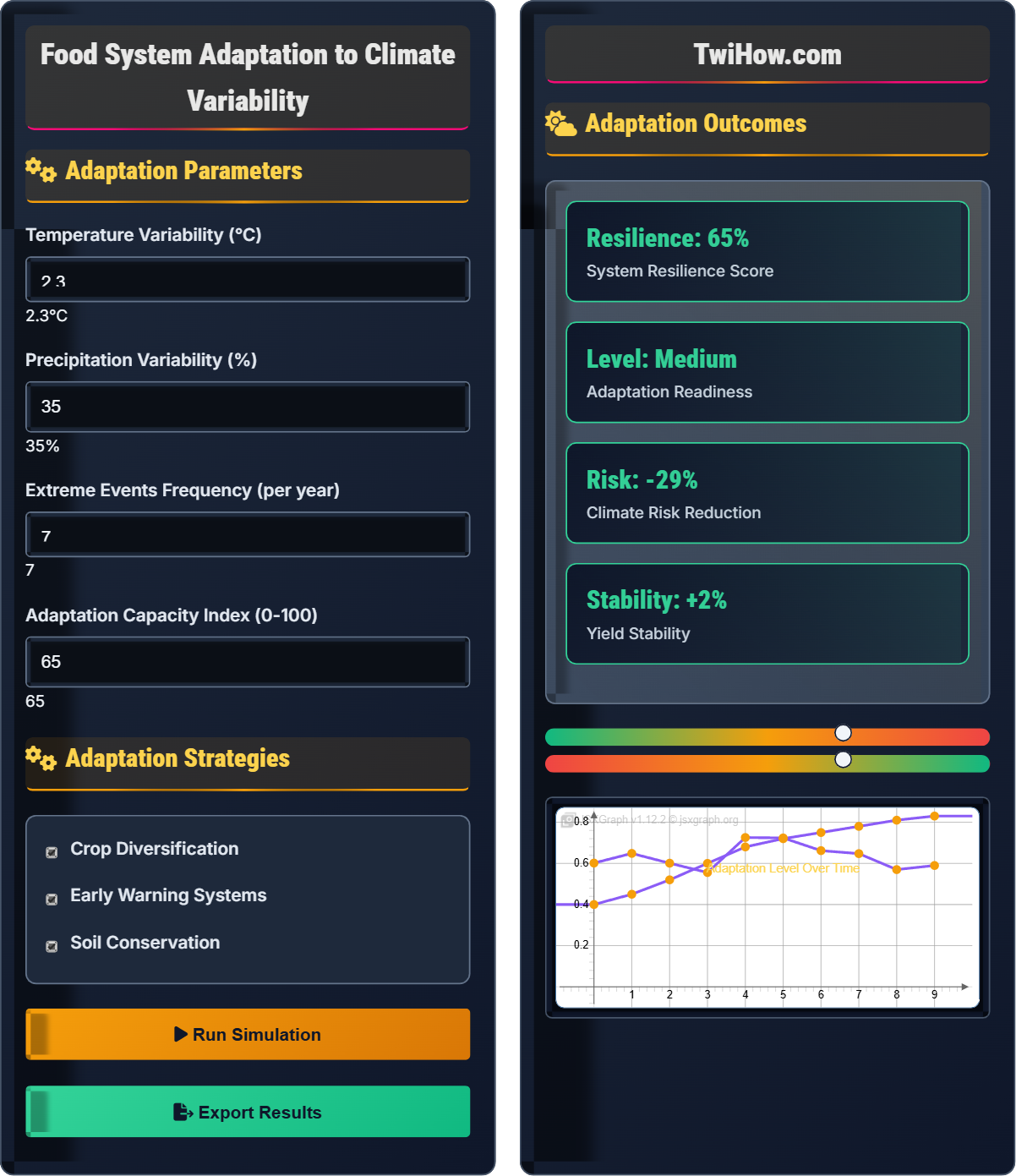
Adaptation Parameters
Adaptation Strategies
Adaptation Outcomes
| Strategy | Effectiveness | Cost | Implementation |
|---|---|---|---|
| Crop Diversification | 85% | Low | High |
| Early Warning | 75% | Medium | Medium |
| Soil Conservation | 80% | Low | High |
| Water Management | 70% | Medium | Medium |
W=Weather, T=Temperature, P=Precipitation, A=Adaptation, R=Resilience, D=Diversity, M=Management, F=Food, C=Climate
Climate Adaptation in Food Systems Explained
Food system climate adaptation encompasses all strategies and practices implemented to maintain food security and agricultural productivity under changing climatic conditions. This includes managing increased variability in weather patterns, extreme events, and long-term climate shifts.
Adaptation effectiveness is measured using several important indicators:
Where:
- Resilience: System's ability to recover from shocks
- Diversity: Range of crops, practices, and strategies
- Flexibility: Ability to adjust to changing conditions
- Goal: Maximize all three components for robust adaptation
Effective climate adaptation in food systems includes:
- Crop Diversification: Growing multiple crops to spread risk
- Variety Selection: Using climate-resilient cultivars
- Early Warning Systems: Predicting and preparing for extreme events
- Water Management: Efficient use and conservation
- Soil Conservation: Maintaining soil health and structure
- Integrated Approaches: Combining multiple strategies
- On-farm: Individual farmer-level practices
- Community: Collaborative local initiatives
- Regional: Coordinated landscape-level approaches
- National: Policy and institutional support
- Global: International cooperation and knowledge sharing
Climate Adaptation Fundamentals
Climate resilience, adaptation strategies, risk management, crop diversification, agroecology.
Index = (Resilience + Diversity + Flexibility) / 3
Where Index = adaptation effectiveness, Resilience = recovery capacity, Diversity = variety of strategies, Flexibility = adjustment ability.
- Multiple strategies increase resilience
- Local knowledge is valuable
- Monitoring enables learning
Applications
Drought-resistant crops, weather-indexed insurance, agroforestry, water harvesting, climate-smart agriculture.
- Technology adoption
- Farmer training
- Policy support
- Financial incentives
- Regional climate patterns
- Socioeconomic factors
- Cultural acceptance
- Economic feasibility
Climate Adaptation Learning Quiz
Which adaptation strategy provides the greatest resilience against climate variability?
Crop diversification spreads risk across multiple crops with different climate sensitivities, growing seasons, and market demands. If one crop fails due to adverse weather, others may succeed, providing economic stability and food security. This approach mimics natural ecosystem resilience.
The answer is B) Crop diversification.
Students should understand that diversification is a fundamental principle of risk management in uncertain environments. In nature, biodiversity provides ecosystem stability. Similarly, crop diversity provides agricultural system stability. This strategy works because different crops respond differently to varying weather conditions.
Crop Diversification: Growing multiple crops on the same farm
Resilience: Ability to recover from disturbances
Risk Spreading: Distributing risk across multiple options
• Diversity reduces vulnerability
• Multiple crops = multiple income streams
• Match crops to local conditions
• Consider market demand
• Plan seasonal rotations
• Assuming single crop efficiency
• Ignoring market factors
• Overlooking management complexity
Explain how early warning systems contribute to food system climate adaptation. What are the key components and benefits of these systems?
Components: Weather monitoring stations, satellite data, climate models, communication networks, and farmer outreach programs.
Benefits: Allows farmers to prepare for extreme events, adjust planting schedules, implement protective measures, and reduce crop losses.
Implementation: Provides actionable information in advance of weather events, enabling proactive rather than reactive management.
Integration: Links meteorological forecasts with agricultural advice, insurance products, and emergency preparedness plans.
Effectiveness: Studies show early warning systems can reduce agricultural losses by 20-40% when properly implemented.
Early warning systems demonstrate the importance of information in climate adaptation. Students should understand that adaptation is not just about physical changes but also about timely, relevant information that enables decision-making. The key is translating scientific forecasts into practical farmer actions.
Early Warning System: Integrated approach to predict and communicate hazards
Climate Forecast: Prediction of weather patterns weeks to months ahead
Proactive Management: Taking action before problems occur
• Timeliness is crucial
• Information must be actionable
• Local relevance matters
• Use multiple communication channels
• Tailor messages to specific needs
• Build trust with farmers
• Providing generic information
• Ignoring local context
• Poor communication systems
A farmer in a drought-prone region currently grows corn (requires 500mm water, yields $800/ha) and soybeans (requires 400mm water, yields $600/ha). They can switch to drought-resistant sorghum ($700/ha, 300mm water) and millet ($500/ha, 250mm water). If expected rainfall is 350mm this season, calculate which combination maximizes income while meeting water constraints.
Current Crops: Corn requires 500mm (exceeds 350mm available), soybeans require 400mm (also exceeds available). Neither crop is viable this season.
Climate-Smart Crops: Sorghum requires 300mm ≤ 350mm available, millet requires 250mm ≤ 350mm available. Both are viable.
Income Analysis: Sorghum alone: $700/ha. Millet alone: $500/ha. Mixed (assuming half land each): ($700 + $500)/2 = $600/ha average.
Optimal Strategy: Plant sorghum to maximize income while staying within water constraints.
This problem demonstrates how climate adaptation involves replacing vulnerable crops with climate-resilient alternatives. Students should understand that adaptation requires considering both biophysical constraints (water availability) and economic outcomes (income). The key insight is that adaptation may involve accepting lower potential yields to ensure crop survival.
Water Constraint: Maximum water available for crop production
Drought-Resistant: Crops requiring less water to mature
Adaptive Capacity: Ability to adjust to new conditions
• Resources must not exceed availability
• Adaptation may require new crops
• Economic and biophysical factors matter
• Always check resource constraints first
• Consider multiple viable options
• Balance economic and environmental factors
• Ignoring resource constraints
• Calculating only economic returns
• Not considering water requirements
A regional agricultural authority is developing a climate adaptation plan for an area experiencing increased temperature variability and irregular rainfall. Design a comprehensive adaptation strategy considering different stakeholder needs and implementation challenges.
Assessment Phase: Conduct vulnerability assessments, analyze climate projections, engage stakeholders, identify priority areas.
Strategy Development: Promote drought-resistant crops, implement water management systems, develop early warning systems, encourage crop diversification.
Implementation Framework: Establish demonstration plots, provide farmer training, create financial incentives, develop extension services.
Monitoring System: Track adoption rates, measure yield impacts, assess economic outcomes, evaluate resilience indicators.
Stakeholder Engagement: Involve farmers, researchers, government agencies, private sector, civil society organizations.
Regional adaptation planning requires a systems approach that considers multiple scales and actors. Students should understand that successful adaptation requires coordination across sectors and levels, with attention to both technical solutions and institutional arrangements. The key is building adaptive capacity at all levels.
Vulnerability Assessment: Evaluating exposure, sensitivity, and adaptive capacity
Adaptive Capacity: Ability to adjust to climate impacts
Multi-stakeholder Approach: Involving diverse actors in planning
• Plan across multiple scales
• Engage all stakeholders
• Monitor and learn continuously
• Start with pilot projects
• Build on existing institutions
• Consider socioeconomic factors
• Focusing only on technical solutions
• Ignoring social factors
• Not involving local communities
Which factor contributes most to food system resilience against climate variability?
Agroecological diversity creates resilient systems by mimicking natural ecosystems. Diverse species, varieties, and management practices provide multiple pathways for system function. If one component fails, others can compensate, maintaining overall productivity and stability. This diversity includes genetic, species, and ecosystem diversity.
The answer is C) Agroecological diversity.
Students should understand that resilience comes from redundancy and diversity in systems. Natural ecosystems are stable because they have multiple species performing similar functions. Agricultural systems can achieve similar stability through diversity. This principle applies at multiple levels: genetic, species, and ecosystem.
Agroecological Diversity: Biodiversity applied to agricultural systems
Functional Redundancy: Multiple species performing similar functions
Ecological Resilience: Stability through biodiversity
• Diversity creates stability
• Redundancy prevents system failure
• Natural systems provide models
• Look to natural systems
• Create backup options
• Maintain genetic diversity
• Equating efficiency with resilience
• Focusing only on productivity
• Ignoring ecological principles
FAQ
Q: How can I adapt my farm to increasingly unpredictable weather without losing productivity?
A: Several strategies can help maintain productivity under variable conditions:
1. Diversify Crops: Grow multiple crops with different climate requirements
2. Choose Resilient Varieties: Select drought, heat, and flood-tolerant cultivars
3. Improve Soil Health: Build organic matter to retain moisture and nutrients
4. Water Management: Install rainwater harvesting and efficient irrigation
5. Flexible Scheduling: Adjust planting based on seasonal forecasts
6. Early Warning Systems: Subscribe to weather alerts and agricultural advisories
Focus on building flexibility into your farming system to respond to changing conditions.
Q: What policies would most effectively support climate adaptation in agriculture?
A: Effective policies should include:
Financial Support: Insurance programs, subsidies for climate-resilient practices, disaster relief funds.
Knowledge Transfer: Extension services, research partnerships, farmer field schools, digital platforms.
Infrastructure: Irrigation systems, weather stations, storage facilities, early warning networks.
Market Mechanisms: Price stabilization, certification for climate-smart products, green finance.
Institutional Framework: Coordination mechanisms, climate information systems, adaptive governance.
Success requires integrated approaches linking technical, financial, and institutional support.