Food System Governance and Multi-Stakeholder Collaboration
Complete governance guide • Step-by-step explanations
Governance and Collaboration Fundamentals:
Show Governance SimulatorFood system governance involves the rules, institutions, and processes that coordinate the various actors and activities within the food system. Multi-stakeholder collaboration brings together diverse participants—from farmers and consumers to government agencies and NGOs—to make decisions collectively and address complex food system challenges.
Effective governance and collaboration require structured approaches to engage stakeholders meaningfully, align diverse interests, and create accountability mechanisms. This involves balancing public and private interests while ensuring equitable participation and transparent decision-making processes.
Key governance considerations:
- Participation: Ensuring all stakeholders have voice in decision-making
- Transparency: Open and accessible information sharing
- Accountability: Clear responsibilities and oversight mechanisms
- Equity: Fair representation of all stakeholder interests
Successful food system governance creates frameworks that enable coordinated action while respecting the diverse needs and perspectives of all participants, ultimately leading to more sustainable and equitable outcomes.
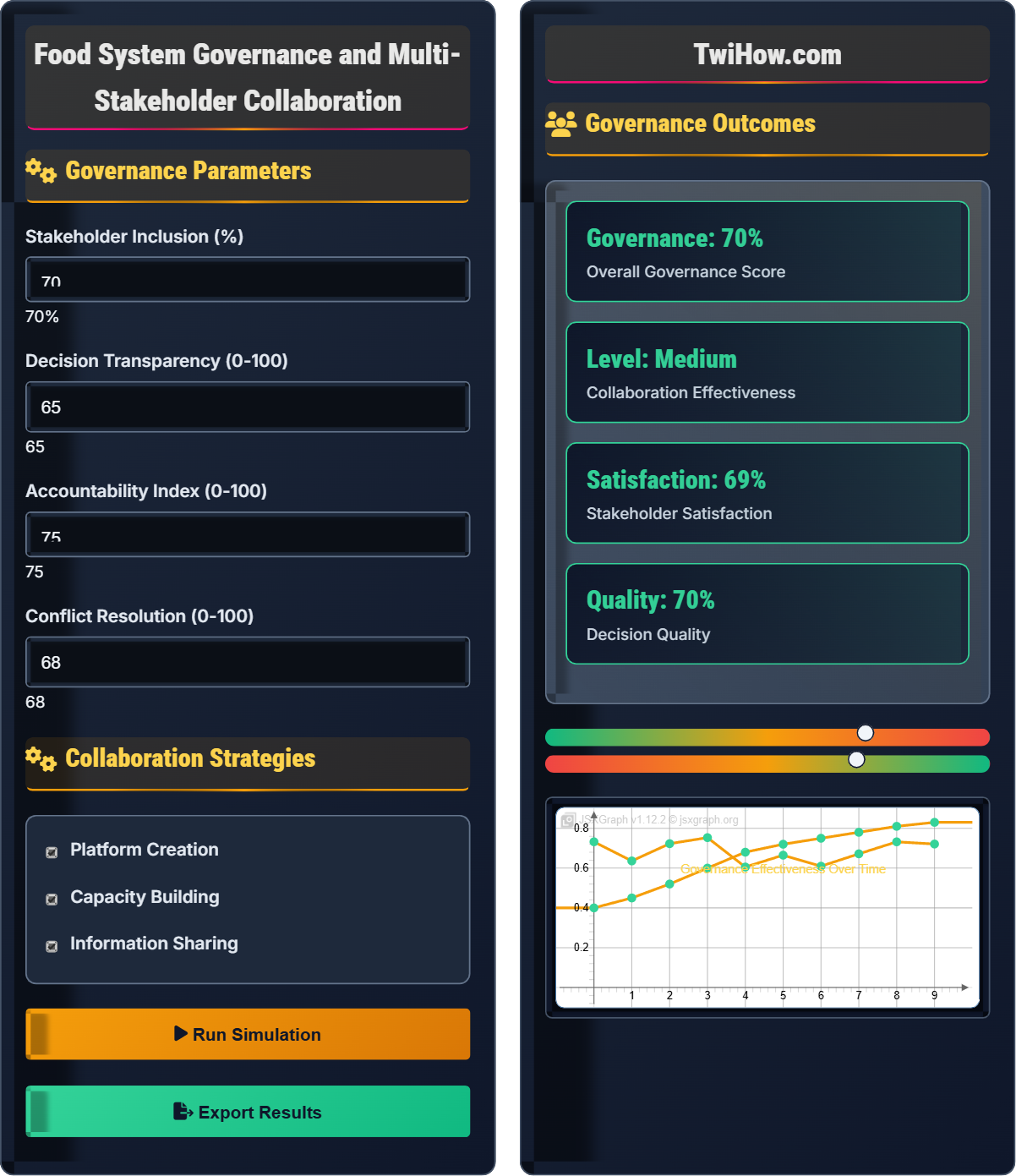
Governance Parameters
Collaboration Strategies
Governance Outcomes
| Dimension | Score | Priority | Action Items |
|---|---|---|---|
| Transparency | 65% | High | Improve reporting |
| Accountability | 75% | Medium | Strengthen oversight |
| Participation | 70% | High | Expand inclusion |
| Conflict Resolution | 68% | Medium | Enhance mediation |
F=Farmers, C=Consumers, G=Government, P=Private Sector, N=NGOs, A=Agriculture, R=Retail, D=Decision, M=Multi-stakeholder
Food System Governance Explained
Food system governance encompasses the institutions, rules, processes, and decision-making structures that coordinate activities across the entire food system. It involves how stakeholders interact, make decisions, and hold each other accountable to achieve food security and sustainability goals.
Governance effectiveness is measured using several important indicators:
Where:
- Transparency: Openness and accessibility of information
- Accountability: Responsibility and oversight mechanisms
- Participation: Stakeholder engagement and inclusion
- Goal: Maximize all components for effective governance
Effective food system governance includes:
- Multi-stakeholder Platforms: Inclusive decision-making forums
- Policy Coordination: Aligning across sectors and levels
- Transparency Mechanisms: Open information and reporting
- Accountability Systems: Oversight and evaluation processes
- Conflict Resolution: Mediation and dispute resolution
- Capacity Building: Enhancing stakeholder capabilities
- Formal: Government-led policy and regulatory frameworks
- Voluntary: Industry-led initiatives and standards
- Hybrid: Public-private partnerships and collaborations
- Community: Local-level governance and self-organization
- International: Global governance and coordination mechanisms
Governance and Collaboration Fundamentals
Multi-stakeholder governance, collaborative decision-making, stakeholder engagement, accountability mechanisms, transparency.
Index = (Transparency + Accountability + Participation) / 3
Where Index = governance effectiveness, Transparency = information openness, Accountability = responsibility mechanisms, Participation = stakeholder engagement.
- Inclusion strengthens legitimacy
- Transparency builds trust
- Accountability ensures performance
Applications
Multi-stakeholder platforms, food policy councils, public-private partnerships, certification schemes, collaborative standards.
- Stakeholder mapping
- Platform establishment
- Process design
- Capacity building
- Power dynamics
- Representation
- Resource allocation
- Decision-making authority
Governance and Collaboration Learning Quiz
Which stakeholder group is most critical for effective food system governance?
Effective food system governance requires the inclusion of all stakeholders who have a legitimate interest in food system outcomes. This includes farmers, consumers, government, private sector, civil society, and academic institutions. Each group brings unique perspectives, knowledge, and interests that are essential for comprehensive governance.
The answer is C) All stakeholders equally.
Students should understand that food systems are complex socio-technical systems with multiple interdependent actors. No single group has all the knowledge or interests needed for effective governance. The key is creating inclusive processes that respect different perspectives while seeking common ground.
Stakeholder: Individual or group affected by or affecting system outcomes
Legitimate Interest: Genuine connection to system impacts
Inclusive Governance: Decision-making involving all affected parties
• Multiple perspectives improve decisions
• Inclusion builds legitimacy
• Diverse knowledge is valuable
• Map all relevant stakeholders
• Ensure proportional representation
• Facilitate meaningful participation
• Assuming one group knows best
• Ignoring marginalized voices
• Tokenistic participation
Explain the key components of effective multi-stakeholder platforms for food system governance. What challenges do they face and how can these be addressed?
Key Components: Clear mandate, representative membership, transparent processes, adequate resources, skilled facilitation, and accountability mechanisms.
Challenges: Power imbalances, conflicting interests, resource constraints, competing priorities, and coordination difficulties.
Addressing Challenges: Establish clear rules of engagement, ensure balanced representation, provide capacity building, create binding commitments, and implement conflict resolution mechanisms.
Success Factors: Political support, stakeholder commitment, transparent governance, regular evaluation, and adaptive management.
Outcomes: Better decisions, increased legitimacy, enhanced cooperation, and more sustainable outcomes.
Multi-stakeholder platforms represent a shift from traditional top-down governance to collaborative approaches. Students should understand that while these platforms can improve decision-making, they require careful design and ongoing management to address inherent challenges like power imbalances and conflicting interests.
Multi-stakeholder Platform: Forum bringing together diverse actors
Facilitation: Process management for effective group work
Binding Commitments: Enforceable agreements among parties
• Design matters for effectiveness
• Power dynamics must be addressed
• Processes need resources
• Start with agreed-upon issues
• Build trust gradually
• Establish clear rules
• Assuming consensus is easy
• Ignoring power imbalances
• Inadequate facilitation
A food governance platform has farmers wanting maximum production, environmentalists demanding conservation, and consumers seeking affordable prices. If each group has 40% of the vote, and 20% goes to government representatives, design a decision-making process that addresses all concerns while maintaining platform effectiveness.
Issue Mapping: Identify specific concerns within each group (not just broad positions).
Multi-criteria Analysis: Evaluate options based on economic, environmental, and social criteria.
Iterative Process: Break decisions into phases, allowing for experimentation and learning.
Compromise Framework: Find win-win solutions like sustainable intensification that increases productivity while reducing environmental impact.
Decision Rules: Use supermajority (60%) for major decisions, allowing for consensus-building across groups.
Monitoring: Establish indicators for each stakeholder priority to track outcomes.
This problem demonstrates the reality of conflicting stakeholder interests in governance. Students should understand that effective governance doesn't eliminate conflicts but creates processes to manage them constructively. The key is finding creative solutions that address underlying interests rather than just stated positions.
Stakeholder Interests: Underlying needs and concerns
Win-Win Solutions: Outcomes benefiting multiple parties
Supermajority: Voting threshold above simple majority
• Address interests, not just positions
• Create structured dialogue
• Build trust through process
• Focus on shared objectives
• Use objective criteria
• Allow for experimentation
• Assuming zero-sum conflicts
• Ignoring underlying interests
• Forcing quick consensus
A country wants to reform its food system governance to be more inclusive and effective. Design a comprehensive reform plan addressing institutional structures, stakeholder engagement, and accountability mechanisms.
Institutional Reform: Establish national food council with representation from all stakeholder groups, create regional coordination mechanisms, and define clear roles and responsibilities.
Stakeholder Engagement: Implement structured consultation processes, establish permanent multi-stakeholder platforms, and create mechanisms for marginalized voices.
Accountability Systems: Develop performance indicators, create reporting requirements, establish oversight bodies, and implement feedback mechanisms.
Transparency Measures: Mandate public disclosure of decisions, create open data platforms, and ensure accessible information.
Capacity Building: Provide training for stakeholders, strengthen civil society organizations, and invest in governance capabilities.
Governance reform requires comprehensive approaches addressing structures, processes, and capabilities. Students should understand that effective reform involves multiple dimensions and requires sustained effort. The key is creating systems that are both legitimate and effective.
Governance Reform: Systematic changes to decision-making systems
Accountability Mechanisms: Processes ensuring responsibility
Stakeholder Consultation: Formal processes for input gathering
• Reform requires political will
• Multiple dimensions must align
• Capacity building is essential
• Start with agreed-upon problems
• Build incrementally
• Ensure resource commitment
• Assuming structural changes alone work
• Ignoring implementation capacity
• Not addressing power dynamics
Why is transparency crucial for effective food system governance?
Transparency is essential for building trust among stakeholders and ensuring the legitimacy of governance processes. When decision-making processes and outcomes are open and accessible, stakeholders can verify that their interests are being considered and that decisions are made fairly. This builds confidence in the system and encourages continued participation.
The answer is B) To build trust and legitimacy.
Students should understand that transparency is foundational to effective governance. Without transparency, stakeholders cannot verify that their interests are being represented or that decisions are made in good faith. This undermines trust and participation, which are essential for governance effectiveness.
Transparency: Openness in decision-making processes
Legitimacy: Recognition of authority and fairness
Trust: Confidence in institutions and processes
• Trust is essential for cooperation
• Transparency enables accountability
• Legitimacy requires openness
• Make information accessible
• Report regularly
• Use plain language
• Assuming information is enough
• Not considering accessibility
• Focusing only on outputs
FAQ
Q: How can farmers have meaningful input in food system governance when we're just one voice among many?
A: Farmers can have meaningful input through several strategies:
1. Organization: Join or form farmer associations, cooperatives, or unions to speak with a collective voice
2. Representation: Elect or designate representatives to participate in governance platforms
3. Knowledge Sharing: Contribute practical knowledge and on-the-ground experience
4. Alliances: Partner with other stakeholders who share common interests
5. Advocacy: Engage in policy discussions and public awareness campaigns
6. Capacity Building: Develop skills in communication, negotiation, and governance processes
Collective organization and strategic engagement can amplify farmer voices significantly.
Q: What institutional mechanisms work best for multi-stakeholder food system governance?
A: Effective institutional mechanisms include:
Multi-stakeholder Platforms: Structured forums for ongoing dialogue and decision-making with clear rules of engagement.
Food Policy Councils: Advisory bodies with formal government linkages that bridge policy and implementation.
Public-Private Partnerships: Collaborative arrangements leveraging strengths of both sectors.
Citizen Panels: Representative groups providing input on specific issues or policies.
Co-management Systems: Shared governance arrangements between government and other stakeholders.
Success factors: Clear mandates, adequate resources, skilled facilitation, transparent processes, and binding commitments.