Food System Resilience in Crisis Situations
Complete guide • Step-by-step explanations
Food System Resilience:
Show Crisis Resilience PlannerFood system resilience refers to the capacity of food systems to withstand, adapt to, and recover from various crisis situations including natural disasters, pandemics, economic shocks, and supply chain disruptions. Building resilient food systems requires proactive planning, diversification, and adaptive capacity.
Key considerations include supply chain redundancy, local food production, emergency stockpiling, alternative distribution channels, and community-based food security measures. These strategies ensure continued food access during crisis situations.
Successful resilience planning involves multiple stakeholders, including government agencies, food producers, distributors, retailers, and communities. Collaboration and coordination are essential for effective crisis response.
Real-world applications include emergency food distribution networks, diversified supply chains, local food systems, and policy frameworks that support food security during crises.
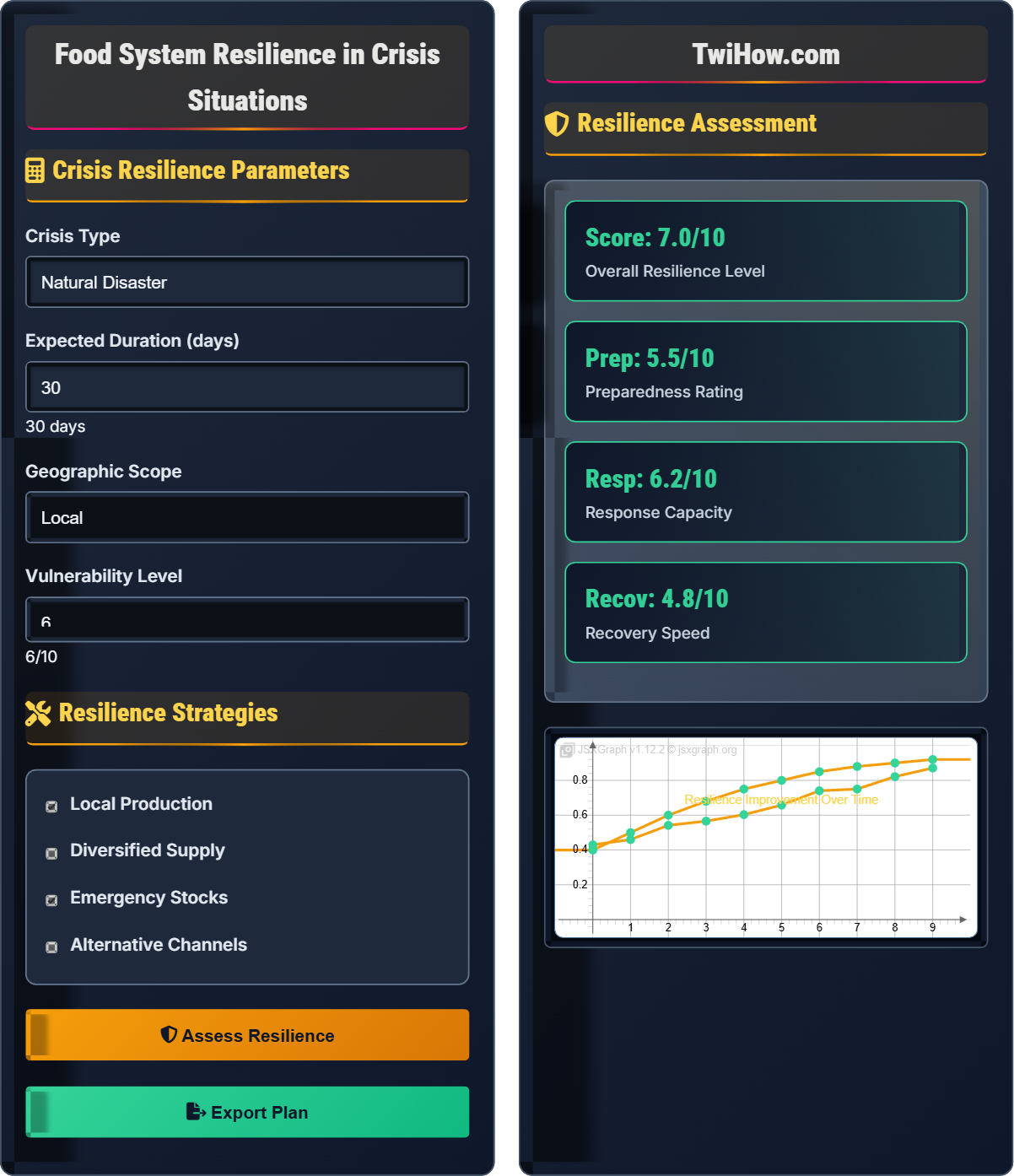
Crisis Resilience Parameters
Resilience Strategies
Resilience Assessment
| Component | Score | Status | Recommendations |
|---|---|---|---|
| Supply Chain | 6.8 | Average | Diversify suppliers |
| Storage Capacity | 7.5 | Good | Maintain current levels |
| Emergency Response | 7.2 | Good | Practice response plans |
| Community Support | 6.5 | Average | Strengthen partnerships |
Food System Resilience in Crisis Situations
Food system resilience refers to the capacity of food systems to withstand, adapt to, and recover from various crisis situations. This includes natural disasters, pandemics, economic shocks, and supply chain disruptions while maintaining food security for all populations.
Effective food system resilience requires multiple coordinated strategies:
Developing local and regional food production capabilities reduces dependence on distant supply chains and increases food security during transportation disruptions. This includes urban agriculture, community gardens, and regional farming initiatives.
Creating multiple supply routes and sources prevents single points of failure. This includes having backup suppliers, alternative transportation methods, and redundant distribution networks.
Maintaining strategic reserves of essential food items provides buffer capacity during supply disruptions. This includes both government reserves and community-level food banks.
Resilience Strategies
Local production, supply chain diversification, emergency stockpiling, alternative distribution channels, and community-based food security initiatives.
Resilience Index = (Preparedness × 0.3) + (Response Capacity × 0.3) + (Adaptive Capacity × 0.25) + (Recovery Speed × 0.15)
Where each component is rated on a 0-10 scale.
- Diversification reduces risk
- Early warning systems are essential
- Community involvement strengthens resilience
- Coordination is critical
Crisis Examples
The hurricane highlighted the importance of emergency food distribution networks and the vulnerability of centralized food systems. Lessons learned led to improved disaster preparedness and community-based food security measures.
The pandemic revealed weaknesses in just-in-time supply chains and the importance of local food production. It accelerated the adoption of alternative distribution methods like food delivery and curbside pickup.
Droughts demonstrate the need for water-efficient agriculture, diversified crop production, and emergency food assistance programs. Effective management requires early warning systems and adaptive farming practices.
Crisis Resilience Planner
Food System Resilience Quiz
Why is supply chain diversification important for food system resilience?
Supply chain diversification is crucial for food system resilience because it prevents single points of failure. When multiple suppliers, transportation routes, and distribution channels are available, the system can continue operating even if one element fails. This redundancy is essential during crisis situations when parts of the system may be disrupted.
The answer is B) It prevents single points of failure.
Supply chain diversification operates on the principle of redundancy and risk distribution. Just as investors diversify their portfolios to reduce risk, food systems must diversify their supply chains to reduce vulnerability. This creates multiple pathways for food to reach consumers, ensuring continuity during disruptions.
Supply Chain Diversification: Having multiple sources and routes for food
Single Point of Failure: Element whose failure stops the whole system
Redundancy: Backup systems to ensure continuity
• Multiple suppliers reduce risk
• Alternative routes ensure access
• Redundancy creates resilience
• Identify backup suppliers
• Plan alternative routes
• Maintain flexibility
• Over-relying on single suppliers
• Not planning for disruptions
• Ignoring regional alternatives
Describe the key components of an effective food system emergency preparedness plan and explain why each component is important.
Key Components of Emergency Preparedness Plan:
Risk Assessment: Identifying potential threats and vulnerabilities in the food system. This provides the foundation for targeted preparedness measures.
Communication Systems: Establishing clear channels for information sharing between stakeholders during emergencies. Essential for coordinated response.
Resource Allocation: Determining how food and supplies will be distributed during crises. Critical for ensuring equitable access.
Staff Training: Preparing personnel to respond effectively during emergencies. Ensures rapid and appropriate response.
Backup Systems: Alternative supply chains and distribution methods. Provides continuity during disruptions.
Each component is vital because preparedness reduces response time, minimizes suffering, and enables more effective crisis management.
Emergency preparedness is proactive rather than reactive. By planning before crises occur, food systems can respond more effectively, reduce the severity of impacts, and recover more quickly. Preparedness transforms chaotic responses into organized, coordinated efforts.
Emergency Preparedness: Planning and organizing before crises
Response Capacity: Ability to react to emergencies
Resource Allocation: Distributing supplies effectively
• Preparation is better than reaction
• Communication is essential
• Training improves response
• Practice response plans
• Update plans regularly
• Coordinate with stakeholders
• Not planning for specific scenarios
• Inadequate communication systems
• Insufficient training
A coastal city of 250,000 residents faces a hurricane that disrupts major highways and port operations for 10 days. The city normally receives 90% of its food through the port and major highways. Calculate the food shortage risk and propose three strategies to maintain food security during the disruption.
Food Shortage Risk Calculation:
Normal Supply Dependency: 90% of food supply through vulnerable routes
Disruption Duration: 10 days
Risk Level: Very High - City dependent on disrupted supply routes
Strategies:
1. Emergency Stockpiling: Activate pre-positioned food reserves to cover 5-7 days of consumption
2. Alternative Routes: Utilize inland transportation routes and airports for air cargo
3. Local Production: Mobilize local farms and food processing facilities to supplement supply
These strategies would reduce the risk from Very High to Moderate during the disruption period.
This example demonstrates how geographic vulnerabilities can create severe food security risks. Effective crisis response requires having multiple contingency strategies ready for implementation. The key is to reduce dependence on single supply routes.
Supply Route: Path food takes from producer to consumer
Emergency Stockpiling: Pre-positioned food reserves
Contingency Strategy: Backup plan for emergencies
• Identify supply route vulnerabilities
• Maintain emergency reserves
• Develop alternative routes
• Map supply chains
• Identify weak points
• Plan alternatives
• Not mapping supply chains
• Inadequate reserves
• No alternative plans
After a pandemic disrupted food supply chains, a region needs to rebuild its food system with enhanced resilience. They have identified that their previous system was too dependent on distant suppliers and just-in-time inventory. Evaluate three approaches to improve post-crisis resilience: (1) Increase local production capacity, (2) Establish regional food hubs, (3) Implement strategic food reserves. Recommend the optimal combination and explain your reasoning.
Approach Evaluation:
Local Production Increase:
Pros: Reduces dependence on distant suppliers, creates local jobs, shorter supply chains
Cons: Higher costs, seasonal limitations, capacity constraints
Regional Food Hubs:
Pros: Centralized distribution, coordination benefits, economies of scale
Cons: Potential single points of failure, requires infrastructure investment
Strategic Food Reserves:
Pros: Immediate buffer during disruptions, stability during shortages
Cons: Storage costs, inventory management challenges, potential waste
Optimal Combination: Implement all three approaches together. Local production reduces distance dependency, regional hubs provide coordination, and reserves offer immediate buffer capacity.
Food system resilience is best achieved through layered approaches that address different aspects of vulnerability. No single strategy can address all potential disruptions, so a combination of approaches provides comprehensive protection.
Layered Protection: Multiple strategies for comprehensive resilience
Just-in-Time Inventory: Minimal stock, frequent deliveries
Regional Hub: Centralized distribution center
• Multiple strategies are better
• Balance local and regional
• Plan for different disruptions
• Diversify supply sources
• Maintain strategic reserves
• Build local capacity
• Single-strategy approaches
• Not balancing local/regional
• Inadequate reserves
Which factor contributes most significantly to food system vulnerability during crisis situations?
Supply chain concentration contributes most significantly to food system vulnerability. When food systems rely heavily on few suppliers, transportation routes, or distribution centers, disruptions to these elements can severely impact food access. This creates systemic risk that affects the entire system.
The answer is B) Supply chain concentration.
Supply chain concentration creates systemic risk by creating dependencies that, when disrupted, affect the entire food system. This is different from other factors that may cause temporary inconvenience but don't fundamentally threaten the system's ability to function.
Supply Chain Concentration: Dependence on few suppliers/routes
Systemic Risk: Risk that affects the entire system
Vulnerability: Susceptibility to disruption
• Diversification reduces vulnerability
• Concentration creates risk
• Dependencies must be managed
• Identify concentrated dependencies
• Create backup options
• Monitor supply chains
• Not mapping supply chains
• Over-concentration of suppliers
• Ignoring dependency risks
FAQ
Q: How can local governments prepare food systems for crisis situations with limited budgets?
A: Local governments can prepare food systems with limited budgets by:
1. Community Partnerships: Collaborate with food banks, local farms, and volunteer organizations
2. GIS Mapping: Use mapping technology to identify food access gaps and resources
3. Coordination Networks: Establish communication protocols with neighboring jurisdictions
4. Volunteer Mobilization: Train community volunteers for food distribution
5. Policy Tools: Use zoning and procurement policies to support local food systems
6. Information Systems: Develop simple tracking and communication systems
Start with what you have and build incrementally.
Q: What strategies can food producers implement to enhance system resilience?
A: Food producers can enhance resilience by:
1. Diversification: Grow multiple crops and raise various livestock species
2. Direct Sales: Develop farmers' markets, CSAs, and local sales channels
3. Storage Capacity: Maintain on-farm storage for emergency situations
4. Technology: Use precision agriculture and climate-smart techniques
5. Cooperation: Join producer cooperatives for shared resources
6. Insurance: Obtain crop and business interruption insurance
These strategies reduce dependence on single markets and inputs.