Food System Transformation in Developing Regions
Complete guide • Step-by-step explanations
Food System Transformation:
Show Transformation PlannerTransforming food systems in developing regions requires addressing complex challenges including infrastructure deficits, limited access to technology, inadequate financing, and social inequalities. Successful transformations must be context-specific, culturally appropriate, and economically viable while promoting food security and sustainability.
Key considerations include infrastructure development, technology transfer, capacity building, policy frameworks, and community engagement. These transformations must balance modernization with preservation of traditional knowledge and practices.
Effective strategies involve multi-stakeholder collaboration, progressive implementation, and adaptive management approaches that respond to local conditions and changing circumstances.
Real-world applications include agricultural modernization programs, rural infrastructure development, market access improvements, and policy reforms that support sustainable food systems.
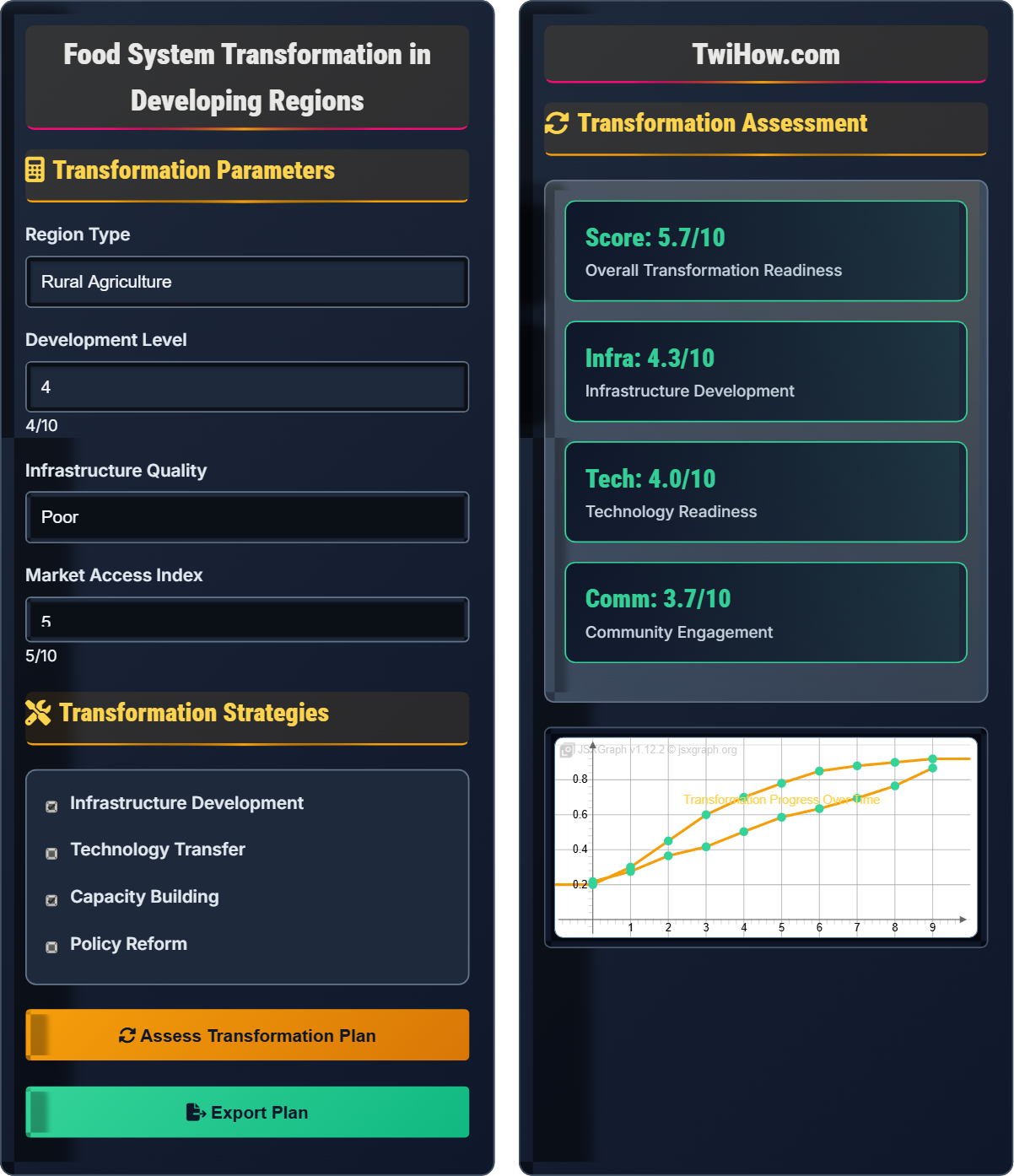
Transformation Parameters
Transformation Strategies
Transformation Assessment
| Component | Score | Status | Recommendations |
|---|---|---|---|
| Infrastructure | 5.2 | Fair | Focus on roads and storage |
| Technology | 6.1 | Good | Mobile platforms and training |
| Finance | 4.8 | Fair | Microfinance expansion |
| Policy | 6.5 | Good | Streamline regulations |
Transforming Food Systems in Developing Regions
Food system transformation in developing regions involves comprehensive changes to production, processing, distribution, and consumption patterns. This includes upgrading infrastructure, introducing appropriate technologies, building institutional capacity, and creating enabling policy environments.
Successful food system transformation requires coordinated action across multiple dimensions:
Transportation networks, storage facilities, processing centers, and market infrastructure are foundational for efficient food systems. Improved infrastructure reduces post-harvest losses and connects producers to markets.
Appropriate technologies for production, processing, and information systems can significantly improve efficiency and access. This includes both low-tech solutions and digital platforms.
Training and education programs for farmers, processors, and other stakeholders are essential for adopting new practices and technologies effectively.
Strategic Approaches
Infrastructure development, technology transfer, capacity building, policy reform, market development, and social inclusion.
Transformation Index = (Infrastructure × 0.25) + (Technology × 0.2) + (Capacity × 0.2) + (Policy × 0.2) + (Community × 0.15)
Where each component is rated on a 0-10 scale.
- Context-specific solutions
- Community participation
- Progressive implementation
- Multi-stakeholder collaboration
Case Studies
Rwanda's systematic approach to agricultural transformation included cooperative formation, input provision, and market development, resulting in significant productivity gains and poverty reduction.
India's transformation through improved seeds, fertilizers, and irrigation significantly increased food production, though with mixed social and environmental outcomes.
Brazil's comprehensive approach addressed food security through multiple interventions including income support, school feeding, and family farming support.
Transformation Planner
Food System Transformation Quiz
What is the most critical infrastructure need for food system transformation in developing regions?
Transportation networks are the most critical infrastructure for food system transformation. Without roads, bridges, and transportation systems, agricultural products cannot reach markets, inputs cannot reach farmers, and value-added processing cannot be effectively distributed. Transportation is the backbone of all other food system activities.
The answer is B) Transportation networks.
Transportation infrastructure creates the physical connections that enable all other aspects of the food system to function. While other infrastructure is important, transportation directly impacts the ability to move goods and people, which is fundamental to food system operation.
Infrastructure: Basic physical systems of a region
Transportation Network: Roads, railways, ports, and logistics
Value Chain: Series of activities that add value
• Connectivity enables access
• Transportation moves goods
• Infrastructure supports other activities
• Focus on key routes first
• Consider all-season access
• Plan for future growth
• Not considering maintenance
• Ignoring seasonal challenges
• Not planning for expansion
Explain why community participation is essential for successful food system transformation and describe strategies to ensure meaningful engagement.
Importance of Community Participation:
Local Knowledge: Communities possess valuable knowledge about local conditions, practices, and needs that external experts may not understand.
Ownership: When communities participate in planning and implementation, they take ownership of initiatives, increasing sustainability.
Acceptance: Community involvement builds trust and acceptance of new practices and technologies.
Equity: Participation ensures that transformation benefits reach all community members, including marginalized groups.
Strategies for Meaningful Engagement:
• Participatory Planning: Involve community members in decision-making processes
• Capacity Building: Provide training and education to enable effective participation
• Transparent Communication: Share information openly and listen to community concerns
• Inclusive Representation: Ensure all groups (women, youth, elders, minorities) are represented
• Feedback Mechanisms: Create channels for ongoing input and adjustment
Community participation transforms development from "done to" to "done with" communities. This approach respects local autonomy and builds on existing strengths while addressing specific needs and constraints.
Community Participation: Active involvement in decision-making
Local Knowledge: Indigenous understanding of conditions
Stakeholder Engagement: Involving all affected parties
• Listen before deciding
• Respect existing knowledge
• Include all voices
• Use local languages
• Hold meetings at convenient times
• Provide childcare
• Tokenistic participation
• Not following through on commitments
• Ignoring dissenting voices
A development agency has $1 million to transform the food system in a rural region of 50,000 people. They must allocate funds between infrastructure ($400,000), technology ($250,000), training ($200,000), and policy support ($150,000). Calculate the potential impact of this allocation and suggest optimizations.
Current Allocation Analysis:
Infrastructure (40%): Likely to have high impact on access and efficiency
Technology (25%): Moderate impact with appropriate selection
Training (20%): High impact on adoption and sustainability
Policy (15%): Long-term systemic impact
Optimization Suggestions:
• Increase training allocation to 30% ($300,000) to ensure adoption
• Reduce infrastructure to 35% ($350,000) to fund training
• Maintain technology at 20% ($200,000) for targeted interventions
• Increase policy support to 15% ($150,000) for enabling environment
This allocation prioritizes human capacity, which is critical for transformation success.
Human capacity is often the limiting factor in development interventions. While infrastructure and technology are important, their impact depends on people's ability to use them effectively. Investing in training ensures that other investments yield maximum returns.
Resource Allocation: Distribution of available funds
Human Capacity: Skills and knowledge of people
Investment Returns: Benefits from expenditures
• People are the key resource
• Training enables other investments
• Balance immediate and long-term needs
• Invest in trainers first
• Use participatory planning
• Monitor and adjust
• Focusing only on hardware
• Not considering maintenance
• Ignoring social factors
Evaluate three policy approaches for supporting food system transformation: (1) Input subsidies, (2) Market price guarantees, (3) Infrastructure investment. Recommend the optimal approach for a developing region with limited government resources.
Policy Evaluation:
Input Subsidies: Pros: Immediate impact on production, helps farmers afford inputs. Cons: Expensive, may create dependency, requires ongoing funding.
Price Guarantees: Pros: Provides market security, encourages production. Cons: Distorts markets, expensive, may lead to oversupply.
Infrastructure Investment: Pros: Creates long-term benefits, enables other interventions, multiplier effects. Cons: High initial cost, takes time to see results.
Recommendation: Infrastructure investment is optimal for limited resources because it creates enabling conditions for other interventions and has long-term benefits that compound over time.
Infrastructure investments often provide the highest return on investment in developing regions because they enable all other economic activities. Unlike subsidies which require continuous funding, infrastructure continues to provide benefits long after the initial investment.
Public Investment: Government spending on public goods
Enabling Environment: Conditions that support activity
Multiplier Effect: One investment enabling more activity
• Focus on enabling conditions
• Consider long-term returns
• Build on existing assets
• Prioritize high-impact investments
• Engage private sector
• Use phased implementation
• Focusing on short-term fixes
• Not considering sustainability
• Ignoring local capacity
Which factor is most important for successful technology adoption in developing food systems?
While all factors are important, cultural appropriateness is fundamental to technology adoption. Technologies that conflict with cultural practices, beliefs, or social structures will face resistance regardless of their technical merit or cost-effectiveness. Cultural appropriateness ensures that technologies fit within existing social systems and are accepted by communities.
The answer is B) Cultural appropriateness.
Technology adoption is a social process that depends on community acceptance. Even the most technically superior technology will fail if it doesn't align with local values, practices, and social structures. Cultural appropriateness creates the foundation for successful adoption.
Cultural Appropriateness: Alignment with local values and practices
Social Acceptance: Community approval and adoption
Technology Adoption: Acceptance and use of innovations
• Culture shapes acceptance
• Technology must fit context
• Social factors matter most
• Engage community early
• Respect local practices
• Adapt rather than impose
• Assuming universal solutions
• Not consulting communities
• Imposing external models
FAQ
Q: How can smallholder farmers access new technologies for food system transformation?
A: Smallholder farmers can access new technologies through:
1. Cooperative Groups: Pool resources to purchase shared equipment
2. Government Programs: Subsidies and extension services
3. Private Sector: Partnership programs with agribusiness
4. NGOs: Development programs and pilot projects
5. Mobile Platforms: Digital services and information
6. Peer Networks: Learning from other farmers
Start with low-cost, high-impact technologies and gradually expand.
Q: What policies are most effective for supporting food system transformation?
A: Most effective policies include:
1. Investment in Infrastructure: Roads, storage, and processing facilities
2. Education and Extension: Training and technical support
3. Market Development: Connecting farmers to markets
4. Financial Services: Access to credit and insurance
5. Research and Development: Supporting innovation
6. Regulatory Framework: Standards and quality assurance
Integrated approaches that address multiple constraints simultaneously are most effective.