Emerging Innovations in Food Production & Distribution
Complete guide • Step-by-step explanations
Food Production & Distribution Innovations:
Show Innovation TrackerEmerging innovations in food production and distribution are transforming how we grow, process, and deliver food. These innovations address challenges like climate change, resource scarcity, and growing population demands while improving efficiency and sustainability.
Key innovations include vertical farming, precision agriculture, blockchain traceability, AI-driven logistics, and alternative protein sources. These technologies promise to revolutionize food systems and enhance food security.
Successful implementation requires collaboration between technology providers, farmers, distributors, and policymakers to ensure innovations are accessible and effective.
Real-world applications span from urban farming startups to large-scale agricultural technology deployments and smart distribution networks.
Innovation Assessment Parameters
Implementation Factors
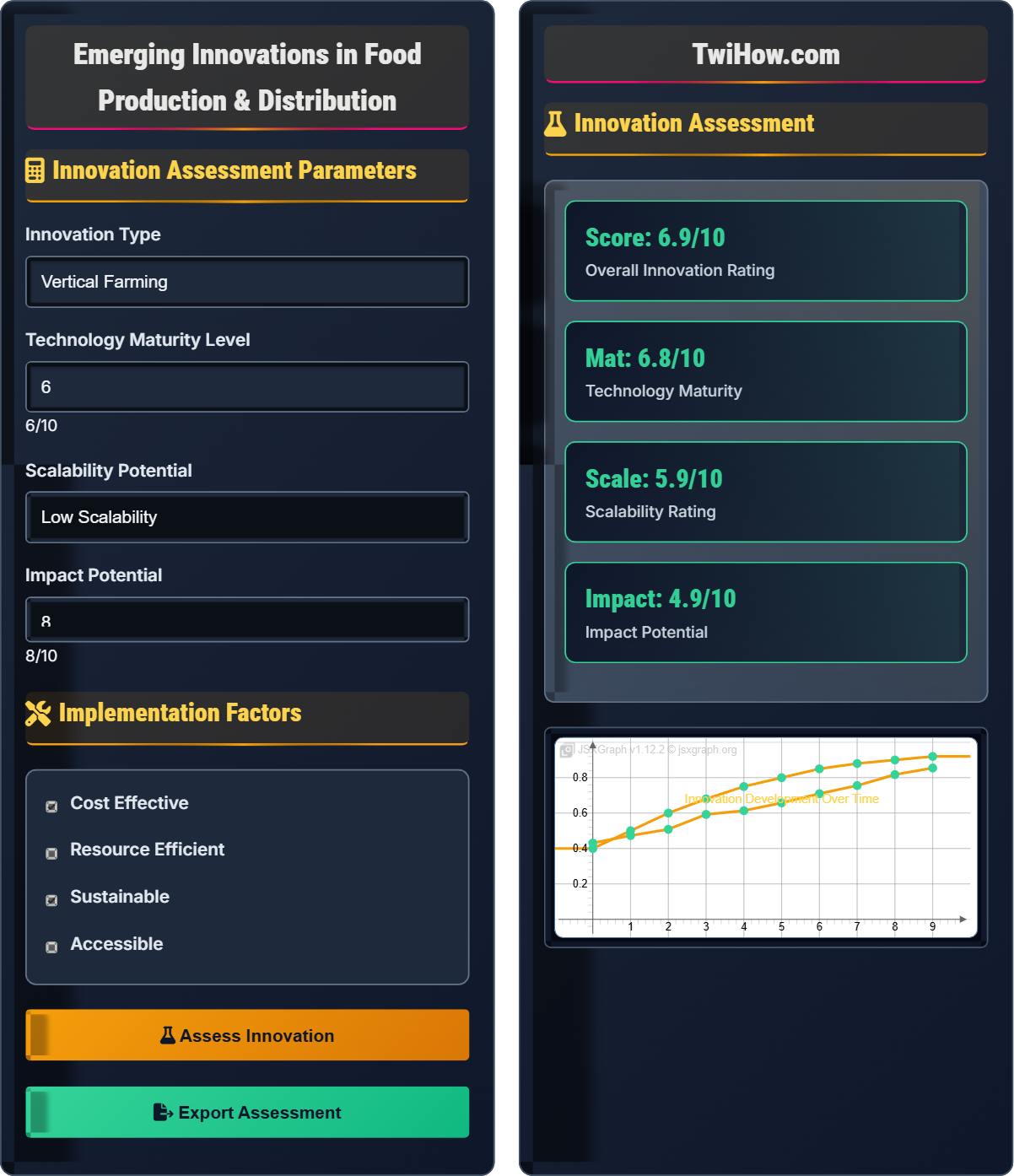
Innovation Assessment
| Factor | Score | Status | Recommendations |
|---|---|---|---|
| Technology Readiness | 6.8 | Good | Continue development efforts |
| Market Potential | 7.4 | Good | Expand pilot programs |
| Impact Assessment | 8.2 | Excellent | Accelerate deployment |
| Implementation Feasibility | 7.1 | Good | Develop implementation guidelines |
Emerging Innovations in Food Production & Distribution
Emerging innovations in food production and distribution are transforming traditional approaches to growing, processing, and delivering food. These innovations address critical challenges including climate change, resource scarcity, population growth, and changing consumer preferences.
Food innovations span multiple categories and technologies:
Includes precision agriculture, vertical farming, automated harvesting, drone monitoring, and AI-driven crop management. These technologies optimize resource use and increase productivity.
Encompasses blockchain traceability, AI logistics, cold chain optimization, drone delivery, and smart packaging. These innovations improve supply chain efficiency and food safety.
Features alternative proteins, cellular agriculture, fermentation technologies, and novel food processing methods. These innovations create new food products and improve existing ones.
Innovation Technologies
Vertical farming, precision agriculture, blockchain traceability, AI logistics, alternative proteins, cellular agriculture, and smart packaging.
Innovation Score = (Technology Readiness × 0.3) + (Market Potential × 0.25) + (Impact Assessment × 0.25) + (Implementation Feasibility × 0.2)
Where each component is rated on a 0-10 scale.
- Technology must be market-ready
- Scalability is essential
- Impact should be measurable
- Implementation must be feasible
Success Stories
AeroFarms pioneered vertical farming technology, growing leafy greens indoors using aeroponics and LED lighting. Their system uses 95% less water than traditional farming and produces crops year-round.
Climate FieldView provides precision agriculture tools that help farmers optimize crop management using satellite imagery, weather data, and field sensors to make data-driven decisions.
Impossible Foods developed plant-based meat alternatives using heme protein technology, creating products that closely mimic the taste and texture of animal meat while being more sustainable.
Innovation Tracker
Food Innovation Quiz
What is the primary advantage of vertical farming compared to traditional agriculture?
The primary advantage of vertical farming is year-round production. Controlled indoor environments allow for consistent crop production regardless of weather conditions, seasons, or geographical location. This enables consistent supply and potentially higher yields per square foot compared to traditional farming.
The answer is B) Year-round production.
Vertical farming leverages controlled environments to optimize growing conditions, eliminate weather dependencies, and maximize space utilization. This represents a fundamental shift from traditional agriculture that is limited by seasonal and climatic constraints.
Vertical Farming: Indoor farming in stacked layers
Controlled Environment: Artificially regulated growing conditions
Year-Round Production: Consistent output regardless of season
• Controlled environment enables consistency
• Space efficiency is crucial
• Energy costs are significant
• Consider energy efficiency
• Optimize lighting systems
• Focus on high-value crops
• Not accounting for energy costs
• Choosing wrong crop types
• Overlooking technical complexity
Explain how blockchain technology enhances food traceability and why it's considered revolutionary for food security.
How Blockchain Enhances Traceability:
Immutable Records: Once data is entered into the blockchain, it cannot be altered or deleted, creating permanent records of food origins and journeys.
Decentralized Storage: Records are stored across multiple nodes, preventing single points of failure and ensuring data integrity.
Real-Time Updates: Every transaction and movement of food products is recorded immediately, providing up-to-date information.
Revolutionary Impact: Blockchain enables rapid identification of contamination sources during foodborne illness outbreaks, significantly reducing the scope and duration of recalls. This protects public health and reduces economic losses.
Blockchain creates a transparent, tamper-proof record of food products from farm to fork. This unprecedented level of transparency enables more effective food safety management and builds consumer trust in food systems.
Blockchain: Distributed ledger technology
Traceability: Ability to track product journey
Immutable: Cannot be changed or deleted
• Records cannot be altered
• Decentralized storage
• Real-time updates
• Implement gradually
• Ensure stakeholder participation
• Focus on critical points
• Not engaging all stakeholders
• Overcomplicating implementation
• Ignoring data quality
A 500-acre farm currently uses traditional farming methods and averages 180 bushels of corn per acre with input costs of $300 per acre. They're considering implementing precision agriculture technology that costs $75,000 initially but promises 15% yield increase and 10% input cost reduction. Calculate the payback period and evaluate the investment.
Current Situation:
Total yield = 500 acres × 180 bushels/acre = 90,000 bushels
Total input cost = 500 acres × $300/acre = $150,000
After Implementation:
Yield increase = 180 × 1.15 = 207 bushels/acre
Total yield = 500 × 207 = 103,500 bushels
Input cost reduction = $300 × 0.90 = $270/acre
Total input cost = 500 × $270 = $135,000
Annual Benefit:
Yield increase = 13,500 bushels
Assuming $4/bushel corn price: $54,000 revenue increase
Input savings: $15,000
Total annual benefit: $69,000
Payback Period: $75,000 ÷ $69,000 = 1.09 years
This represents an excellent investment with quick payback.
This example demonstrates how precision agriculture can provide significant economic benefits through both increased yields and reduced input costs. The technology pays for itself relatively quickly while providing ongoing benefits.
Precision Agriculture: Data-driven farming optimization
Yield Increase: Higher production per unit area
Payback Period: Time to recover investment
• Calculate ROI carefully
• Consider ongoing costs
• Factor in learning curve
• Start with pilot areas
• Train personnel properly
• Monitor results carefully
• Not calculating full ROI
• Underestimating training needs
• Ignoring maintenance costs
A food company is evaluating whether to invest in plant-based meat alternatives. They estimate the market will grow from $5B to $25B over the next 5 years. The company needs $2M for R&D and $5M for production facilities. Calculate the market growth rate and assess the investment opportunity considering potential challenges.
Market Growth Calculation:
Current market: $5B
Projected market: $25B
Time period: 5 years
Compound annual growth rate = (25/5)^(1/5) - 1 = 35.7%
Investment Assessment:
Required investment: $7M
Market growth rate: 35.7% annually
Challenges to Consider:
• High competition from established players
• Consumer acceptance and taste preferences
• Regulatory approval processes
• Scaling production capabilities
Given the high growth rate, this could be a valuable investment if the company has competitive advantages.
Alternative proteins represent a rapidly growing market opportunity. However, success requires differentiation, quality, and effective scaling. Companies must consider both growth potential and competitive challenges.
Alternative Proteins: Non-animal protein sources
Compound Growth: Growth on top of previous growth
Market Opportunity: Potential for business growth
• Assess market growth carefully
• Consider competitive landscape
• Evaluate production capabilities
• Research market trends
• Test consumer acceptance
• Plan scaling carefully
• Overestimating market growth
• Underestimating competition
• Not considering production costs
Which of the following is NOT a primary benefit of AI in food distribution logistics?
Manual route planning is not a benefit of AI in food distribution logistics. In fact, AI automates route planning, making it more efficient and optimized than manual planning. AI can analyze traffic patterns, weather conditions, and delivery windows to optimize routes automatically.
The answer is D) Manual route planning.
AI in logistics replaces manual processes with automated, optimized solutions. The technology analyzes vast amounts of data to make decisions that would be impossible for humans to make manually, leading to improved efficiency and reduced costs.
AI Logistics: Artificial intelligence in supply chains
Predictive Maintenance: Anticipating equipment failures
Demand Forecasting: Predicting future demand
• Automation improves efficiency
• Data analysis enables optimization
• AI replaces manual tasks
• Implement gradually
• Focus on data quality
• Train staff on new systems
• Not investing in data infrastructure
• Overlooking staff training
• Expecting instant results
FAQ
Q: How can small farmers access and afford emerging agricultural technologies?
A: Small farmers can access technology through:
1. Cooperative Purchasing: Pool resources with other farmers to buy equipment
2. Technology-as-a-Service: Pay-per-use models instead of ownership
3. Government Programs: Subsidies and grants for technology adoption
4. Mobile Applications: Smartphone-based solutions with minimal investment
5. Extension Services: University and government technology demonstrations
6. Leasing Programs: Rent equipment with option to buy later
Start with technologies that provide immediate returns on investment.
Q: How do emerging food technologies affect food safety and quality?
A: Emerging technologies enhance food safety and quality through:
1. Blockchain Traceability: Rapid identification of contamination sources
2. Sensor Monitoring: Real-time tracking of temperature and conditions
3. Precision Processing: Consistent processing parameters
4. Automated Quality Control: Consistent inspection and sorting
5. Smart Packaging: Freshness indicators and extended shelf life
6. Data Analytics: Predictive quality and safety monitoring
These technologies create more robust and responsive food safety systems.