Emerging Trends in Food System Sustainability for 2026
Complete sustainability trends guide • Step-by-step explanations
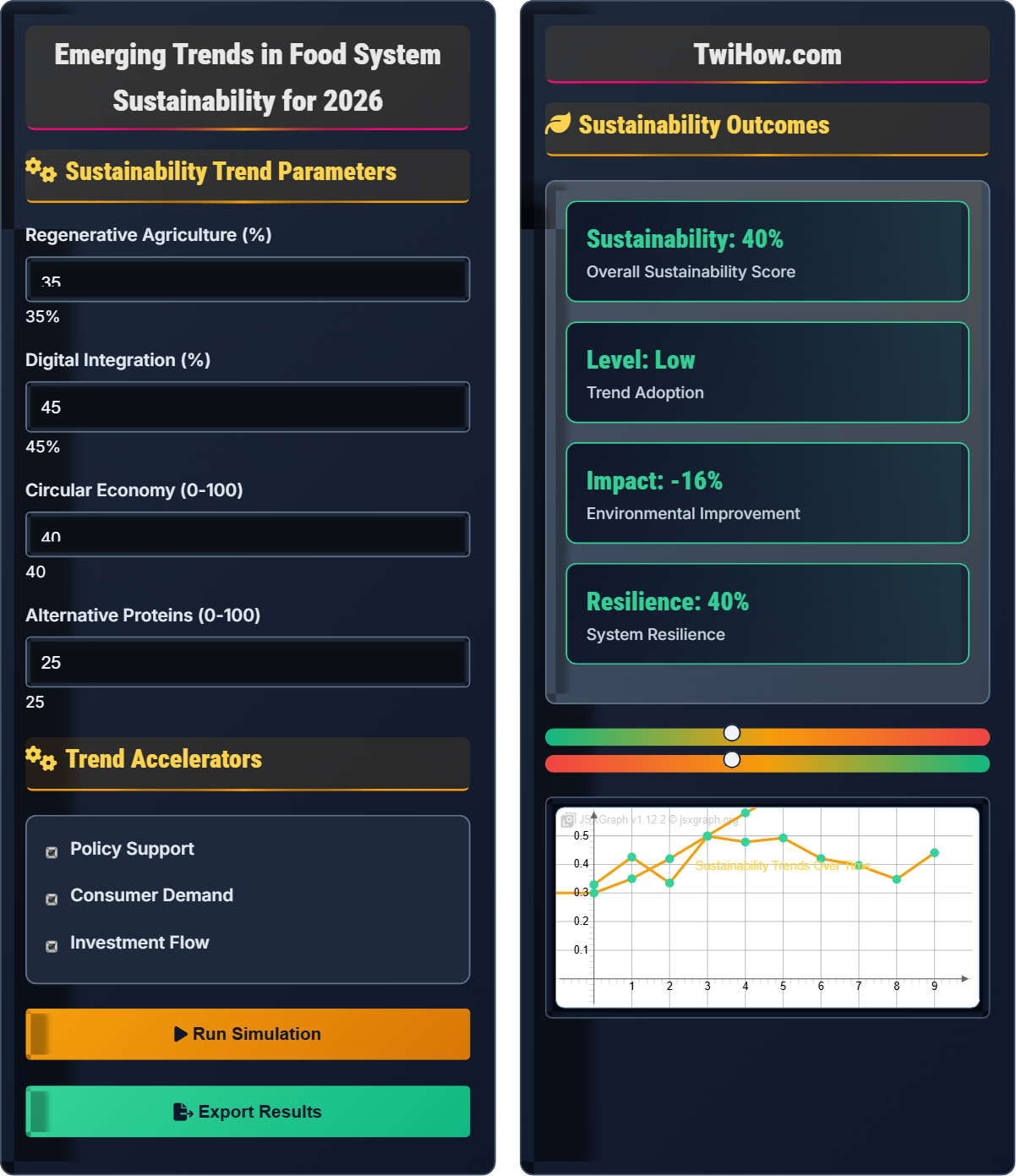
Sustainability Trends Overview:
Show Sustainability Trends SimulatorThe food system sustainability landscape is rapidly evolving, driven by climate change imperatives, technological advances, and changing consumer expectations. By 2026, key trends will reshape how we produce, process, distribute, and consume food to meet growing demand while preserving environmental resources.
Emerging trends focus on regenerative practices, circular economy principles, precision technologies, and systemic approaches that address multiple sustainability challenges simultaneously. These innovations promise to deliver more resilient, efficient, and equitable food systems.
Key sustainability trends for 2026:
- Regenerative Agriculture: Soil health, biodiversity conservation, and carbon sequestration
- Digital Transformation: AI, IoT, and blockchain for precision and transparency
- Circular Economy: Waste reduction, resource recovery, and closed-loop systems
- Alternative Proteins: Plant-based, cellular, and insect proteins
These trends represent a convergence of environmental necessity, technological capability, and market demand, creating unprecedented opportunities for sustainable food system transformation.
Sustainability Trend Parameters
Trend Accelerators
Sustainability Outcomes
| Trend | Adoption | Impact | Timeline |
|---|---|---|---|
| Regenerative Agriculture | 35% | High | 2026-2030 |
| Digital Integration | 45% | Very High | 2026-2028 |
| Circular Economy | 40% | Medium | 2026-2032 |
| Alternative Proteins | 25% | High | 2026-2030 |
R=Regenerative, D=Digital, C=Circular, S=Sustainability, P=Precision, A=Alternative, I=Innovation, F=Food, C=Consumers
Food System Sustainability Trends Explained
Emerging sustainability trends in food systems represent innovative approaches and technologies that address environmental, social, and economic challenges simultaneously. These trends reflect the convergence of scientific research, technological advancement, and market demand for more sustainable food production and consumption patterns.
Sustainability trends are measured using several important indicators:
Where:
- Environmental Impact: Resource efficiency and ecological footprint
- Social Equity: Fair access and distribution of benefits
- Economic Viability: Financial sustainability and profitability
- Goal: Optimize all components for true sustainability
Emerging trends include:
- Regenerative Agriculture: Practices that restore soil health and biodiversity
- Precision Farming: Data-driven optimization of inputs and outputs
- Circular Economy: Closed-loop systems minimizing waste
- Alternative Proteins: Plant-based, cellular, and insect proteins
- Blockchain Transparency: Traceability and accountability
- Climate-Smart Agriculture: Resilience and mitigation strategies
- Technology: Leveraging AI, IoT, and big data
- Policy: Regulatory frameworks and incentives
- Market: Consumer demand and supply chain pressure
- Collaboration: Multi-stakeholder partnerships
- Investment: Capital for innovation and scaling
Sustainability Trends Fundamentals
Regenerative agriculture, precision farming, circular economy, alternative proteins, sustainability metrics, climate-smart agriculture.
Index = (Environmental Impact + Social Equity + Economic Viability) / 3
Where Index = sustainability effectiveness, Environmental Impact = ecological footprint, Social Equity = fair distribution, Economic Viability = financial sustainability.
- All three pillars must be balanced
- Technology enables scalability
- Market demand drives adoption
Applications
Regenerative farming systems, precision agriculture platforms, alternative protein production, blockchain traceability, circular supply chains.
- Technology adoption
- Policy development
- Market incentives
- Stakeholder engagement
- Scalability challenges
- Cost barriers
- Regulatory frameworks
- Consumer acceptance
Sustainability Trends Learning Quiz
Which practice is most characteristic of regenerative agriculture?
Cover cropping is a fundamental practice of regenerative agriculture that involves planting protective crops between main harvests to prevent soil erosion, improve soil health, and enhance biodiversity. This practice builds soil organic matter, retains moisture, and provides habitat for beneficial organisms.
The answer is B) Cover cropping.
Students should understand that regenerative agriculture focuses on restoring and enhancing natural systems rather than depleting them. Cover crops represent a shift from extraction to restoration, providing multiple benefits including soil health improvement, carbon sequestration, and biodiversity enhancement. This practice exemplifies the regenerative principle of working with natural processes.
Regenerative Agriculture: Farming that restores ecosystem health
Cover Cropping: Growing protective plants between main crops
Soil Health: Physical, chemical, and biological properties supporting plant growth
• Restore rather than extract
• Work with natural processes
• Build soil organic matter
• Think in terms of ecosystem health
• Consider long-term impacts
• Look for nature-based solutions
• Confusing regenerative with organic
• Focusing only on production
• Ignoring ecosystem services
Explain how circular economy principles apply to food systems and describe the key components of a circular food system.
Circular Economy Definition: Economic system that eliminates waste and promotes continuous resource use through closed loops.
Application to Food Systems: Minimizing food waste, utilizing by-products, recycling nutrients, and designing out waste.
Key Components: Waste reduction, composting, bioenergy production, water recycling, and nutrient cycling.
Implementation: Food waste valorization, industrial symbiosis, and regenerative practices.
Benefits: Reduced environmental impact, cost savings, resource efficiency, and new revenue streams.
Challenges: Infrastructure requirements, coordination complexity, and behavioral change needs.
Students should understand that circular economy transforms the traditional linear model (take-make-dispose) into a closed loop system. In food systems, this means viewing waste as a resource and creating systems where materials flow continuously. The key is designing systems that naturally cycle resources back into productive use.
Circular Economy: Economic system eliminating waste through closed loops
Waste Valorization: Converting waste into valuable products
Industrial Symbiosis: Companies sharing resources and byproducts
• Design out waste
• Circulate materials
• Regenerate nature
• Think in terms of material flows
• Identify waste streams as resources
• Consider system-wide impacts
• Viewing it as just recycling
• Ignoring system design
• Not considering economic viability
A company producing alternative proteins has initial investment of $10 million. Current production costs are $8/kg, selling at $12/kg. With economies of scale, costs are projected to drop to $4/kg by 2026. If they produce 1 million kg annually, calculate the break-even point and projected profit improvement.
Current Profit per kg: $12 - $8 = $4/kg
Current Annual Revenue: 1M × $12 = $12M
Current Annual Costs: 1M × $8 = $8M
Current Annual Profit: $12M - $8M = $4M
Break-even Volume: $10M ÷ $4 profit/kg = 2.5M kg
Projected Profit per kg (2026): $12 - $4 = $8/kg
Projected Annual Profit (2026): 1M × $8 = $8M
Profit Improvement: $8M - $4M = $4M annually
This problem demonstrates the economic potential of alternative proteins as production scales. Students should understand that initial high costs often decrease with volume, making alternative proteins economically competitive with conventional options. The key insight is that sustainability and profitability can align as markets mature.
Economies of Scale: Cost reductions from increased production volume
Break-even Point: Volume where total revenue equals total costs
Alternative Proteins: Non-animal protein sources
• Consider initial investment costs
• Account for scaling effects
• Calculate long-term profitability
• Factor in learning curves
• Consider market demand growth
• Account for technology improvements
• Ignoring initial investment
• Not considering scaling effects
• Forgetting to calculate break-even
A farm wants to implement precision agriculture technologies including GPS-guided equipment, soil sensors, and variable rate application. Initial costs are $100,000 with annual maintenance of $10,000. Expected benefits include 15% reduction in fertilizer costs ($20,000 savings), 10% yield increase (additional $30,000 revenue), and 20% fuel savings ($5,000). Calculate ROI and recommend implementation strategy.
Annual Benefits: $20,000 (fertilizer) + $30,000 (yield) + $5,000 (fuel) = $55,000
Annual Costs: $10,000 (maintenance)
Net Annual Benefit: $55,000 - $10,000 = $45,000
Payback Period: $100,000 ÷ $45,000 = 2.2 years
ROI: ($45,000 ÷ $100,000) × 100 = 45%
Recommendation: Implement in phases starting with highest-impact technologies, begin with small plots to validate benefits, and ensure staff training and support systems are in place.
This problem demonstrates the economic case for precision agriculture adoption. Students should understand that technology investments must be evaluated based on both costs and benefits. The key insight is that precision agriculture can simultaneously improve profitability and environmental performance through optimized resource use.
Precision Agriculture: Technology-enabled site-specific farming
Variable Rate Application: Applying inputs at varying rates across field
Return on Investment (ROI): Ratio of net profit to investment cost
• Calculate comprehensive benefits
• Consider implementation phases
• Factor in training needs
• Start with pilot implementations
• Measure actual vs. projected benefits
• Plan for ongoing support
• Underestimating training costs
• Not considering maintenance
• Ignoring implementation complexity
What is the primary benefit of blockchain technology in food systems?
Blockchain technology provides immutable, transparent records of food journey from farm to fork, enabling complete traceability. This allows verification of origin, quality, safety, and sustainability claims, which builds consumer trust and enables rapid response to food safety issues.
The answer is B) Enhanced traceability and transparency.
Students should understand that blockchain's value lies in creating trust through transparency rather than directly improving production. The technology addresses consumer concerns about food origin, safety, and sustainability by providing verifiable records that cannot be altered. This creates new market opportunities for producers who can prove their practices.
Blockchain: Distributed ledger technology
Traceability: Tracking product journey through supply chain
Immutable Records: Data that cannot be changed
• Trust through transparency
• Immutable records
• End-to-end visibility
• Focus on trust building
• Consider consumer benefits
• Plan for data integration
• Confusing with cryptocurrency
• Underestimating integration costs
• Ignoring data quality needs
FAQ
Q: How can I afford to implement these new sustainability technologies on my farm?
A: Several financing and implementation strategies can help:
1. Phased Implementation: Start with high-impact, low-cost technologies
2. Government Programs: Apply for sustainability grants and subsidies
3. Leasing Options: Rent equipment instead of buying outright
4. Cooperative Purchasing: Pool resources with other farmers
5. Loan Programs: Access special agricultural sustainability loans
6. Cost-Benefit Analysis: Focus on technologies with quick paybacks
Begin with practices that provide immediate benefits like cover crops or soil testing.
Q: What policies would best accelerate adoption of sustainability trends?
A: Effective policies include:
Financial Incentives: Payments for ecosystem services, tax credits for sustainable practices, and grants for technology adoption.
Regulatory Frameworks: Standards for sustainability, environmental protection requirements, and reporting obligations.
Market Development: Certification programs, green procurement policies, and consumer education initiatives.
Research Support: Funding for innovation, extension services, and knowledge transfer programs.
Infrastructure: Investment in broadband, renewable energy, and transportation systems.
Success requires combining carrots (incentives) with sticks (regulations) and support (services).