Food Sovereignty vs Food Security
Complete guide • Policy & systems
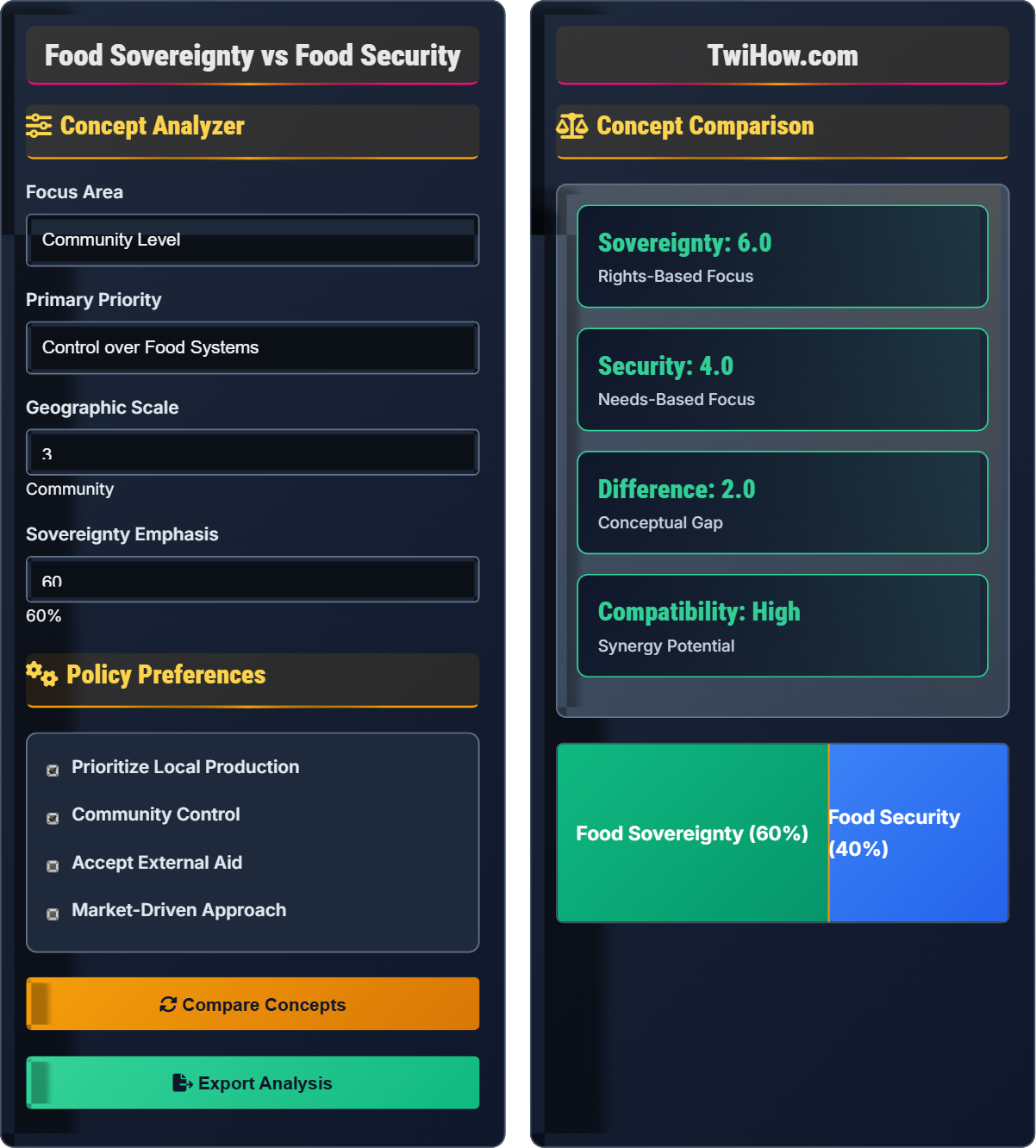
Food Systems Comparison:
Compare ConceptsFood sovereignty and food security are related but distinct concepts in food systems. Food security focuses on ensuring people have access to sufficient, safe, and nutritious food, while food sovereignty emphasizes the right of peoples to define their own food and agriculture systems. Understanding these differences is crucial for developing effective food policies.
Key differences include:
- Approach: Food security is needs-based, food sovereignty is rights-based
- Control: Food security can involve external aid, food sovereignty emphasizes local control
- Scale: Food security is individual/household focused, food sovereignty is community/national focused
- Production: Food security doesn't specify production methods, food sovereignty emphasizes sustainable/local production
Both concepts aim to address hunger and malnutrition, but through different philosophical and policy approaches.
Concept Analyzer
Policy Preferences
Concept Comparison
Food sovereignty is the right of peoples to healthy and culturally appropriate food produced through ecologically sound and sustainable methods, and their right to define their own food and agriculture systems.
Key aspects: Local control, cultural appropriateness, sustainable production, democratic participation in food system decisions.
Food security exists when all people, at all times, have physical, social, and economic access to sufficient, safe, and nutritious food that meets their dietary needs and food preferences for an active and healthy life.
Key aspects: Availability, access, utilization, stability of food supply.
Food Sovereignty Principles
Emphasizes sustainable and local food production methods that prioritize environmental health and farmer autonomy.
Advocates for local communities to have decision-making power over their food systems rather than external forces.
Respects traditional foods and dietary preferences of communities, supporting cultural identity.
Food Security Principles
Ensures people have physical access to food through proximity, infrastructure, and distribution systems.
Guarantees people have economic means to purchase adequate food for nutritional needs.
Ensures people can properly use food through adequate diet, clean water, sanitation, and health care.
| Aspect | Food Sovereignty | Food Security |
|---|---|---|
| Definition | Right to define food systems | Access to adequate food |
| Focus | Systems and rights | Individual access |
| Approach | Bottom-up, democratic | Top-down, needs-based |
| Production | Local, sustainable | Any method that works |
| Decision-Making | Community-controlled | Government/market-driven |
| Cultural Context | Central consideration | Secondary factor |
Food Sovereignty vs Food Security Explained
Food sovereignty and food security are two related but fundamentally different approaches to addressing hunger and food access. While both aim to ensure people have access to adequate nutrition, they differ significantly in their philosophical foundations and policy prescriptions.
Food Security: A needs-based approach focused on ensuring individuals and households have access to sufficient, safe, and nutritious food. It addresses the question "Are people getting enough to eat?"
Food Sovereignty: A rights-based approach emphasizing the right of peoples to define their own food and agriculture systems. It addresses the question "Who controls the food system?"
These concepts emerged from different contexts and serve different purposes in food policy discussions.
How these concepts translate into different policy approaches:
- Food Security: Emergency food aid, food banks, income support programs, market interventions
- Food Sovereignty: Support for small-scale farmers, protection of local markets, seed sovereignty, agroecology promotion
- Food Security: Technological solutions, food fortification, supplementation programs
- Food Sovereignty: Cultural preservation, traditional knowledge protection, democratic participation
While often presented as competing concepts, food sovereignty and food security can be complementary. Food security can be seen as a prerequisite for sovereignty, while sovereignty can strengthen long-term food security. However, tensions arise when immediate access needs conflict with longer-term systemic changes.
Historical Context
Food security: 1970s international conferences • Food sovereignty: 1996 Via Campesina declaration.
Policy Evolution = (Historical Context × Social Movements) + Institutional Adoption
Where Policy = approach to food access, Context = economic and political conditions.
- Concepts emerged from different social movements
- Food security is more institutionally accepted
- Food sovereignty challenges existing power structures
- Both address fundamental human needs
Case Studies
Brazil's Zero Hunger program, India's Public Distribution System, Cuba's urban agriculture movement.
- Emergency response (security-focused)
- Systemic reform (sovereignty-focused)
- Hybrid approaches
- Community-based initiatives
- Context-specific implementation
- Political feasibility
- Resource requirements
- Long-term sustainability
Real-World Applications
Brazil's Zero Hunger program (2003-2010) exemplifies a food security approach. The government implemented cash transfer programs, school feeding initiatives, and food banks to address immediate hunger needs. While successful in reducing undernourishment, critics argued it didn't address underlying power imbalances in food systems or promote local agricultural sovereignty.
Cuba's response to the post-Soviet economic crisis exemplifies food sovereignty principles. The country developed extensive urban agriculture, promoted organic farming, and decentralized food production. This approach enhanced both food security and local control over food systems, demonstrating how the two concepts can work together.
India's Public Distribution System provides subsidized food grains to millions of people, addressing food security needs. However, critics argue that the system reinforces dependence on external supplies and doesn't empower communities to control their food systems, highlighting tensions between security and sovereignty.
Historical Timeline
Food Sovereignty vs Food Security Quiz
Which of the following best describes the fundamental difference between food sovereignty and food security?
The fundamental difference lies in their philosophical foundations. Food security is needs-based, focusing on ensuring individuals have access to sufficient food. Food sovereignty is rights-based, emphasizing the right of peoples to define their own food systems and control their food production methods.
The answer is B) Food security is needs-based, food sovereignty is rights-based.
Understanding the philosophical foundation of each concept is crucial for distinguishing between them. Food security emerged from international efforts to address hunger and malnutrition, focusing on measurable outcomes like caloric intake and nutritional adequacy. Food sovereignty emerged from social movements advocating for democratic control over food systems and resistance to corporate influence.
Needs-Based: Focused on fulfilling specific requirements
Rights-Based: Grounded in fundamental human rights
Philosophical Foundation: Underlying beliefs that guide approaches
• Food security focuses on outcomes
• Food sovereignty focuses on processes
• Rights-based approaches emphasize agency
• Think about who controls decisions
• Consider the role of local communities
• Remember sovereignty implies self-determination
• Confusing focus with outcomes
• Misunderstanding rights vs. needs
• Over-simplifying the concepts
Compare the policy implications of food sovereignty and food security approaches. How would each approach address food access challenges differently?
Food Security Approach: Policies would focus on increasing food availability through imports, subsidies, food banks, and emergency aid. The emphasis would be on ensuring adequate calories and nutrients reach populations in need, regardless of production methods or decision-making processes.
Food Sovereignty Approach: Policies would prioritize supporting local food systems, protecting small-scale farmers, promoting sustainable agriculture, and ensuring communities have control over their food decisions. The focus would be on building resilient local food systems.
While food security might quickly address immediate hunger through food imports, food sovereignty would work to build long-term resilience by strengthening local production capacity and community control.
The policy differences reflect the fundamental orientations of each concept. Food security policies tend to be more technocratic and outcome-oriented, focusing on measurable indicators like caloric intake and malnutrition rates. Food sovereignty policies tend to be more political and process-oriented, focusing on power relationships and democratic participation in food systems.
Technocratic: Focused on technical expertise and measurable outcomes
Political: Concerned with power relationships and governance
Democratic Participation: Involvement in decision-making processes
• Consider both immediate and long-term impacts
• Evaluate power relationships
• Assess sustainability of solutions
• Think about root causes vs. symptoms
• Consider who benefits from policies
• Evaluate long-term sustainability
• Assuming all policies fit one approach
• Not considering implementation challenges
• Ignoring potential synergies
A developing country faces chronic food insecurity with 30% of children experiencing stunting due to malnutrition. The government has two options: (A) Accept international food aid and import subsidized grain, or (B) Invest in local agriculture, farmer cooperatives, and sustainable farming practices. Analyze both options through the lenses of food security and food sovereignty.
Option A (Food Security Lens): Immediate benefits include rapid reduction in hunger and malnutrition, meeting urgent caloric needs. However, it may create dependency and not address underlying production issues.
Option A (Food Sovereignty Lens): Creates dependency on external donors, undermines local producers, and reduces community control over food systems.
Option B (Food Security Lens): Longer-term approach that may not address immediate needs but builds sustainable food access. May take years to show results.
Option B (Food Sovereignty Lens): Empowers local communities, strengthens local economies, and promotes sustainable practices. Builds long-term resilience.
The optimal approach might combine immediate food security measures with long-term sovereignty-building initiatives.
This scenario illustrates the tension between immediate needs and long-term systemic change. In practice, many experts advocate for "hybrid" approaches that address urgent food security needs while simultaneously building the foundations for food sovereignty. The challenge is sequencing interventions appropriately.
Stunting: Low height-for-age indicating chronic malnutrition
Hybrid Approach: Combining elements of different strategies
Sequencing: Order and timing of interventions
• Address immediate needs first
• Build long-term capacity
• Consider context-specific solutions
• Assess urgency vs. sustainability trade-offs
• Consider political feasibility
• Evaluate community acceptance
• Choosing only one approach
• Not considering implementation capacity
• Ignoring political economy factors
You are a policy advisor helping a country design food system reforms. The government wants to improve food access while also empowering local communities. Propose a strategy that incorporates both food security and food sovereignty principles.
Phase 1 (Immediate): Implement food security measures such as emergency food programs, school feeding initiatives, and conditional cash transfers to address urgent needs.
Phase 2 (Medium-term): Develop local food production capacity through farmer support programs, cooperative formation, and sustainable agriculture training.
Phase 3 (Long-term): Strengthen democratic participation in food system decisions, establish local food procurement policies, and protect traditional food systems.
Integration Strategies: Link emergency programs to local procurement when possible, ensure community participation in program design, and gradually shift from external inputs to local capacity.
Successful integration of both approaches requires careful planning and phased implementation. The key is to use food security interventions as stepping stones toward sovereignty goals, rather than creating permanent dependencies. Community participation and local ownership are essential throughout the process.
Phased Implementation: Gradual rollout over time periods
Stepping Stones: Intermediate steps toward larger goals
Local Ownership: Community control and investment in programs
• Address immediate needs first
• Build local capacity gradually
• Ensure community participation
• Start with pilot programs
• Monitor and evaluate continuously
• Adapt based on feedback
• Trying to implement everything at once
• Not involving communities in planning
• Failing to monitor outcomes
Which of the following best describes the relationship between food sovereignty and food security?
While food sovereignty and food security have different philosophical foundations and policy prescriptions, they can complement each other. Food security can address immediate access needs while food sovereignty builds long-term resilience and community control. Many experts advocate for integrated approaches that draw from both concepts.
The answer is C) They can complement each other in policy approaches.
The relationship between these concepts is complex and dynamic. Rather than viewing them as competing approaches, it's more productive to consider how they can reinforce each other. Food security can provide the foundation for sovereignty by ensuring basic needs are met, while sovereignty can enhance long-term food security by building resilient systems.
Complement: Enhance or complete each other
Integrated Approaches: Combining elements of different strategies
Reinforce: Strengthen each other
• Consider synergistic possibilities
• Evaluate trade-offs thoughtfully
• Context matters significantly
• Look for win-win scenarios
• Consider hybrid approaches
• Evaluate implementation feasibility
• Treating as completely opposing concepts
• Not considering implementation challenges
• Overlooking contextual factors
FAQ
Q: Are food sovereignty and food security opposites?
A: No, they are not opposites, though they have different emphases. Food security focuses on ensuring people have access to sufficient, safe, and nutritious food, while food sovereignty emphasizes the right of peoples to define their own food and agriculture systems. They can complement each other - food security can address immediate needs while food sovereignty builds long-term resilience and community control. However, tensions can arise when immediate access needs conflict with longer-term systemic changes.
Q: Which approach should governments prioritize - food sovereignty or food security?
A: Rather than prioritizing one over the other, effective food policy often integrates both approaches. Governments typically need to address immediate food security needs (hunger, malnutrition) while simultaneously building the foundations for food sovereignty (local production capacity, community control, sustainable practices). The specific balance depends on local contexts, but the most robust approaches combine emergency response capabilities with long-term system strengthening.