Food Marketing & Consumption Patterns
Complete guide • Step-by-step explanations
Food Marketing & Consumption:
Show Influence CalculatorFood marketing and advertising significantly influence consumer behavior, shaping preferences, purchase decisions, and consumption patterns. Understanding these influences is crucial for making informed choices and developing effective public health policies.
Key psychological mechanisms include emotional appeals, social proof, scarcity tactics, and visual presentation. These strategies target different demographics with varying degrees of success.
Impact varies by age group, with children being particularly susceptible to marketing messages. The effects extend beyond individual choices to influence family purchasing decisions and long-term dietary habits.
Real-world applications include marketing campaigns, product placement, and digital advertising strategies that shape food preferences and consumption behaviors.
Influence Analysis Parameters
Influence Factors
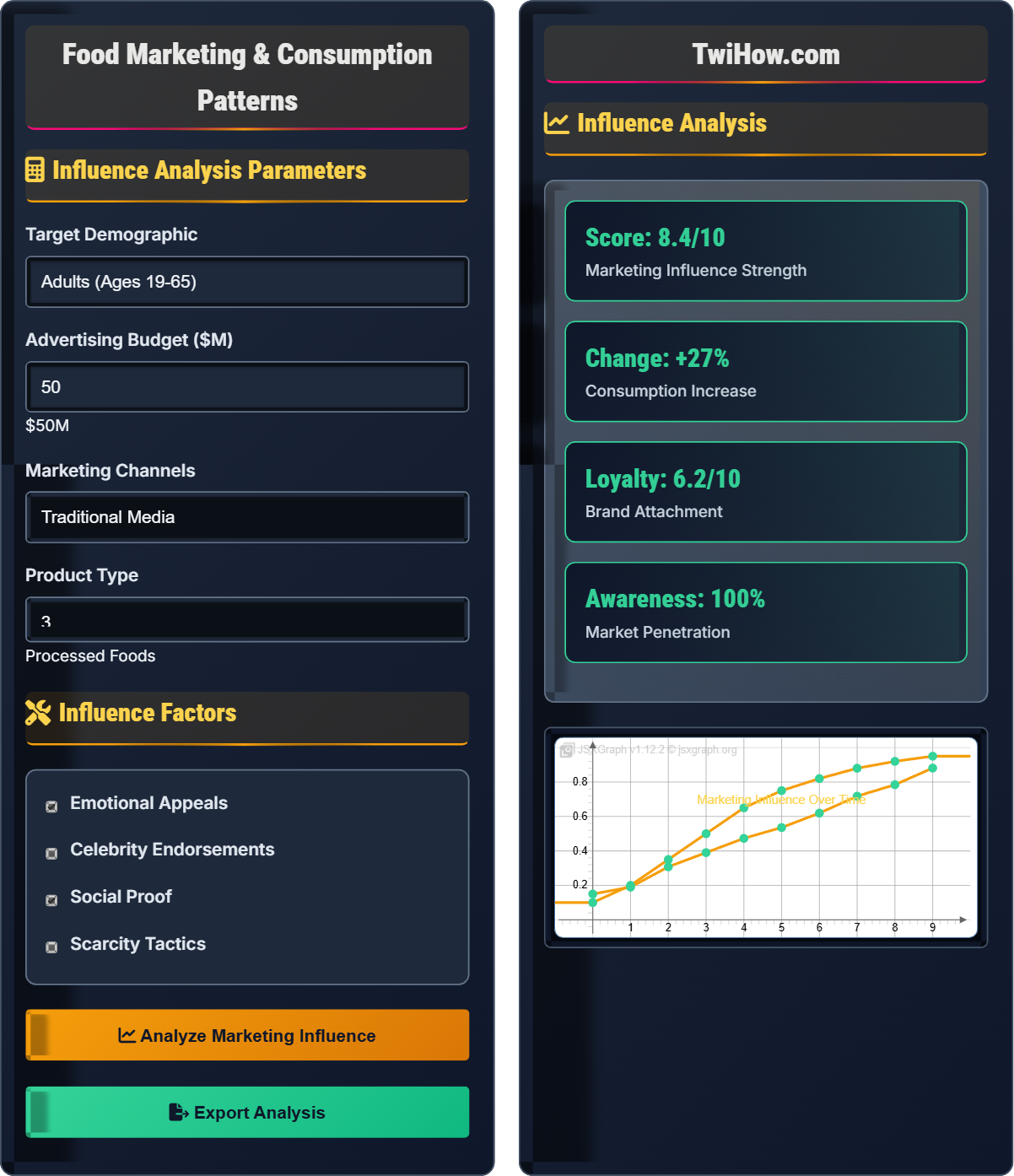
Influence Analysis
| Channel | Influence | Reach | Effectiveness |
|---|---|---|---|
| TV Ads | High | 85% | 7.2/10 |
| Social Media | Medium | 70% | 6.8/10 |
| Low | 30% | 4.5/10 | |
| Outdoor | Medium | 60% | 6.1/10 |
Impact of Food Marketing and Advertising on Consumption Patterns
Food marketing and advertising significantly influence consumer behavior, shaping preferences, purchase decisions, and consumption patterns. These influences operate through psychological mechanisms that affect both conscious and subconscious decision-making processes.
Food marketing employs several psychological strategies to influence consumption:
Marketing campaigns create emotional associations with food products, linking them to happiness, comfort, family, or celebration. These emotional connections often override rational decision-making.
Advertisements feature crowds enjoying products, celebrity endorsements, and testimonials to create social validation, making consumers more likely to try the product.
Marketing creates urgency through limited-time offers, exclusive deals, or "while supplies last" messaging to prompt immediate purchase decisions.
Marketing Strategies
Emotional appeals, social proof, scarcity tactics, bandwagon effects, authority influence, and psychological pricing.
Influence Score = (Exposure × 0.3) + (Attention × 0.25) + (Emotion × 0.25) + (Social Proof × 0.2)
Where each component is rated on a 0-10 scale.
- Children are most susceptible
- Visual appeal drives decisions
- Emotional connections matter
- Repetition reinforces impact
Case Studies
McDonald's has evolved its marketing strategies over decades, initially targeting families and children with Happy Meals, then adapting to adult health consciousness while maintaining child appeal through character marketing and digital engagement.
Apple successfully positioned its products as premium lifestyle choices, demonstrating how marketing can influence perceptions and willingness to pay premium prices for seemingly ordinary products.
Successful restaurant chains use localized marketing, cultural adaptation, and consistent branding to influence consumption patterns across diverse markets while maintaining brand identity.
Marketing Influence Calculator
Food Marketing & Consumption Quiz
Which psychological mechanism is most effective in influencing food consumption through marketing?
Emotional appeals are the most effective psychological mechanism in food marketing. Marketing campaigns that create positive emotional associations with food products (happiness, comfort, family, celebration) significantly influence consumption patterns by bypassing rational decision-making processes. Emotional connections often override logical considerations like price or nutrition.
The answer is B) Emotional appeals.
Food marketing leverages the limbic system (emotional center of the brain) to create automatic responses to food cues. When people associate positive emotions with certain foods, they're more likely to consume them regardless of hunger or nutritional value. This is why nostalgic advertising and comfort food marketing are so effective.
Emotional Appeals: Marketing strategies that create emotional connections to products
Limbic System: Brain region controlling emotions and automatic responses
Psychological Pricing: Pricing strategies that influence perceived value
• Emotions drive consumption decisions
• Rational thought can be overridden
• Associations persist over time
• Be aware of emotional triggers
• Pause before impulsive purchases
• Focus on actual needs vs wants
• Assuming all decisions are rational
• Underestimating emotional influence
• Ignoring marketing tactics
Explain why children are more susceptible to food marketing than adults, and describe the long-term implications of this susceptibility.
Why Children Are More Susceptible:
Developmental Stage: Children lack fully developed critical thinking skills to evaluate marketing messages objectively.
Brand Recognition: Children form brand preferences early and carry them into adulthood.
Pester Power: Children influence family purchasing decisions through persistent requests.
Visual Processing: Children are more responsive to colorful, animated marketing content.
Long-term Implications: Early exposure to marketing for unhealthy foods can establish lifelong consumption patterns, contribute to childhood obesity, and influence adult dietary preferences. Children who develop preferences for highly processed, calorie-dense foods are more likely to maintain these preferences as adults.
Childhood is a critical period for establishing food preferences and eating habits. Marketing during this developmental stage can have lasting effects because children haven't yet developed the cognitive skills to critically evaluate persuasive messages. This creates a window of opportunity for marketers but also raises ethical concerns about targeting vulnerable populations.
Critical Thinking: Ability to analyze and evaluate information objectively
Brand Loyalty: Preference for particular brands developed over time
Pester Power: Influence children have on family purchasing decisions
• Children lack critical evaluation skills
• Early preferences persist
• Educate children about marketing
• Model healthy consumption
• Limit exposure to unhealthy ads
• Assuming children think rationally
• Not monitoring ad exposure
• Ignoring long-term effects
A food company spends $100 million on advertising for a new snack product. Market research shows that for every $1 million spent, consumption increases by 2% among children, 1.5% among teens, and 0.8% among adults. If the target market consists of 40% children, 30% teens, and 30% adults, calculate the expected overall consumption increase and discuss the implications.
Calculations:
Children Impact: 40% × ($100M × 2% per $1M) = 40% × 200% = 80%
Teens Impact: 30% × ($100M × 1.5% per $1M) = 30% × 150% = 45%
Adults Impact: 30% × ($100M × 0.8% per $1M) = 30% × 80% = 24%
Total Expected Increase: 80% + 45% + 24% = 149%
Overall Consumption Increase: 149% ÷ 100% = 1.49 or 149% total increase
Implications: The campaign would expect a 149% increase in consumption, with children driving most of the growth. This demonstrates the disproportionate impact of marketing on younger demographics.
This example illustrates how marketing effectiveness varies significantly across demographic groups. The disproportionate impact on children highlights the ethical considerations of targeting vulnerable populations and the potential for long-term habit formation through marketing exposure.
Market Research: Study of consumer behavior and market conditions
Demographic Targeting: Directing marketing to specific population groups
Consumption Increase: Rise in quantity consumed
• Effectiveness varies by demographic
• Children are more responsive
• Long-term impacts matter
• Consider demographic sensitivity
• Evaluate long-term effects
• Assess ethical implications
• Assuming uniform response rates
• Ignoring demographic differences
• Not considering long-term effects
A public health department wants to counteract the effects of junk food marketing in schools. They propose a media literacy program teaching students to recognize marketing tactics. If food marketing increases consumption by 25% among students, and the program reduces this effect by 40%, calculate the net impact and evaluate the program's effectiveness.
Baseline Impact: Food marketing increases consumption by 25%
Program Effect: Reduces marketing impact by 40%
Reduction Amount: 25% × 40% = 10%
Net Impact: 25% - 10% = 15%
Program Effectiveness: The program reduces the marketing impact from 25% to 15%, achieving a 40% reduction in the original effect.
Evaluation: The program is moderately effective, reducing but not eliminating marketing influence. Continued education and policy interventions may be needed for greater impact.
Media literacy programs can partially counteract marketing influence by teaching critical evaluation skills. However, the effectiveness depends on program quality, frequency, and reinforcement. Multiple interventions may be needed for substantial impact.
Media Literacy: Ability to critically evaluate media messages
Counter-Marketing: Efforts to reduce marketing influence
Policy Intervention: Government actions to regulate marketing
• Education reduces but doesn't eliminate
• Multiple approaches may be needed
• Continuous reinforcement helps
• Combine education with regulation
• Start early in development
• Reinforce key concepts
• Expecting education alone to solve
• Not measuring effectiveness
• Ignoring other intervention types
Which aspect of digital food marketing is most concerning from a public health perspective?
While all aspects of digital marketing raise concerns, targeted social media ads are particularly concerning because they leverage detailed personal data to create highly personalized, potentially manipulative experiences. These ads can exploit individual vulnerabilities and preferences in ways that traditional marketing cannot.
The answer is B) Targeted social media ads.
Targeted digital advertising represents a significant evolution in marketing sophistication. By analyzing browsing behavior, purchase history, and personal data, companies can create highly personalized marketing experiences that are difficult to resist. This level of personalization raises new ethical and regulatory challenges.
Targeted Advertising: Personalized ads based on individual data
Data Mining: Extracting patterns from personal information
Personalization: Tailoring experiences to individuals
• Personalization increases influence
• Privacy concerns arise
• Regulation lags behind technology
• Review privacy settings
• Be aware of personalization
• Consider data sharing
• Not understanding data collection
• Ignoring personalization effects
• Over-sharing personal data
FAQ
Q: How can I protect my children from the influence of food marketing?
A: To protect children from food marketing influence:
1. Media Literacy: Teach children to recognize advertising techniques and question marketing messages
2. Healthy Alternatives: Provide appealing, healthy snacks to reduce cravings for marketed products
3. Screen Time Management: Limit exposure to advertising-heavy content
4. Family Involvement: Include children in meal planning and cooking to build food knowledge
5. Role Modeling: Demonstrate healthy eating habits and critical thinking about marketing
6. Policy Advocacy: Support regulations limiting marketing to children
These strategies help children develop critical thinking skills while reducing their exposure to manipulative marketing.
Q: How can adults make more informed food choices despite marketing influence?
A: Adults can make more informed choices by:
1. Reading Labels: Focus on ingredients and nutritional information rather than marketing claims
2. Shopping Lists: Plan purchases to avoid impulse buying
3. Brand Independence: Try generic alternatives to reduce marketing dependency
4. Education: Learn about marketing techniques and psychological triggers
5. Meal Prep: Prepare meals in advance to reduce reliance on convenience foods
6. Community Support: Share information with friends and family about marketing tactics
These strategies help maintain autonomy in food choices while recognizing marketing influence.