Impact of Food System Consolidation on Farmers and Consumers
Complete food consolidation guide • Step-by-step explanations
Food Consolidation Fundamentals:
Show Consolidation Impact SimulatorFood system consolidation refers to the increasing concentration of ownership and control within the food industry, from seed production to retail sales. This phenomenon has profound implications for both farmers and consumers, affecting prices, competition, and market dynamics.
As fewer companies control larger portions of the food system, traditional relationships between farmers and buyers, and consumers and suppliers, are fundamentally altered. Understanding these impacts is crucial for developing effective policies and business strategies.
Key consolidation trends:
- Vertical Integration: Companies controlling multiple stages of production
- Horizontal Concentration: Fewer companies controlling larger market shares
- Supply Chain Control: Dominance in processing, distribution, and retail
- Technology Leverage: Using data and technology to increase market power
Modern food systems consolidation affects pricing power, innovation, and market access. While it can create efficiencies, it also raises concerns about fair competition and equitable distribution of economic benefits.
Consolidation Parameters
Impact Scenarios
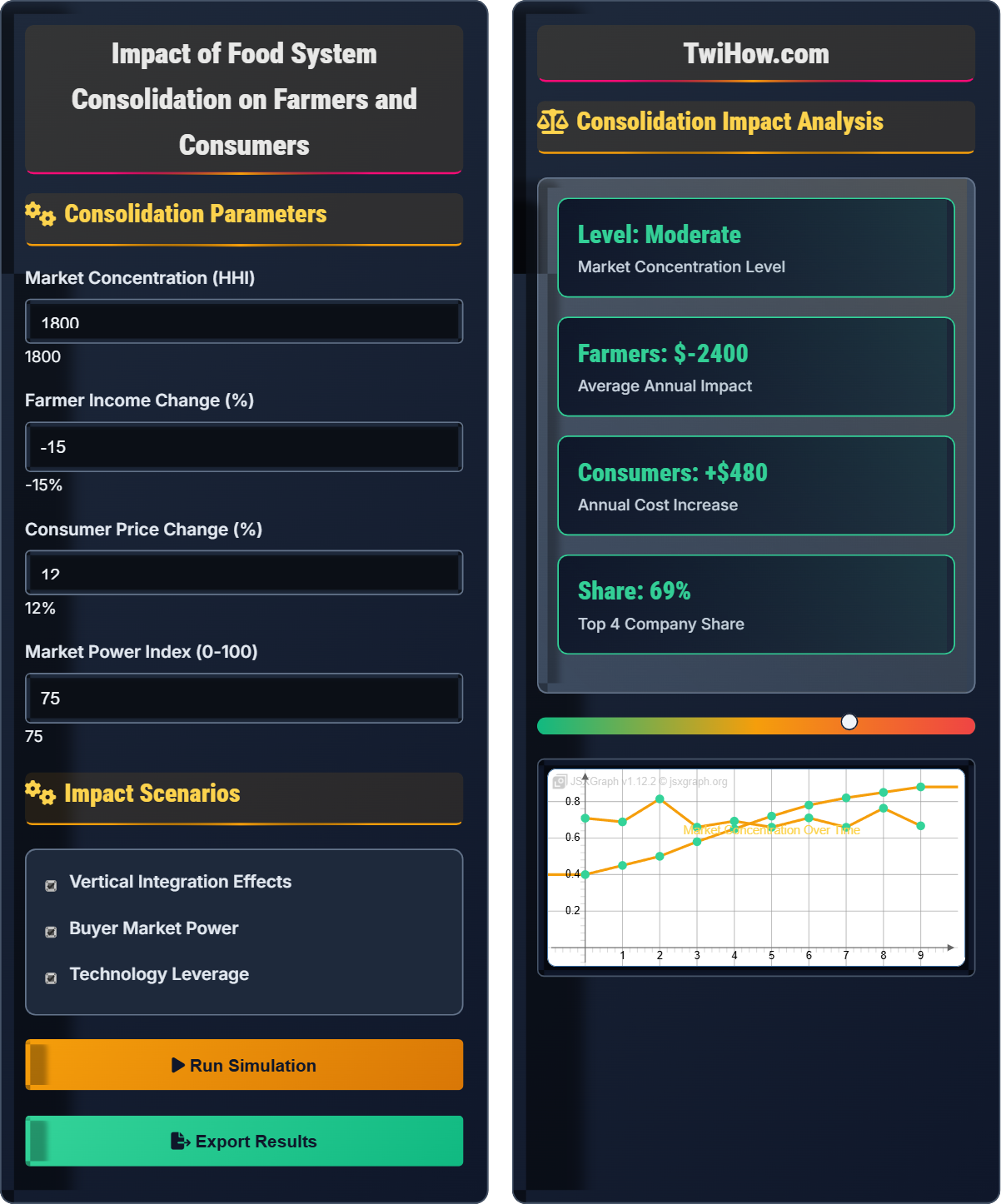
Consolidation Impact Analysis
| Stakeholder | Impact Type | Effect | Magnitude |
|---|---|---|---|
| Small Farmers | Income | Decrease | -25% |
| Large Farmers | Income | Stable | 0% |
| Consumers | Prices | Increase | +12% |
| Markets | Competition | Reduction | -40% |
S=Seeds, F=Farmers, L=Large Co, P=Processing, D=Distribution, R=Retail, C=Consumers
Food System Consolidation Explained
Food system consolidation refers to the process by which fewer companies gain increasing control over various stages of the food production and distribution chain. This includes seed production, farming, processing, distribution, and retail sales.
Market concentration is measured using several indicators:
Where:
- HHI: Sum of squared market shares
- s_i: Market share of firm i
- n: Number of firms in market
- Interpretation: >2500=Highly concentrated, 1500-2500=Moderately concentrated, <1500=Unconcentrated
Consolidation affects multiple stakeholder groups differently:
- Farmers: Reduced bargaining power, standardized contracts, dependency
- Consumers: Higher prices, reduced choice, potential quality impacts
- Markets: Reduced competition, innovation barriers, price manipulation
- Communities: Economic displacement, rural decline, local business loss
- Environment: Industrial practices, resource concentration, sustainability concerns
- Antitrust Enforcement: Preventing anti-competitive mergers
- Farmer Cooperatives: Collective bargaining power
- Local Markets: Supporting decentralized food systems
- Regulation: Price transparency, contract fairness
- Technology: Direct-to-consumer platforms
Food Consolidation Fundamentals
Market concentration, HHI index, monopsony power, vertical integration, horizontal concentration.
HHI = Σ(s_i)² where s_i = market share of firm i
Where HHI = Herfindahl-Hirschman Index, s_i = percentage market share of firm i.
- HHI > 2500 indicates high concentration
- Consolidation reduces competitive pressure
- Market power increases with concentration
Impacts
Reduced bargaining power, price manipulation, market dependency, supply chain disruption.
- Price analysis
- Market share tracking
- Contract evaluation
- Competition monitoring
- Asymmetric market power
- Dependency relationships
- Information asymmetries
- Barriers to exit
Food Consolidation Learning Quiz
Which measure indicates the highest level of market concentration?
The Herfindahl-Hirschman Index (HHI) measures market concentration, where higher values indicate greater concentration. An HHI above 2500 is considered highly concentrated, indicating significant market power held by a few firms. The index is calculated by summing the squares of individual firms' market shares.
The answer is C) Herfindahl-Hirschman Index of 2500.
Understanding market concentration measures is fundamental to analyzing food system consolidation. The HHI provides a quantitative way to assess market competitiveness. Students should remember that HHI values range from near zero (perfect competition) to 10,000 (complete monopoly), with thresholds indicating different levels of concern for regulators.
Herfindahl-Hirschman Index (HHI): Measure of market concentration based on market shares
Market Concentration: Degree to which market share is dominated by a few firms
Monopoly: Single firm controls entire market
• HHI > 2500 = Highly concentrated market
• 1500-2500 = Moderately concentrated
• < 1500 = Unconcentrated market
• Remember HHI calculation method
• Higher values mean less competition
• Used by antitrust authorities
• Confusing HHI with other indices
• Forgetting to square market shares
Explain how food system consolidation affects farmers' bargaining power and economic outcomes. What are the primary mechanisms through which these impacts occur?
Reduced Bargaining Power: As fewer companies control purchasing, farmers have fewer buyers to choose from, reducing their negotiating leverage. This creates monopsony power where buyers can dictate prices.
Standardized Contracts: Consolidated buyers impose standard terms and conditions, limiting farmers' ability to negotiate favorable arrangements.
Dependency Relationships: Farmers become dependent on specific buyers, creating vulnerability to price manipulation and contract termination.
Economic Outcomes: Lower prices received, increased input costs (as suppliers consolidate), reduced profit margins, and decreased farm viability.
Primary Mechanisms: Market concentration, vertical integration, information asymmetries, barriers to exit, and economies of scale that favor large operations.
The relationship between market structure and farmer outcomes is fundamental to understanding consolidation impacts. Students should grasp that market power is transferred from farmers to buyers as consolidation increases. This creates a systematic disadvantage for farmers who must accept whatever terms are offered due to limited alternatives.
Monopsony: Market with single buyer and many sellers
Bargaining Power: Ability to influence transaction terms
Vertical Integration: Controlling multiple production stages
• Fewer buyers = less farmer power
• Dependency reduces autonomy
• Information asymmetries favor large firms
• Consider supply-demand dynamics
• Think about market alternatives
• Analyze power relationships
• Ignoring market structure effects
• Overlooking dependency relationships
• Focusing only on price impacts
A regional grain market had 10 independent buyers paying $5.50 per bushel to farmers. After consolidation, 3 large companies now control 85% of purchases, paying $4.80 per bushel. Meanwhile, consumer prices increased from $6.20 to $6.80 per bushel. Calculate the total annual impact on farmers and consumers if 2 million bushels are produced annually. Analyze the distribution of benefits.
Farmers' Impact: Price reduction from $5.50 to $4.80 = $0.70 per bushel decrease. Annual impact = 2,000,000 × $0.70 = $1,400,000 loss.
Consumers' Impact: Price increase from $6.20 to $6.80 = $0.60 per bushel increase. Annual impact = 2,000,000 × $0.60 = $1,200,000 cost increase.
Benefit Distribution: Consolidated companies capture the difference between what they pay farmers and charge consumers. They save $1.4M on purchases and collect an additional $1.2M in revenue, creating a $2.6M advantage.
Net Effect: $2.6M transfers from farmers and consumers to consolidated companies, representing wealth concentration in fewer hands.
This problem demonstrates the economic mechanics of consolidation. Students should understand that consolidation creates intermediaries who capture value from both ends of the supply chain. The mathematical analysis reveals how market power translates into economic advantage, with clear winners and losers in the redistribution of value.
Market Power: Ability to influence prices and quantities
Value Capture: Appropriating surplus from transactions
Intermediary: Entity between producer and consumer
• Consolidation affects both ends of supply chain
• Value redistributes to dominant players
• Economic impacts compound annually
• Calculate impacts separately
• Consider cumulative effects
• Track value flow directions
• Missing double impact on farmers
• Ignoring consumer effects
• Not calculating net transfer
Regulators are considering blocking a proposed merger that would increase market concentration from an HHI of 1800 to 2400 in a regional food processing market. Analyze the potential benefits and risks of allowing vs. blocking the merger, considering impacts on farmers, consumers, and market competition.
Allowing Merger: Potential benefits include operational efficiencies, cost savings, and innovation. However, risks include increased market power, reduced competition, higher consumer prices, and lower farmer payments.
Blocking Merger: Preserves competition, protects farmers' bargaining power, maintains consumer choice, but may forego efficiency gains.
Analysis: Current HHI (1800) is moderately concentrated; proposed HHI (2400) approaches highly concentrated threshold. The merger would significantly increase market power, likely harming both farmers and consumers.
Recommendation: Block the merger or approve with significant divestitures to maintain competitive market structure.
Antitrust decisions require balancing competing interests. Students should understand that while consolidation may create efficiencies, it also reduces competition. The challenge is determining whether efficiency gains outweigh competitive harms. Regulatory frameworks use concentration thresholds to guide these decisions.
Antitrust: Laws preventing anti-competitive practices
Merger Review: Evaluation of proposed business combinations
Divestiture: Requirement to sell assets to maintain competition
• HHI > 2500 triggers scrutiny
• Efficiency gains must be demonstrated
• Competitive harm must be prevented
• Consider all stakeholders
• Evaluate efficiency claims
• Assess competitive effects
• Focusing on only one side
• Accepting efficiency claims uncritically
• Ignoring market dynamics
Which of the following is the most direct consequence of food system consolidation on consumers?
Food system consolidation typically leads to higher retail prices as consolidated companies gain market power and can charge premium prices. With fewer competitors, there's reduced pressure to compete on price. While consolidation may sometimes lead to operational efficiencies, these are often captured as profits rather than passed to consumers as lower prices.
The answer is B) Higher retail prices.
Students should understand that market power directly translates to pricing power. When competition decreases, companies can set higher prices without losing customers to competitors. This is the fundamental economic mechanism through which consolidation affects consumers. While other effects may occur, pricing is the most direct and measurable impact.
Market Power: Ability to set prices above competitive levels
Price Competition: Competition based on price differences
Consumer Surplus: Benefit consumers receive from lower prices
• Less competition = higher prices
• Market power increases with concentration
• Efficiency gains don't guarantee lower prices
• Follow the money flow
• Consider market structure
• Analyze incentive structures
• Assuming efficiency equals lower prices
• Ignoring market power effects
• Focusing on indirect benefits
FAQ
Q: How can I maintain profitability when large companies control most of the market?
A: Despite market consolidation challenges, several strategies can help:
1. Cooperative Formation: Join or form farmer cooperatives to increase collective bargaining power
2. Direct Marketing: Sell directly to consumers through farmers' markets, CSAs, or online platforms
3. Specialization: Focus on niche markets or organic/specialty products with premium prices
4. Value Addition: Process and package products yourself to capture more value
5. Partnerships: Form strategic alliances with other farmers or businesses
6. Technology: Use precision agriculture to reduce costs and improve efficiency
These approaches help reduce dependence on consolidated buyers and capture more value locally.
Q: What can consumers do to counteract the effects of food system consolidation?
A: Consumers have several options to influence market dynamics:
Shopping Choices: Support local farms, cooperatives, and independent retailers to strengthen decentralized markets.
Collective Action: Participate in consumer advocacy groups that push for fair competition policies.
Political Engagement: Contact representatives about antitrust enforcement and agricultural policy reforms.
Education: Learn about food system issues and share knowledge with others.
Alternative Channels: Use community-supported agriculture (CSA), food co-ops, and farmers' markets.
While individual actions may seem small, collective consumer behavior can drive significant market changes and policy responses.