Impact of Food System Digitalization on Small-Scale Producers
Complete digitalization guide • Step-by-step explanations
Digitalization Impact Fundamentals:
Show Digitalization Impact SimulatorFood system digitalization is transforming how small-scale producers operate, market, and connect to value chains. Digital technologies offer unprecedented opportunities for small farmers to access information, markets, and services that were previously unavailable, but also pose challenges related to access, literacy, and equity.
Digital tools can level the playing field by providing small producers with real-time market information, precision agriculture guidance, and direct access to consumers. However, successful adoption requires addressing barriers like connectivity, cost, and technical skills.
Key digitalization impacts:
- Access: Improved access to markets, information, and services
- Efficiency: Enhanced production and marketing efficiency
- Equity: Potential to reduce information asymmetries
- Barriers: Connectivity, literacy, and cost challenges
Successful digitalization for small-scale producers requires targeted approaches that address specific constraints while maximizing benefits through user-friendly technologies and supportive ecosystems.
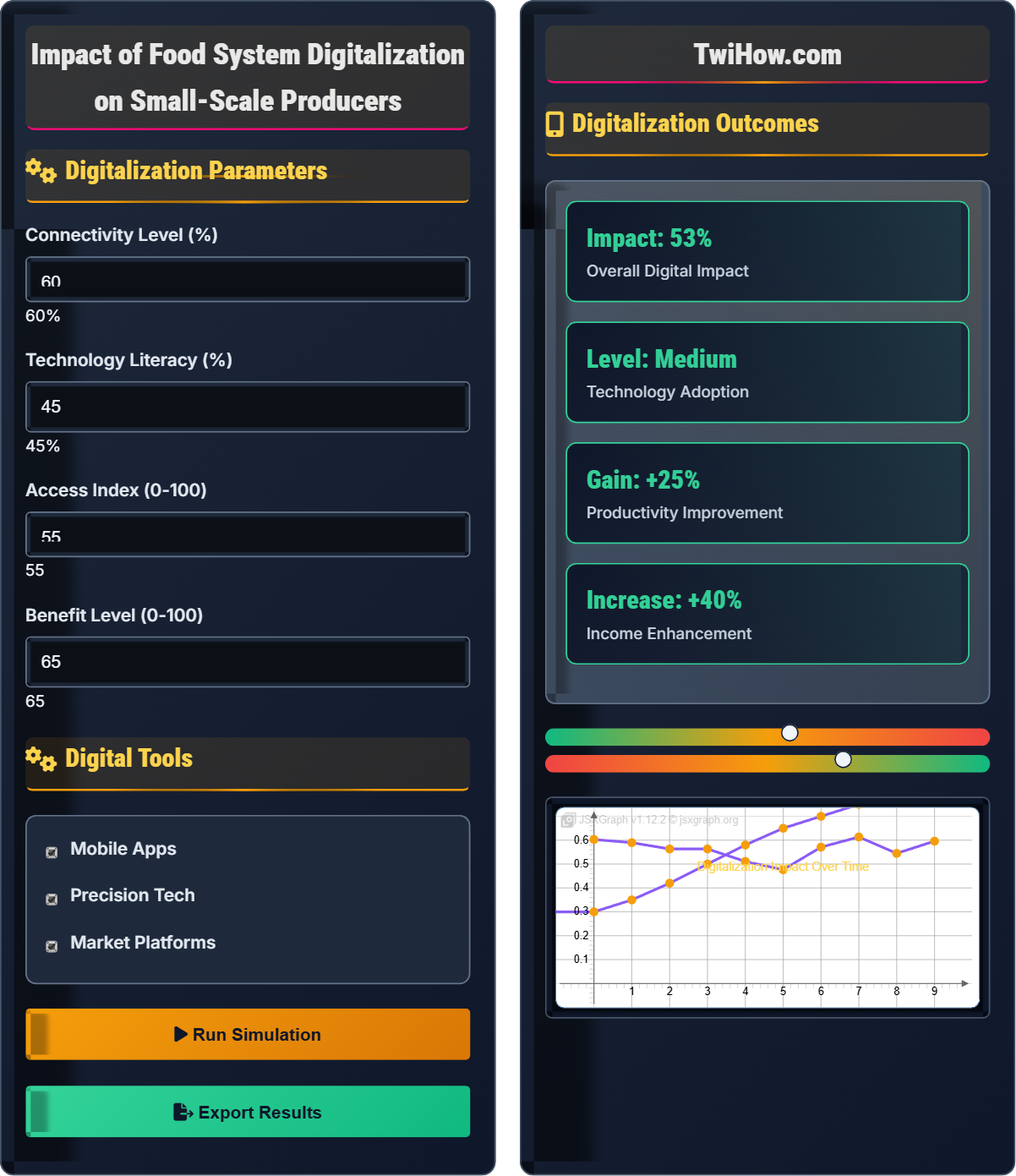
Digitalization Parameters
Digital Tools
Digitalization Outcomes
| Aspect | Score | Challenge Level | Opportunity |
|---|---|---|---|
| Connectivity | 60% | Medium | Infrastructure expansion |
| Literacy | 45% | High | Training programs |
| Access | 55% | Medium | Platform development |
| Benefits | 65% | Low | Value creation |
S=Small Producers, P=Platforms, M=Markets, D=Digital, T=Tools, I=Information, A=Analytics, F=Food, C=Consumers
Food System Digitalization Impact Explained
Food system digitalization refers to the integration of digital technologies throughout the food production, processing, distribution, and consumption chain. For small-scale producers, this includes mobile apps, precision agriculture tools, digital market platforms, and data analytics that can enhance their operations and market access.
Digitalization impact is measured using several important indicators:
Where:
- Access: Availability and accessibility of digital tools
- Adoption: Actual use and integration of technologies
- Benefits: Measurable improvements in outcomes
- Goal: Maximize all components for effective digitalization
Key benefits for small-scale producers include:
- Market Access: Direct connection to buyers and price information
- Information Services: Weather, prices, and advisory services
- Precision Agriculture: Optimized input use and yields
- Financial Services: Digital payments and credit access
- Knowledge Sharing: Peer learning and expert advice
- Supply Chain Integration: Better coordination and traceability
- Mobile-First: Smartphone-based solutions for accessibility
- Simple Interfaces: User-friendly designs for low-literacy users
- Offline Capability: Functionality without constant internet
- Peer Networks: Community-based adoption and support
- Public-Private: Partnership models for sustainability
Digitalization Impact Fundamentals
Digital agriculture, precision farming, mobile technology, information access, technology adoption, digital divide.
Index = (Access + Adoption + Benefits) / 3
Where Index = digitalization effectiveness, Access = tool availability, Adoption = actual usage, Benefits = outcome improvements.
- Access without adoption is ineffective
- Benefits depend on proper use
- Simple solutions work best
Applications
Mobile apps, precision agriculture tools, digital marketplaces, farm management systems, weather forecasting services.
- Needs assessment
- Technology selection
- User training
- Ongoing support
- Connectivity challenges
- Cost barriers
- Literacy levels
- Cultural acceptance
Digitalization Impact Learning Quiz
Which digital tool is most accessible to small-scale producers with limited resources?
Basic mobile phone apps are the most accessible digital tool for small-scale producers because smartphones are increasingly common and affordable, mobile networks are widely available, and apps can provide essential services like market prices, weather information, and agricultural advice at low cost.
The answer is B) Basic mobile phone apps.
Students should understand that digitalization must be appropriate for the context and resources of small-scale producers. The most effective digital tools are those that match the technological infrastructure and economic capacity of target users. Mobile technology represents the sweet spot between functionality and accessibility.
Appropriate Technology: Technology matching user capabilities
Accessibility: Ease of access and use
Mobile Penetration: Smartphone availability in target areas
• Match technology to user capacity
• Consider infrastructure availability
• Affordability is crucial
• Start with basic functionality
• Use familiar interfaces
• Enable offline capability
• Assuming high-tech solutions are best
• Ignoring infrastructure constraints
• Not considering cost barriers
Explain how the digital divide affects small-scale producers' ability to benefit from digitalization. What are the key barriers and potential solutions?
Key Barriers: Limited internet connectivity, high cost of devices and data, low digital literacy, language barriers, and lack of relevant content in local languages.
Impact: Exacerbates existing inequalities, limits market access, reduces competitive advantage, and excludes producers from digital value chains.
Solutions: Infrastructure development, subsidized access programs, simplified interfaces, multilingual content, peer-to-peer learning, and offline-capable tools.
Implementation: Public-private partnerships, community-based approaches, and targeted support for marginalized groups.
Outcomes: More equitable access to digital benefits and reduced inequality.
Students should understand that digitalization can both bridge and widen gaps depending on implementation. The digital divide represents a significant challenge that must be actively addressed to ensure that digital tools benefit all producers equitably. Solutions must be comprehensive and context-specific.
Digital Divide: Gap between those with and without digital access
Equitable Access: Equal opportunity regardless of circumstances
Infrastructure Development: Investment in connectivity and systems
• Address barriers systematically
• Consider multiple factors
• Ensure inclusive design
• Map specific barriers
• Engage communities
• Use multiple channels
• Assuming universal access
• Not considering literacy levels
• Ignoring cultural factors
A small farmer spends $20/year on a mobile app that provides market price information. The app helps them sell 10% more produce at 5% higher prices. If they normally sell $2,000 worth of produce annually, calculate the return on investment and determine if the app is financially worthwhile.
Without App: Annual sales = $2,000
With App: Volume increase = $2,000 × 1.10 = $2,200; Price increase = $2,200 × 1.05 = $2,310
Revenue Gain: $2,310 - $2,000 = $310
App Cost: $20
Net Benefit: $310 - $20 = $290
ROI: ($290 ÷ $20) × 100 = 1,450%
Conclusion: The app is highly financially worthwhile with a 1,450% return on investment.
This problem demonstrates that even small investments in digital tools can yield substantial returns for small-scale producers. Students should understand that the value of digital tools often comes from information and efficiency gains rather than direct cost savings. The key is measuring the impact on both volume and price.
Return on Investment (ROI): Ratio of net benefit to investment cost
Market Information: Data on prices and demand
Value Creation: Increasing product value through information
• Consider both volume and price impacts
• Calculate net benefits
• Compare to investment costs
• Track multiple outcome measures
• Consider long-term benefits
• Factor in time savings
• Only considering direct cost savings
• Not calculating net benefits
• Ignoring volume effects
Design a digital platform specifically for small-scale producers that addresses connectivity, literacy, and cost challenges while providing market access and information services. Consider user interface, functionality, and sustainability.
Interface Design: Simple, visual interface with minimal text, large buttons, voice capabilities, and local language support.
Connectivity: Offline-first approach with data synchronization when connected, SMS fallback, and compressed data transmission.
Functionality: Market prices, weather forecasts, agricultural advice, buyer connections, and simple record keeping.
Cost Model: Free basic services with premium features, ad-supported model, or fee-sharing with successful transactions.
Training: Peer-to-peer learning, video tutorials, and local champions for support.
Sustainability: Partnerships with governments, NGOs, and private sector for funding and operation.
This problem demonstrates the need for holistic design approaches that address multiple constraints simultaneously. Students should understand that successful digital platforms for small-scale producers must be designed with their specific constraints and needs in mind, rather than simply adapting existing solutions.
Offline-First: Functionality without internet connection
User-Centered Design: Design focused on user needs
Sustainable Model: Financially viable long-term approach
• Design for user constraints
• Ensure functionality without connectivity
• Create sustainable funding
• Conduct user research
• Test with target users
• Iterate based on feedback
• Assuming urban technology works rurally
• Not considering connectivity constraints
• Ignoring user capacity
What is the most critical factor for successful technology adoption by small-scale producers?
Simple usability is the most critical factor for technology adoption by small-scale producers. Technologies that are easy to use, understand, and maintain are more likely to be adopted and used consistently. Complex features or interfaces can create barriers that prevent adoption or lead to abandonment.
The answer is B) Simple usability.
Students should understand that adoption is more important than sophistication. In technology deployment for small-scale producers, the focus should be on solving real problems in simple, accessible ways rather than creating feature-rich solutions that are difficult to use. Usability directly impacts adoption rates and sustained use.
Usability: Ease of use and learning
Technology Adoption: Acceptance and consistent use of technologyUser Experience: Overall experience of interacting with technology
• Simplicity drives adoption
• Usability affects sustainability
• User needs come first
• Minimize learning curve
• Use familiar patterns
• Test with users
• Prioritizing features over simplicity
• Assuming high technical literacy
• Not testing with target users
FAQ
Q: I have a basic smartphone but struggle with technology. What digital tools can help me without being too complicated?
A: Several simple digital tools can help you:
1. Market Price Apps: Simple interfaces showing current prices for your crops
2. Weather Apps: Basic weather forecasts for planning
3. Text Services: SMS-based information services
4. Voice Apps: Audio-based agricultural advice
5. Simple Booking: Apps for arranging transport or services
6. Video Guides: Visual tutorials for farming techniques
Look for tools with large buttons, minimal text, and local language support.
Q: How can we ensure digital tools reach small-scale producers who lack connectivity?
A: Effective strategies include:
Infrastructure Development: Invest in rural connectivity through public-private partnerships.
Offline Solutions: Develop tools that work offline and sync when connected.
Community Access Points: Establish shared access through cooperatives or community centers.
Hybrid Approaches: Combine digital with traditional media like radio and SMS.
Local Champions: Train local leaders to assist others with digital tools.
Progressive Rollout: Start with areas of better connectivity and expand gradually.
Success requires addressing infrastructure, affordability, and literacy simultaneously.