Impact of Industrial Agriculture on Soil and Water Resources
Complete environmental guide • Sustainability
Industrial Agriculture Impact:
Analyze Environmental ImpactIndustrial agriculture has transformed food production through mechanization, chemical inputs, and intensive farming practices. While these methods have increased yields and efficiency, they have also had significant environmental impacts on soil and water resources. Understanding these impacts is crucial for developing sustainable agricultural systems.
Key environmental impacts include:
- Soil Degradation: Erosion, compaction, loss of organic matter, and reduced biodiversity
- Water Pollution: Chemical runoff, eutrophication, and groundwater contamination
- Resource Depletion: Unsustainable water extraction and soil nutrient depletion
- Chemical Accumulation: Pesticides and fertilizer residues in ecosystems
These impacts threaten long-term food security and environmental sustainability, necessitating the adoption of more sustainable farming practices.
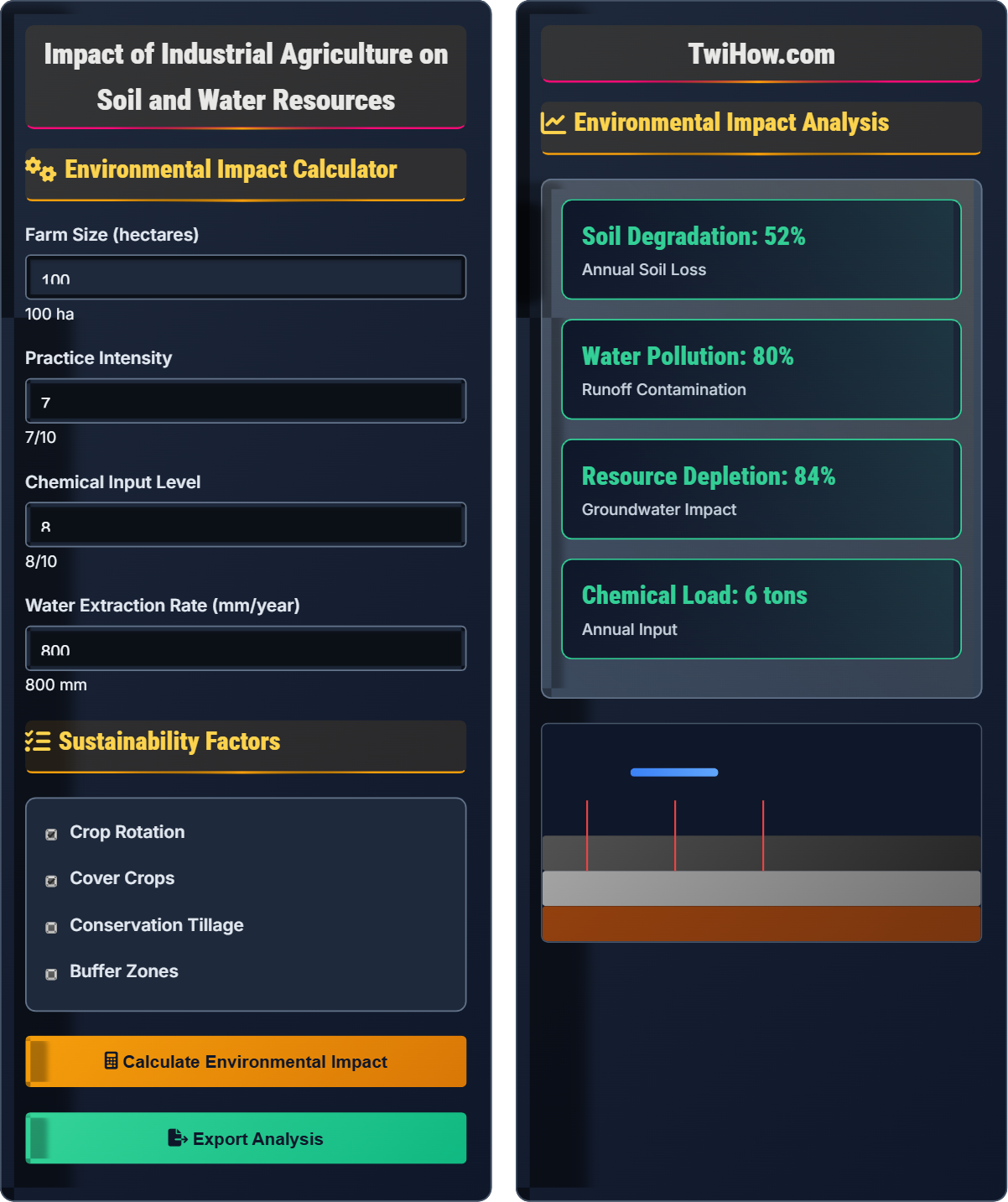
Environmental Impact Calculator
Sustainability Factors
Environmental Impact Analysis
Soil Impact Analysis
Industrial practices including heavy machinery and intensive tillage lead to soil erosion and compaction, reducing soil structure and water infiltration capacity.
Intensive farming depletes soil organic matter through continuous cultivation without adequate organic inputs, reducing fertility and water retention.
Chemical inputs and monoculture practices reduce soil microbial diversity and beneficial organisms, affecting soil health.
Continuous cropping without proper nutrient cycling leads to soil nutrient depletion, requiring increasing chemical inputs.
Water Impact Analysis
Excess fertilizers and pesticides wash into waterways, causing eutrophication and aquatic ecosystem disruption.
Chemicals leach through soil layers, contaminating groundwater supplies and affecting drinking water quality.
Intensive irrigation depletes aquifers faster than they can be replenished, creating long-term water scarcity.
Changes in land use and vegetation affect local water cycles, reducing natural water retention and recharge.
Impact Mechanisms
Excess nutrients and chemicals move through soil profile, reaching groundwater and surface water systems.
Heavy rainfall carries topsoil, nutrients, and chemicals into waterways, causing pollution and erosion.
Heavy machinery compresses soil, reducing porosity and water infiltration, increasing runoff and erosion.
Over-application of specific nutrients disrupts natural soil chemistry and affects plant and microbial health.
Industrial Agriculture Environmental Impact
Industrial agriculture refers to large-scale, mechanized farming systems that rely heavily on chemical inputs, monocultures, and intensive practices to maximize yields and efficiency. This approach has dominated global food production since the mid-20th century, significantly increasing food output but also creating substantial environmental challenges.
This process chain shows how industrial practices lead to environmental degradation through multiple pathways.
Industrial agriculture affects environmental resources through several interconnected pathways:
- Soil Degradation: Erosion, compaction, organic matter loss, salinization
- Water Depletion: Groundwater overdraft, aquifer depletion, altered water cycles
- Water Pollution: Chemical runoff, eutrophication, groundwater contamination
- Biodiversity Loss: Habitat destruction, species decline, ecosystem simplification
- Chemical Accumulation: Persistent residues in soil and water systems
- Reduced Soil Fertility: Leading to dependency on external inputs
- Water Scarcity: Affecting both agriculture and communities
- Food Security Threats: Due to resource depletion
- Climate Change: Through greenhouse gas emissions
- Economic Costs: Remediation and health impacts
Soil Impact Mechanisms
Erosion, compaction, organic matter loss, nutrient depletion, biodiversity decline, chemical accumulation.
Environmental Impact = (Soil Degradation × Water Depletion) + (Chemical Load × Biodiversity Loss)
Where Impact = environmental degradation level, Soil = soil health indicator.
- Soil health affects long-term productivity
- Chemical inputs create cumulative effects
- Water and soil impacts are interconnected
- Recovery takes decades to centuries
Water Impact Pathways
Chemical runoff, groundwater contamination, aquifer depletion, eutrophication, altered hydrology.
- Chemical application to fields
- Surface runoff during rainfall
- Subsurface leaching to groundwater
- Transport to water bodies
- Ecosystem disruption and contamination
- Water impacts spread beyond farm boundaries
- Contamination persists for years
- Effects cascade through ecosystems
- Remediation is extremely costly
Soil Degradation Mechanisms
Intensive tillage and heavy machinery use break down soil structure, making it susceptible to wind and water erosion. This removes the fertile topsoil layer, reducing long-term productivity.
Excessive use of chemical fertilizers and pesticides alters soil pH, kills beneficial microorganisms, and reduces organic matter content, ultimately degrading soil health.
Heavy farm equipment compacts soil, reducing pore space and limiting water infiltration, root penetration, and oxygen availability, which affects plant growth.
Repeated cropping without proper nutrient cycling depletes essential minerals while overloading soils with specific nutrients, disrupting natural soil chemistry.
Water Resource Impacts
Excess fertilizers and pesticides wash into rivers and lakes during rainfall, causing algal blooms and oxygen depletion that kill aquatic life and create dead zones.
Chemicals leach through soil layers into groundwater, contaminating drinking water supplies and affecting human health for decades.
Intensive irrigation withdraws groundwater faster than natural recharge rates, creating long-term water scarcity and affecting regional water availability.
Excess nitrogen and phosphorus from agricultural runoff cause explosive algae growth in water bodies, depleting oxygen and killing fish populations.
Industrial vs Sustainable Agriculture
| Factor | Industrial Agriculture | Sustainable Practices |
|---|---|---|
| Soil Erosion | High (5-10 tons/ha/year) | Low (1-2 tons/ha/year) |
| Water Usage | High (800-1200 mm/year) | Moderate (400-600 mm/year) |
| Chemical Inputs | High (200-400 kg/ha/year) | Low (50-100 kg/ha/year) |
| Soil Organic Matter | Declining | Increasing |
| Biodiversity | Low | High |
| Water Quality | Degraded | Protected |
Historical Impact Timeline
Sustainability Solutions
Implementing sustainable practices can reverse environmental damage while maintaining productivity and profitability.
Industrial Agriculture Impact Quiz
Which industrial practice contributes most to soil erosion?
Intensive tillage and monoculture practices contribute most to soil erosion. Tillage breaks down soil structure and leaves soil exposed to wind and water erosion. Monoculture systems lack the diverse root systems that help bind soil together. These practices remove the protective vegetation cover and destroy soil aggregates that maintain soil structure.
The answer is B) Intensive tillage and monoculture.
Soil erosion occurs when soil particles are detached and transported by wind or water. The key factors are the force of detachment (rainfall, wind) and the resistance of soil to erosion (structure, vegetation cover). Industrial practices that expose soil and break down structure significantly increase erosion risk.
Soil Erosion: Removal of topsoil by natural forces
Monoculture: Growing single crop species
Soil Structure: Arrangement of soil particles
• Bare soil is highly erodible
• Root systems bind soil particles
• Tillage breaks soil aggregates
• Consider soil exposure
• Think about root systems
• Evaluate mechanical disturbance
• Confusing conservation with erosion practices
• Not considering soil structure
• Ignoring vegetation cover effects
Explain how industrial agriculture contributes to water contamination and what the long-term consequences are.
Contamination Pathways: Excess fertilizers (nitrogen and phosphorus) and pesticides applied to fields are carried by surface runoff into rivers and lakes, and leach through soil into groundwater systems. This creates nutrient pollution that causes eutrophication.
Immediate Effects: Algal blooms, fish kills, and creation of hypoxic "dead zones" in water bodies. Groundwater contamination affects drinking water quality.
Long-term Consequences: Persistent chemical residues in ecosystems, reduced biodiversity, loss of aquatic life, contaminated drinking water supplies, and degraded water quality that can take decades to remediate.
Regional Impact: Contamination spreads beyond farm boundaries, affecting entire watersheds and coastal areas.
Water contamination from agriculture follows a predictable pathway: chemical application → runoff/leaching → transport → accumulation in water bodies → ecosystem disruption. The key is understanding how water moves through the landscape and carries pollutants with it.
Eutrophication: Nutrient enrichment causing algae blooms
Leaching: Chemicals moving through soil
Runoff: Surface water carrying pollutants
• Water connects all ecosystems
• Contamination spreads beyond source
• Remediation is extremely difficult
• Consider water flow paths
• Think about chemical persistence
• Evaluate ecosystem connectivity
• Not considering watershed connectivity
• Underestimating contamination spread
• Ignoring long-term persistence
A 500-hectare industrial farm applies 300 kg of nitrogen fertilizer per hectare annually. If 25% of this nitrogen runs off into local waterways and 15% leaches into groundwater, calculate the total nitrogen entering water systems and explain the environmental implications.
Total Nitrogen Applied: 500 ha × 300 kg/ha = 150,000 kg
Nitrogen in Runoff: 150,000 kg × 25% = 37,500 kg
Nitrogen in Groundwater: 150,000 kg × 15% = 22,500 kg
Total Nitrogen Entering Water Systems: 37,500 + 22,500 = 60,000 kg
Environmental Implications: This nitrogen load will cause eutrophication in surface waters, leading to algal blooms, oxygen depletion, fish kills, and creation of dead zones. Groundwater contamination will affect drinking water quality for years.
This calculation demonstrates how seemingly small percentages of nutrient loss can result in massive environmental loads when scaled up to industrial farming operations. The key insight is that agricultural systems are leaky, and small losses become large environmental problems.
Nitrogen Load: Amount of nitrogen entering water systems
Eutrophication: Nutrient enrichment process
Dead Zone: Oxygen-depleted water area
• Small percentages scale to large amounts
• Nutrients cause cascading effects
• Environmental impacts are cumulative
• Calculate total inputs first
• Consider cumulative effects
• Think about ecosystem thresholds
• Not calculating total inputs
• Ignoring cumulative effects
• Underestimating environmental impacts
You are designing a sustainable farming system to replace an industrial operation that has caused soil degradation and water pollution. Propose a comprehensive approach that addresses both soil and water resource concerns.
Soil Restoration: Implement cover cropping, reduced tillage, compost application, and crop rotation to rebuild soil organic matter and structure.
Water Protection: Establish buffer strips along waterways, implement precision agriculture to reduce chemical inputs, and install water management systems.
Integrated Practices: Use integrated pest management, crop diversification, and agroforestry to create resilient systems.
Monitoring: Regular soil testing, water quality monitoring, and biodiversity assessment to track improvement.
Transition Strategy: Phased implementation over 3-5 years to maintain productivity while building soil health.
Long-term Goals: Achieve carbon sequestration, water conservation, and biodiversity enhancement while maintaining economic viability.
Sustainable agriculture requires holistic approaches that address multiple environmental concerns simultaneously. The key is understanding the interconnected nature of soil and water systems and implementing practices that enhance both.
Agroecology: Ecological farming approach
Regenerative Agriculture: Soil-building practices
Integrated Systems: Multi-faceted approaches
• Address root causes
• Implement holistically
• Monitor continuously
• Start with soil health
• Consider water flow
• Plan for transitions
• Addressing symptoms not causes
• Not considering system interactions
• Ignoring transition challenges
What is the most serious long-term consequence of industrial agriculture on soil resources?
The most serious long-term consequence is irreversible soil structure loss. Once soil aggregates are broken down through intensive tillage and chemical use, and organic matter is depleted, it can take decades to centuries to restore soil structure naturally. This fundamentally affects soil productivity and ecosystem function.
The answer is B) Irreversible soil structure loss.
Soil structure is the foundation of soil health. It affects water infiltration, root penetration, nutrient availability, and biological activity. Once destroyed, soil structure is extremely difficult to restore, making it the most serious long-term impact of industrial practices.
Soil Structure: Physical arrangement of particles
Soil Aggregates: Clusters of soil particles
Organic Matter: Decomposed plant/animal material
• Soil structure is fundamental
• Recovery takes very long
• Structure affects all functions
• Consider permanence
• Think about restoration time
• Evaluate functional impacts
• Underestimating restoration time
• Not considering functional impacts
• Focusing on reversible changes
FAQ
Q: Can sustainable farming practices maintain productivity while reducing environmental impact?
A: Yes, sustainable farming practices can maintain or even increase productivity while reducing environmental impact. Practices like cover cropping, crop rotation, and precision agriculture improve soil health, reduce input costs, and often result in higher long-term yields. The key is building soil health and biodiversity, which creates resilient systems.
Q: What are the most effective solutions for reversing industrial agriculture damage?
A: The most effective solutions include: 1) Conservation tillage to reduce erosion, 2) Cover cropping to build soil organic matter, 3) Precision agriculture to reduce chemical inputs, 4) Buffer strips to protect waterways, 5) Crop rotation to break pest cycles, and 6) Agroforestry to enhance biodiversity. These practices work synergistically to restore ecosystem health.