What is the Impact of Monoculture Farming on Biodiversity and Resilience?
Complete agriculture guide • Step-by-step explanations
Monoculture Impacts:
Show Impact CalculatorMonoculture farming, the practice of growing a single crop species over large areas, has profound impacts on biodiversity and ecosystem resilience. While it offers short-term economic benefits, it reduces genetic diversity, increases pest vulnerability, and degrades soil health, making agricultural systems less resilient to environmental stresses.
Key impacts of monoculture farming:
- Biodiversity Loss: Reduction in plant, insect, and soil microorganism diversity
- Pest Vulnerability: Increased susceptibility to disease and pest outbreaks
- Soil Degradation: Nutrient depletion and reduced soil health
- Ecosystem Services: Decline in pollination, natural pest control
- Genetic Erosion: Loss of crop genetic diversity
Alternatives like polyculture and agroecology offer more sustainable approaches.
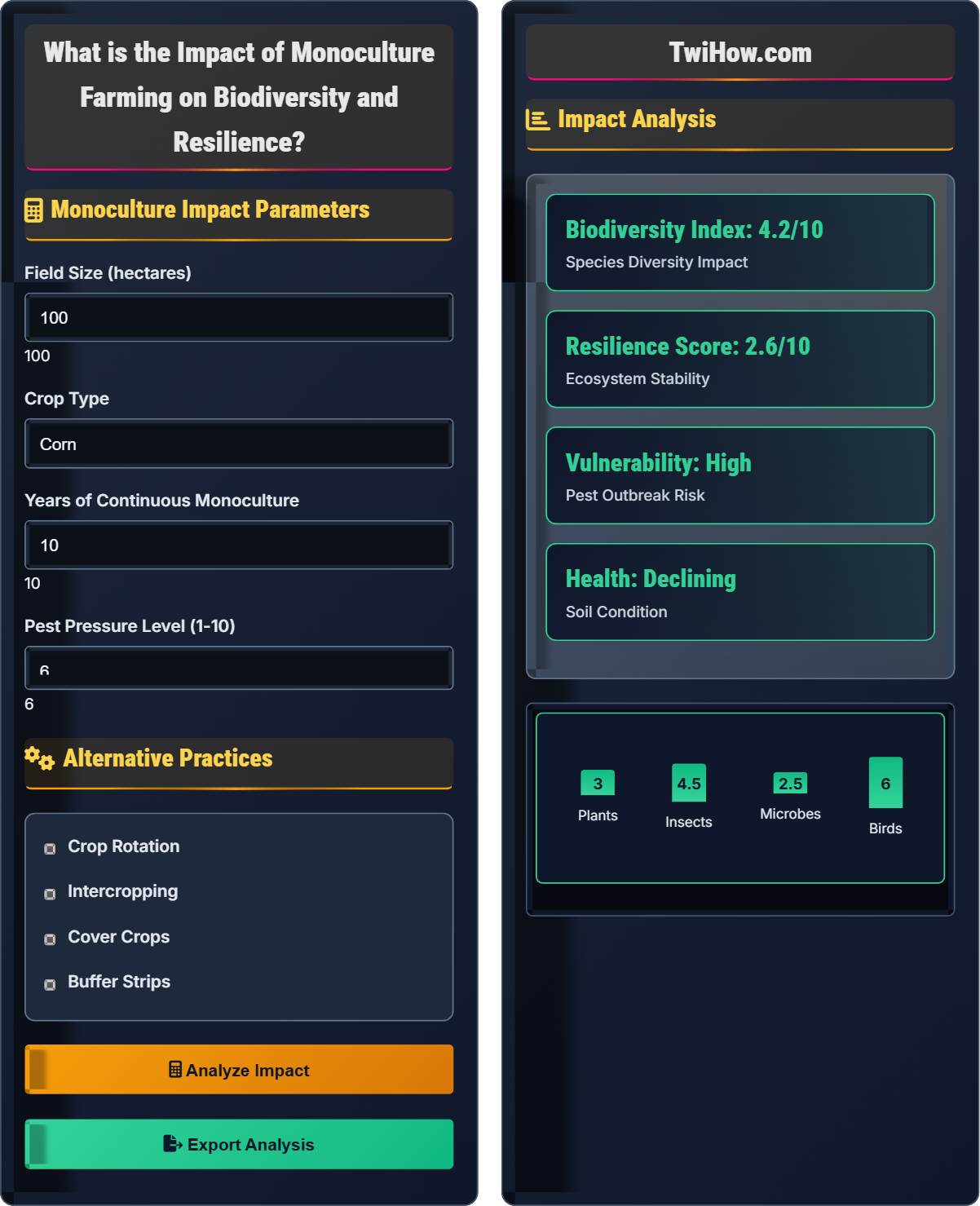
Monoculture Impact Parameters
Alternative Practices
Impact Analysis
| Category | Impact | Severity | Recovery Time |
|---|---|---|---|
| Plant Species | Significant Loss | High | 10-20 years |
| Soil Microorganisms | Decline | Medium | 5-10 years |
| Insect Populations | Reduced Diversity | High | 5-15 years |
| Wildlife Habitat | Fragmentation | High | 20-50 years |
Monoculture Impact on Biodiversity and Resilience
Monoculture farming is the agricultural practice of growing a single crop species over large areas for consecutive seasons. This approach maximizes short-term efficiency and simplifies management but has significant ecological consequences.
Characteristics of monoculture systems:
- Uniform Planting: Single species dominates the landscape
- Standardized Management: Uniform inputs and practices
- Economic Efficiency: Simplified harvesting and processing
- Genetic Uniformity: Often identical cultivars planted
- Temporal Repetition: Same crop grown season after season
The impact on biodiversity can be quantified as:
Studies show that monocultures typically support 50-90% fewer species than diverse polyculture systems, depending on the crop and region.
Where:
- Species Richness: Number of different species in the ecosystem
- Monoculture: Single crop system
- Polyculture: Multiple crop system
Research demonstrates significant measurable impacts of monoculture farming:
- Bird Diversity: 50-70% reduction compared to diverse systems
- Insect Populations: 60-80% decline in beneficial species
- Soil Microorganisms: 30-50% reduction in diversity
- Pest Outbreak Risk: 3-5 times higher than diverse systems
- Disease Susceptibility: Significantly increased for genetically uniform crops
Agroecological alternatives can restore biodiversity and resilience:
- Crop Rotation: Alternating different crops to break pest cycles
- Intercropping: Growing multiple crops simultaneously
- Agroforestry: Integrating trees with crops
- Polyculture: Mimicking natural ecosystem diversity
- Buffer Strips: Maintaining habitat corridors
Biodiversity Impacts
Plant diversity, soil microorganisms, beneficial insects, pollinators, wildlife habitat, genetic variation.
Species Richness = Number of different species in ecosystem
Shannon Diversity Index = -Σ(pi × ln(pi)), where pi is proportion of species i.
- Monocultures support 50-90% fewer species than diverse systems
- Genetic diversity decreases with each generation of selection
- Beneficial insects decline due to habitat loss
- Soil health deteriorates over time
Resilience Effects
Ecosystem stability, pest resistance, disease tolerance, climate adaptation, soil health, nutrient cycling.
- Stress tolerance capacity
- Recovery time from disturbance
- Functional redundancy
- Adaptive capacity
- System stability metrics
- Monocultures have low functional redundancy
- Single stress can affect entire system
- Recovery from pest outbreaks is difficult
- Climate change adaptation is limited
Monoculture Impact Quiz
How does monoculture farming typically affect species diversity compared to polyculture systems?
Monoculture farming typically decreases species diversity by 50-90% compared to polyculture systems. This occurs because single-species plantings provide limited habitat, food sources, and ecological niches for other organisms. The simplified ecosystem structure supports far fewer species than diverse polyculture systems.
The answer is B) Decreases diversity by 50-90%.
Biodiversity depends on habitat complexity and resource availability. Monocultures create homogeneous environments with limited niches, while polycultures provide diverse habitats, flowering periods, and food sources that support a wider range of species. This principle is fundamental to ecology and conservation biology.
Monoculture: Agricultural practice of growing a single crop species
Polyculture: Growing multiple crop species together
Species Diversity: Number and relative abundance of species in ecosystem
• Habitat complexity supports more species
• Resource diversity increases niche availability
• Genetic diversity enhances ecosystem stability
• Think of ecosystems as complex networks
• More connections mean greater stability
• Diversity provides backup systems
• Assuming monocultures support more diversity
• Underestimating the impact of habitat simplification
• Ignoring temporal diversity requirements
Explain why monoculture farming systems are more vulnerable to pest outbreaks compared to diverse cropping systems. Include the mechanisms involved and provide specific examples.
Mechanisms of Increased Pest Vulnerability:
1. Abundant Host Plants: Large areas of the same crop provide ample food for specialists
2. Limited Natural Enemies: Fewer beneficial insects due to habitat simplification
3. Reduced Functional Diversity: No alternative plants to disrupt pest cycles
4. Genetic Uniformity: If one plant is susceptible, all are susceptible
Examples:
• Irish Potato Famine (1845-1852): Genetic uniformity led to catastrophic crop failure
• Corn Leaf Blight (1970): Affected 15% of US corn crop due to genetic similarity
• Bark Beetle Outbreaks: Monoculture forests are more vulnerable than diverse stands
Contrast with Diverse Systems: Polycultures provide habitat for natural enemies, create physical barriers to pest movement, and dilute host plant density, reducing outbreak risk.
The "monoculture vulnerability hypothesis" explains why single-crop systems are more prone to pest problems. Pests evolve rapidly and can adapt to exploit abundant resources. Diverse systems create a more complex environment that naturally suppresses pest populations through competition and predation.
Pest Outbreak: Rapid population increase causing economic damage
Functional Diversity: Variety of ecological roles in system
Natural Enemies: Predators and parasitoids controlling pests
• Pests evolve faster than crops can adapt
• Natural enemies need diverse resources
• Genetic diversity provides insurance against pests
• Think of pests as exploiting abundance
• Diversity creates natural barriers
• Healthy ecosystems regulate themselves
• Underestimating pest evolutionary capacity
• Ignoring role of natural enemies
• Assuming genetic engineering solves all problems
A 1000-hectare corn field practicing monoculture has experienced pest outbreaks requiring $200 per hectare in pesticide applications annually. If a diversified farming system with crop rotation and intercropping reduces pest pressure by 70%, calculate the annual savings in pesticide costs. Also consider that diversified systems may have 15% higher labor costs ($150 per hectare). What is the net economic impact?
Current Monoculture Costs:
Pesticide costs: 1000 ha × $200/ha = $200,000 annually
After Diversification:
Pesticide reduction: 70% of $200,000 = $140,000 reduction
New pesticide costs: $200,000 - $140,000 = $60,000
Additional Labor Costs:
Increased labor: 15% of baseline labor costs
Assuming baseline labor was $100/ha: $100 × 1.15 = $115/ha
Total labor: 1000 ha × $115/ha = $115,000
Net Economic Impact:
Savings from pesticides: $140,000
Additional labor costs: $15,000 (increase from $100,000 to $115,000)
Net savings: $140,000 - $15,000 = $125,000 annually
This represents a 62.5% reduction in pest management costs.
This example demonstrates that diversified farming can be economically viable while providing ecological benefits. Although diversified systems may require more labor, they often reduce input costs for pesticides and fertilizers, leading to improved profitability over time.
Integrated Pest Management: Combining biological, cultural, and chemical controls
Ecological Economics: Considering ecosystem services in economic calculations
Externalities: Costs not reflected in market prices
• Economic analysis should include environmental costs
• Diversification reduces risk
• Long-term sustainability matters
A farmer has been growing corn in monoculture for 15 years. Soil tests reveal organic matter has declined from 4% to 2%, nitrogen availability has decreased by 40%, and beneficial microbe populations have dropped by 60%. Calculate the recovery timeline if the farmer adopts a 4-year crop rotation including nitrogen-fixing legumes and cover crops. Assume organic matter increases by 0.3% per year, nitrogen availability recovers at 15% per year, and microbe populations recover at 25% per year.
Current Status After 15 Years Monoculture:
Organic matter: 2% (was 4%) - needs to increase by 2%
Nitrogen availability: 60% of original (down 40%) - needs to increase by 40%
Microbial populations: 40% of original (down 60%) - needs to increase by 60%
Recovery Rates:
Organic matter: 0.3% per year → 2% ÷ 0.3% = 6.7 years
Nitrogen availability: 15% per year → 40% ÷ 15% = 2.7 years
Microbial populations: 25% per year → 60% ÷ 25% = 2.4 years
Overall Recovery Timeline: Approximately 7 years to reach pre-degradation levels
Management Strategy: The farmer should expect gradual improvement over 3-4 years, with significant benefits appearing after 5-7 years of implementing rotation and cover crops.
Soil recovery follows different timelines for different components. Biological components like microorganisms often recover fastest, while structural components like organic matter take longer. This demonstrates the importance of patience and long-term thinking in sustainable agriculture.
Soil Organic Matter: Decomposed plant and animal material in soil
Nitrogen Fixation: Conversion of atmospheric nitrogen to plant-available form
Microbial Biomass: Living component of soil organic matter
• Soil recovery takes time and consistent management
• Different soil components recover at different rates
• Cover crops accelerate recovery significantly
• Start with nitrogen-fixing cover crops
• Include diverse plant families in rotation
• Monitor soil health indicators regularly
• Expecting immediate results
• Not including nitrogen fixers
• Neglecting soil testing
Which ecosystem service is most significantly reduced by monoculture farming compared to diverse agricultural systems?
Pollination services are most significantly reduced by monoculture farming. Diverse flowering plants provide nectar and pollen sources throughout the growing season, supporting pollinator populations. Monocultures typically flower for only a brief period, leaving pollinators without adequate food resources for most of the year. Studies show that pollinator diversity and abundance can decline by 50-80% in intensive monoculture systems.
The answer is B) Pollination services.
Pollinators require diverse, continuous food sources throughout their active season. Monocultures create temporal gaps in flowering resources and often rely on pesticides that harm pollinators. Diverse systems provide habitat, nesting sites, and continuous bloom periods that support healthy pollinator communities.
Ecosystem Services: Benefits provided by natural ecosystems
Pollination: Transfer of pollen between flowers
Functional Groups: Species performing similar ecological roles
• Pollinators need diverse flowering plants
• Continuous bloom periods support populations
• Pesticides harm beneficial insects
• Include flowering plants throughout growing season
• Create pollinator habitat corridors
• Reduce pesticide use near flowering crops
• Assuming all crops don't need pollination
• Underestimating pollinator importance
• Not considering pesticide impacts
FAQ
Q: Is it economically viable to transition from monoculture to diverse cropping systems?
A: Yes, diverse cropping systems can be economically viable and often more profitable in the long term:
1. Reduced Input Costs: Lower fertilizer and pesticide expenses due to natural pest control and nitrogen fixation
2. Risk Reduction: Multiple crops spread financial risk across different markets and weather conditions
3. Premium Markets: Growing demand for sustainably produced crops commands higher prices
4. Soil Health Benefits: Improved fertility reduces long-term amendment costs
5. Government Incentives: Programs supporting conservation and sustainable practices
While transition years may involve learning curves and temporary adjustments, studies consistently show that diversified farms achieve better long-term profitability and resilience.
Q: How can farmers transition from monoculture to more sustainable practices without losing productivity?
A: Farmers can transition gradually while maintaining or improving productivity:
1. Start with Cover Crops: Introduce during fallow periods to improve soil without disrupting cash crops
2. Implement Crop Rotation: Begin with 2-year rotations and expand complexity over time
3. Add Beneficial Companion Plants: Introduce nitrogen-fixing legumes alongside primary crops
4. Use Buffer Strips: Plant habitat corridors around fields to attract beneficial insects
5. Adopt Integrated Pest Management: Reduce pesticide dependency through biological controls
6. Participate in Extension Programs: Access research-based guidance and peer support
Many farmers find that diversified systems maintain or exceed yields while providing additional benefits.