Consumer Behavior & Education in Food System Change
Complete guide • Step-by-step explanations
Consumer Behavior & Education:
Show Behavior AnalyzerConsumer behavior and education play crucial roles in driving food system change. Informed consumers who understand the impact of their food choices can create market demand for sustainable, healthy, and ethically produced food products. Education empowers consumers to make choices that align with their values and contribute to systemic change.
Key factors include awareness of food production impacts, understanding of nutrition, knowledge of sustainability issues, and access to information that guides decision-making.
Successful behavior change requires comprehensive education programs, clear information labeling, and supportive policy environments that make sustainable choices accessible and affordable.
Real-world applications include nutrition education programs, sustainability labeling initiatives, and community-based food education that influences purchasing decisions and consumption patterns.
Behavior Change Parameters
Education Strategies
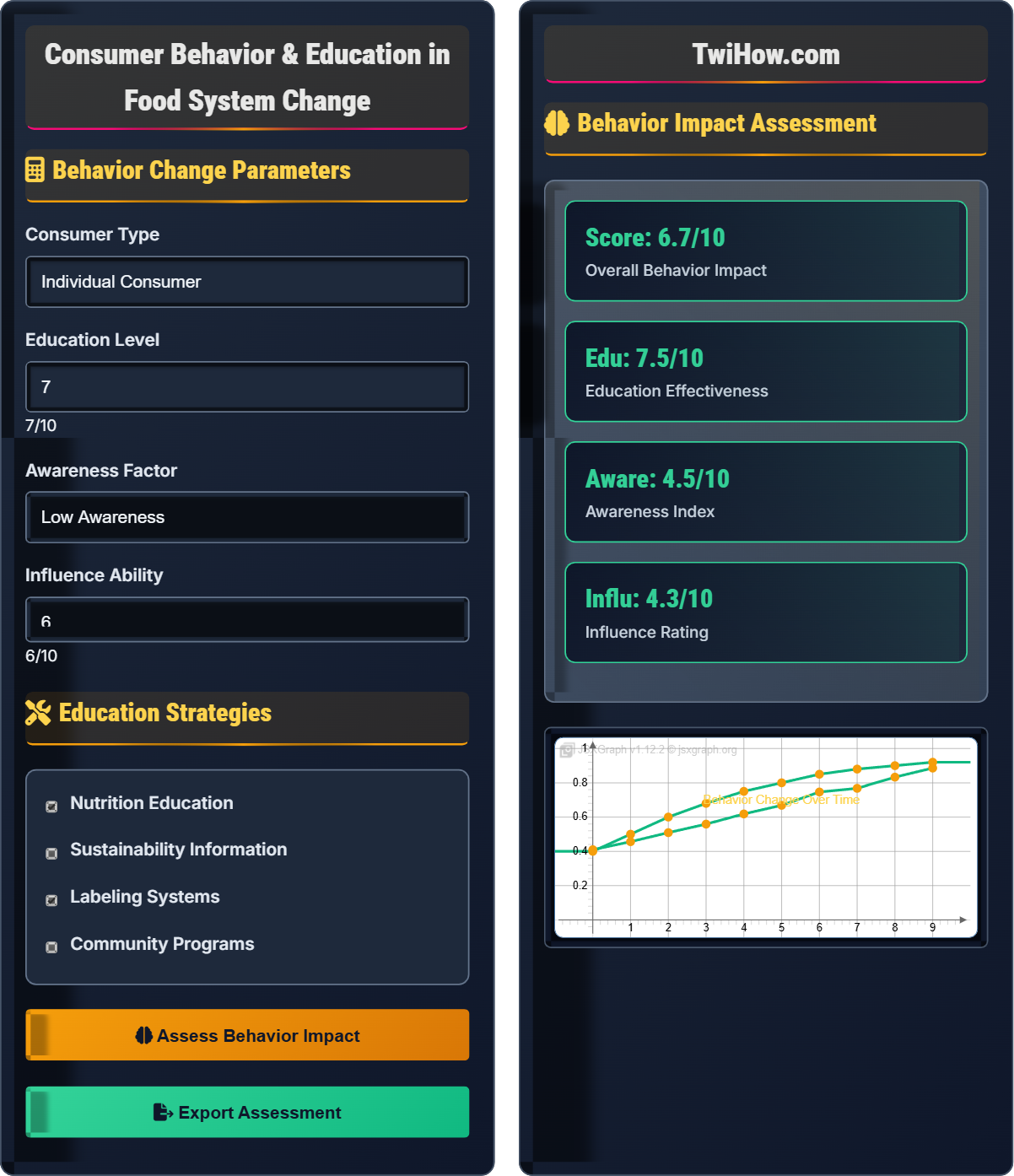
Behavior Impact Assessment
| Factor | Score | Status | Recommendations |
|---|---|---|---|
| Knowledge Base | 7.5 | Good | Continue education efforts |
| Decision Making | 6.8 | Good | Improve information access |
| Behavior Change | 7.2 | Good | Reinforce positive behaviors |
| Community Impact | 6.5 | Good | Expand social influence |
Consumer Behavior & Education in Food System Change
Consumer behavior encompasses the decision-making processes and actions individuals take when selecting, purchasing, using, and disposing of food products. Understanding these behaviors is crucial for creating effective strategies that promote positive food system change.
Consumer behavior is influenced by multiple factors:
Education and information significantly influence consumer choices. Well-informed consumers are more likely to make decisions that align with sustainability and health goals. This includes understanding nutritional information, environmental impacts, and ethical considerations.
Personal values and attitudes toward food, health, environment, and social justice drive consumption patterns. When consumers value sustainability, they're more likely to choose environmentally friendly products.
Price, income, and perceived value significantly impact food choices. Sustainable and healthy options must be economically accessible to achieve widespread adoption.
Education Strategies
Nutrition education, sustainability awareness, labeling systems, community programs, digital platforms, and policy support.
Behavior Change = (Knowledge × 0.3) + (Motivation × 0.25) + (Opportunity × 0.25) + (Social Influence × 0.2)
Where each component is rated on a 0-10 scale.
- Education must be accessible
- Values alignment is crucial
- Accessibility drives adoption
- Community support matters
Success Stories
The Nordic countries implemented comprehensive labeling systems that helped consumers identify sustainable and healthy food options, leading to significant changes in purchasing behavior and market demand.
These programs connect students with local agriculture, teaching them about food systems while creating demand for local, sustainable food in school cafeterias.
CSA programs educate consumers about seasonal eating and direct farming relationships, building awareness and commitment to sustainable agriculture.
Consumer Behavior Analyzer
Consumer Behavior & Education Quiz
According to research, what is the most effective way to influence consumer food choices?
Simple, clear labeling is the most effective way to influence consumer food choices. Research consistently shows that consumers prefer straightforward information that can be quickly understood. Complex data often leads to confusion and decision paralysis, while clear labels enable quick comparisons and informed choices.
The answer is B) Simple, clear labeling.
Consumer decision-making is often quick and intuitive rather than analytical. Clear, simple information that highlights key attributes (like healthfulness or sustainability) in an easily recognizable format is more likely to influence behavior than complex scientific data.
Clear Labeling: Simple, understandable information
Decision Paralysis: Inability to choose due to complexity
Heuristic Processing: Quick, intuitive decision-making
• Simplicity drives action
• Clear benefits motivate
• Use symbols and colors
• Highlight key information
• Make it scannable
• Overloading with information
• Using complex terminology
• Ignoring visual elements
Explain how consumer habits form and describe strategies to change established food consumption patterns.
Habit Formation Process:
Cue: Environmental triggers that initiate behavior (e.g., seeing a fast-food sign)
Routine: The behavior itself (e.g., ordering fast food)
Reward: Satisfaction that reinforces the behavior (e.g., taste, convenience)
Change Strategies:
• Substitution: Replace unhealthy routines with healthier alternatives
• Environment Modification: Remove triggers for unhealthy choices
• Gradual Change: Implement small, manageable modifications
• Positive Reinforcement: Reward new, healthy behaviors
• Education: Increase awareness of habit formation
Changing habits requires understanding the cue-routine-reward cycle and systematically altering components.
Habits are automatic behaviors triggered by environmental cues. Changing established food habits requires disrupting the cue-routine-reward cycle and replacing it with new, healthier patterns. This process takes time and consistent effort.
Habit Loop: Cue-routine-reward cycle
Automatic Behavior: Unconscious repeated actions
Environmental Triggers: External cues that initiate behavior
• Habits are automatic
• Environment shapes behavior
• Change takes time
• Identify your cues
• Plan healthy substitutions
• Track your progress
• Expecting instant change
• Not addressing triggers
• Being too ambitious
A community of 50,000 people has 30% of residents interested in sustainable food choices. Through education programs, 15% of interested residents change their behavior, and each person influences 2 others. Calculate the potential reach and evaluate the effectiveness of this approach.
Initial Interested Population:
50,000 × 30% = 15,000 residents interested in sustainable food
Behavior Change:
15,000 × 15% = 2,250 residents who change behavior
Secondary Influence:
2,250 × 2 = 4,500 additional residents influenced
Total Reach:
2,250 + 4,500 = 6,750 residents impacted
Community Penetration:
6,750 ÷ 50,000 = 13.5% of community reached
This approach is effective, reaching over 13% of the community through a cascade effect.
This example demonstrates the multiplier effect of behavior change through social networks. When early adopters influence others, the impact extends beyond direct education programs, creating a ripple effect throughout the community.
Social Influence: Impact of one person's behavior on others
Multiplier Effect: Amplification through social networks
Community Penetration: Percentage of community reached
• Social networks amplify impact
• Early adopters are influential
• Behavior spreads socially
• Identify opinion leaders
• Leverage social proof
• Encourage sharing
• Not leveraging social networks
• Ignoring early adopters
• Not measuring ripple effects
A city wants to increase sustainable food choices among residents. They have budget for either: (A) Large-scale educational campaigns, or (B) Hands-on workshops and cooking classes. Evaluate both approaches and recommend the most effective strategy.
Large-Scale Campaigns:
Pros: Reaches many people, creates awareness, builds momentum
Cons: Low engagement, limited behavior change, difficult to measure impact
Hands-On Workshops:
Pros: High engagement, skill building, immediate application, measurable results
Cons: Smaller reach, higher per-person cost, requires ongoing commitment
Recommendation: A hybrid approach starting with hands-on workshops to create a core group of advocates, then using them to amplify educational campaigns. This combines the reach of campaigns with the effectiveness of hands-on learning.
Effective behavior change often requires both awareness and skill development. Educational campaigns create awareness, while hands-on experiences provide the skills and confidence needed to change behavior. The combination is more effective than either approach alone.
Behavior Change: Lasting modification of actions
Skill Building: Developing practical abilities
Hybrid Approach: Combining multiple strategies
• Awareness alone isn't enough
• Skills enable action
• Combination strategies work best
• Start with engaged audiences
• Provide practical tools
• Create supportive environments
• Assuming awareness changes behavior
• Not providing practical skills
• Ignoring social context
Which economic factor most significantly influences consumer food choices?
Price sensitivity is the most significant economic factor influencing consumer food choices. While taste, convenience, and brand loyalty are important, economic constraints often determine what consumers can afford to purchase. Sustainable and healthy options must be economically accessible to achieve widespread adoption.
The answer is B) Price sensitivity.
Price sensitivity represents the fundamental economic constraint that limits consumer choice. Even when consumers are aware of and motivated to make sustainable choices, financial limitations often prevent them from doing so. This highlights the importance of making sustainable options economically viable.
Price Sensitivity: Responsiveness to price changes
Economic Accessibility: Affordability of sustainable options
Consumer Constraints: Factors limiting choice
• Price determines access
• Economic factors are primary
• Affordability enables change
• Focus on value propositions
• Address economic barriers
• Highlight long-term savings
• Ignoring economic constraints
• Assuming everyone can afford premium options
• Not addressing cost-effectiveness
FAQ
Q: How can educators effectively teach sustainable food choices to different age groups?
A: Effective approaches by age group:
1. Children: Hands-on activities, gardening, storytelling, visual learning
2. Teens: Social media, peer influence, environmental impact, practical skills
3. Adults: Health benefits, cost savings, cooking skills, family focus
4. Elderly: Health maintenance, tradition, social aspects, accessibility
5. Community: Cultural relevance, local examples, group activities
Adapt communication style, examples, and activities to each group's interests and life stage.
Q: How can I make more sustainable food choices without spending more money?
A: Economical sustainable choices:
1. Seasonal Produce: Buy fruits and vegetables in season when they're cheaper
2. Plant-Based Meals: Beans, lentils, and grains cost less than meat
3. Reduce Waste: Plan meals, use leftovers, compost scraps
4. Local Sources: Farmers markets often have competitive prices
5. DIY Options: Grow herbs, preserve seasonal produce
6. Bulk Purchasing: Buy staples in larger quantities
Sustainable choices often save money by reducing waste and focusing on basics.