Food Banks and Emergency Food Assistance Role
Complete assistance guide • Food security
Food Assistance Systems:
Assess Food Bank ImpactFood banks and emergency food assistance programs play a crucial role in addressing food insecurity and hunger in communities. These organizations collect, store, and distribute food to individuals and families in need, serving as a critical safety net during times of economic hardship, natural disasters, and other emergencies. They operate through a network of partnerships with government agencies, retailers, farms, and volunteers.
Key functions include:
- Food Collection: Gathering donated and purchased food from various sources
- Storage and Distribution: Managing inventory and distributing to partner agencies
- Emergency Response: Providing rapid assistance during crises and disasters
- Community Outreach: Connecting with vulnerable populations and coordinating services
- Advocacy: Raising awareness about hunger and food insecurity issues
Food banks serve millions of people annually, playing an essential role in the social safety net alongside government nutrition programs.
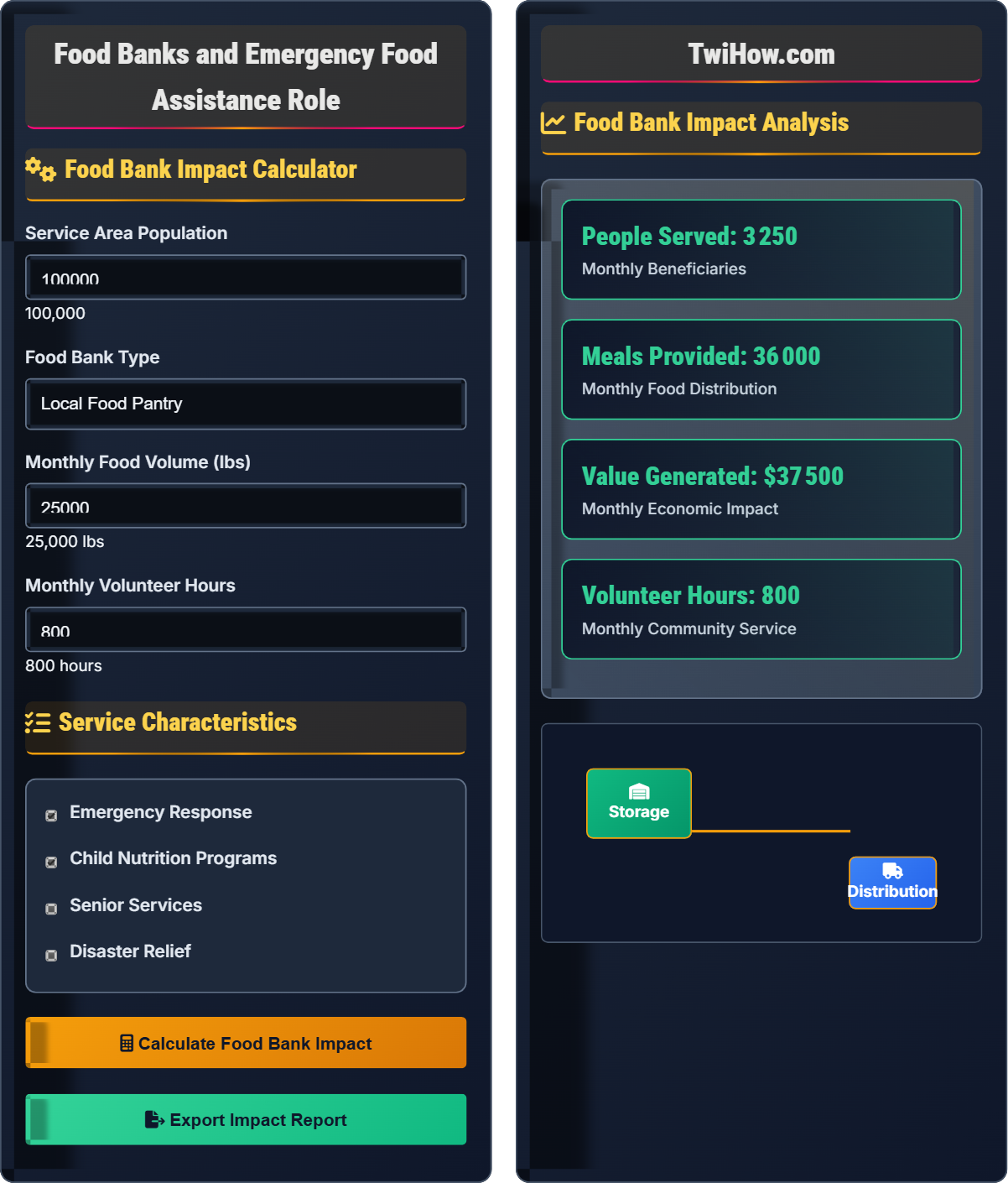
Food Bank Impact Calculator
Service Characteristics
Food Bank Impact Analysis
Storage
Distribution
Food Bank Operations
Food banks source products from multiple channels including donations from farms, manufacturers, retailers, and government programs. They also purchase food when donations are insufficient.
Food banks operate through a network of partner agencies including food pantries, soup kitchens, shelters, and mobile distribution sites to reach those in need.
Food banks implement strict safety protocols to ensure food quality and safety, including temperature control, expiration date monitoring, and proper handling procedures.
Volunteers are essential for food sorting, packing, and distribution operations, providing critical support to food bank operations.
Service Programs
Regular distribution sites where individuals and families can receive free food packages based on need and eligibility criteria.
Hot meal programs that serve prepared meals to people experiencing food insecurity, often in congregate settings.
Mobile distribution units that bring food directly to underserved communities, schools, and senior centers.
Specialized programs that provide food for children during weekends, holidays, and summer months when school meals are unavailable.
Emergency Response
Food banks provide emergency food assistance during natural disasters, hurricanes, floods, and other emergencies when regular food access is disrupted.
During economic crises, unemployment surges, or other emergencies, food banks rapidly scale operations to meet increased demand.
Food banks coordinate with government agencies, emergency management, and other organizations to ensure efficient disaster response.
Emergency response requires pre-positioned food supplies, transportation capabilities, and distribution networks ready for rapid deployment.
Food Banks and Emergency Food Assistance
Food banks are nonprofit organizations that collect, store, and distribute food to partner agencies serving people experiencing food insecurity. They serve as centralized warehouses that receive food donations and purchases, sort and store them, then distribute to local food pantries, soup kitchens, shelters, and other partner agencies. Food banks play a crucial role in the emergency food system, serving millions of people annually.
This process shows how food moves from donors to recipients through the food bank system.
Food banks serve multiple functions in the food security system:
- Food Distribution: Collecting and distributing food to partner agencies
- Emergency Response: Providing rapid assistance during disasters and crises
- Advocacy: Raising awareness about hunger and food insecurity
- Education: Promoting nutrition and food literacy programs
- Coordination: Serving as hubs for local food assistance networks
- Volunteer Mobilization: Engaging community volunteers in service
- Natural Disasters: Hurricanes, floods, earthquakes, wildfires
- Economic Crises: Recessions, job losses, economic downturns
- Health Emergencies: Pandemics, disease outbreaks
- Seasonal Needs: Holiday periods, winter months
- Individual Crises: Medical emergencies, family emergencies
Food Bank Operations
Food sourcing, storage management, distribution coordination, quality control, volunteer coordination, community outreach.
Community Impact = (Food Distributed × People Served) ÷ (Volunteer Hours + Operational Costs)
Where Impact = food security improvement, Food = pounds distributed.
- Efficiency increases with scale
- Quality control is essential
- Partnerships multiply impact
- Volunteers are critical resources
Emergency Response
Disaster relief, economic support, health emergencies, seasonal assistance, individual crisis support.
- Assessment of needs and resources
- Activation of emergency protocols
- Mobilization of food and volunteers
- Distribution to affected areas
- Monitoring and adjustment
- Speed is crucial in emergencies
- Coordination with agencies essential
- Pre-positioned supplies critical
- Community relationships matter
Food Bank Operations
Food banks source products through multiple channels: donations from farms, food manufacturers, and retailers; purchases from wholesale suppliers; government commodity programs; and community food drives. This diverse sourcing helps ensure consistent supply and variety of products.
Food banks operate warehouse facilities with proper storage conditions for different food types. They implement inventory management systems to track donations, expiration dates, and distribution to partner agencies. Temperature control and pest prevention are critical for food safety.
Food banks distribute through a network of partner agencies including food pantries, soup kitchens, homeless shelters, senior centers, and mobile food distributions. This network model allows them to reach communities efficiently and serve diverse populations.
Food banks implement strict safety protocols including temperature monitoring, expiration date tracking, proper handling procedures, and food safety training for staff and volunteers. They follow FDA and state regulations for food storage and distribution.
Service Programs
Food pantries provide free groceries to individuals and families experiencing food insecurity. Clients typically receive bags or boxes of food based on family size and need. Pantries often operate on specific days and may require registration or documentation of need.
Soup kitchens serve hot, prepared meals to people experiencing food insecurity. These programs often operate in congregate settings and may provide additional services like hygiene facilities and case management.
Mobile food pantries bring food directly to underserved communities, schools, and senior centers. This service is particularly valuable in rural areas or neighborhoods with limited transportation access.
Specialized programs provide food for children during weekends, holidays, and summer months when school meals are unavailable. Backpack programs and summer feeding initiatives help bridge gaps in food access for children.
Emergency Response Capabilities
Food banks maintain emergency preparedness plans and pre-positioned food supplies for rapid deployment during natural disasters. They coordinate with emergency management agencies and provide food assistance to evacuation centers and affected communities.
During economic downturns, job losses, and recessions, food banks rapidly scale operations to meet increased demand. They often establish additional distribution sites and extend hours of operation to serve more people.
During health emergencies like pandemics, food banks adapt operations to ensure food access while maintaining safety protocols. They may implement contactless distribution, home delivery, and enhanced safety measures.
Emergency response requires coordination with government agencies, emergency management, healthcare providers, and other organizations. Food banks must have transportation capabilities and distribution networks ready for rapid deployment.
Food Assistance Comparison
| Service Type | Food Banks | Government Programs |
|---|---|---|
| Reach | Local/Regional | National |
| Flexibility | High | Low |
| Response Time | Quick | Slow |
| Eligibility | Minimal | Strict |
| Food Choice | Limited | Specific |
| Community Engagement | High | Low |
Historical Development
Economic Impact Analysis
Food banks provide significant economic value through efficient food distribution, volunteer engagement, and emergency response capabilities.
Food Bank and Emergency Assistance Quiz
What is the primary function of food banks in the emergency food system?
Food banks primarily function as centralized warehouses that collect, store, and distribute food to partner agencies such as food pantries, soup kitchens, and shelters. They do not typically serve individual clients directly but support the network of agencies that do.
The answer is B) Collecting, storing, and distributing food to partner agencies.
Food banks operate as intermediary organizations in the emergency food system. They serve as centralized distribution points that allow smaller agencies to access food supplies more efficiently than if they sourced food individually. This hub-and-spoke model maximizes efficiency and reach.
Food Bank: Centralized warehouse organization
Partner Agency: Local organization that serves clients
Hub-and-Spoke Model: Centralized distribution system
• Food banks serve agencies, not individuals
• Partnerships multiply impact
• Think of food banks as warehouses
• Consider the distribution network
• Remember the intermediary role
• Confusing food banks with food pantries
• Assuming direct client service
• Not understanding the network model
Explain how food banks respond to natural disasters and what makes them effective in emergency situations.
Preparation: Food banks maintain emergency plans, pre-positioned supplies, and transportation capabilities. They coordinate with emergency management agencies and have distribution networks ready for rapid deployment.
Response: During disasters, food banks rapidly scale operations, establish emergency distribution sites, and coordinate with relief organizations to provide food assistance to affected communities.
Effectiveness: Food banks are effective in emergencies because they have established supply chains, transportation capabilities, distribution networks, and trained personnel ready to respond quickly.
Coordination: They work with government agencies, emergency management, and other organizations to ensure efficient response and avoid duplication of efforts.
Food banks' effectiveness in emergencies stems from their preparedness and established infrastructure. Their ability to rapidly scale operations is crucial during disasters when regular food access is disrupted and demand surges.
Emergency Preparedness: Plans and resources for disasters
Rapid Response: Quick action during emergencies
Supply Chain: Network for food distribution
• Preparedness enables rapid response
• Coordination prevents duplication
• Consider pre-positioned resources
• Think about scaling capabilities
• Remember coordination importance
• Not considering preparedness
• Ignoring coordination needs
• Underestimating infrastructure
A food bank serves 50 partner agencies and distributes 200,000 pounds of food monthly. Each pound of food provides 1.5 meals on average. If the food bank serves 3,000 families monthly, calculate the average meals provided per family and explain the economic impact of this service.
Total Meals: 200,000 lbs × 1.5 meals/lb = 300,000 meals
Meals per Family: 300,000 meals ÷ 3,000 families = 100 meals per family
Economic Impact: Assuming $3 per meal value, the food bank provides $900,000 in food value monthly ($300 per family). This represents significant cost savings for families and economic value to the community.
Community Impact: The food bank helps families stretch their budgets, reduces food insecurity, and supports local economic stability.
This calculation demonstrates the significant impact food banks have on families and communities. By providing substantial amounts of food, they help families allocate resources to other necessities and contribute to overall community stability.
Meals per Pound: Food quantity conversion
Economic Value: Dollar value of food assistance
Community Impact: Broader economic effects
• Calculate total impact
• Consider per-family effects
• Evaluate economic value
• Calculate total meals first
• Consider per-person impact
• Think about economic value
• Not calculating total impact
• Forgetting economic value
• Ignoring per-family effects
You are designing a food assistance program for a community of 50,000 people with 15% food insecurity. Design a comprehensive approach that includes food banks, pantries, and emergency services, explaining how they would work together.
Needs Assessment: 50,000 × 15% = 7,500 people experiencing food insecurity
Food Bank: Central warehouse serving 10-15 partner agencies, providing 200,000-300,000 lbs monthly
Food Pantries: 8-10 strategically located pantries serving different neighborhoods, operating 2-3 days weekly
Mobile Distribution: 2 mobile units serving rural/underserved areas monthly
Emergency Response: Pre-positioned supplies and rapid response protocols for disasters
Coordination: Centralized scheduling, resource allocation, and case management to avoid duplication
Effective food assistance requires a coordinated system with multiple components working together. The key is ensuring comprehensive coverage while avoiding gaps and duplication in service.
Comprehensive Coverage: Serving entire target population
Service Coordination: Avoiding duplication
Strategic Placement: Location for maximum access
• Assess actual needs
• Coordinate services
• Ensure coverage
• Calculate actual needs
• Consider geographic distribution
• Plan for emergencies
• Not calculating actual needs
• Poor geographic planning
• Ignoring emergency preparedness
What is the estimated economic value of volunteer hours in food banks?
The Independent Sector estimates the value of volunteer time at approximately $25 per hour. This value represents the economic benefit that volunteer labor provides to food banks and other nonprofits, enabling them to accomplish more with limited financial resources.
The answer is C) $25 per hour.
Volunteer labor is crucial to food bank operations, providing significant economic value while engaging community members in service. This volunteer time enables food banks to stretch their financial resources and serve more people.
Volunteer Value: Economic benefit of unpaid labor
Community Engagement: Volunteer participation
Resource Leverage: Stretching financial resources
• Volunteers provide significant value
• Community engagement is important
• Volunteer time enables expansion
• Appreciate volunteer contributions
• Consider economic impact
• Plan volunteer engagement
• Underestimating volunteer value
• Not appreciating community service
• Ignoring economic benefits
FAQ
Q: How can I help my local food bank?
A: You can help your local food bank by: 1) Volunteering for food sorting, packing, and distribution activities, 2) Donating food items, especially non-perishables, 3) Making monetary donations to purchase needed items, 4) Organizing food drives in your community, 5) Advocating for hunger awareness, and 6) Spreading information about food bank services to those in need.
Q: How do food banks ensure food safety and quality?
A: Food banks ensure safety through: 1) Strict temperature control during storage and transport, 2) Regular inspection and cleaning of facilities, 3) Expiration date monitoring and rotation systems, 4) Staff and volunteer training on food safety, 5) Compliance with FDA and state regulations, 6) Partner agency training on proper food handling, and 7) Regular quality assurance checks throughout the distribution process.