Policy & Governance in Sustainable Food Systems
Complete guide • Step-by-step explanations
Food Policy & Governance:
Show Policy AnalyzerPolicy and governance play critical roles in shaping sustainable food systems through regulations, incentives, and institutional frameworks. Effective governance structures coordinate multiple stakeholders, align incentives, and create enabling environments for sustainable food production and consumption.
Key policy instruments include agricultural subsidies, environmental regulations, food safety standards, and trade policies. These instruments influence production practices, market dynamics, and consumer behavior.
Successful governance requires multi-level coordination between local, regional, national, and international institutions, as well as engagement with civil society, private sector, and research organizations.
Real-world applications include farm bill legislation, sustainable agriculture programs, food safety regulations, and international trade agreements that promote sustainability.
Policy Impact Parameters
Governance Mechanisms
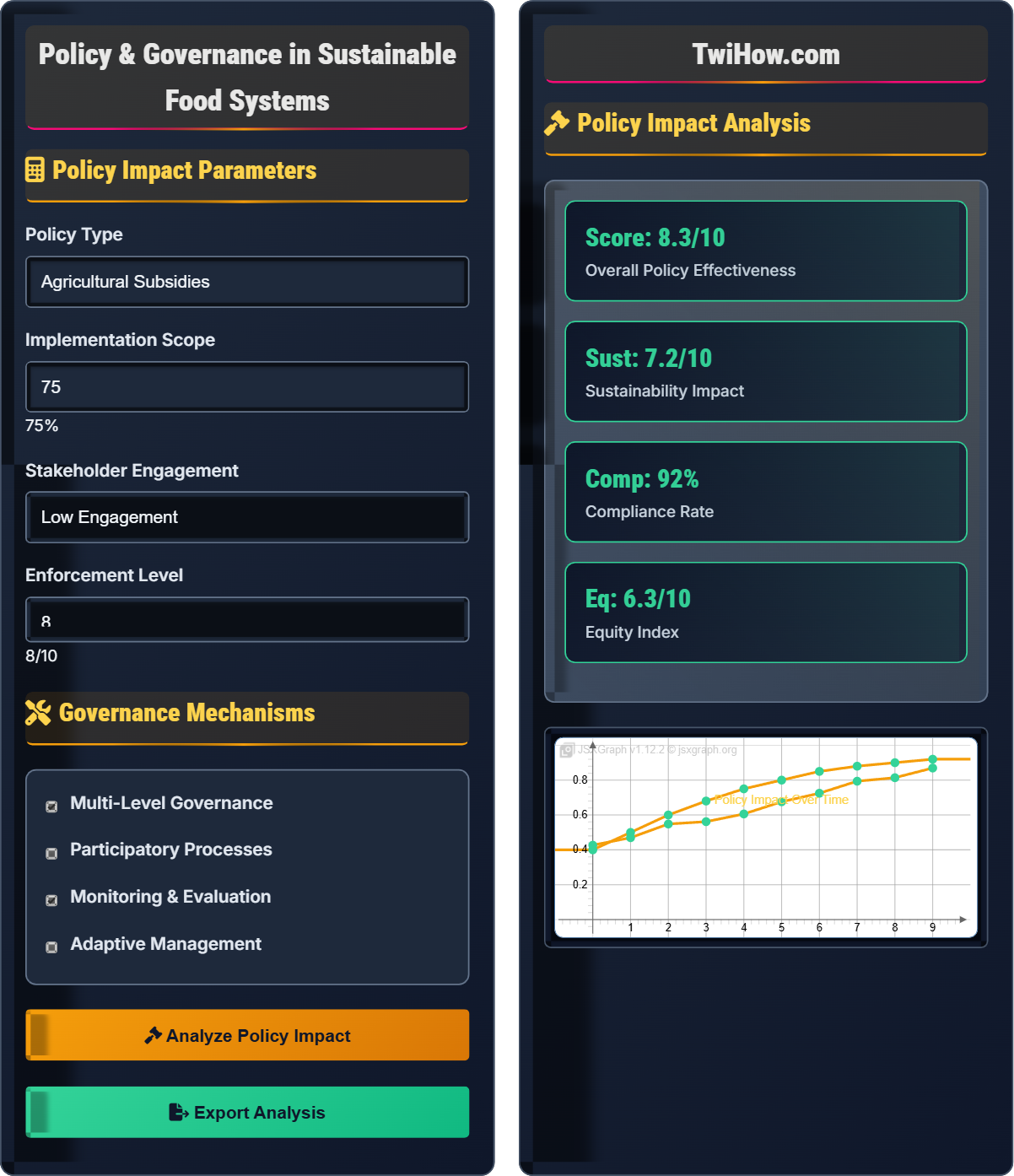
Policy Impact Analysis
| Indicator | Score | Status | Recommendations |
|---|---|---|---|
| Environmental Impact | 7.5 | Good | Strengthen monitoring |
| Economic Viability | 7.2 | Good | Maintain current support |
| Social Equity | 7.1 | Good | Expand outreach |
| Implementation | 8.2 | Excellent | Continue current efforts |
Policy and Governance in Shaping Sustainable Food Systems
Policy and governance are fundamental drivers of sustainable food systems, creating the regulatory, economic, and institutional frameworks that shape production, distribution, and consumption patterns. Effective policies align economic incentives with environmental and social objectives.
Various policy instruments influence food system sustainability:
Subsidies, taxes, and payments for ecosystem services that align economic incentives with sustainability goals. These tools make sustainable practices financially attractive.
Standards, permits, and regulations that set minimum requirements for environmental protection, food safety, and labor conditions. These create baseline sustainability expectations.
Multi-level governance structures that coordinate policies across different sectors and scales. This ensures coherent approaches to complex food system challenges.
Policy Frameworks
Agricultural subsidies, environmental regulations, food safety standards, trade policies, and public procurement guidelines.
Policy Impact = (Design Quality × 0.3) + (Implementation × 0.35) + (Enforcement × 0.2) + (Stakeholder Engagement × 0.15)
Where each component is rated on a 0-10 scale.
- Stakeholder engagement is essential
- Multi-level coordination required
- Evidence-based approaches
- Adaptive management
Success Stories
The CAP has evolved to include environmental and climate objectives alongside traditional production support, demonstrating how agricultural policies can be reformed to promote sustainability.
Brazil's forest code regulates land use in rural areas, balancing agricultural production with environmental protection through mandatory preservation areas.
Public procurement policies that require school food purchases to include local and sustainable products, creating market incentives for sustainable production.
Policy Impact Analyzer
Food Policy & Governance Quiz
Which policy instrument is most effective for encouraging sustainable agricultural practices?
While economic incentives are highly effective for encouraging sustainable practices, the most comprehensive approach combines multiple instruments. Economic incentives provide positive motivation, regulations set minimum standards, and information campaigns build awareness. A multi-instrument approach addresses different motivations and constraints.
The answer is D) All of the above.
Effective policy design often requires multiple instruments working together. Different policy tools address different aspects of behavior change and can complement each other. No single instrument is universally effective for all situations and stakeholders.
Policy Instruments: Tools used to achieve policy objectives
Economic Incentives: Financial rewards or penalties
Regulatory Framework: Rules and standards
• Multiple instruments work best
• Tailor to specific contexts
• Consider stakeholder needs
• Combine carrots and sticks
• Consider implementation costs
• Monitor effectiveness
• Relying on single instruments
• Not considering implementation
• Ignoring stakeholder needs
Explain the concept of multi-level governance in food systems and why it's important for sustainability.
Multi-Level Governance Concept:
Definition: Coordination between different levels of government (local, regional, national, international) and various sectors to address complex food system challenges.
Components:
• Vertical Integration: Linking policies across different government levels
• Horizontal Integration: Coordinating across different sectors (agriculture, environment, health, trade)
• Stakeholder Engagement: Including civil society, private sector, and research organizations
Importance: Food systems operate across multiple scales and sectors, requiring coordinated approaches that address interdependencies and avoid conflicting policies.
Food systems are complex adaptive systems that operate at multiple scales simultaneously. Effective governance requires coordination across these scales to address cross-cutting issues like climate change, food security, and rural development that transcend administrative boundaries.
Multi-Level Governance: Coordination across government levels
Vertical Integration: Linking different government tiers
Horizontal Integration: Coordination across sectors
• Address cross-scale issues
• Coordinate across sectors
• Engage multiple stakeholders
• Create coordination mechanisms
• Align incentives across levels
• Share information systems
• Siloed policy development
• Not coordinating across levels
• Ignoring sectoral linkages
A country wants to reduce agricultural greenhouse gas emissions by 30% over 10 years while maintaining food security and farmer livelihoods. Design a policy package that addresses this challenge, considering economic incentives, regulatory approaches, and support measures.
Policy Package Design:
Economic Instruments:
• Carbon payments for farmers adopting mitigation practices
• Reduced input subsidies for high-emission practices
• Premium payments for carbon-sequestering crops
Regulatory Approaches:
• Emission standards for large operations
• Mandatory reporting for operations above threshold
• Environmental licensing requirements
Support Measures:
• Technical assistance for low-emission practices
• Research and development funding
• Transition support for affected farmers
This comprehensive approach provides incentives, sets standards, and supports implementation.
Complex challenges like climate change require multi-faceted policy approaches that address different aspects of the problem. The combination of incentives, regulations, and support measures creates a comprehensive framework that can achieve ambitious goals while addressing stakeholder concerns.
Policy Package: Integrated set of policy instruments
Greenhouse Gas Emissions: Climate-changing gases
Food Security: Reliable access to sufficient food
• Address multiple objectives
• Consider stakeholder needs
• Provide support measures
• Use carrot-and-stick approach
• Provide transition support
• Monitor progress
• Not considering implementation
• Ignoring stakeholder concerns
• Not providing support
A government is designing new food safety regulations but faces resistance from small farmers who claim the rules will be too costly. Evaluate three engagement strategies: (1) Top-down consultation, (2) Collaborative design, (3) Pilot programs with feedback. Recommend the best approach and justify your reasoning.
Strategy Evaluation:
Top-down Consultation:
Pros: Faster implementation, clear authority
Cons: Limited buy-in, resistance to implementation
Collaborative Design:
Pros: High buy-in, practical solutions, legitimacy
Cons: Slower process, potential conflicts
Pilot Programs:
Pros: Evidence-based adjustments, reduced risk
Cons: Limited scale, may not address all concerns
Best Approach: Collaborative design with pilot programs. This combines stakeholder engagement with evidence-based refinement, building trust while ensuring practical implementation.
Effective policy design requires stakeholder engagement to build legitimacy and ensure practical implementation. Collaborative approaches that involve affected parties in the design process tend to produce more acceptable and effective policies than top-down approaches.
Stakeholder Engagement: Involving affected parties
Policy Legitimacy: Acceptance of policy authority
Bottom-Up Design: Stakeholder-driven development
• Engage early in process
• Address concerns seriously
• Provide feedback mechanisms
• Use multiple engagement methods
• Provide clear feedback
• Address power imbalances
• Consulting too late
• Not acting on feedback
• Ignoring implementation concerns
Which factor is most critical for successful integration of food policies across different sectors?
Institutional coordination is most critical for successful policy integration. Even with adequate funding, political support, and technical expertise, policies will fail to integrate effectively without proper coordination mechanisms between different government departments and agencies. Coordination ensures coherent approaches and prevents conflicting policies.
The answer is B) Institutional coordination.
Institutional coordination addresses the structural challenges of governing complex systems that span multiple sectors and jurisdictions. Without proper coordination mechanisms, policies may work at cross-purposes or create implementation conflicts.
Institutional Coordination: Mechanisms linking different agencies
Policy Integration: Coherent approaches across sectors
Cross-Sectoral Links: Connections between different domains
• Structure enables coordination
• Clear responsibilities needed
• Information sharing critical
• Create coordination bodies
• Establish information systems
• Define clear roles
• Not establishing coordination
• Unclear responsibilities
• Poor information sharing
FAQ
Q: How can we design policies that work for both large and small food producers?
A: Design policies with flexibility and differentiation:
1. Scale-Adjusted Requirements: Different standards for different operation sizes
2. Graduated Implementation: Phased rollouts with longer timelines for smaller producers
3. Technical Assistance: Support programs specifically for small producers
4. Group Approaches: Allow collective compliance through cooperatives
5. Performance-Based Standards: Focus on outcomes rather than methods
6. Market Access Support: Help small producers access premium markets
Flexibility ensures equitable implementation across different scales.
Q: How can farmers influence food policy development?
A: Farmers can influence policy through:
1. Producer Organizations: Join or form agricultural associations
2. Public Consultations: Participate in government comment periods
3. Research Partnerships: Collaborate with universities on policy research
4. Political Engagement: Contact representatives and attend hearings
5. Coalition Building: Work with other stakeholders on shared issues
6. Documentation: Provide evidence of policy impacts
Collective action amplifies individual voices in policy processes.