Research and Innovation in Food System Improvement
Complete guide • Step-by-step explanations
Food System Innovation:
Show Food Innovation SimulatorResearch and innovation play crucial roles in improving food systems by developing sustainable practices, reducing waste, increasing productivity, and ensuring food security. These efforts encompass technological advances, policy development, and scientific breakthroughs that address challenges in production, processing, distribution, and consumption.
Food system improvement involves multiple interconnected components:
- Sustainable Agriculture: Practices that protect the environment while maintaining productivity
- Technology Integration: Precision farming, automation, and data analytics
- Supply Chain Optimization: Reducing losses and improving distribution
- Nutrition Enhancement: Biofortification and food safety improvements
- Waste Reduction: Circular economy approaches and efficient resource use
Modern food system innovations leverage big data, biotechnology, and sustainable practices to create resilient and efficient systems that can feed growing populations while preserving natural resources.
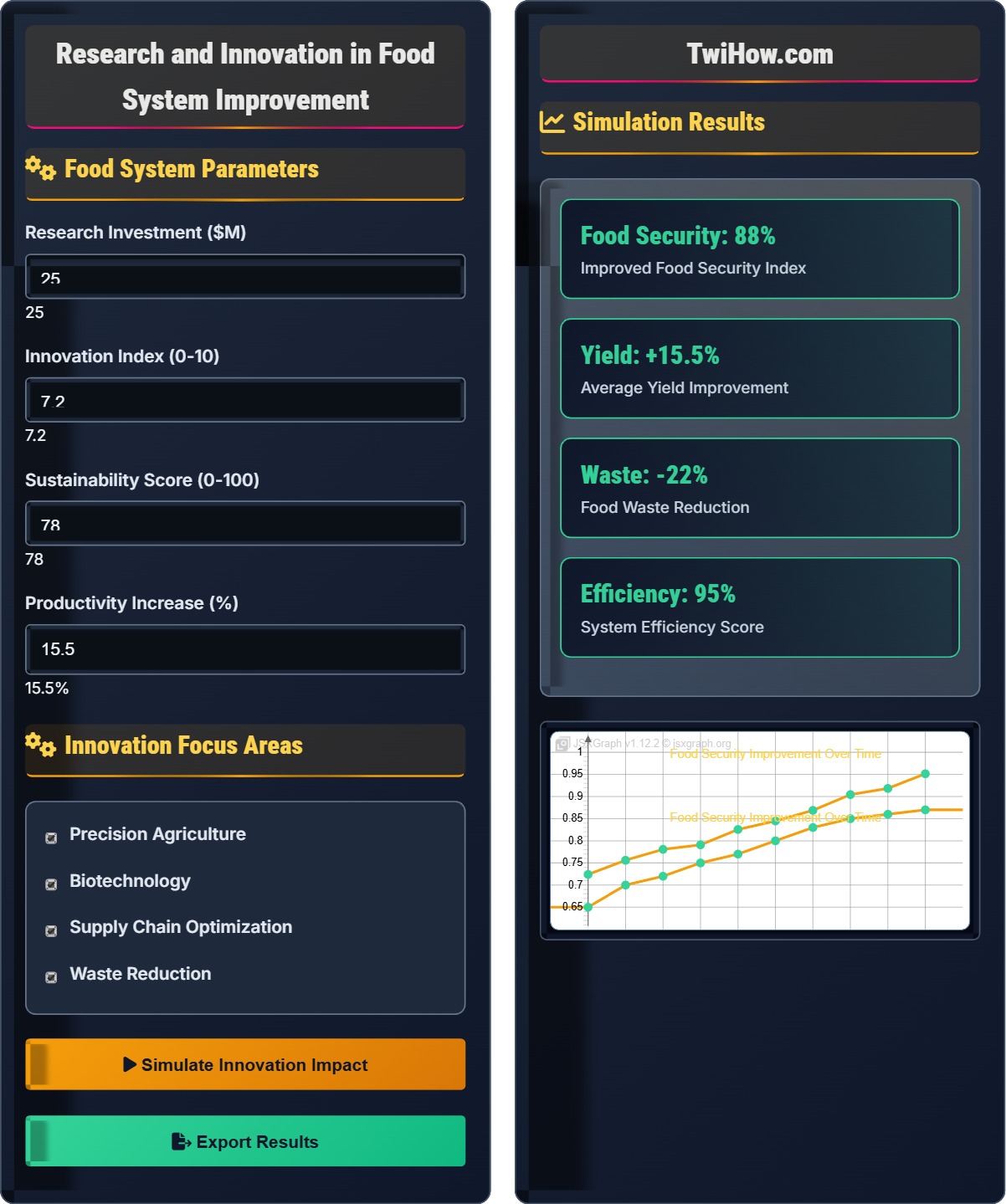
Food System Parameters
Innovation Focus Areas
Simulation Results
| Focus Area | Impact Score | Resources Allocated | Expected Benefit |
|---|---|---|---|
| Precision Agriculture | 8.2 | 30% | 12% yield increase |
| Biotechnology | 7.8 | 25% | 8% nutrition enhancement |
| Supply Chain | 7.5 | 20% | 15% waste reduction |
| Waste Reduction | 8.5 | 25% | 22% loss prevention |
Research and Innovation in Food Systems
Food system research encompasses scientific studies and innovations aimed at improving every aspect of food production, processing, distribution, and consumption. This interdisciplinary field combines agricultural science, economics, environmental science, and technology to create more efficient, sustainable, and equitable food systems.
Major innovation areas in food system improvement include:
Where:
- Precision Agriculture: Using technology to optimize crop yields
- Biotechnology: Developing improved seeds and processing methods
- Supply Chain Optimization: Reducing losses and improving distribution
- Waste Reduction: Minimizing post-harvest losses
- Circular Economy: Reusing resources and minimizing waste
Key areas where research and innovation are transforming food systems:
- Climate-Resilient Crops: Developing varieties that withstand extreme weather
- Digital Farming: IoT sensors, satellite imagery, and AI for decision-making
- Vertical Farming: Growing food in controlled indoor environments
- Alternative Proteins: Plant-based and lab-grown meat alternatives
- Blockchain Supply Chains: Transparent tracking of food products
- Smart Packaging: Extending shelf life and monitoring freshness
- Technological: New equipment, software, and processing methods
- Process: Improved methodologies and workflows
- Organizational: New business models and partnerships
- Social: Community-based solutions and farmer education
- Policy: Regulatory frameworks supporting innovation
Fundamentals of Food System Innovation
Food security, sustainability, precision agriculture, biotechnology, supply chain optimization, circular economy.
Impact = (Productivity × Sustainability × Accessibility) / (Cost + Risk)
Where Impact = overall improvement in food system performance.
- Innovation must balance productivity and sustainability
- Technology adoption requires farmer acceptance
- Systems thinking is essential for comprehensive solutions
Applications
Smart irrigation, drought-resistant crops, food traceability systems, vertical farming, alternative proteins.
- Crop breeding and genetics
- Soil health management
- Water conservation technologies
- Post-harvest handling
- Market access solutions
- Economic viability for farmers
- Environmental impact
- Scalability potential
- Social equity
Food System Innovation Quiz
Which of the following best describes the role of precision agriculture in food system improvement?
Precision agriculture uses technology such as GPS, sensors, drones, and data analytics to optimize farming inputs like water, fertilizers, and pesticides. This approach increases efficiency, reduces waste, and improves yields while minimizing environmental impact. It enhances rather than replaces traditional farming methods.
The answer is B) Using technology to optimize inputs and increase efficiency.
Precision agriculture represents a significant shift from traditional farming methods. Instead of applying inputs uniformly across entire fields, farmers can now use data-driven approaches to apply exactly what's needed, where it's needed, when it's needed. This targeted approach maximizes productivity while minimizing resource waste and environmental impact.
Precision Agriculture: Farming management concept based on observing, measuring, and responding to inter and intra-field variability in crops
Variable Rate Technology: Equipment that adjusts application rates based on location-specific needs
Remote Sensing: Technology that captures data about crops and soil from satellites or aircraft
• Technology should enhance, not replace, farmer knowledge
• Data-driven decisions improve efficiency
• Targeted inputs reduce waste and costs
• Start with small pilot projects to demonstrate value
• Combine technology with traditional farming wisdom
• Monitor ROI to ensure economic viability
• Assuming technology eliminates the need for farmer expertise
• Not considering cost-benefit ratios
• Ignoring local conditions and contexts
Explain how biotechnology contributes to food system improvement and describe three specific examples of biotechnological innovations in agriculture.
Biotechnology Role: Biotechnology in agriculture involves using living organisms or their components to improve crops, livestock, and farming practices. It enables scientists to develop plants and animals with enhanced traits that contribute to food security, sustainability, and nutrition.
Three Examples:
1. Drought-Resistant Crops: Genetic modification has produced corn and soybean varieties that can survive extended dry periods, helping farmers maintain yields during climate stress.
2. Biofortified Foods: Golden Rice is engineered to produce beta-carotene, addressing vitamin A deficiency in rice-dependent populations.
3. Bt Crops: Crops engineered to produce Bacillus thuringiensis toxin resist insect pests, reducing pesticide use and crop losses.
Biotechnology offers precise tools for crop improvement that complement traditional breeding methods. While traditional breeding takes many generations and introduces many genes simultaneously, biotechnology allows for targeted modifications with specific desired traits. This precision accelerates the development of improved varieties while maintaining genetic diversity.
Biotechnology: Use of living systems and organisms to develop or make products
Biofortification: Process of increasing nutritional value of staple foods
Genetic Engineering: Direct manipulation of an organism's genes using biotechnology
• Safety assessments are crucial for biotech products
• Regulatory approval ensures public safety
• Public acceptance requires transparency
• Combine biotechnology with sustainable farming practices
• Focus on farmer and consumer benefits
• Address regulatory requirements early
• Not considering regulatory frameworks
• Ignoring public perception concerns
• Overlooking environmental impacts
A developing country loses 30% of its harvested crops due to poor storage and transportation infrastructure. The government plans to invest $50 million in supply chain innovations including cold storage facilities, improved transport, and digital tracking systems. Calculate the expected reduction in post-harvest losses and estimate the economic benefits assuming a crop value of $200 million annually.
Current Losses: 30% of $200M = $60M annually
Expected Improvement: Supply chain innovations typically reduce losses by 15-25 percentage points
New Loss Rate: 30% - 20% = 10%
New Loss Amount: 10% of $200M = $20M annually
Annual Savings: $60M - $20M = $40M annually
ROI: $40M savings / $50M investment = 0.8 annual ROI (or 80% return)
This represents a significant improvement in food security and farmer incomes while reducing environmental waste from lost crops.
Supply chain innovations often provide the highest return on investment in food systems. By focusing on reducing post-harvest losses, countries can significantly increase available food without increasing production. This approach addresses both food security and environmental sustainability by maximizing the utilization of existing agricultural output.
Post-Harvest Losses: Reduction in quantity or quality of agricultural products between harvest and consumption
Cold Chain: Temperature-controlled supply chain for perishable goods
Return on Investment (ROI): Measure of profitability from an investment
• Infrastructure investments have long-term benefits
• Maintenance is crucial for sustained benefits
• Farmer education supports adoption
• Prioritize high-value crops first
• Develop local maintenance capacity
• Create market incentives for quality
• Underestimating maintenance costs
• Not involving local communities
• Failing to establish quality standards
A farming cooperative wants to implement sustainable innovations to reduce their environmental footprint while maintaining profitability. Propose three research-backed innovations they could adopt and explain the potential trade-offs of each approach.
Three Sustainable Innovations:
1. Integrated Pest Management (IPM): Combines biological, cultural, and chemical methods to control pests.
Trade-offs: Reduced pesticide costs vs. increased labor for monitoring and implementation.
2. Conservation Tillage: Reduces soil disturbance to preserve soil health and carbon sequestration.
Trade-offs: Lower fuel costs and soil erosion vs. potential increase in herbicide use initially.
3. Agroforestry Systems: Integrating trees with crops to enhance biodiversity and soil fertility.
Trade-offs: Long-term soil benefits vs. short-term reduced planting area and slower returns.
All three approaches require initial investment in knowledge and sometimes equipment, but provide long-term sustainability and economic benefits.
Sustainable innovations often involve short-term costs for long-term benefits. Farmers must balance immediate economic needs with future sustainability goals. Successful implementation typically requires supportive policies, access to credit, and extension services to help navigate the transition period. The key is to identify innovations that provide both environmental and economic benefits over time.
Integrated Pest Management (IPM): Ecological approach to pest control combining multiple strategies
Conservation Tillage: Farming method that leaves crop residue on fields between plantings
Agroforestry: Land use system integrating trees and shrubs with crops
• Transition periods require patience and support
• Economic and environmental goals can align
• Local adaptation is crucial for success
• Start with pilot demonstrations
• Build farmer-to-farmer networks
• Seek certification for premium markets
• Expecting immediate returns
• Not considering local conditions
• Overlooking market access
Which of the following represents the greatest challenge in implementing food system innovations?
While innovative technologies are being developed and funding exists for research, the greatest challenge lies in getting farmers and communities to adopt and scale these innovations. Factors like cost, complexity, cultural barriers, lack of trust, inadequate extension services, and risk aversion can prevent successful implementation of proven innovations.
The answer is B) Adoption and scaling by farmers and communities.
The innovation adoption challenge highlights the importance of human-centered design in agricultural research. Technologies that work perfectly in laboratory or demonstration settings often face barriers in real-world implementation. Successful innovation requires understanding farmer needs, building trust, providing adequate support, and designing solutions that fit local contexts and capabilities.
Innovation Adoption: Process by which individuals accept and begin using new ideas
Technology Transfer: Movement of technology from research to practical application
Extension Services: Educational programs to help farmers adopt new practices
• User needs must drive innovation design
• Support systems are crucial for adoption
• Cultural sensitivity improves uptake
• Engage farmers in innovation development
• Demonstrate clear benefits
• Provide ongoing support and training
• Top-down innovation without farmer input
• Insufficient support during transition
• Not considering local constraints
FAQ
Q: How can small-scale farmers access and afford agricultural innovations?
A: Small-scale farmers can access innovations through several pathways:
1. Cooperative Models: Join farmer cooperatives to share costs of expensive technologies like precision agriculture equipment
2. Government Programs: Many governments offer subsidies and grants for adopting approved innovations
3. Mobile Services: Access to services like soil testing, weather forecasts, and market prices through mobile apps
4. Public-Private Partnerships: Companies partnering with NGOs to provide affordable innovations to smallholders
5. Gradual Adoption: Start with low-cost innovations like improved seeds or integrated pest management before moving to high-tech solutions
Success depends on finding innovations that match the farmer's resources, skills, and market access while providing clear benefits.
Q: What policies best support innovation in food systems?
A: Effective policies for food system innovation include:
Research Investment: Government funding for agricultural research institutions and universities to develop locally appropriate innovations
Extension Services: Programs that connect researchers with farmers to facilitate technology transfer and adoption
Market Access: Infrastructure development and policies that connect farmers to profitable markets
Intellectual Property: Balanced IP laws that encourage innovation while ensuring access for small farmers
Regulatory Framework: Streamlined approval processes for safe innovations while maintaining safety standards
Risk Management: Insurance and financial instruments that help farmers adopt new technologies
Successful policy frameworks integrate these elements to create an enabling environment for innovation adoption across the food system.