Role of Smallholder Farmers in Global Food Systems
Complete farmer guide • Food security
Smallholder Farmers:
Assess Farmer ImpactSmallholder farmers play a crucial role in global food systems, producing approximately 80% of the food consumed in developing countries. These farmers operate on small plots of land (typically less than 2 hectares) and are vital for food security, rural development, and biodiversity conservation. Their contributions extend far beyond food production to include environmental stewardship and cultural preservation.
Key contributions include:
- Food Production: Feeding billions of people, particularly in developing regions
- Biodiversity Conservation: Maintaining diverse crop varieties and ecosystems
- Employment Creation: Providing livelihoods for rural communities
- Environmental Stewardship: Practicing sustainable farming methods
- Cultural Preservation: Maintaining traditional knowledge and practices
Despite their importance, smallholder farmers face significant challenges including limited access to markets, technology, finance, and climate-related risks.
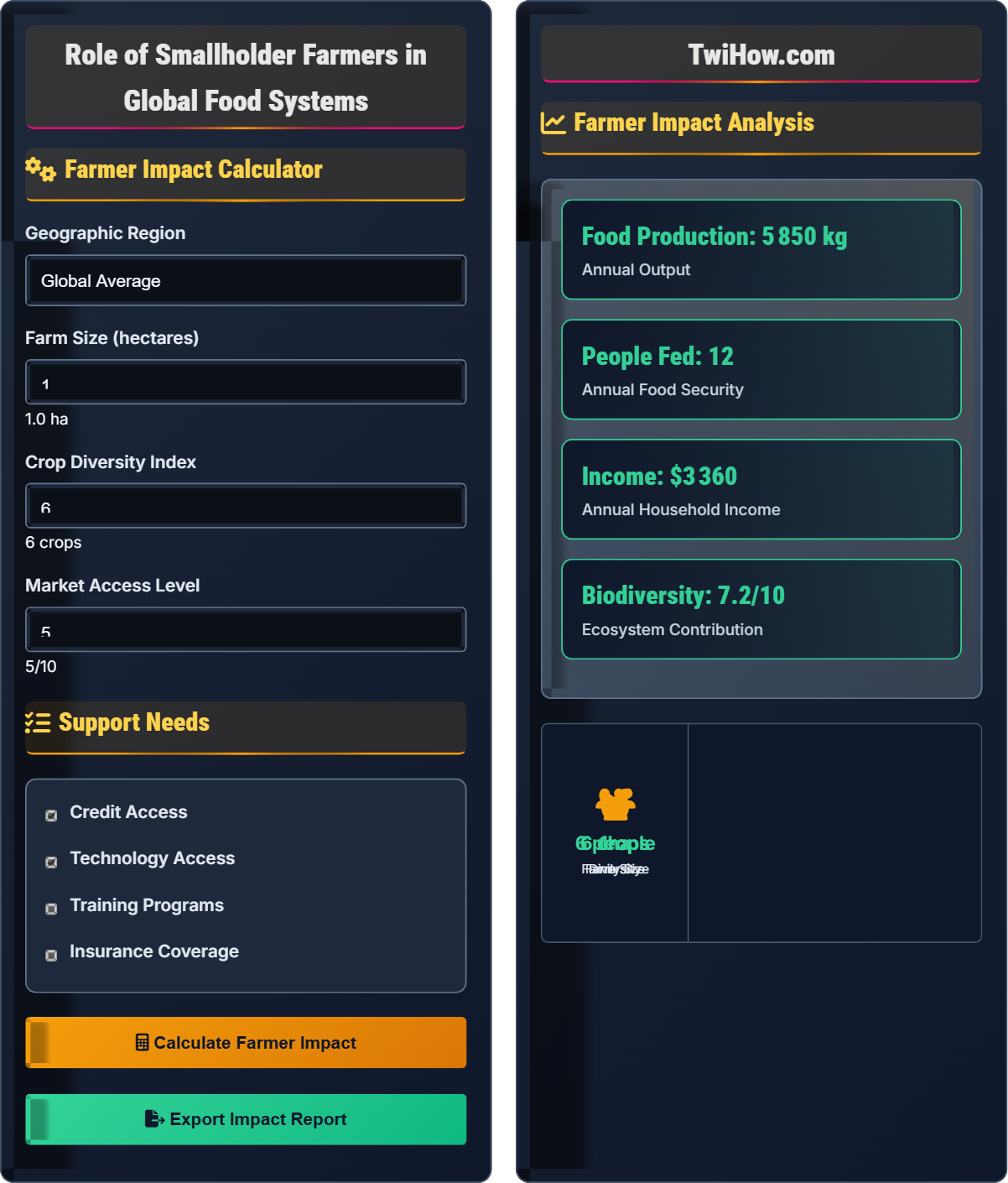
Farmer Impact Calculator
Support Needs
Farmer Impact Analysis
Smallholder Farmer Contributions
Smallholders produce approximately 80% of the food consumed in developing countries, playing a crucial role in feeding billions of people and ensuring local food security.
Small farms maintain greater crop diversity and preserve traditional varieties, contributing to genetic conservation and ecosystem resilience.
Smallholder farming provides livelihoods for approximately 2 billion people worldwide, supporting rural economies and communities.
Many smallholder farmers practice sustainable methods including organic farming, agroforestry, and integrated pest management.
Key Challenges
Smallholders often face difficulties accessing profitable markets due to poor infrastructure, lack of information, and limited bargaining power.
Small farms are particularly vulnerable to climate change impacts with limited resources to adapt to changing conditions.
Most smallholders lack access to credit and financial services needed to invest in their farms and improve productivity.
Smallholders often lack access to modern agricultural technologies, inputs, and information systems.
Support Mechanisms
Microfinance, agricultural loans, and insurance schemes tailored to smallholder needs help farmers invest in their operations.
Technical assistance and training programs help farmers adopt improved practices and technologies.
Cooperatives and farmer organizations help smallholders access better markets and negotiate fair prices.
Improving roads, storage facilities, and communication systems enhances smallholder productivity and market access.
Smallholder Farmers in Global Food Systems
Smallholder farmers are defined as agricultural producers who cultivate relatively small plots of land, typically less than 2 hectares (5 acres). They represent the majority of the world's 570 million farms and are found primarily in developing countries. These farmers often rely on family labor and have limited access to modern agricultural inputs and technologies.
This process connects smallholder farmers to global food systems through multiple pathways.
Key statistics about smallholder farmers:
- 80%: Of food consumed in developing countries is produced by smallholders
- 570 million: Total farms worldwide, with most being smallholdings
- 2 billion: People depend on smallholder agriculture for their livelihoods
- 75%: Of the world's poor live in rural areas and depend on agriculture
- 500 million: Smallholder farms globally, primarily family-operated
- Sub-Saharan Africa: 80% of farms are smallholder operations
- Asia: Home to 80% of the world's smallholder farmers
- Latin America: Mix of small and large-scale operations
- Global: Smallholders dominate in developing nations
Smallholder Contributions
Food security, biodiversity conservation, rural employment, environmental stewardship, cultural preservation, traditional knowledge.
Farmer Impact = (Food Production × Food Security) + (Biodiversity × Sustainability) + (Employment × Rural Development)
Where Impact = contribution to food systems, Production = agricultural output.
- Small farms often have higher productivity per hectare
- Diverse farming systems enhance resilience
- Local knowledge is invaluable for sustainability
- Market access is crucial for success
Challenges and Solutions
Market access, climate change, financing, technology, infrastructure, education, gender inequality, land tenure.
- Improve access to finance and insurance
- Strengthen farmer organizations
- Invest in rural infrastructure
- Provide technical assistance
- Develop climate-smart agriculture
- Context-specific solutions needed
- Gender considerations important
- Traditional knowledge valuable
- Market linkages essential
Smallholder Farmer Contributions
Smallholder farmers are the backbone of food security in developing countries, producing most of the food consumed locally. They ensure food availability and accessibility for billions of people, particularly in rural and peri-urban areas. Their diverse farming systems contribute to nutritional security by providing a variety of crops.
Small farms maintain greater crop diversity than large-scale monocultures, preserving traditional varieties and wild relatives. This genetic diversity is crucial for food security and climate adaptation, providing the foundation for future crop improvement.
Smallholder agriculture provides employment for approximately 2 billion people worldwide, supporting rural economies and reducing migration to urban areas. This creates stable communities and maintains rural social structures.
Many smallholder farmers practice sustainable methods including organic farming, agroforestry, and integrated pest management. These practices conserve soil, water, and biodiversity while maintaining ecosystem services.
Major Challenges
Smallholders often face difficulties accessing profitable markets due to poor infrastructure, lack of information, limited bargaining power, and distance from urban centers. This affects their ability to sell products at fair prices.
Small farms are particularly vulnerable to climate change impacts including droughts, floods, and extreme weather events. Limited resources for adaptation make them more susceptible to production losses.
Most smallholders lack access to credit, insurance, and financial services needed to invest in inputs, technology, and farm improvements. This limits their ability to increase productivity and adapt to challenges.
Smallholders often lack access to modern agricultural technologies, improved seeds, fertilizers, and information systems. This limits their productivity and competitiveness in markets.
Smallholder vs Large-Scale Agriculture
| Aspect | Smallholder | Large-Scale |
|---|---|---|
| Land Size | <2 hectares | >100 hectares |
| Employment | Family-based | Mechanized |
| Diversity | High | Low |
| Productivity/ha | Often higher | Lower |
| Biodiversity | High | Low |
| Food Security | Local focus | Export focus |
Historical and Future Role
Investment in Smallholder Farmers
Investment in smallholder farmers typically generates high returns in terms of food security, poverty reduction, and rural development.
Smallholder Farmers Quiz
What percentage of food consumed in developing countries is produced by smallholder farmers?
Smallholder farmers produce approximately 80% of the food consumed in developing countries. This statistic highlights their crucial role in global food security and local food systems. Despite their importance, smallholders often lack the resources and support needed to maximize their potential.
The answer is C) 80%.
This statistic demonstrates the disproportionate contribution of smallholder farmers to food security in developing regions. It's important to understand that while small farms may seem insignificant individually, collectively they form the backbone of food systems in many parts of the world. This fact challenges the assumption that large-scale agriculture is always more efficient.
Smallholder Farmers: Agricultural producers with small plots (<2 hectares)
Food Security: Access to sufficient, safe, and nutritious food
Developing Countries: Nations with lower economic development
• Small farms are more common globally than large ones
• Smallholders often have higher productivity per hectare
• Local food systems depend heavily on small farmers
• Remember the 80% statistic
• Consider the global distribution of farms
• Think about food security implications
• Assuming large farms produce most food globally
• Underestimating smallholder contributions
• Focusing only on developed countries
Explain how smallholder farmers contribute to biodiversity conservation and why this is important for global food security.
Biodiversity Conservation: Smallholder farmers maintain greater crop diversity than large-scale operations, preserving traditional varieties, heirloom seeds, and wild relatives. They often practice polyculture systems that support diverse ecosystems.
Genetic Resources: Small farms serve as living gene banks, maintaining genetic diversity that is crucial for crop improvement and adaptation to climate change.
Ecological Services: Diverse farming systems support beneficial insects, soil microorganisms, and other species that contribute to ecosystem health.
Food Security Importance: Genetic diversity provides the foundation for developing new crop varieties that can resist diseases, pests, and climate stress. Without this diversity, global food systems would be vulnerable to catastrophic failures.
Biodiversity in agriculture acts as an insurance policy for food security. When smallholder farmers maintain diverse crops and varieties, they preserve genetic resources that may be crucial for future food production challenges. This diversity provides options for adaptation to changing conditions and emerging threats.
Polyculture: Growing multiple crops together
Heirloom Varieties: Traditional cultivars preserved over generations
Genetic Diversity: Variation within species for adaptation
• Diversity provides resilience to threats
• Traditional varieties have unique traits
• Genetic resources are irreplaceable
• Think of diversity as a safety net
• Consider long-term implications
• Link biodiversity to food security
• Not connecting biodiversity to food security
• Underestimating genetic value
• Focusing only on productivity
A smallholder farmer in rural Kenya manages a 1-hectare plot growing maize, beans, and vegetables. The farmer feeds a family of 6 and sells surplus at local markets. If each person requires 300kg of food annually and the farm produces 4,000kg per year, calculate the farmer's food security contribution and assess the economic impact assuming local vegetables sell for $0.50/kg and the farmer spends $300 on inputs.
Food Security Contribution: Family requirement = 6 people × 300kg = 1,800kg
Surplus available = 4,000kg - 1,800kg = 2,200kg
Additional people fed = 2,200kg ÷ 300kg/person = 7.3 people
Total food security impact = 6 + 7.3 = 13.3 people
Economic Impact: Revenue from sales = 2,200kg × $0.50/kg = $1,100
Net income = $1,100 - $300 = $800
This demonstrates how smallholder farmers contribute significantly to local food security and rural economies.
This example illustrates the multiplier effect of smallholder farming. The farmer not only feeds their family but also contributes to food security for others in the community while generating income that circulates in the local economy. This demonstrates the broader economic impact of smallholder agriculture beyond direct production.
Food Security Contribution: Number of people supported by farm output
Economic Impact: Financial effects on local economy
Multiplier Effect: Economic benefits beyond direct production
• Calculate total food security impact
• Consider economic ripple effects
• Account for input costs
• Calculate both direct and indirect impacts
• Consider the community perspective
• Account for all economic factors
• Only calculating direct family impact
• Not considering economic effects
• Forgetting input costs
You are designing a program to support smallholder farmers in a rural community facing climate change challenges. Identify the most effective support mechanisms and explain why they would be most beneficial for the farmers.
Climate-Resilient Seeds: Provide drought-resistant and flood-tolerant varieties to help farmers adapt to changing conditions.
Weather Information Systems: Implement mobile-based weather forecasts and advisory services to help farmers make informed decisions.
Water Management: Support rainwater harvesting, drip irrigation, and water conservation techniques.
Financial Services: Offer climate insurance and credit for investing in adaptation measures.
Training Programs: Educate farmers on climate-smart agriculture practices and sustainable techniques.
Market Access: Develop value chains for climate-resilient crops to ensure market access.
Effective support for smallholder farmers facing climate change requires a multi-faceted approach that addresses both immediate needs and long-term adaptation. The most successful programs combine technological solutions with financial support and capacity building to create comprehensive resilience strategies.
Climate-Resilient Seeds: Varieties adapted to climate stress
Climate Insurance: Protection against weather-related losses
Climate-Smart Agriculture: Sustainable farming practices
• Combine multiple support mechanisms
• Address both mitigation and adaptation
• Include financial and technical support
• Prioritize farmer participation
• Build on traditional knowledge
• Ensure long-term sustainability
• Focusing only on technological solutions
• Not involving farmers in planning
• Ignoring financial constraints
Which of the following best describes the economic impact of smallholder farmers on rural communities?
Smallholder farmers have a significant economic impact on rural communities through multiple channels: they provide employment for family members and hired workers, participate in local markets as both buyers and sellers, contribute to local economies through spending, and create demand for local services and inputs. Their economic activities extend far beyond their own households.
The answer is B) Significant impact through employment and local markets.
Smallholder farmers are not isolated economic units but are deeply integrated into rural economies. Their activities create multiplier effects that benefit entire communities. This demonstrates the importance of supporting smallholder agriculture as a tool for rural development and poverty reduction.
Multiplier Effect: Economic impact extending beyond direct activity
Rural Economy: Economic activities in rural areas
Local Markets: Markets serving nearby communities
• Smallholders drive rural economic activity
• Economic impacts extend beyond farms
• Rural development depends on agriculture
• Think about economic ripple effects
• Consider both direct and indirect impacts
• Look at community-level effects
• Underestimating economic multiplier effects
• Focusing only on individual farm impacts
• Ignoring rural economic linkages
FAQ
Q: What are the most effective policies to support smallholder farmers?
A: Effective policies include: 1) Investment in rural infrastructure (roads, storage, communications), 2) Access to credit and financial services, 3) Extension services and training programs, 4) Market development and support for farmer organizations, 5) Research and development of appropriate technologies, and 6) Climate adaptation and risk management programs. The most successful approaches combine multiple interventions.
Q: Is investing in smallholder farmers economically viable?
A: Yes, investing in smallholder farmers typically generates high returns in terms of food security, poverty reduction, and rural development. Studies show that every dollar invested in smallholder agriculture can generate $2-10 in economic returns through increased productivity, improved food security, and rural economic growth. Microfinance programs, for example, often achieve repayment rates of 90%+.