Technology in Food Traceability & Transparency
Complete guide • Step-by-step explanations
Food Traceability & Transparency:
Show Traceability SimulatorFood traceability and transparency refer to the ability to track food products through every stage of the supply chain, from farm to fork. Technology plays a crucial role in enabling real-time tracking, verification, and communication of food origin, processing, and distribution details.
Key technologies transforming food traceability include blockchain for immutable records, IoT sensors for real-time monitoring, RFID tags for product identification, and cloud-based platforms for data sharing.
Benefits include enhanced food safety, reduced contamination risks, improved consumer trust, faster recall processes, and better supply chain efficiency.
Real-world applications span from farm-to-fork tracking systems to smart packaging that monitors freshness and authenticity verification platforms.
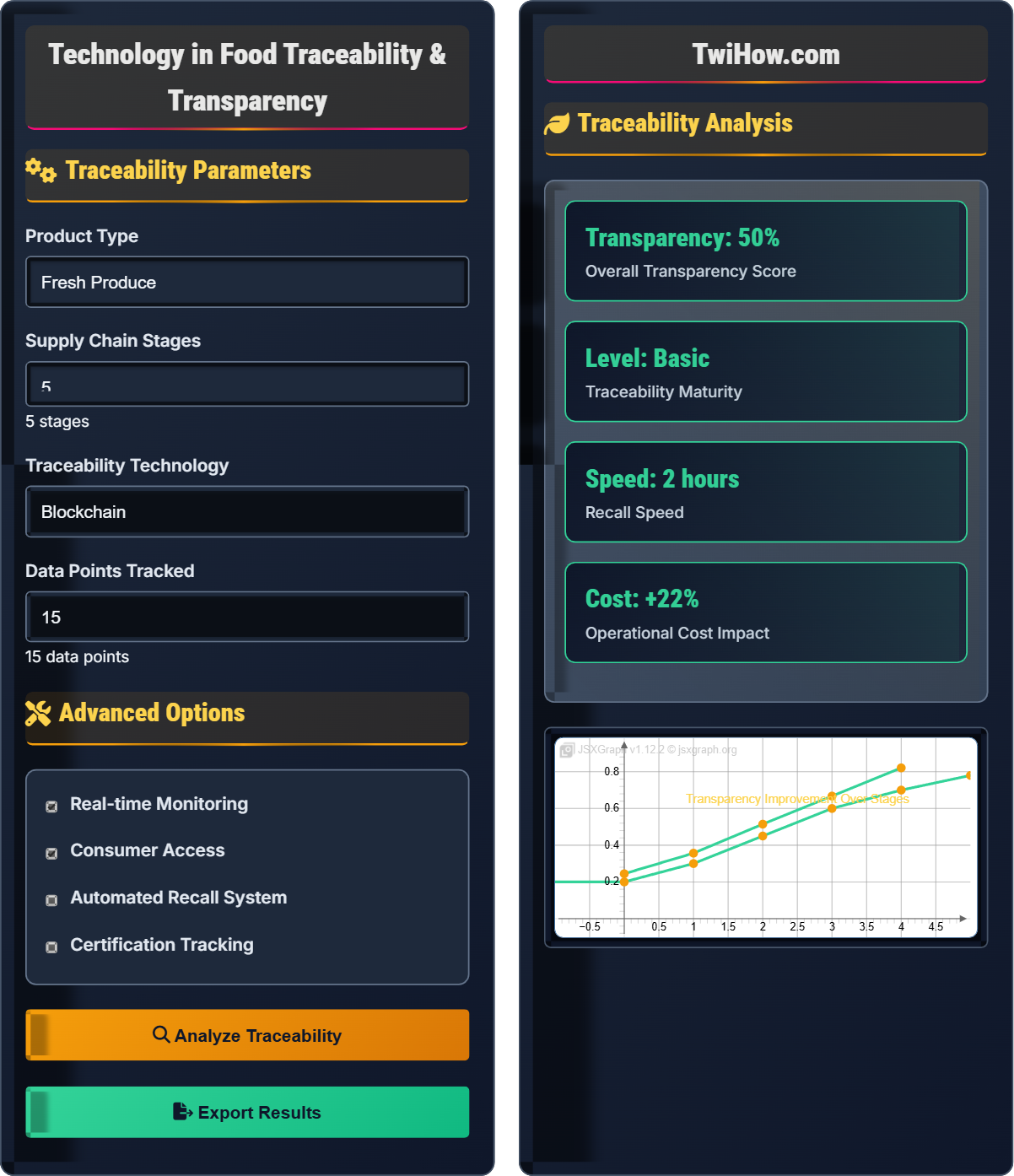
Traceability Parameters
Advanced Options
Traceability Analysis
| Stage | Technology Used | Data Captured | Verification |
|---|---|---|---|
| Farm | Sensors + GPS | Origin, Date, Conditions | Blockchain |
| Processing | RFID Tags | Facility, Date, Batch | QR Code |
| Distribution | IoT Monitors | Temperature, Location | Blockchain |
| Retail | RFID Scanners | Shelf Life, Location | QR Code |
| Consumer | Mobile App | All Data Available | Blockchain |
How Technology Improves Food Traceability & Transparency
Food traceability is the ability to track any food, feed, food-producing animal, or substance that is intended to be incorporated into a food or feed through all stages of production, processing, and distribution. It enables the identification of the source of food and the destination of its products, providing transparency throughout the entire food supply chain.
Several technologies work together to create comprehensive food traceability systems:
Blockchain provides an immutable, decentralized ledger that records every transaction and movement of food products. Each block contains data about the product's journey, from origin to destination, creating an unalterable record that all parties in the supply chain can access.
Internet of Things (IoT) sensors monitor environmental conditions like temperature, humidity, and location throughout the supply chain. These sensors provide real-time data that helps ensure food safety and quality.
Radio Frequency Identification (RFID) tags and Quick Response (QR) codes enable unique product identification and easy access to detailed product information. Consumers can scan these codes to view the complete history of their food.
Technology Applications
Blockchain, IoT sensors, RFID tags, QR codes, cloud platforms, mobile applications, and AI-powered analytics.
Transparency Score = (Data Points Captured / Total Possible Data Points) × 100
Where Data Points = Origin, Processing, Storage, Distribution, Retail, Quality Metrics.
- Data must be captured at every supply chain stage
- Records should be immutable and verifiable
- Information should be accessible to consumers
- Systems must be scalable and cost-effective
Case Studies
Walmart implemented IBM's blockchain technology to track leafy greens from farm to store. The system reduced the time needed to trace food sources from weeks to seconds, significantly improving recall efficiency and consumer safety.
Carrefour uses blockchain to provide customers with detailed information about food products, including origin, farming practices, and processing details. QR codes on products allow customers to access complete product histories.
Norway implemented a comprehensive traceability system for seafood using RFID tags and blockchain to track fish from catch to consumer, ensuring sustainable fishing practices and preventing illegal fishing.
Interactive Traceability Simulation
Food Traceability & Transparency Quiz
Which of the following is the primary advantage of using blockchain technology in food traceability?
Blockchain technology provides an immutable, decentralized ledger that creates permanent records of every transaction and movement in the food supply chain. This ensures that once data is recorded, it cannot be altered or deleted, providing transparency and trust throughout the system.
The answer is B) Immutable and transparent record keeping.
Blockchain's distributed nature means that records are stored across multiple nodes, making it nearly impossible to alter or delete information without consensus. This creates a trusted system where all participants can verify the authenticity of food products and their journey through the supply chain.
Immutable: Unable to be changed or altered
Decentralized: Distributed across multiple locations rather than controlled by a single entity
Ledger: A record of transactions and movements
• Blockchain records cannot be altered once confirmed
• Multiple parties can access and verify the same records
• Transparency increases consumer trust
• Think of blockchain as a permanent digital fingerprint
• Multiple copies ensure data integrity
• Consumers can verify product claims
• Confusing blockchain with other database technologies
• Assuming blockchain is only for cryptocurrency
• Ignoring the importance of immutability
Explain how IoT sensors contribute to food safety throughout the supply chain and describe specific scenarios where they provide critical value.
IoT sensors play a crucial role in food safety by continuously monitoring environmental conditions throughout the supply chain:
Temperature Monitoring: Sensors track cold chain integrity, alerting stakeholders when temperatures exceed safe ranges that could cause spoilage or bacterial growth.
Humidity Control: Monitoring moisture levels prevents mold growth and maintains product quality during storage and transport.
Location Tracking: GPS sensors provide real-time location data, ensuring products follow approved routes and arrive on schedule.
Gas Detection: Sensors can detect ethylene levels in fruit storage or harmful gases that indicate contamination.
Critical Scenarios: During a foodborne illness outbreak, IoT data can quickly identify which shipments were exposed to unsafe conditions, enabling precise recalls rather than broad product withdrawals.
IoT sensors act as the eyes and ears of the supply chain, providing continuous monitoring that humans cannot achieve. They collect data 24/7, creating a comprehensive picture of product conditions and enabling proactive interventions before problems escalate.
IoT (Internet of Things): Network of physical devices that collect and exchange data
Cold Chain: Temperature-controlled supply chain for perishable goods
Proactive Monitoring: Preventive approach to identifying issues before they become problems
• Continuous monitoring prevents quality degradation
• Real-time alerts enable immediate action
• Data logs provide evidence for compliance
• Deploy sensors at critical control points
• Set appropriate alert thresholds
• Integrate with existing management systems
• Placing sensors in non-critical locations
• Setting inappropriate alert thresholds
• Failing to integrate with response systems
A food distributor handles 10,000 products daily across 50 retail locations. Without proper traceability, a contamination issue requires 2 weeks to identify affected products, affecting 500 stores and costing $2 million in losses. With blockchain-based traceability and IoT monitoring, they can identify and isolate affected products within 4 hours, affecting only 10 stores and reducing losses to $50,000. Calculate the ROI of implementing the traceability system and explain the broader benefits.
Without Traceability: 2-week identification time, $2M losses per incident
With Traceability: 4-hour identification time, $50K losses per incident
Loss Reduction: $2,000,000 - $50,000 = $1,950,000 per incident
Time Reduction: 336 hours to 4 hours = 332-hour improvement
ROI Calculation: If the system costs $500,000 to implement and prevents just one major incident per year, the ROI is ($1,950,000 - $500,000) / $500,000 = 290%.
Broad Benefits: Improved consumer trust, regulatory compliance, operational efficiency, and competitive advantage.
This example demonstrates how traceability systems provide both direct financial benefits and indirect value through risk reduction. The rapid identification capability transforms a crisis situation into a manageable issue, preserving brand reputation and operational continuity.
ROI (Return on Investment): Financial metric comparing gain to cost
Traceability System: Technology-enabled tracking throughout supply chain
Risk Mitigation: Reducing potential negative impacts
• Calculate both direct and indirect benefits
• Consider frequency of incidents prevented
• Factor in reputational value
• Quantify intangible benefits where possible
• Consider cumulative effect of multiple incidents
• Account for ongoing operational savings
• Only calculating direct costs
• Ignoring reputational damage
• Underestimating prevention value
A consumer purchases organic vegetables and wants to verify the certification. Using QR code technology, they scan the product and access a blockchain-based record showing: Farm location (verified organic), Harvest date, Processing facility (organic certified), Transportation log, and Retail information. Evaluate the effectiveness of this transparency system and propose improvements.
System Effectiveness: The QR code provides immediate access to verified information, confirming organic certification through blockchain. The consumer can verify each stage of the product's journey.
Strengths: Immediate access, verified data, comprehensive information, consumer empowerment.
Proposed Improvements: Add third-party audit verification, real-time sensor data integration, sustainability metrics, farmer stories, and nutritional information.
Additional Features: Interactive maps showing farm location, video tours, ingredient sourcing details, and social impact information.
Consumer transparency systems bridge the gap between production and consumption, enabling informed decision-making. The combination of QR codes and blockchain creates a seamless experience while maintaining data integrity and accessibility.
Consumer Empowerment: Giving consumers access to information for decision-making
Verified Data: Information confirmed through trusted sources
Third-Party Audit: Independent verification by external organization
• Information must be easily accessible
• Data integrity must be maintained
• Verification processes must be credible
• Make information scannable with minimal steps
• Present data in user-friendly format
• Include visual elements for engagement
• Providing too much technical information
• Making access difficult or time-consuming
• Failing to verify data sources
Which combination of technologies provides the most comprehensive food traceability system?
A comprehensive traceability system requires multiple technologies working together: Blockchain provides immutable record-keeping, IoT sensors offer real-time monitoring, and QR codes enable consumer access. This integrated approach covers data capture, verification, and accessibility.
The answer is B) Blockchain + IoT sensors + QR codes.
No single technology can address all traceability needs. Each technology serves a specific function: sensors collect data, blockchain verifies it, and consumer interfaces make it accessible. Integration creates a comprehensive solution that addresses all stakeholder needs.
Integrated System: Multiple technologies working together
Comprehensive Solution: Addresses all stakeholder requirements
Stakeholder Needs: Producer, processor, retailer, and consumer requirements
• Multiple technologies provide redundancy
• Integration enhances functionality
• Each stakeholder has different needs
• Start with core technology requirements
• Plan for scalability and integration
• Consider all stakeholder perspectives
• Assuming single technology solves all needs
• Neglecting consumer accessibility
• Failing to plan for technology evolution
FAQ
Q: How can small farmers participate in technology-enhanced traceability systems?
A: Small farmers can participate in traceability systems through:
1. Mobile Applications: Simple apps that allow farmers to record farming practices, harvest dates, and inputs used
2. Cooperative Systems: Joining producer cooperatives that share the cost of traceability technology
3. Cloud-Based Platforms: Low-cost subscription services that provide traceability without expensive hardware
4. Government Programs: Participating in subsidized programs that support technology adoption
5. Scalable Solutions: Starting with basic QR codes and gradually adding more sophisticated tracking as the operation grows
Many platforms now offer tiered pricing and simplified interfaces specifically designed for smaller operations.
Q: How can I verify that the traceability information I see is accurate and trustworthy?
A: To verify traceability information accuracy:
1. Check for Third-Party Certifications: Look for independent verification from organizations like USDA Organic, Fair Trade, or GlobalGAP
2. Blockchain Verification: True blockchain systems provide immutable records that can't be altered after creation
3. Real-Time Data: Authentic systems provide live sensor data rather than static information
4. Industry Standards: Verify that the system follows recognized standards like GS1 or ISO 22005
5. Company Reputation: Research the company's history and commitment to transparency
Always look for systems that provide detailed, specific information rather than generic claims. Reputable systems will have multiple verification points and clear audit trails.