Resources for Understanding and Engaging in Food System Transformation
Complete transformation guide • Step-by-step explanations
Transformation Resources Overview:
Show Transformation Resource FinderFood system transformation requires diverse resources and tools to understand complex challenges and implement effective solutions. From educational materials and research publications to engagement platforms and policy frameworks, these resources provide the knowledge and tools needed to drive meaningful change.
Effective transformation resources span multiple categories, including academic research, practical tools, policy guidance, and community engagement platforms. Understanding how to access and utilize these resources is crucial for stakeholders at all levels.
Key resource categories:
- Educational Materials: Courses, guides, and training resources
- Research Publications: Academic studies and reports
- Policy Tools: Frameworks and implementation guides
- Engagement Platforms: Networks and collaboration tools
Successful transformation combines multiple resource types to build comprehensive understanding and enable effective action across the food system.
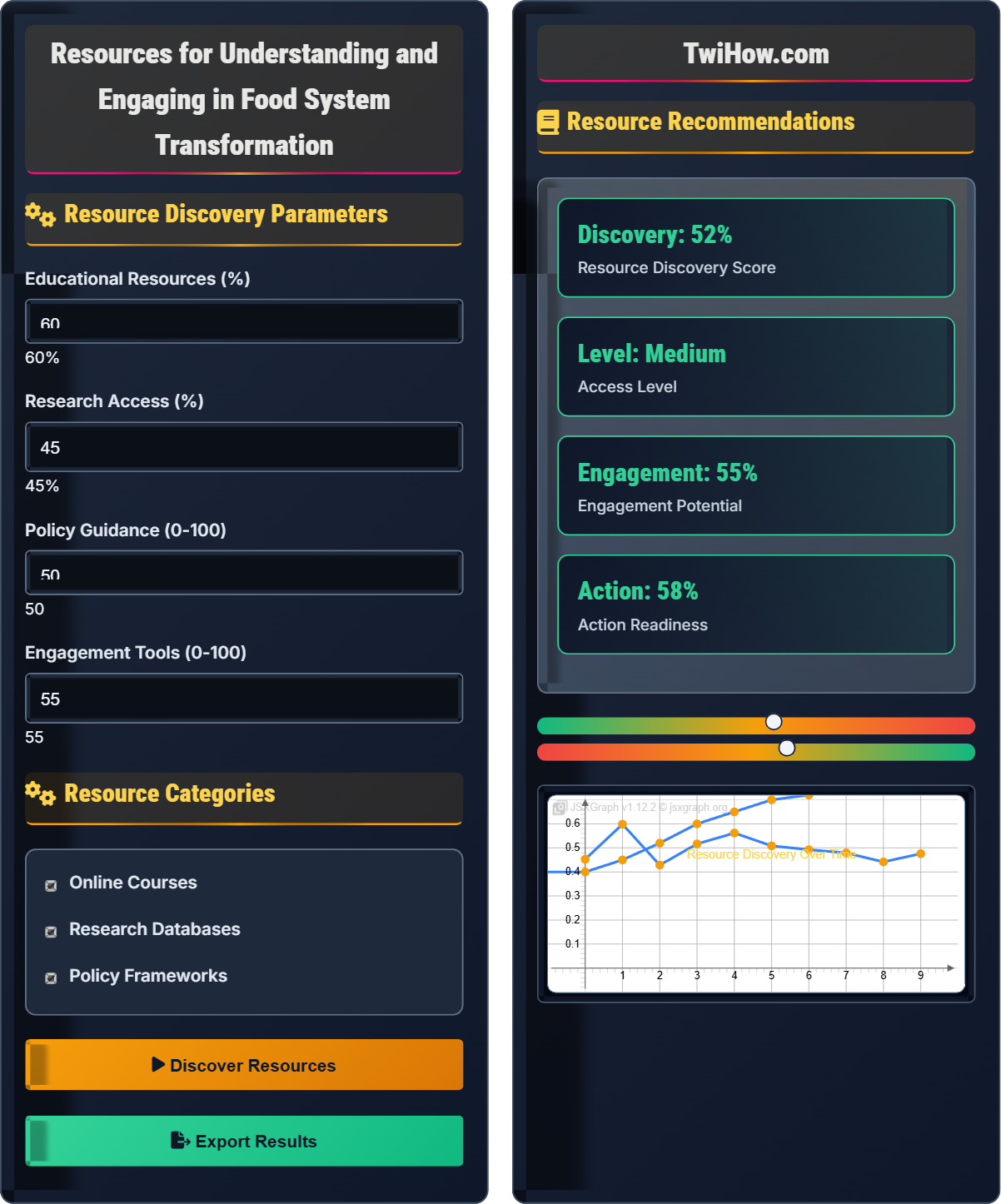
Resource Discovery Parameters
Resource Categories
Resource Recommendations
| Category | Availability | Quality | Relevance |
|---|---|---|---|
| Educational | 60% | High | Very High |
| Research | 45% | High | High |
| Policy | 50% | Medium | High |
| Engagement | 55% | Medium | Medium |
E=Education, R=Research, P=Policy, K=Knowledge, T=Tools, I=Information, C=Community, F=Food, A=Action
Food System Transformation Resources Explained
Food system transformation resources encompass all materials, tools, and platforms that support understanding, planning, and implementing changes in food systems. These resources range from educational materials and research publications to policy frameworks and engagement platforms that facilitate collaboration and action.
Resource effectiveness is measured using several important indicators:
Where:
- Accessibility: Ease of access and availability
- Quality: Accuracy and reliability of information
- Relevance: Applicability to user needs and context
- Goal: Maximize all components for effective resources
Key resource categories include:
- Educational Materials: Courses, guides, and training programs
- Research Publications: Academic studies and scientific reports
- Policy Frameworks: Guidelines and implementation strategies
- Engagement Platforms: Networks and collaboration tools
- Case Studies: Real-world examples and lessons learned
- Tools and Templates: Practical implementation resources
- Individual: Self-directed learning and exploration
- Community: Group learning and peer exchange
- Institutional: Formal education and training
- Network: Professional and stakeholder networks
- Collaborative: Multi-stakeholder initiatives
Transformation Resources Fundamentals
Food system transformation, educational resources, research databases, policy frameworks, engagement platforms, knowledge sharing.
Index = (Accessibility + Quality + Relevance) / 3
Where Index = resource effectiveness, Accessibility = ease of access, Quality = reliability, Relevance = applicability.
- Quality over quantity
- Context matters
- Multiple sources needed
Applications
Online courses, research databases, policy toolkits, community networks, case study repositories, implementation guides.
- Resource identification
- Quality assessment
- Contextualization
- Application planning
- Language barriers
- Access limitations
- Quality variations
- Cultural relevance
Transformation Resources Learning Quiz
Which type of educational resource is most effective for understanding complex food system concepts?
Interactive courses are most effective for understanding complex food system concepts because they combine multiple learning modalities, allow for practice and feedback, and can adapt to different learning styles. They provide structured pathways through complex topics and often include practical applications.
The answer is B) Interactive courses.
Students should understand that complex systems like food systems require multi-modal learning approaches. Interactive courses engage learners actively, provide immediate feedback, and allow for progressive complexity. This approach is superior to passive learning methods for understanding interconnected and dynamic systems.
Interactive Course: Educational program with active participation
Multi-modal Learning: Using multiple senses and methods
Complex Systems: Interconnected elements with emergent properties
• Active learning is more effective
• Multiple modalities enhance understanding
• Feedback improves learning
• Look for interactive elements
• Choose multi-modal resources
• Seek structured learning paths
• Relying on single learning mode
• Not seeking feedback
• Ignoring structured approaches
Explain how to evaluate the quality and reliability of research resources on food system transformation. What criteria should be used?
Source Evaluation: Check author credentials, institutional affiliation, and publication venue reputation.
Methodology Assessment: Evaluate research design, sample size, data collection methods, and analytical approaches.
Peer Review: Verify if the research has undergone peer review process.
Transparency: Assess whether data, methods, and limitations are clearly presented.
Replication: Look for studies that have been replicated or validated by others.
Conflicts of Interest: Identify potential biases or funding sources that might influence findings.
Timeliness: Consider whether the research reflects current understanding and practices.
Students should understand that not all research resources are equally reliable. Critical evaluation skills are essential for navigating the vast amount of information available. The key is developing systematic approaches to assess credibility and relevance for specific needs.
Peer Review: Independent expert evaluation of research quality
Methodology: Research design and data collection approach
Replication: Repeating study to verify results
• Verify source credibility
• Check methodology rigor
• Look for peer review
• Cross-reference multiple sources
• Check publication dates
• Look for funding disclosures
• Accepting all published research
• Not checking methodology
• Ignoring potential bias
A community organization has $10,000 to spend on resources for food system transformation. They can either purchase a comprehensive course package for $8,000 (benefiting 50 people) or buy multiple individual resources for $10,000 (benefiting 30 people). The course package has a 90% completion rate with high impact, while individual resources have 60% completion with moderate impact. Calculate the cost-effectiveness of each option.
Course Package: Cost per person = $8,000 ÷ 50 = $160/person
Actual Beneficiaries: 50 × 0.90 = 45 people completing with high impact
Individual Resources: Cost per person = $10,000 ÷ 30 = $333.33/person
Actual Beneficiaries: 30 × 0.60 = 18 people completing with moderate impact
Cost-Effectiveness: Course package reaches 45 people at $160 each vs. individual resources reaching 18 people at $333.33 each.
Conclusion: Course package is more cost-effective with higher impact.
This problem demonstrates the importance of considering both reach and effectiveness when evaluating resource investments. Students should understand that higher completion rates and impact levels can justify higher per-unit costs when the overall benefit is greater.
Cost-Effectiveness: Ratio of cost to benefit achieved
Completion Rate: Percentage who finish resource
Impact Level: Degree of positive change achieved
• Consider completion rates
• Factor in impact levels
• Calculate per-unit effectiveness
• Calculate actual beneficiaries
• Consider impact quality
• Factor in completion rates
• Not considering completion rates
• Ignoring impact differences
• Only looking at per-unit cost
Design a curation strategy for food system transformation resources that serves multiple stakeholder groups (farmers, policymakers, educators, consumers). Consider accessibility, quality, and relevance for each group.
Farmers: Focus on practical guides, case studies, and implementation tools with clear action steps.
Policymakers: Provide evidence-based research, policy frameworks, and economic analyses.
Educators: Offer curricula, teaching materials, and multimedia resources for different levels.
Consumers: Create accessible information on food choices, sustainability impacts, and engagement opportunities.
Curation Process: Establish quality standards, create user-friendly access points, and maintain regular updates.
Implementation: Develop searchable database with filtering options and user feedback mechanisms.
This problem demonstrates that resource curation must consider diverse user needs and contexts. Students should understand that effective resource management involves understanding audience requirements and tailoring presentation accordingly while maintaining quality standards.
Resource Curation: Systematic collection and organization
Stakeholder Groups: Different audiences with varying needs
Quality Standards: Criteria for resource evaluation
• Understand audience needs
• Maintain quality standards
• Ensure accessibility
• Segment by user type
• Create tailored collections
• Provide multiple access points
• One-size-fits-all approach
• Not considering user needs
• Ignoring accessibility issues
Which type of engagement platform is most effective for facilitating multi-stakeholder food system transformation?
Dedicated collaboration platforms are most effective because they provide structured spaces for multi-stakeholder engagement, document sharing, discussion forums, and project management tools. These platforms facilitate ongoing collaboration and knowledge exchange among diverse stakeholder groups.
The answer is B) Dedicated collaboration platforms.
Students should understand that meaningful engagement requires structured platforms that support ongoing interaction and collaboration. Simple communication tools are insufficient for complex multi-stakeholder processes. The key is creating spaces that facilitate sustained dialogue and action.
Collaboration Platform: Structured space for multi-party engagement
Multi-stakeholder: Multiple interest groups involved
Knowledge Exchange: Sharing of information and experiences
• Structure enables engagement
• Ongoing interaction is needed
• Multiple tools may be required
• Choose appropriate tools
• Ensure accessibility
• Provide training and support
• Using inappropriate platforms
• Not considering user needs
• Ignoring technical requirements
FAQ
Q: What are the best resources for farmers interested in sustainable practices?
A: Best resources for farmers include:
1. Extension Services: Local agricultural extension offices with practical guides
2. Farmer Networks: Peer-to-peer learning groups and cooperatives
3. Case Studies: Real examples from successful farmers
4. Video Tutorials: Visual demonstrations of techniques
5. Mobile Apps: Field-specific tools and calculators
6. Workshops: Hands-on training sessions
Focus on practical, field-tested resources that match your specific context.
Q: What resources provide evidence-based policy recommendations for food system transformation?
A: Evidence-based policy resources include:
International Organizations: FAO, WHO, and UN reports with policy frameworks.
Academic Journals: Peer-reviewed research on policy effectiveness.
Think Tanks: Policy institutes with evidence-based recommendations.
Government Reports: National and international policy analyses.
Case Studies: Documented policy implementations and outcomes.
Meta-analyses: Synthesized research findings across multiple studies.
Always verify research quality and consider context applicability.