How to Conserve Water in Garden or Farm
Sustainable farming guide • Step-by-step explanations
Water Conservation Overview:
Show Water Conservation SimulatorWater conservation in gardens and farms involves implementing efficient irrigation systems, soil moisture management, and water-saving techniques to maximize plant health while minimizing water usage. Effective water conservation can reduce usage by 30-50% while maintaining or improving crop yields.
Key conservation methods include:
- Drip Irrigation: Targeted watering at plant roots
- Rainwater Harvesting: Collecting and storing precipitation
- Mulching: Reducing evaporation from soil surface
- Soil Amendment: Improving water retention capacity
Water conservation strategies adapt to local climate, soil conditions, and plant requirements while building long-term resilience against drought.
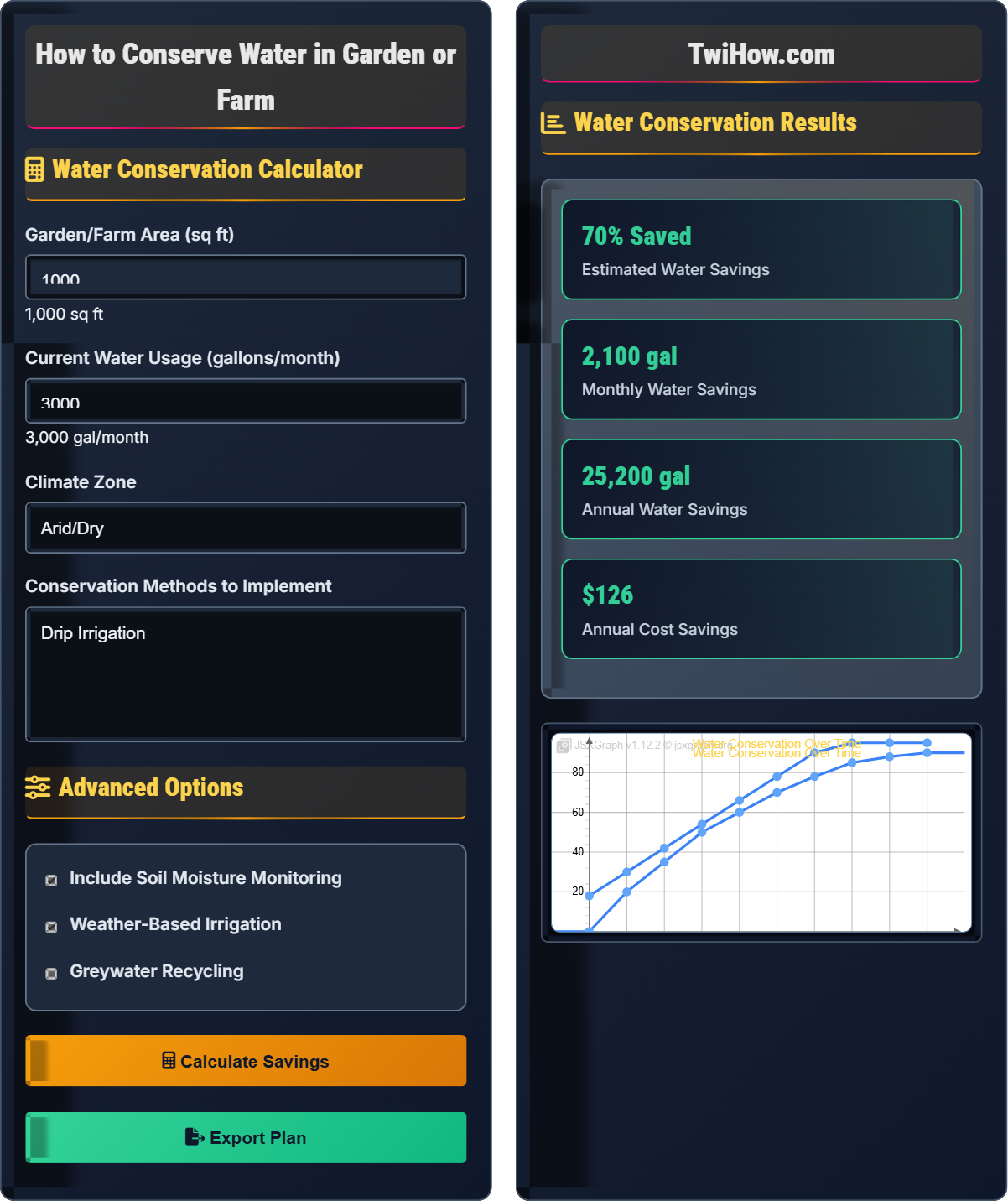
Water Conservation Calculator
Advanced Options
Water Conservation Results
| Method | Efficiency | Cost | Savings |
|---|---|---|---|
| Drip Irrigation | 90% | $500 | 35% |
| Mulching | 70% | $100 | 20% |
| Rainwater Harvesting | 60% | $800 | 25% |
| Smart Controllers | 85% | $200 | 30% |
Plan
Install
Monitor
Optimize
Expand
Water Conservation Methods Explained
Water conservation efficiency is calculated as the percentage reduction in water usage while maintaining or improving plant health:
Where Water Saved = Original Usage - New Usage after implementing conservation methods.
Drip irrigation systems deliver water directly to plant root zones with 85-95% efficiency compared to 50-70% for traditional sprinklers:
- Targeted Delivery: 90% of water reaches plant roots
- Reduced Evaporation: Water applied directly to soil
- Lower Pressure: Operates at lower pressures than sprinklers
- Automated Control: Programmable scheduling
Collecting rainwater maximizes available water resources:
- Roof collection: 0.6 gallons per square foot per inch of rain
- Tank sizing: 1 gallon per sq ft of collection area × inches of rainfall
- Filtering: Remove debris and contaminants
- Distribution: Gravity-fed or pump systems
Example: 1,000 sq ft roof × 1 inch rain = 600 gallons collected.
- Organic Matter: 1% OM holds 20,000+ gallons per acre
- Mulching: Reduces evaporation by 70-80%
- Compaction Relief: Improves water infiltration
- Plant Spacing: Optimizes root zone competition
Water Conservation Fundamentals
Evapotranspiration, soil moisture, irrigation efficiency, water retention, conservation methods.
Savings = (Original Usage - New Usage) / Original Usage × 100
Where efficiency improvements reduce water waste and increase plant utilization.
- Water early morning or late evening
- Match water delivery to plant needs
- Minimize evaporation losses
- Maximize rainwater capture
Conservation Methods
Drip irrigation, mulching, rainwater harvesting, soil amendment, smart controllers.
- Assess current water usage
- Implement highest impact methods first
- Monitor and measure results
- Expand successful practices
- Start with simple, low-cost methods
- Combine multiple techniques
- Monitor soil moisture regularly
- Adjust for seasonal variations
Irrigation Systems
Water Conservation Visualization
Water Conservation Learning Quiz
Which irrigation method has the highest water use efficiency?
Drip irrigation has the highest efficiency at 85-95%, delivering water directly to plant root zones with minimal evaporation and runoff. Sprinkler systems are 50-70% efficient, flood irrigation is 40-60% efficient, and hand watering varies widely but typically achieves 60-80% efficiency depending on application technique.
The answer is C) Drip irrigation.
Understanding irrigation efficiency is crucial for water conservation planning. The efficiency percentage indicates how much of the applied water actually reaches and benefits the plants. Higher efficiency systems reduce waste and lower water bills while potentially improving plant health through more precise water delivery.
Irrigation Efficiency: Percentage of applied water reaching plants
Evapotranspiration: Combined water loss from evaporation and transpiration
Runoff: Water flowing away without infiltrating soil
• Higher efficiency = more water savings
• Consider initial cost vs. long-term savings
• Maintenance affects efficiency over time
• Start with drip irrigation for high-value crops
• Use pressure regulators to maintain efficiency
• Install filters to prevent clogging
• Overwatering with efficient systems
• Not maintaining irrigation equipment
• Installing systems without proper planning
Explain how mulching conserves water and calculate the potential water savings for a 500 sq ft garden. Assume mulch reduces evaporation by 75% and the garden previously required 20 gallons per week.
Mulching Benefits: Mulch conserves water by:
1. Reducing Evaporation: Prevents direct sunlight on soil surface
2. Temperature Regulation: Keeps soil cooler during hot weather
3. Moisture Retention: Creates barrier against wind evaporation
4. Soil Health: Decomposing organic mulch improves water-holding capacity
Calculation: 20 gallons/week × 0.75 = 15 gallons saved per week. Annual savings: 15 × 52 = 780 gallons per year.
Mulching is one of the most cost-effective water conservation methods. The effectiveness depends on mulch type, thickness (3-4 inches optimal), and coverage area. Organic mulches provide additional benefits by improving soil structure as they decompose, further enhancing water retention.
Mulch: Protective layer covering soil surface
Evaporation: Water conversion to vapor
Water-Holding Capacity: Soil's ability to retain moisture
• Apply 3-4 inches thick layer
• Keep away from plant stems
• Replenish annually as needed
• Use organic mulch for soil improvement
• Apply after soil is moist
• Use local materials when available
• Applying too thickly (creates water barrier)
• Using fresh wood chips that deplete nitrogen
• Not replenishing as it decomposes
A homeowner has a 2,000 sq ft roof area and lives in a region receiving 15 inches of annual rainfall. Calculate the potential rainwater harvest. If the household garden requires 500 gallons per month, what percentage of water needs could be met by rainwater harvesting? Assume 85% collection efficiency accounting for losses.
Roof Collection Formula: 0.6 gallons per sq ft per inch of rain
Annual Potential: 2,000 sq ft × 15 inches × 0.6 gal/sq ft/inch = 18,000 gallons
After Collection Efficiency: 18,000 × 0.85 = 15,300 gallons annually
Garden Needs: 500 gal/month × 12 months = 6,000 gallons annually
Percentage Met: (15,300 ÷ 6,000) × 100 = 255% - More than enough!
Rainwater harvesting can completely supply water needs in many regions. The 0.6 factor accounts for the fact that 1 inch of rain on 1 square foot equals 0.623 gallons. Collection efficiency accounts for losses from evaporation, spillage, and first-flush diverters that remove contaminated water.
Collection Efficiency: Percentage of available rainwater captured
First-Flush Diverter: System that discards initial contaminated water
Storage Tank: Container for harvested rainwater
• Size tank appropriately for roof area
• Account for seasonal rainfall variation
• Include overflow systems
• Connect multiple downspouts to one tank
• Install filters to remove debris
• Use dark tanks to prevent algae growth
• Undersizing storage tanks
• Not accounting for seasonal variations
• Forgetting overflow provisions
A farmer irrigates 10 acres with a traditional sprinkler system using 200 gallons per day per acre. The farmer considers installing a smart irrigation system with soil moisture sensors and weather-based controllers. Research shows smart systems reduce water usage by 30-40%. Calculate the potential water savings and estimate the payback period if the system costs $15,000 and water costs $0.005 per gallon.
Current Usage: 10 acres × 200 gal/day/acre × 365 days = 730,000 gallons/year
Water Savings: 730,000 × 0.35 = 255,500 gallons saved annually (using 35% average)
Cost Savings: 255,500 × $0.005 = $1,277.50 annually
Payback Period: $15,000 ÷ $1,277.50 = 11.7 years
Additional benefits include improved crop yields and reduced labor.
Smart irrigation systems use technology to optimize water application based on actual plant needs and environmental conditions. While the initial investment is substantial, the long-term savings in water costs and improved crop yields often justify the expense. Many regions offer rebates for water-efficient technologies.
Smart Controller: Irrigation timer with weather sensors
Soil Moisture Sensor: Device measuring actual soil water content
Evapotranspiration: Water lost to atmosphere from soil and plants
• Calibrate sensors properly
• Regular maintenance required
• Consider regional rebates
• Start with small pilot area
• Program seasonal adjustments
• Poor sensor placement
• Not calibrating for soil type
• Over-relying on automation
Which soil amendment provides the greatest improvement in water retention capacity?
Organic matter provides the greatest improvement in water retention capacity. Each 1% increase in soil organic matter enables soil to hold 20,000+ additional gallons of water per acre. While clay has high water-holding capacity, organic matter provides superior water retention while also improving soil structure, drainage, and biological activity. Sand and perlite primarily improve drainage rather than retention.
The answer is C) Organic Matter.
Organic matter acts like a sponge in soil, absorbing and releasing water as plants need it. Unlike clay, which can become compacted and impede drainage, organic matter improves both water retention and soil structure. The relationship between organic matter and water retention is exponential, meaning small increases in organic matter provide disproportionately large improvements in water-holding capacity.
Water-Holding Capacity: Soil's ability to retain moisture
Organic Matter: Decomposed plant and animal material
Soil Structure: Arrangement of soil particles
• Add 1-2% OM annually to maintain levels
• Compost is excellent organic matter source
• Test soil before and after amendments
• Apply compost before planting season
• Use diverse organic materials
• Maintain 3-6% organic matter target
• Not testing soil organic matter levels
• Adding amendments without testing first
• Expecting immediate results
Water-Saving Technologies
FAQ
Q: What's the best time of day to water my garden to conserve water?
A: The best times to water are:
• Early Morning (5-9 AM): Lowest evaporation, plants dry before evening
• Late Evening (8-10 PM): Reduced evaporation, but ensure plants dry quickly
Watering during midday results in 30-50% loss to evaporation. Early morning is generally preferred as it allows plants to absorb water before heat stress and reduces disease risk by allowing foliage to dry during daylight hours.
Q: How much water can I save by switching from overhead sprinklers to drip irrigation?
A: Drip irrigation typically saves 30-50% water compared to overhead sprinklers:
Sprinkler Efficiency: 50-70% (30-50% lost to evaporation, wind drift)
Drip Efficiency: 85-95% (water delivered directly to root zone)
For a 10-acre farm using 100,000 gallons monthly with sprinklers, drip irrigation could save 30,000-50,000 gallons monthly. Additional benefits include reduced weed growth, improved fertilizer efficiency, and better plant health.