How do I evaluate the sustainability of seeds and plant varieties?
Complete seed sustainability guide • Step-by-step evaluation
Seed Sustainability Fundamentals:
Show Seed Sustainability CalculatorEvaluating seed sustainability involves assessing genetic diversity, adaptability, environmental impact, and long-term viability. Sustainable seeds come from open-pollinated, heirloom, or carefully managed hybrid varieties that maintain genetic integrity and adaptability to changing conditions.
Key sustainability factors:
- Genetic Diversity: Maintaining varied gene pools for resilience
- Open Pollination: Seeds that breed true to type
- Adaptability: Performance in local conditions
- Non-GMO Status: Genetic modification considerations
- Organic Certification: Growing and processing standards
- Seed Saving Potential: Ability to harvest viable seeds
Choosing sustainable seeds supports biodiversity and food security for future generations.
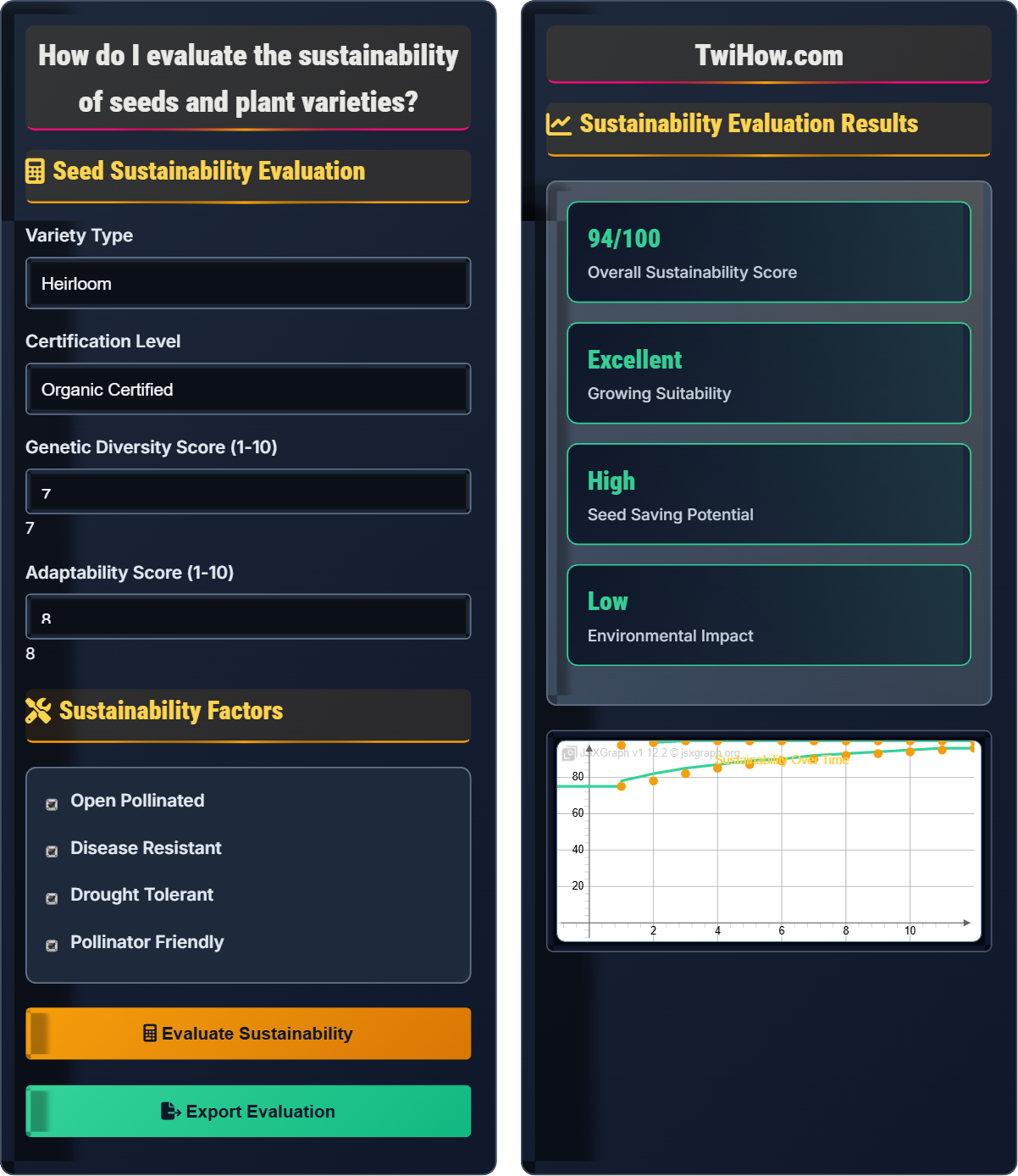
Seed Sustainability Evaluation
Sustainability Factors
Sustainability Evaluation Results
| Factor | Score | Weight | Contribution |
|---|---|---|---|
| Genetic Diversity | 7 | 25% | 17.5 |
| Adaptability | 8 | 20% | 16.0 |
| Open Pollinated | Yes | 20% | 20.0 |
| Certification | Organic | 15% | 15.0 |
| Disease Resistance | Yes | 10% | 10.0 |
| Seed Saving | High | 10% | 10.0 |
Recommendations
-
Save seeds from the best performing plants for next year's planting
-
Rotate varieties to maintain genetic diversity
-
Support local seed networks and exchanges
-
Document variety performance for future reference
Seed Sustainability Evaluation Explained
Seed sustainability encompasses genetic diversity, adaptability, environmental impact, and long-term viability. Sustainable seeds come from open-pollinated, heirloom, or carefully managed hybrid varieties that maintain genetic integrity and adaptability to changing conditions. Evaluating seed sustainability requires considering multiple factors that contribute to long-term agricultural resilience.
Where:
- Factor Score: Individual rating for each sustainability factor (1-10)
- Weight: Relative importance of each factor (percentages sum to 100%)
- Sustainability Score: Composite score out of 100
Key areas where sustainable seed evaluation makes an impact:
- Biodiversity: Preserving genetic diversity for future generations
- Climate Resilience: Adapting to changing weather patterns
- Food Security: Ensuring reliable food production systems
- Economic Stability: Reducing dependence on external inputs
- Environmental Health: Minimizing ecological impact
- Cultural Heritage: Preserving traditional varieties
- Source Responsibly: Choose reputable seed companies committed to sustainability
- Grow Open-Pollinated: Support varieties that can reproduce true to type
- Save Seeds: Maintain genetic lines for future planting
- Rotate Varieties: Prevent genetic bottlenecking
- Document Performance: Track variety success for informed decisions
Seed Sustainability Fundamentals
Genetic diversity, open pollination, heirloom varieties, organic certification, seed saving, biodiversity.
Sustainability Score = Σ(Factor Score × Weight)
Where Sustainability Score = composite sustainability rating out of 100.
- Choose open-pollinated varieties
- Verify organic certifications
- Consider local adaptability
Applications
Seed saving, variety selection, biodiversity conservation, climate adaptation.
- Biodiversity preservation
- Climate resilience
- Food security
- Economic independence
- Genetic diversity maintenance
- Local adaptation
- Seed saving feasibility
- Certification standards
Seed Sustainability Learning Quiz
What distinguishes heirloom varieties from hybrid varieties?
Heirloom varieties are open-pollinated cultivars that have been passed down through generations and breed true to type, meaning offspring plants closely resemble the parent. Hybrid varieties (especially F1 hybrids) are created by crossing two distinct parent lines and do not breed true to type—the offspring will show genetic segregation and variability. This makes heirlooms more sustainable for seed saving.
The answer is B) Heirlooms breed true to type, hybrids do not.
Understanding the difference between heirloom and hybrid varieties is fundamental to seed sustainability. Heirlooms offer genetic stability and the ability to save seeds that will produce similar plants year after year. Hybrids, while often offering benefits like uniformity and vigor, require purchasing new seeds each year or result in unpredictable offspring if seeds are saved. This distinction affects long-term food security and farmer independence.
Heirloom Variety: Open-pollinated cultivar maintained over many generations
Hybrid Variety: Result of crossbreeding two distinct parent lines
Open-Pollinated: Plants that reproduce true to type through natural pollination
• Heirlooms breed true to type
• Hybrids show genetic segregation
• Seed saving requires open-pollinated varieties
• Look for "OP" or "open-pollinated" labels
• Check for seed saving instructions
• Research variety history
• Trying to save hybrid seeds for consistent results
• Confusing hybrid vigor with sustainability
• Not verifying open-pollinated status
Explain why genetic diversity is crucial for seed sustainability and how it affects plant resilience.
Genetic Diversity Importance: Genetic diversity within a plant variety provides the raw material for adaptation to changing environmental conditions. When a population has wide genetic variation, some individuals are likely to possess traits that allow them to survive challenges like disease outbreaks, drought, or temperature extremes.
Plant Resilience Effects: Diverse genetics mean that if a pathogen attacks a crop, not all plants will be equally susceptible. Some may have natural resistance, allowing the population to survive. This genetic buffer prevents catastrophic crop failure and maintains food security.
Long-term Benefits: Genetic diversity enables evolutionary adaptation to climate change, emerging pests, and shifting growing conditions. Monocultures with low diversity are vulnerable to widespread failure, as seen in historical famines.
Genetic diversity acts as nature's insurance policy. In a genetically diverse population, if environmental conditions change or new threats emerge, there's a higher probability that some individuals possess traits enabling survival. This concept is fundamental to evolutionary biology and agricultural sustainability. The Irish Potato Famine serves as a historical example of the dangers of genetic uniformity in crops.
Genetic Diversity: Variation in DNA sequences within a population
Monoculture: Large area planted with genetically identical crops
Genetic Bottleneck: Reduction in genetic diversity
• Maintain diverse gene pools
• Avoid genetic bottlenecks
• Preserve rare varieties
• Grow multiple varieties of the same crop
• Participate in seed exchanges
• Preserve heritage varieties
• Planting only one variety per crop
• Not rotating genetic lines
• Ignoring diversity benefits
A farmer is deciding between purchasing hybrid tomato seeds for $5 per packet (enough for 25 plants) or heirloom seeds for $3 per packet (same quantity). Hybrid seeds produce 20% higher yields but cannot be saved. Heirloom seeds can be saved, producing 100 seeds per plant. Calculate the break-even point for seed saving to make heirlooms economically viable compared to continuously purchasing hybrids.
Hybrid Cost (Year 1): $5 per packet
Heirloom Cost (Year 1): $3 per packet
Seed Saving Potential: 25 plants × 100 seeds = 2,500 seeds
Equivalent Packets Saved: 2,500 seeds ÷ 25 seeds per packet = 100 packets
Value of Saved Seeds: 100 packets × $5 = $500
Break-even: Even saving seeds for one year provides $500 worth of seeds for future years. After accounting for the 20% yield difference, heirlooms still provide significant economic advantage after the first year, with the advantage increasing each subsequent year.
This problem demonstrates the long-term economic benefits of seed saving. While hybrid seeds may offer immediate advantages like higher yields, the ability to save seeds from heirloom varieties creates substantial value over time. The initial investment in heirloom seeds pays dividends for many years, making them economically superior despite potentially lower initial yields. This analysis doesn't even account for the genetic diversity and sustainability benefits.
Break-even Point: When costs equal benefits
Seed Saving: Collecting and storing seeds for future plantingEconomic Viability: Financial sustainability of a practice
• Consider long-term costs
• Factor in seed saving potential
• Account for yield differences
• Calculate multi-year economics
• Consider genetic diversity value
• Factor in labor for seed saving
• Only considering first-year costs
• Ignoring seed saving benefits
• Not accounting for yield differences
A gardener wants to purchase seeds that meet sustainability standards. Compare the requirements for Organic certification, Non-GMO Project verification, and Certified Naturally Grown standards. Which certification would be most important for long-term sustainability?
Organic Certification: Requires no synthetic pesticides, fertilizers, or GMOs. Focuses on soil health, biodiversity, and ecological balance. Seeds must be produced without prohibited substances.
Non-GMO Project: Verifies absence of genetically modified organisms through testing and traceability. Focuses specifically on genetic modification, not broader growing practices.
Certified Naturally Grown: Similar to organic but with lighter regulatory burden. Emphasizes natural growing methods and biodiversity.
Most Important: Organic certification addresses the broadest range of sustainability factors including soil health, biodiversity, and environmental impact, making it most comprehensive for long-term sustainability.
Different certifications address different aspects of sustainability. Organic certification takes a holistic approach, considering not just the absence of GMOs but also soil health, biodiversity, and environmental impact. Non-GMO certification is narrower in scope, focusing only on genetic modification. For comprehensive sustainability, organic certification provides the most thorough evaluation of environmental and ecological practices.
Organic Certification: Verification of sustainable growing practices
Non-GMO Verification: Confirmation of absence of genetic modification
Certified Naturally Grown: Alternative organic certification program
• Understand certification differences
• Consider your sustainability priorities
• Verify certification authenticity
• Research certifying organizations
• Look for multiple certifications
• Consider local alternatives
• Confusing certification types
• Not verifying certification validity
• Assuming all "natural" is sustainable
Which factor most directly contributes to a plant variety's adaptability to changing climate conditions?
Genetic diversity within a variety provides the raw material for adaptation to changing conditions. When environmental pressures arise (such as temperature changes, drought, or new pests), plants with diverse genetics are more likely to contain individuals with traits enabling survival. Uniform varieties lack this adaptive potential and are vulnerable to environmental changes.
The answer is B) Genetic diversity within the variety.
Adaptability is fundamentally dependent on genetic variation. Evolutionary adaptation occurs when selective pressures act upon existing genetic diversity. Varieties with narrow genetic bases (like many F1 hybrids) may perform well under specific conditions but lack the flexibility to respond to environmental changes. This is why genetic diversity is considered the foundation of sustainable agriculture and climate resilience.
Adaptability: Ability to adjust to changing conditions
Genetic Diversity: Variation in genetic makeup within a population
Climate Resilience: Ability to withstand climate variations
• Prioritize genetic diversity
• Select for adaptability over uniformity
• Maintain diverse gene pools
• Choose landrace varieties
• Grow populations rather than clones
• Allow natural selection to occur
• Prioritizing uniformity over diversity
• Ignoring genetic base
• Not considering climate change
FAQ
Q: How can I tell if seeds are truly sustainable and not just marketed as such?
A: Look for these indicators of genuine sustainability:
Documentation: Reputable seed companies provide detailed information about breeding history, genetic background, and growing conditions.
Open Pollination: True open-pollinated varieties will breed true to type when isolated from other varieties.
Certifications: Genuine organic or non-GMO certifications involve third-party verification.
Performance Records: Established varieties have documented performance across multiple locations and years.
Seed Saving Instructions: Sustainable varieties come with clear guidance on seed saving and isolation requirements.
Be wary of vague marketing terms without specific details.
Q: What role does genetic diversity play in sustainable agriculture?
A: Genetic diversity is the foundation of sustainable agriculture:
Adaptation: Provides raw material for evolution and adaptation to changing conditions.
Disease Resistance: Diverse genetics mean not all plants are equally susceptible to pathogens.
Climate Resilience: Varied traits help populations survive weather extremes.
Yield Stability: Diverse populations show more stable yields over time.
Evolutionary Potential: Maintains capacity for future adaptation.
Without genetic diversity, agricultural systems become vulnerable to catastrophic failure, as seen in historical famines caused by crop uniformity.