Crop Water Needs & Irrigation Methods
Complete guide • Step-by-step instructions
Efficient water management is crucial for sustainable agriculture and optimal crop production. Understanding crop water needs and selecting appropriate irrigation methods can significantly impact yield, water conservation, and farm profitability. This guide covers the fundamentals of crop water requirements, soil water relationships, and various irrigation systems.
Water management involves calculating crop evapotranspiration, understanding soil water holding capacity, and matching irrigation methods to crop stage and soil conditions. Proper irrigation scheduling prevents both drought stress and waterlogging, optimizing plant health and resource use efficiency.
Key considerations:
- Crop Type: Water requirements vary significantly between crops
- Climate: Temperature, humidity, and wind affect water needs
- Soil: Texture and structure influence water retention
- Stage: Water needs change throughout growing season
- Method: Irrigation choice affects efficiency and uniformity
Success depends on accurate assessment, proper timing, and efficient delivery systems.
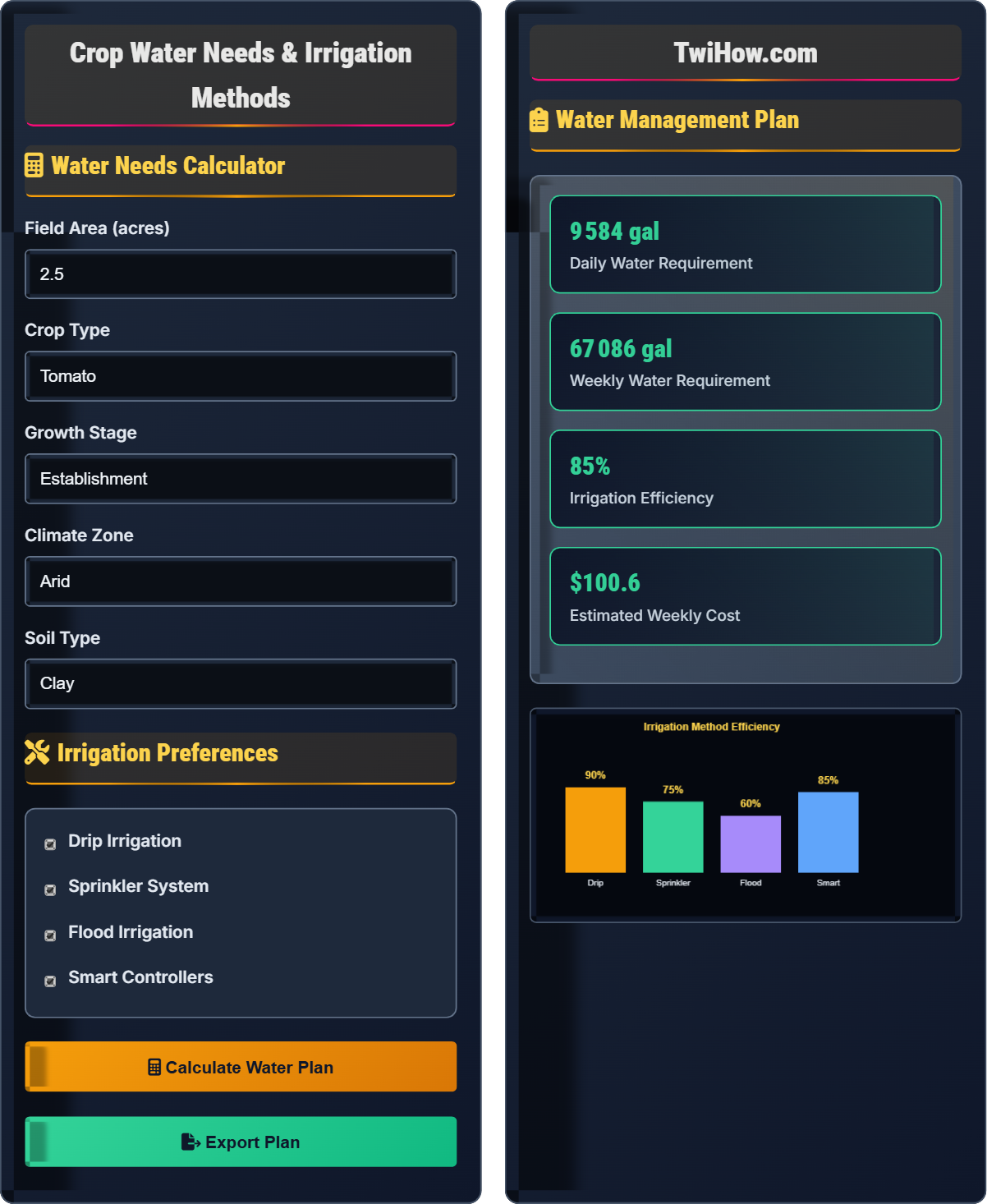
Water Needs Calculator
Irrigation Preferences
Water Management Plan
| Method | Efficiency | Application Rate |
|---|---|---|
| Drip Irrigation | 90% | 0.25 in/hr |
| Sprinkler | 75% | 0.5 in/hr |
| Flood | 60% | 1.0 in/hr |
Crop Water Needs Fundamentals
Crop water requirements are determined by several interconnected factors:
- Evapotranspiration (ET): Combined water loss from evaporation and transpiration
- Crop Coefficient (Kc): Specific water needs based on crop type and growth stage
- Climate Conditions: Temperature, humidity, wind speed, and solar radiation
- Soil Characteristics: Water holding capacity and infiltration rate
- Growth Stage: Water needs vary from establishment to harvest
The fundamental equation for irrigation scheduling:
Where:
- ETc: Crop evapotranspiration (mm/day)
- Kc: Crop coefficient (dimensionless)
- ETo: Reference evapotranspiration (mm/day)
Typical Kc values for common crops at peak demand:
- Vegetables: Tomatoes (1.15), Lettuce (1.05), Peppers (1.10)
- Field Crops: Corn (1.20), Soybeans (1.15), Wheat (1.10)
- Fruits: Strawberries (1.00), Berries (1.05)
- Perennials: Grapes (1.15), Fruit Trees (1.20)
Understanding soil water dynamics:
- Field Capacity: Maximum water held after drainage (60-70% of available water)
- Wilting Point: Water level where plants cannot extract water (0% available)
- Available Water: Water between field capacity and wilting point
- Readily Available Water: Portion easily extracted by plants (50-75% of available water)
Irrigation Methods & Systems
Most efficient method delivering water directly to root zone:
- Efficiency: 85-95% water use efficiency
- Advantages: Precise water delivery, reduces evaporation, allows fertigation
- Disadvantages: Higher initial cost, requires filtration, maintenance intensive
- Best For: Vegetables, orchards, vineyards, high-value crops
Simulates rainfall over large areas:
- Efficiency: 70-85% water use efficiency
- Advantages: Uniform coverage, adaptable to irregular shapes
- Disadvantages: Wind drift losses, higher evaporation
- Best For: Row crops, pastures, large areas
Modern technologies for precise water management:
- Soil Moisture Sensors: Measure actual soil water content
- Weather Stations: Adjust irrigation based on local conditions
- Smart Controllers: Automated scheduling based on data inputs
- Variable Rate Irrigation: Adjust water application by zone
Irrigation Method Comparison
- Efficiency: 85-95%
- Cost: High initial investment
- Maintenance: Regular cleaning/filtering
- Water Savings: 30-50% compared to other methods
- Best For: High-value crops, limited water
- Efficiency: 70-85%
- Cost: Medium investment
- Maintenance: Moderate, nozzle cleaning
- Water Savings: 10-30% compared to flood
- Best For: Large areas, various crops
Crop Water Needs & Irrigation Quiz
Which growth stage typically requires the highest water application rate for most crops?
The flowering and fruiting stages typically require the highest water application rates for most crops. This is when plants are developing reproductive structures and fruits, which requires significant water for cell expansion and metabolic processes. Water stress during this critical period can severely impact yield and quality.
The answer is C) Flowering/Fruiting.
This question tests understanding of the relationship between crop development stages and water requirements. The flowering and fruiting stages are critical periods when water stress can cause irreversible yield losses. Understanding this relationship is fundamental to effective irrigation scheduling and crop management.
Evapotranspiration (ET): Combined water loss from soil and plants
Critical Growth Stage: Period when water stress causes greatest yield loss
Water Stress: Condition when plants don't receive adequate water
• Flowering/fruiting stages are most sensitive to water stress
• Water needs vary throughout the growing season
• Critical periods require priority water allocation
• Monitor soil moisture more frequently during critical growth stages
• Increase irrigation frequency during flowering/fruiting
• Adjust schedules based on weather conditions
• Under-irrigating during critical growth stages
• Not adjusting irrigation based on crop development
• Over-irrigating during establishment phase
Calculate the daily water requirement for 5 acres of corn at the flowering stage in a semi-arid climate. Given: ETo = 0.25 in/day, Kc = 1.20, and irrigation efficiency = 80%.
Step 1: Calculate ETc (Crop Evapotranspiration)
ETc = Kc × ETo = 1.20 × 0.25 in/day = 0.30 in/day
Step 2: Calculate Daily Water Requirement
Water requirement = ETc × Field area
Water requirement = 0.30 in/day × 5 acres
Convert inches to gallons: 1 acre-inch = 27,154 gallons
Water requirement = 0.30 × 5 × 27,154 = 40,731 gallons/day
Step 3: Account for Irrigation Efficiency
Applied water = Water requirement ÷ Efficiency
Applied water = 40,731 ÷ 0.80 = 50,914 gallons/day
The corn crop requires approximately 50,914 gallons of applied water per day during flowering.
This calculation demonstrates the fundamental relationship between crop water needs and irrigation system efficiency. The example shows how inefficiencies in the irrigation system require more water to be applied to meet the actual crop requirement. Understanding this relationship is essential for accurate water budgeting and system design.
Reference Evapotranspiration (ETo): Water loss from grass reference surface
Crop Coefficient (Kc): Multiplier for crop-specific water needs
Irrigation Efficiency: Percentage of applied water beneficially used
• ETc = Kc × ETo for crop-specific water needs
• Applied water must account for system inefficiencies
• Different crops have different Kc values
• Use local weather data for accurate ETo calculations
• Adjust Kc values based on growth stage
• Regularly calibrate irrigation system efficiency
• Not accounting for irrigation system inefficiencies
• Using incorrect Kc values for growth stage
• Ignoring the difference between water requirement and applied water
A farmer has 10 acres of tomatoes in the fruiting stage requiring 0.35 inches of water per day. Their drip irrigation system delivers 0.25 inches per hour and operates at 90% efficiency. Calculate the daily operation time needed and the total weekly water requirement.
Step 1: Calculate Total Daily Water Requirement
Water needed = 0.35 in/day × 10 acres = 3.5 acre-inches/day
Convert to gallons: 3.5 × 27,154 = 95,039 gallons/day
Step 2: Account for System Efficiency
Water to apply = 3.5 ÷ 0.90 = 3.89 acre-inches/day
Step 3: Calculate Operation Time
Operation time = Water to apply ÷ Application rate
Operation time = 3.89 acre-inches ÷ (0.25 in/hr × 10 acres) = 1.56 hours/day
Step 4: Calculate Weekly Requirement
Weekly water = 3.5 acre-inches/day × 7 days = 24.5 acre-inches
Weekly water in gallons = 24.5 × 27,154 = 665,273 gallons
The system needs to operate for 1.56 hours daily, applying a total of 665,273 gallons weekly.
This problem demonstrates practical irrigation scheduling calculations. The example shows how to translate crop water needs into actual system operation parameters. Understanding these calculations is crucial for effective water management and system optimization.
Acre-Inch: Volume of water covering 1 acre to 1 inch depth
Application Rate: Rate at which water is delivered to field
Irrigation Scheduling: Timing and amount of irrigation applications
• Calculate actual water needs before system capacity
• Account for system efficiency in scheduling
• Regular calibration ensures accurate applications
• Monitor soil moisture to verify scheduled applications
• Adjust timing based on weather conditions
• Keep detailed records of water applications
• Not accounting for system efficiency in calculations
• Using incorrect application rates for system
• Not adjusting for changing weather conditions
A farmer needs to irrigate 50 acres of vegetables (mixed crops) with limited water supply (200,000 gallons/month). The farm has sandy loam soil and is located in a semi-arid region. Recommend the most appropriate irrigation system and justify your choice based on water efficiency and crop needs.
Recommendation: Drip Irrigation System
Justification:
1. Water Efficiency: Drip systems achieve 85-95% efficiency compared to 70-80% for sprinklers and 50-70% for flood irrigation. This maximizes the use of limited water supply.
2. Soil Compatibility: Sandy loam soil has moderate water holding capacity. Drip irrigation delivers water slowly, reducing deep percolation losses that would occur with faster application methods.
3. Crop Suitability: Vegetables have shallow root systems and require frequent, precise watering. Drip systems provide optimal water delivery directly to the root zone.
4. Climate Adaptation: In semi-arid conditions with limited water, the precision and efficiency of drip irrigation are essential.
5. Water Budget Analysis: With 200,000 gallons/month available, drip irrigation can support the required crop water needs more effectively than other methods.
This problem demonstrates how to select irrigation systems based on multiple constraints. The solution shows how water efficiency, soil characteristics, crop needs, and climate all influence system selection. This example illustrates the integrated approach required for effective irrigation management.
System Selection: Choosing irrigation method based on site conditions
Water Budget: Available water compared to crop requirements
Soil-Water Relationships: How soil type affects irrigation needs
• Match irrigation system to crop and soil characteristics
• Consider water availability in system selection
• Evaluate total cost including installation and operation
• Consider multiple systems for different crop areas
• Factor in labor requirements for system maintenance
• Evaluate long-term sustainability of water supply
• Selecting system based on cost alone
• Not considering soil characteristics
• Ignoring water availability constraints
What is the term for the amount of water that can be held in soil between field capacity and permanent wilting point?
Available water is the portion of soil water that can be extracted by plants between field capacity (maximum water held after drainage) and permanent wilting point (minimum water available to plants). This represents the water that plants can actually use from the soil.
The answer is A) Available Water.
This question tests understanding of fundamental soil-water relationships. The concept of available water is crucial for irrigation scheduling because it defines the water reservoir that plants can access. Understanding this relationship helps determine when irrigation is needed and how much water to apply.
Field Capacity: Maximum water held after gravitational drainage
Permanent Wilting Point: Water content when plants cannot extract water
Available Water: Water between field capacity and wilting point
• Plants can only use available water from soil
• Different soil types hold different amounts of available water
• Irrigation should replenish available water before stress occurs
• Clay soils hold more available water than sandy soils
• Monitor soil moisture at different depths
• Consider root depth when assessing water availability
• Confusing available water with total water content
• Not considering soil type differences
• Ignoring the relationship between soil water and plant stress
FAQ
Q: How do I know if I'm overwatering or underwatering my crops?
A: Signs of overwatering: yellowing leaves, wilting despite wet soil, fungal growth, root rot, and nutrient leaching. Signs of underwatering: wilting during heat of day, leaf curling, stunted growth, and premature dropping of leaves or flowers. Use soil moisture meters or the finger test (insert finger 4-6 inches deep) to check soil conditions. Most crops prefer soil that is moist but not saturated. Generally, plants need about 1-1.5 inches of water per week including rainfall. Consider installing soil moisture sensors for precise monitoring.
Q: Is drip irrigation worth the investment for a small home garden?
A: Yes, drip irrigation can be very beneficial for home gardens. Benefits include: 90%+ water efficiency (saves water bills), reduced weed growth (water only goes to plants), lower disease incidence (no water on leaves), and time savings (automated watering). For a small garden (under 1000 sq ft), a basic drip system costs $100-300 and pays for itself within 1-2 seasons through water savings. Systems are easy to install and can be expanded. Consider soaker hoses as a simpler, less expensive alternative ($20-50) that provides similar benefits for smaller spaces.