How to Improve Soil Health Naturally Without Chemicals
Sustainable farming guide • Step-by-step explanations
Soil Health Fundamentals:
Show Soil Health SimulatorImproving soil health naturally involves enhancing the physical, chemical, and biological properties of soil through organic matter addition, beneficial microorganisms, and sustainable farming practices. Healthy soil contains a diverse ecosystem of bacteria, fungi, earthworms, and other organisms that work together to create fertile growing conditions.
Key natural soil improvement methods include:
- Composting: Adding decomposed organic matter to increase nutrients
- Cover Crops: Protecting soil between growing seasons
- Crop Rotation: Alternating plant types to balance nutrients
- Organic Amendments: Natural fertilizers and soil conditioners
Natural soil improvement creates a self-sustaining ecosystem that reduces dependency on synthetic inputs while increasing long-term productivity.
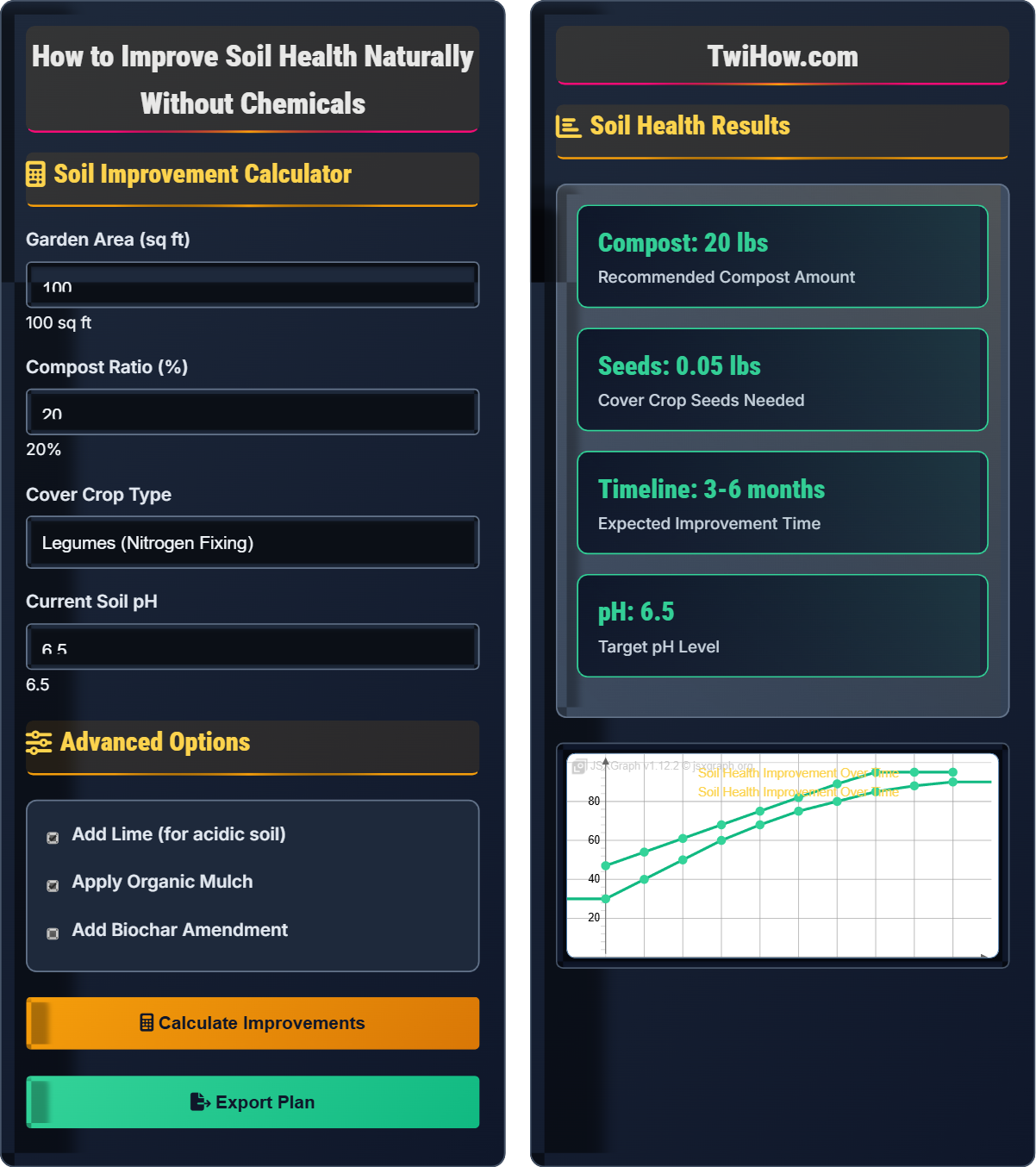
Soil Improvement Calculator
Advanced Options
Soil Health Results
| Action | Amount | Timing | Benefits |
|---|---|---|---|
| Add Compost | 200 lbs | Now | Improve structure |
| Plant Cover Crop | 5 lbs seeds | Fall | Add nitrogen |
| Apply Mulch | 2-4 inches | Year-round | Retain moisture |
| Add Lime | 50 lbs | Spring | Balances pH |
Compost
Mulch
Lime
Cover Crop
Test Soil
Harvest
Natural Soil Improvement Methods Explained
Composting transforms kitchen scraps and yard waste into nutrient-rich soil amendment. The ideal carbon-to-nitrogen ratio for composting is approximately 30:1, calculated as:
Organic matter improves soil structure, water retention, and provides food for beneficial microorganisms. Aim for 3-6% organic matter content in healthy soil.
Cover crops protect soil from erosion, suppress weeds, and add organic matter when decomposed. Different types provide various benefits:
- Legumes: Fix nitrogen from atmosphere (100-200 lbs N/acre)
- Grasses: Produce extensive root systems and organic matter
- Brassicas: Break compacted soil layers with taproots
- Winter Kill: Die off naturally in cold weather
Healthy soil contains billions of microorganisms per gram, including bacteria, fungi, protozoa, and nematodes. These organisms:
- Decompose organic matter
- Cycle nutrients for plant uptake
- Create soil aggregates
- Protect plants from pathogens
Earthworms can process up to 36 tons of organic matter per acre annually.
- Biochar: Long-lasting carbon that improves soil structure
- Rock Dust: Slow-release minerals and trace elements
- Kelp Meal: Micronutrients and growth stimulants
- Wood Ash: Potassium and pH adjustment
Soil Health Fundamentals
Soil biology, organic matter, pH balance, water retention, nutrient cycling, soil structure.
Soil Health Index = (Organic Matter % + Water Retention + Biological Activity) / 3
Where optimal ranges: OM 3-6%, WR 25-40%, BA high diversity.
- Maintain 3-6% organic matter content
- Keep pH between 6.0-7.0 for most crops
- Minimize soil disturbance
Natural Improvement Methods
Composting, cover cropping, crop rotation, organic amendments, reduced tillage.
- Test soil composition and pH
- Add organic matter regularly
- Plant cover crops during off-season
- Rotate crop families annually
- Build organic matter gradually
- Encourage beneficial microorganisms
- Minimize chemical inputs
- Monitor soil health regularly
Soil Composition Visualization
Soil Health Learning Quiz
What is the ideal percentage of organic matter in healthy agricultural soil?
Healthy agricultural soil typically contains 3-6% organic matter. This range provides optimal soil structure, water retention, and nutrient availability while supporting beneficial microorganisms. Lower percentages indicate depleted soil, while higher percentages are typically found in forest soils or heavily amended garden beds.
The answer is B) 3-6%.
Organic matter serves as the foundation of soil health. It acts as a sponge to retain water and nutrients, provides food for beneficial microorganisms, and helps bind soil particles together into stable aggregates. Understanding target ranges helps farmers and gardeners know when soil amendments are needed.
Organic Matter: Decomposed plant and animal material in soil
Soil Aggregates: Clusters of soil particles bound together
Water Retention: Soil's ability to hold moisture for plants
• Organic matter decomposes over time
• Regular additions maintain levels
• Higher levels improve soil quality
• Test soil annually to monitor OM levels
• Add 1-2 inches of compost yearly
• Use cover crops to add organic matter
• Assuming all soil has adequate organic matter
• Not testing soil before amending
• Adding too much organic matter at once
Explain the composting process and the ideal carbon-to-nitrogen ratio. Why is this ratio important for efficient decomposition?
Composting Process: Composting is the aerobic decomposition of organic matter by microorganisms. The process involves mesophilic bacteria initially, followed by thermophilic bacteria that generate heat (130-160°F) to kill pathogens and weed seeds.
Ideal C:N Ratio: Approximately 30:1 carbon to nitrogen by weight. Carbon provides energy for microorganisms, while nitrogen provides protein for reproduction.
Importance: A balanced C:N ratio ensures efficient decomposition without odor problems or nutrient loss. Too much carbon slows decomposition; too much nitrogen causes ammonia loss and odors.
Understanding the composting process helps optimize conditions for rapid, odor-free decomposition. The C:N ratio is crucial because it determines the rate of decomposition and the quality of the finished compost. Balancing "brown" materials (high carbon) with "green" materials (high nitrogen) creates optimal conditions for beneficial microorganisms.
Aerobic Decomposition: Breakdown in presence of oxygen
Mesophilic Bacteria: Organisms active at moderate temperatures
Thermophilic Bacteria: Heat-loving organisms
• Maintain 30:1 C:N ratio for best results
• Turn pile regularly for aeration
• Keep moisture at 40-60%
• Chop materials for faster decomposition
• Layer brown and green materials
• Monitor temperature with thermometer
• Adding meat or dairy products
• Not turning the pile enough
• Incorrect C:N ratio causing odors
A farmer has exhausted soil with low nitrogen levels and compaction issues. The farm experiences mild winters with occasional freezes. Which cover crop combination would be most beneficial and why? Calculate the expected nitrogen contribution if planting 10 acres of leguminous cover crop yielding 150 lbs N/acre.
Recommended Combination: Winter rye (grass) + crimson clover (legume). Rye provides excellent soil penetration and organic matter, while clover fixes atmospheric nitrogen.
Total Nitrogen Contribution: 10 acres × 150 lbs N/acre = 1,500 lbs total nitrogen
Benefits: Clover adds nitrogen, rye breaks compaction, mixture provides both benefits while winter-hardy varieties survive mild freezes.
Selecting appropriate cover crops requires considering local climate, soil issues, and desired benefits. Mixing grasses and legumes combines the advantages of both: grasses for soil structure and organic matter, legumes for nitrogen fixation. The nitrogen contribution calculation demonstrates the economic value of biological nitrogen fixation compared to synthetic fertilizers.
Nitrogen Fixation: Conversion of atmospheric N₂ to plant-available forms
Biological Nitrogen Fixation: Process by legume-rhizobia partnership
Winter Kill: Cover crop dying due to cold temperatures
• Match crop to climate zone
• Address primary soil issues first
• Consider timing of incorporation
• Plant mixtures for multiple benefits
• Choose winter-hardy varieties for mild climates
• Plan termination timing carefully
• Choosing crops unsuited to climate
• Not considering timing with cash crops
A vegetable farmer grows tomatoes, corn, beans, and lettuce in rotation. Explain the optimal sequence and benefits of this rotation. How does this rotation address nitrogen needs and disease prevention?
Optimal Sequence: Legumes (beans) → Heavy Feeders (corn) → Light Feeders (lettuce) → Heavy Feeders (tomatoes)
Nitrogen Management: Beans fix nitrogen, benefiting subsequent crops. Corn utilizes nitrogen efficiently, while lettuce and tomatoes are heavy feeders that benefit from residual fertility.
Disease Prevention: Breaking pest and disease cycles by alternating crop families. Tomatoes (nightshade) and corn (grass) have different pests, reducing buildup.
Crop rotation is one of the most effective tools for maintaining soil fertility and preventing pest/disease problems. The sequence matters because different crops have varying nutrient needs and contribute differently to soil health. Legumes add nitrogen, heavy feeders deplete it, and rotating crop families prevents pathogen accumulation.
Heavy Feeders: Crops requiring high nutrient inputs
Light Feeders: Crops requiring minimal nutrients
Disease Cycle: Pathogen survival and reproduction pattern
• Rotate crop families annually
• Balance heavy and light feeders
• Include nitrogen-fixing crops
• Plan 3-4 year rotation cycles
• Include cover crops in rotation
• Keep detailed field records
• Growing same crop family consecutively
• Not considering nutrient demands
• Ignoring pest and disease history
Which natural amendment is most effective for improving soil structure and providing long-term carbon storage?
Biochar is produced by pyrolysis (heating organic material without oxygen) and creates a highly stable carbon form that can persist in soil for hundreds to thousands of years. It has an extremely porous structure that improves water retention and provides habitat for beneficial microorganisms. While composted manure provides immediate nutrients, biochar offers long-term structural benefits and carbon sequestration.
The answer is B) Biochar.
Each natural amendment serves different purposes in soil improvement. Biochar stands out for its longevity and structural benefits, making it particularly valuable for long-term soil health improvement. Its unique properties include high surface area, permanent porosity, and resistance to decomposition, which contribute to improved soil aggregation and microbial habitat.
Biochar: Charcoal made from organic materials for soil improvement
Pyrolysis: Heating organic matter without oxygen
Carbon Sequestration: Storing carbon in soil long-term
• Biochar must be properly prepared
• Charge with nutrients before application
• Mix thoroughly with soil
• Compost biochar before application
• Use 1-2% by volume maximum
• Combine with organic matter
• Applying raw biochar without charging
• Using too much at once
• Not incorporating properly
Composting Guide
Compost Ratio Calculator
For every 1 part nitrogen-rich "greens" (kitchen scraps, fresh grass), add 2-3 parts carbon-rich "browns" (dry leaves, paper, wood chips).
Examples:
- Greens: Vegetable scraps, coffee grounds, fresh grass clippings
- Browns: Dry leaves, cardboard, paper, straw
Popular Cover Crops
Winter Rye: Excellent for erosion control and soil structure
Crimson Clover: Adds nitrogen and attractive to pollinators
Winter Wheat: Good biomass producer and cold-tolerant
Radish: Breaks compacted soil layers with deep taproot
FAQ
Q: How long does it take to see improvements in soil health after starting natural amendments?
A: Visible improvements typically begin within 3-6 months, with significant changes occurring over 1-2 growing seasons. You'll notice:
1. 3-6 months: Improved soil structure, easier workability
2. 6-12 months: Better water infiltration and retention
3. 1-2 years: Increased earthworm activity, enhanced plant growth
4. 3-5 years: Optimal organic matter levels, reduced pest pressure
Consistency is key - regular additions of organic matter yield the best results over time.
Q: What's the difference between no-till and reduced-till farming for soil health?
A: Both methods aim to preserve soil structure and biology, but differ in intensity:
No-Till: Zero soil disturbance except for seed placement. Maintains soil aggregates, preserves organic matter, and supports soil organism habitats. Requires specialized equipment and herbicide programs.
Reduced-Till: Minimal soil disturbance, such as strip-till or ridge-till. Combines some benefits of conventional tillage (warming, drying) with reduced erosion and improved soil health compared to full tillage.
Both methods significantly improve soil health compared to conventional tillage, with no-till offering maximum benefits for organic matter accumulation and soil biology preservation.