How do I integrate livestock and crops for a closed-loop system?
Complete closed-loop farming guide • Step-by-step implementation
Closed-Loop Farming Fundamentals:
Show Closed-Loop CalculatorClosed-loop farming integrates livestock and crops in a symbiotic system where waste from one component becomes input for another. Livestock provide manure for crop fertilization, while crops supply feed and bedding. This creates a sustainable cycle that reduces external inputs and maximizes resource efficiency.
Key closed-loop components:
- Nutrient Cycling: Manure → Soil → Crops → Feed → Animals
- Rotational Grazing: Moving animals to optimize pasture health
- Integrated Pest Management: Animals controlling pests naturally
- Waste Utilization: Converting all farm waste into resources
- Resource Sharing: Water, equipment, and labor efficiency
- Seasonal Coordination: Aligning animal and crop cycles
Benefits include reduced costs, improved soil health, enhanced biodiversity, and sustainable food production.
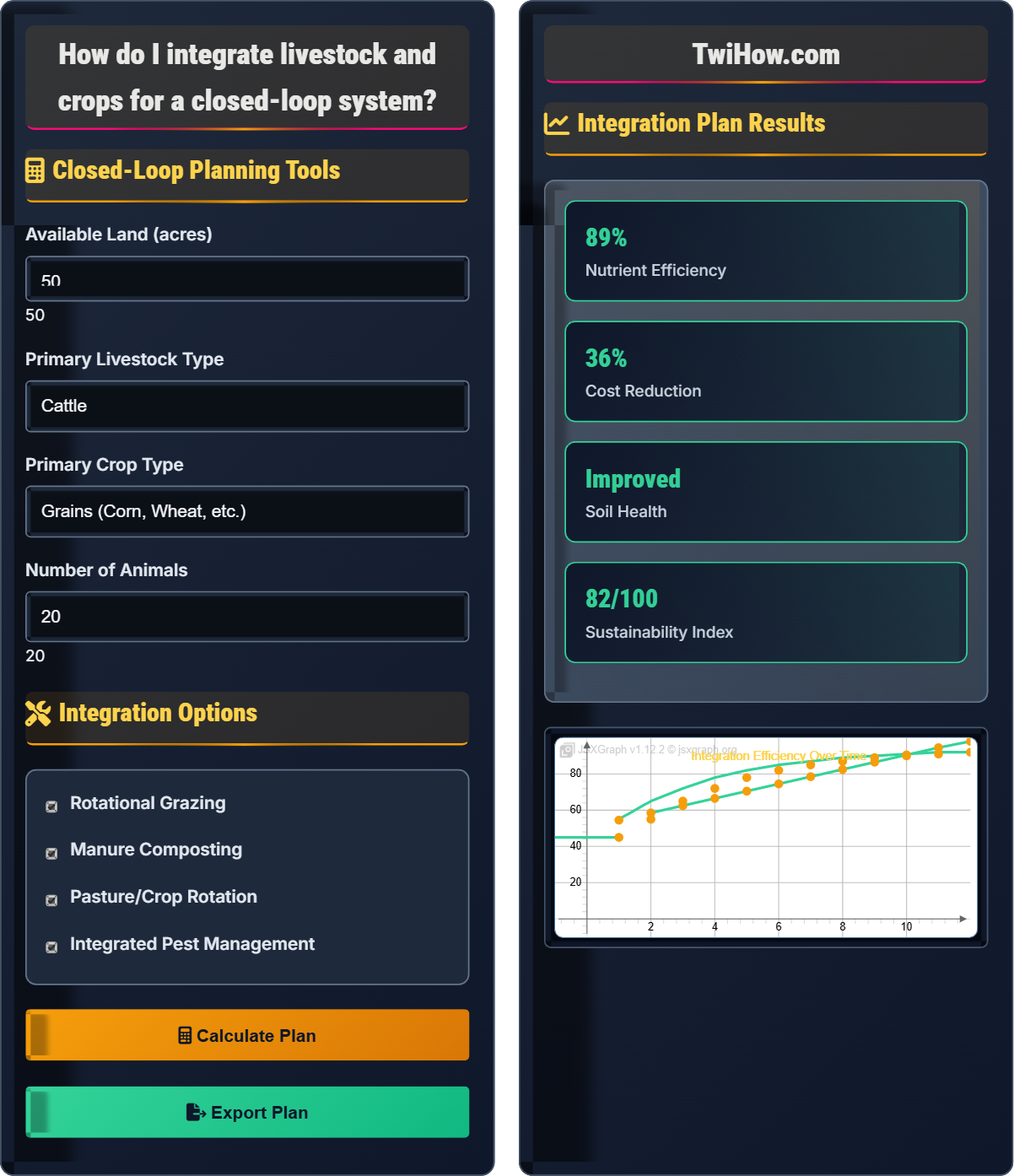
Closed-Loop Planning Tools
Integration Options
Integration Plan Results
| Component | Integration | Benefits | Timeline |
|---|---|---|---|
| Manure Management | Composting system | Soil fertility | Immediate |
| Pasture Rotation | 4-paddock system | Grass recovery | Continuous |
| Crop Integration | Winter grazing | Soil conditioning | Seasonal |
| Pest Control | Chicken foraging | Natural control | Ongoing |
Closed-Loop Farming Planning Explained
Closed-loop farming integrates livestock and crops in a symbiotic system where waste from one component becomes input for another. Livestock provide manure for crop fertilization, while crops supply feed and bedding. This creates a sustainable cycle that reduces external inputs and maximizes resource efficiency. The system mimics natural ecosystems where waste is recycled and nothing is wasted.
Where:
- Nutrients Returned to Soil: From manure, compost, and animal byproducts
- Nutrients Removed from System: From harvested crops and animal products
- Nutrient Efficiency: Percentage of nutrients retained in the system
Key areas where closed-loop farming makes an impact:
- Soil Health: Improved fertility and structure through organic matter
- Resource Efficiency: Reduced waste and external inputs
- Environmental Benefits: Lower carbon footprint and pollution
- Economic Returns: Diversified income streams
- Biodiversity: Enhanced ecosystem services
- Food Security: Localized production systems
- Rotational Grazing: Move animals to prevent overgrazing and allow recovery
- Manure Management: Proper composting and timing of application
- Seasonal Coordination: Align animal and crop cycles for maximum benefit
- Integrated Pest Management: Use animals to control pests naturally
- Soil Testing: Monitor nutrient levels and adjust inputs accordingly
Closed-Loop Farming Fundamentals
Nutrient cycling, rotational grazing, waste utilization, resource efficiency, sustainability, symbiosis.
Nutrient Efficiency = (Nutrients Returned to Soil / Nutrients Removed from System) × 100%
Where Nutrient Efficiency = percentage of nutrients retained in the system.
- Maximize nutrient retention
- Minimize external inputs
- Balance animal and crop needs
Applications
Integrated farming, permaculture, regenerative agriculture, sustainable livestock management.
- Soil fertility enhancement
- Waste reduction
- Cost optimization
- Environmental protection
- Initial setup costs
- Management complexity
- Regulatory compliance
- Market development
Closed-Loop Farming Learning Quiz
In a closed-loop system, what is the primary pathway for nitrogen cycling between livestock and crops?
In a closed-loop system, nitrogen cycles primarily through the pathway: animals consume crops (or crop residues), digest the protein, and excrete nitrogen-rich manure that becomes available to plants. This creates a continuous cycle where nitrogen moves from crops to animals and back to the soil for plant uptake. The key is that the nitrogen is recycled within the system rather than being lost.
The answer is A) Animals eat crops → excrete manure → plants absorb nitrogen.
Nitrogen cycling is fundamental to closed-loop systems. The nitrogen in animal manure comes from the protein they consumed, which originally came from plants. When properly managed, this creates a sustainable cycle where nitrogen is continuously recycled within the farm system. Understanding this cycle helps farmers optimize their integration strategies.
Nitrogen Cycle: Movement of nitrogen through ecosystem components
Manure: Animal waste containing organic nutrients
Protein Digestion: Breakdown of amino acids in animal digestion
• Maintain nitrogen balance
• Properly compost manure
• Time application correctly
• Test soil nitrogen levels regularly
• Compost manure before application
• Apply during optimal growing periods
• Applying raw manure directly
• Not timing application properly
• Over-applying nitrogen
Explain how rotational grazing contributes to a closed-loop system and what factors should be considered when designing a rotation schedule.
Rotational Grazing Benefits: Rotational grazing moves animals systematically between paddocks, allowing pastures to rest and recover. This prevents overgrazing, promotes root growth, and ensures even manure distribution.
Factors for Rotation Schedule:
Grass Growth Rate: Faster growth allows shorter recovery periods
Animal Density: Higher density requires more frequent moves
Season: Growth rates vary with weather and rainfall
Forage Quality: Maintain optimal nutritional levels
Soil Conditions: Prevent compaction and damage
This system creates a closed loop where animals fertilize pastures while benefiting from fresh forage, maximizing both animal health and pasture productivity.
Rotational grazing is a cornerstone of closed-loop systems because it optimizes the interaction between animals and plants. The key is matching animal grazing pressure with plant recovery capacity. This creates a sustainable cycle where animals improve soil fertility through manure while benefiting from high-quality forage. Proper timing is crucial for success.
Rotational Grazing: Moving animals between paddocks systematically
Recovery Period: Time between grazings for pasture regrowth
Stocking Density: Number of animals per unit area
• Match stocking rate to carrying capacity
• Allow adequate recovery time
• Monitor pasture condition
• Use temporary fencing for flexibility
• Monitor grass height regularly
• Adjust rotation based on season
• Moving animals too frequently
• Not allowing enough recovery time
• Overstocking paddocks
A farmer has 100 acres and is considering integrating 30 beef cattle with grain production. The cattle generate 15 tons of manure per year valued at $20 per ton for nitrogen, phosphorus, and potassium. Grain production costs $150 per acre but requires $75 per acre in fertilizer. Calculate the net benefit of integrating livestock for fertilizer replacement and explain other economic benefits.
Manure Value: 15 tons × $20/ton = $300 per year
Fertilizer Savings: $75 per acre × 100 acres = $7,500 per year
Net Fertilizer Benefit: $7,500 - $300 = $7,200 per year
Other Economic Benefits: Additional income from cattle sales, reduced feed costs through grazing, improved soil health leading to higher yields, reduced machinery costs through animal labor, and diversified income streams.
The integration provides significant economic benefits through reduced input costs and improved soil fertility, with additional benefits from diversification and reduced external dependencies.
This problem demonstrates the economic advantages of closed-loop systems. While the direct fertilizer replacement value is significant, the real benefits come from system optimization. The manure provides not just nutrients but also organic matter that improves soil structure and water retention, leading to long-term productivity gains. The economic analysis should consider both direct and indirect benefits.
Fertilizer Replacement Value: Economic value of nutrients in manure
External Input Reduction: Decreased reliance on purchased inputs
System Optimization: Maximizing efficiency across components
• Calculate total system benefits
• Consider long-term improvements
• Factor in management costs
• Track both direct and indirect benefits
• Monitor soil health improvements
• Consider risk reduction benefits
• Only counting direct benefits
• Not considering long-term gains
• Underestimating management costs
A farmer wants to integrate 50 laying hens with a vegetable garden on 5 acres. Design a system that maximizes the benefits of this integration while addressing potential challenges. Include seasonal considerations and management practices.
System Design: Create mobile chicken coops that rotate through garden sections. Use chickens for pest control during growing season and soil preparation during winter.
Seasonal Schedule:
Spring: Move chickens to areas for soil preparation before planting
Summer: Use chickens for pest control in non-sensitive areas
Fall: Turn chickens onto crop residue to clean up pests
Winter: Concentrate in designated areas for manure accumulation
Management Practices: Protect sensitive crops with netting, provide supplemental feed during low insect periods, ensure adequate water and shelter.
This system leverages chickens for multiple purposes while preventing overgrazing and crop damage.
Chicken integration requires careful management to maximize benefits while preventing crop damage. The key is using chickens at appropriate times and in appropriate locations. Their natural foraging behavior controls pests and weeds while their manure fertilizes the soil. Timing is crucial to match their activities with crop needs and growth stages.
Mobile Coops: Portable shelters that can be moved
Integrated Pest Management: Using animals for biological control
Seasonal Integration: Matching animal activities with crop cycles
• Match animal activities to crop needs
• Protect sensitive crops
• Ensure animal welfare
• Use temporary fencing for flexibility
• Provide dust baths for chickens
• Rotate systematically
• Placing chickens in sensitive areas
• Not managing timing properly
• Overstocking areas
Which environmental benefit of closed-loop farming has the most significant long-term impact?
Increased soil organic matter has the most significant long-term environmental impact in closed-loop systems. Organic matter improves soil structure, water retention, nutrient cycling, and biological activity. It serves as the foundation for healthy soil ecosystems and provides benefits that compound over time. While all benefits are important, soil organic matter underpins all other environmental improvements.
The answer is B) Increased soil organic matter.
Soil organic matter is the foundation of soil health. It improves water infiltration and retention, provides nutrients for plants, creates habitat for beneficial organisms, and helps bind soil particles together. In closed-loop systems, animal manure and crop residues continuously add organic matter to the soil, creating a self-reinforcing cycle of improvement. This benefit builds over time and supports all other environmental advantages.
Soil Organic Matter: Decomposed plant and animal materials in soil
Soil Structure: Arrangement of soil particles into aggregates
Biological Activity: Activity of soil microorganisms
• Continuously add organic matter
• Minimize soil disturbance
• Maintain living roots
• Use diverse crop rotations
• Include cover crops
• Minimize tillage
• Not managing organic matter inputs
• Over-tilling the soil
• Removing crop residues
FAQ
Q: How do I start integrating livestock and crops on a small scale?
A: Start small with a simple system:
Phase 1: Begin with 2-3 animals (chickens or small ruminants) on a small plot
Phase 2: Establish a basic rotation schedule between animals and crops
Phase 3: Set up composting for manure management
Phase 4: Monitor soil health and adjust practices
Focus on learning management skills before expanding. Start with animals that complement your existing crops - chickens for pest control in gardens, or sheep for grazing crop residues.
Q: What are the main challenges in closed-loop farming?
A: Key challenges include:
Management Complexity: Coordinating multiple components requires advanced planning and constant monitoring
Initial Investment: Infrastructure costs for fencing, water systems, and handling facilities
Knowledge Requirements: Understanding animal behavior, crop needs, and timing
Regulatory Compliance: Meeting health, environmental, and zoning regulations
Market Development: Finding markets for diverse products
Seasonal Coordination: Aligning animal and crop cycles optimally
However, with proper planning and gradual implementation, these challenges can be overcome to create sustainable, profitable systems.