How to Manage Weeds Without Herbicides
Sustainable farming guide • Step-by-step explanations
Natural Weed Management Overview:
Show Management PlannerManaging weeds without herbicides requires a comprehensive, integrated approach that focuses on prevention, competition, and physical removal. Successful organic weed management builds healthy soil, promotes beneficial plant relationships, and uses mechanical, cultural, and biological methods to suppress unwanted plants while supporting desired crops.
Key strategies include:
- Mulching: Organic and inorganic materials to suppress weeds
- Cultural Controls: Crop rotation, cover crops, dense planting
- Mechanical Controls: Hand weeding, hoeing, cultivation
- Biological Controls: Beneficial insects, allelopathic plants
Integrated approaches are more effective than single methods and build long-term soil health.
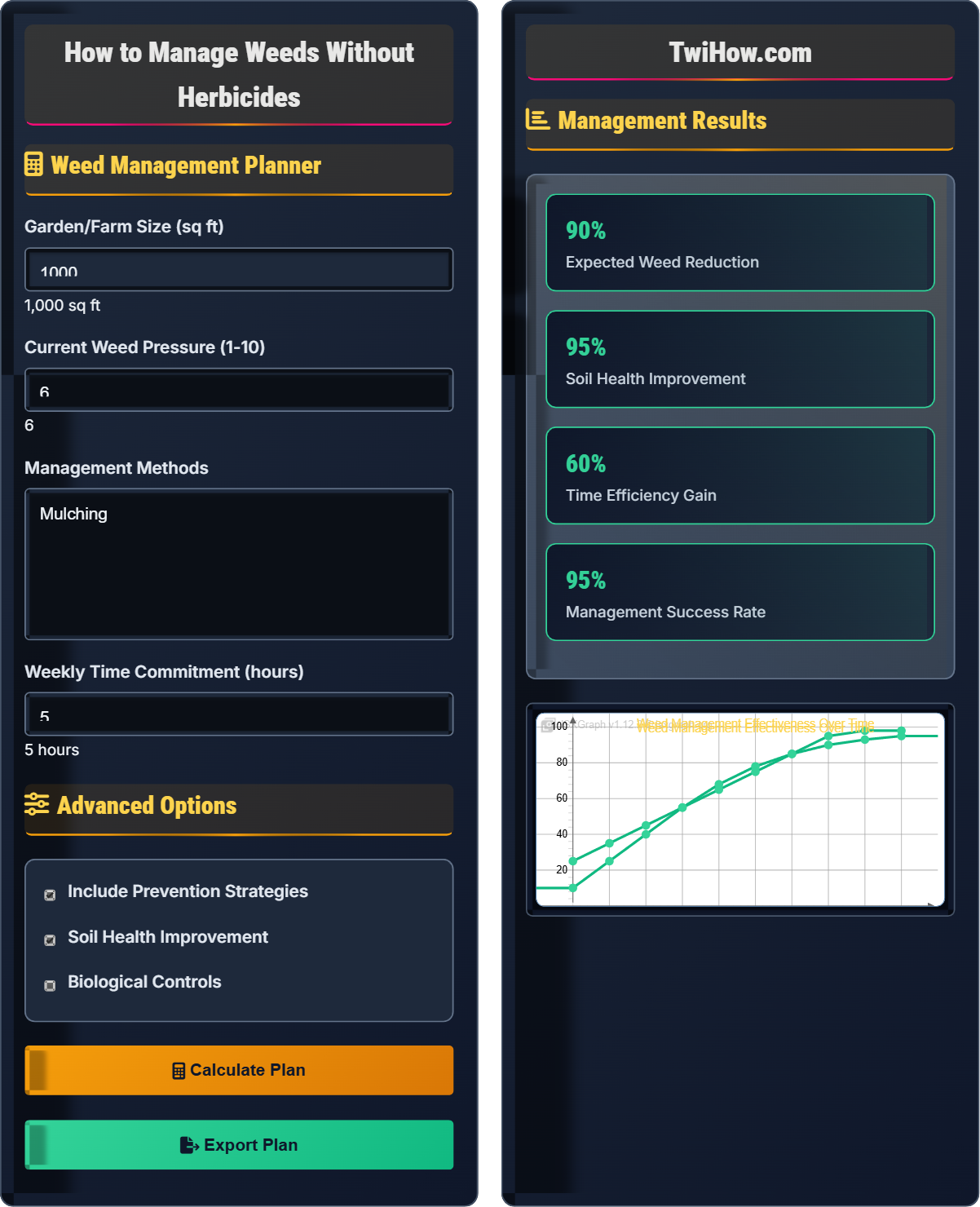
Weed Management Planner
Advanced Options
Management Results
| Method | Effectiveness | Time Required | Cost |
|---|---|---|---|
| Mulching | 80% | 2 hrs/week | Low |
| Hand Weeding | 70% | 3 hrs/week | Free |
| Cover Crops | 85% | 1 hr/week | Medium |
| Crop Rotation | 60% | 2 hrs/week | Low |
Natural Weed Management Explained
The integrated weed management effectiveness is calculated as:
Where WE = Weed Effectiveness, and each component is rated on a 0-100 scale.
Weed suppression through competition:
- Density Effect: Dense plantings reduce available space
- Shading: Canopy coverage limits light penetration
- Root Competition: Nutrient and water competition
- Allelopathy: Chemical suppression by some plants
Effective competition can reduce weed emergence by 60-80%.
Non-chemical approaches to weed management:
- Mulching: Organic or inorganic barriers
- Cover Crops: Living mulch and soil improvement
- Crop Rotation: Breaking weed life cycles
- Soil Health: Promoting beneficial organisms
Combining methods increases overall effectiveness.
- Hand Weeding: Precise removal of individual weeds
- Hoeing: Surface cultivation of young weeds
- Flame Weeding: Thermal control of emerged weeds
- Soil Solarization: Heat treatment for seed control
Weed Management Fundamentals
Integrated pest management, cultural controls, mechanical controls, biological controls, soil health.
WE = (P + S + R) / 3
Where WE = Weed Effectiveness, P = Prevention, S = Suppression, R = Removal.
- Prevent before treating
- Combine multiple methods
- Remove before seeding
- Build soil health
Management Strategies
Mulching, hand weeding, cover crops, crop rotation, flame weeding.
- Assess weed pressure
- Choose appropriate methods
- Implement prevention
- Monitor and adjust
- Start early in season
- Consistent application
- Build soil health
- Track effectiveness
Control Methods
Management Visualization
Weed Management Learning Quiz
Which of the following is the most effective prevention method for controlling weeds?
Mulching is the most effective prevention method among the options listed. Mulch creates a physical barrier that prevents light from reaching weed seeds, which is essential for their germination. It also suppresses existing weed seedlings and prevents new seeds from establishing. While hand weeding, flame weeding, and hoeing are control methods, mulching prevents weeds before they become established.
The answer is B) Mulching.
Prevention is more effective than control in integrated weed management. Mulching works by blocking light, which is essential for most weed seed germination. A 2-4 inch layer of organic mulch can prevent up to 90% of weed seedlings from emerging. This proactive approach reduces the need for reactive control measures and builds long-term weed suppression.
Prevention: Stopping weeds before establishment
Control: Managing existing weeds
Mulch: Protective layer on soil surface
• Apply mulch before weeds emerge
• Maintain proper thickness
• Replenish as needed
• Use 2-4 inches of organic mulch
• Keep mulch away from plant stems
• Replenish annually
• Applying mulch too thin
• Not mulching early enough
• Using fresh grass clippings
Explain how crop rotation helps with weed management and calculate the expected reduction in weed pressure over a 4-year rotation cycle. If a field has 80% weed pressure with continuous corn, and crop rotation reduces pressure by 15% annually, what is the total reduction after 4 years?
Crop Rotation Benefits:
• Breaking Life Cycles: Different crops have different associated weeds
• Altering Management: Different cultivation and timing
• Competitive Differences: Varying plant growth patterns
• Herbicide Rotation: Different selective controls
Calculation: Year 1: 80% × 0.85 = 68%; Year 2: 68% × 0.85 = 57.8%; Year 3: 57.8% × 0.85 = 49.1%; Year 4: 49.1% × 0.85 = 41.7%
Total reduction: 80% - 41.7% = 38.3% reduction after 4 years.
Crop rotation is one of the most effective cultural control methods for weeds. Different crops require different management practices, which disrupts the life cycles of weeds adapted to specific crops. Some weeds are particularly adapted to certain crops, so rotating crops breaks their reproductive cycle. The cumulative effect over multiple years can significantly reduce weed populations.
Crop Rotation: Alternating crop types in sequence
Life Cycle: Weed growth and reproduction pattern
Competitive Exclusion: One species outcompeting another
• Plan 3-4 year rotations
• Include cover crops
• Monitor results
• Include nitrogen fixers
• Vary root structures
• Plan for market demand
• Growing same family consecutively
• Not including soil builders
• Ignoring pest cycles
A gardener wants to mulch a rectangular garden area measuring 20 ft by 30 ft. The recommended mulch depth is 3 inches. Calculate how many cubic yards of mulch are needed. If mulch costs $30 per cubic yard, what is the total cost? Also calculate the weed suppression percentage assuming 2-4 inches provides 80-90% suppression.
Area Calculation: 20 ft × 30 ft = 600 sq ft
Volume Calculation: 600 sq ft × (3 ÷ 12) ft = 150 cubic feet
Cubic Yards: 150 ÷ 27 = 5.56 cubic yards
Cost: 5.56 × $30 = $166.80
Weed Suppression: 3 inches falls within 2-4 inch range = 80-90% suppression
Approximately 85% weed suppression expected.
Proper mulch calculation ensures adequate coverage without waste. The 2-4 inch depth recommendation provides optimal weed suppression while allowing proper water infiltration. Too thin provides insufficient suppression, while too thick can prevent water and air penetration. The cubic yard calculation is important for purchasing the correct amount of mulch.
Cubic Yard: Volume measurement (27 cubic feet)
Optimal Depth: Best mulch thickness for effectiveness
Water Infiltration: Water penetration through mulch
• Measure area accurately
• Calculate depth properly
• Order extra for settling
• Order 10% extra for settling
• Calculate by sections
• Consider delivery costs
• Not converting measurements
• Ordering too little
• Not considering settling
A farmer has a 10-acre field with severe winter annual weed pressure. The field will remain fallow during winter months. Calculate the seed cost for using winter rye as a cover crop if seed costs $35 per 50-lb bag and the recommended rate is 2.5 lbs per 1,000 sq ft. Also calculate the expected weed suppression percentage. (Note: 1 acre = 43,560 sq ft)
Field Area: 10 acres × 43,560 sq ft/acre = 435,600 sq ft
Seed Required: (435,600 ÷ 1,000) × 2.5 lbs = 1,089 lbs
Bags Needed: 1,089 ÷ 50 = 21.78 bags (round up to 22 bags)
Cost: 22 × $35 = $770
Weed Suppression: Winter rye provides 80-90% suppression of winter annuals.
Winter rye is an excellent cover crop for weed suppression due to its rapid fall establishment and dense growth habit. It creates a physical barrier that prevents weed seed germination and competes aggressively with emerging weeds. The allelopathic compounds released by winter rye also inhibit weed seed germination. This provides effective winter annual control while improving soil health.
Winter Annuals: Weeds completing life cycle in winter
Allelopathy: Chemical suppression by plants
Seeding Rate: Amount of seed per area
• Plant before first frost
• Terminate before seed set
• Consider cash crop timing
• Use certified seed
• Plant at proper depth
• Monitor for diseases
• Planting too late
• Not terminating in time
• Poor seed-to-soil contact
When is the best time to hand weed for maximum effectiveness?
The best time to hand weed is when weeds are small seedlings. At this stage, weeds have small, shallow root systems that are easily removed entirely, including the root crown. Small weeds are also easier to identify and distinguish from crop plants. Removing weeds before they develop extensive root systems prevents regrowth and reduces the time required for weeding.
The answer is C) When weeds are small seedlings.
Timing is crucial for effective hand weeding. Small seedlings require minimal effort to remove completely, while mature weeds have developed extensive root systems that are difficult to remove entirely. The "when small, pull all" principle maximizes effectiveness while minimizing effort. Regular, frequent weeding of small weeds is more effective than occasional removal of large weeds.
Seedling Stage: Early plant development phase
Root Crown: Junction of roots and stem
Regrowth: Plant recovery after damage
• Weed when soil is moist
• Remove entire root system
• Dispose of weeds properly
• Water before weeding
• Use proper tools
• Weed after rain
• Waiting too long to weed
• Breaking off tops only
• Not removing entire roots
Control Techniques
FAQ
Q: What's the difference between mulching and sheet mulching?
A: The key differences are:
Traditional Mulching: Applying organic or inorganic materials directly on soil surface to suppress weeds.
Sheet Mulching: Layering organic materials (newspaper, cardboard, compost) to create a "lasagna" effect that kills existing vegetation and builds soil.
Sheet mulching is more intensive but provides longer-lasting weed control and soil improvement.
Q: How effective is flame weeding compared to hand weeding?
A: Effectiveness comparison:
Flame Weeding: 70-85% effectiveness on small seedlings, covers large areas quickly, requires specialized equipment.
Hand Weeding: 95%+ effectiveness when done properly, selective, labor-intensive but precise.
Flame weeding is more efficient for large areas, hand weeding is better for precision and established weeds.