How to Start a Community Garden or Join a Food Cooperative
Complete guide • Step-by-step instructions
Starting a community garden or joining a food cooperative provides numerous benefits: access to fresh, locally grown food, reduced environmental impact, stronger community connections, and shared resources. Both options support sustainable agriculture and local food systems.
Community gardens involve shared spaces where individuals grow their own plots while collaborating on common areas. Food cooperatives are member-owned organizations that purchase and distribute food collectively, often at reduced costs.
Key considerations:
- Location: Accessible, well-drained, sunny area for gardens
- Legal Structure: Permits, insurance, liability coverage
- Membership: Fees, responsibilities, governance
- Sustainability: Long-term planning and resource management
Both approaches require commitment from participants and strong organizational skills to succeed long-term.
Planning Calculator
Additional Features
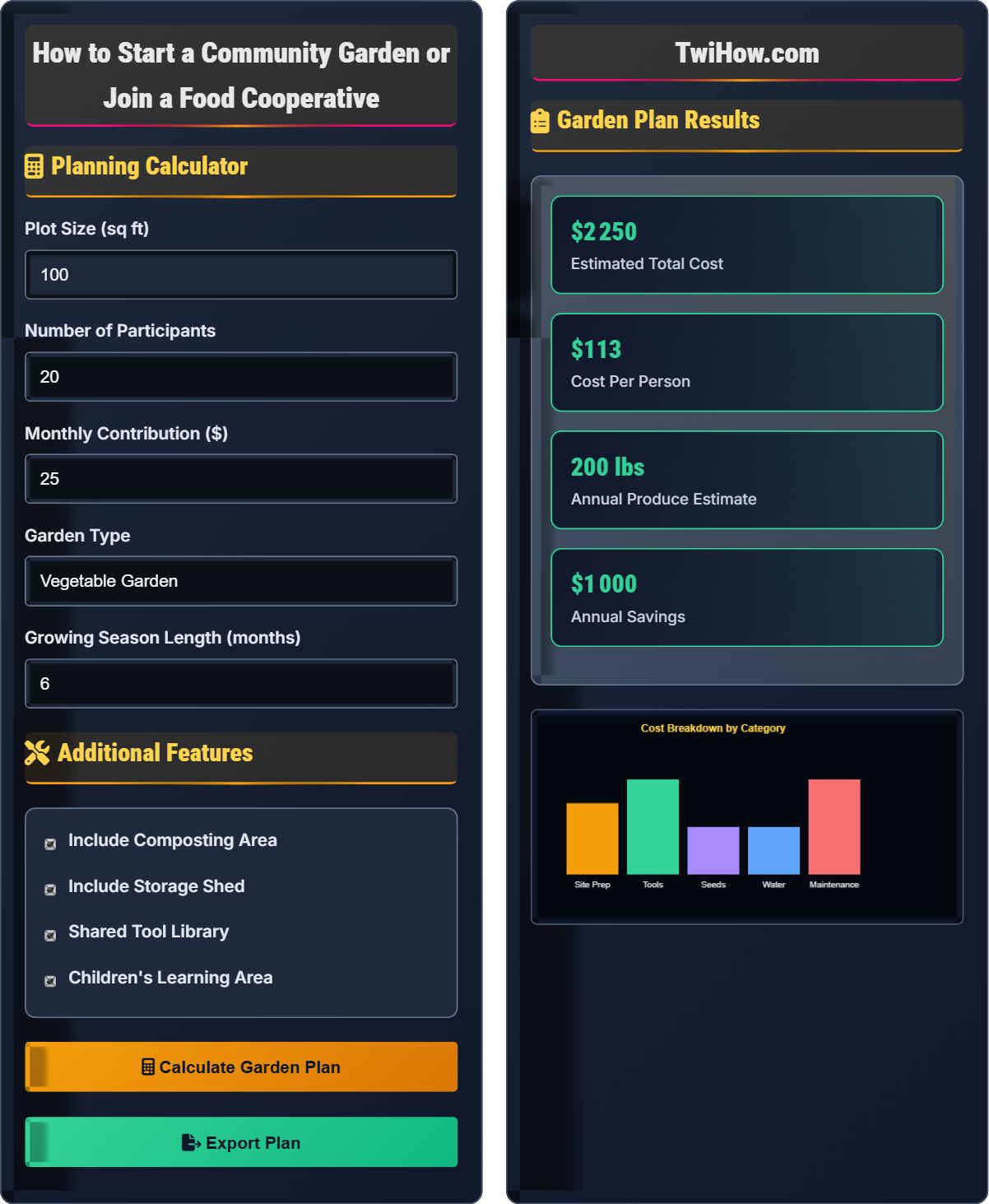
Garden Plan Results
| Item | Cost | Per Person |
|---|---|---|
| Site Preparation | $300 | $15 |
| Tools & Equipment | $400 | $20 |
| Seeds & Plants | $200 | $10 |
| Water & Irrigation | $200 | $10 |
| Maintenance | $400 | $20 |
Starting a Community Garden
A community garden is a shared space where individuals or families cultivate plants in designated plots. These gardens promote sustainable living, strengthen community bonds, and provide access to fresh produce. They can be located in urban, suburban, or rural areas.
Choose a location with:
- Access to Sunlight: At least 6 hours of direct sunlight daily
- Drainage: Well-draining soil to prevent waterlogging
- Accessibility: Proximity to participants and public transportation
- Water Source: Nearby water access for irrigation
- Soil Quality: Test for contamination and nutrient levels
Effective community gardens have clear governance structures:
- Committee Structure: Rotating leadership roles (coordinator, treasurer, secretary)
- Decision Making: Regular meetings with voting on major issues
- Conflict Resolution: Established procedures for addressing disputes
- Participation Requirements: Minimum hours of work per plot
Community gardens require ongoing financial management:
- Startup Costs: Site preparation, tools, water installation, fencing
- Ongoing Expenses: Water fees, insurance, maintenance supplies
- Funding Sources: Membership fees, grants, donations, fundraising events
- Budget Management: Transparent accounting and regular financial reports
Joining a Food Cooperative
A food cooperative is a member-owned business that operates for the benefit of its members. Members pool their resources to buy food and household items at wholesale prices, sharing the savings. Co-ops often prioritize local, organic, and ethically sourced products.
- Lower Prices: Members typically receive 10-20% discounts on purchases
- Product Quality: Emphasis on organic, local, and sustainably produced goods
- Democratic Control: One member, one vote in governance decisions
- Community Connection: Shared values and social interaction opportunities
- Economic Impact: Supports local economy and small producers
Food cooperatives operate on a democratic economic model:
- Member Investment: Initial equity investment becomes ownership share
- Patronage Dividends: Annual refunds based on purchase volume
- Surplus Distribution: Excess revenue returned to members proportionally
- Reinvestment: Some profits reinvested in store improvements
Benefits Comparison
- Physical Activity: Hands-on gardening exercise
- Fresh Produce: Immediate access to homegrown vegetables
- Skill Development: Learn gardening techniques
- Seasonal Focus: Limited growing season
- Land Requirement: Needs outdoor space
- Year-Round: Consistent access to discounted goods
- Variety: Wide selection of products
- Convenience: Shopping similar to regular stores
- Community: Democratic participation
- Financial: Ongoing savings on groceries
Community Garden & Food Cooperative Quiz
Which of the following is the most critical factor when selecting a location for a community garden?
Plants require adequate sunlight for photosynthesis and healthy growth. Most vegetables need at least 6 hours of direct sunlight daily to thrive. While accessibility and parking are important considerations, without sufficient sunlight, the garden will fail regardless of other factors.
The answer is B) Access to at least 6 hours of direct sunlight.
Understanding plant biology is crucial for successful gardening. Photosynthesis, the process by which plants convert light energy into chemical energy, requires adequate sunlight. Without this fundamental requirement, other factors like soil quality and watering become less effective. This demonstrates the importance of prioritizing basic biological needs when planning a garden.
Photosynthesis: Process by which plants convert light energy into chemical energy
Direct Sunlight: Unfiltered sunlight that reaches plants without obstruction
Growing Zone: Geographic area defined by climate conditions suitable for plant growth
• Sunlight is essential for plant growth and fruiting
• Different plants have varying light requirements
• Morning sun is generally more beneficial than afternoon sun
• Observe the site throughout the day to verify sun exposure
• Consider seasonal changes in sun angle
• Account for future tree growth that might cast shade
• Choosing shady locations without considering light requirements
• Not accounting for seasonal variations in sun exposure
• Underestimating the impact of nearby buildings or trees
Explain the key elements of effective governance for a community garden and why each element is important for the garden's success.
Key Elements of Effective Governance:
1. Clear Leadership Structure: Rotating coordinator roles prevent burnout and ensure fresh perspectives. Having specific people responsible for different areas (water, tools, maintenance) creates accountability.
2. Decision-Making Process: Regular meetings with structured voting procedures ensure democratic participation. Major decisions affecting the entire garden should require majority consent.
3. Conflict Resolution: Pre-established procedures for addressing disputes prevent minor disagreements from escalating. Mediation protocols help maintain community harmony.
4. Participation Requirements: Minimum work hours per plot ensure everyone contributes to maintenance. This prevents the burden from falling on a few dedicated members.
Each element is crucial because community gardens rely on voluntary cooperation. Without clear structure, the garden risks disorganization, conflict, and eventual abandonment.
Community gardens are essentially collaborative projects that require careful management of both physical resources and human relationships. The governance structure serves as the skeleton that supports the garden's operations. Without proper governance, even the best-intentioned gardens can fail due to unclear expectations, conflicts between members, or lack of consistent maintenance.
Stakeholder: Anyone with an interest in the garden's success
Consensus Building: Process of reaching agreement among all participants
Accountability: Responsibility for actions and outcomes
• All members should have equal voice in decision-making
• Clear rules prevent confusion and conflict
• Regular communication maintains engagement
• Establish written bylaws early in the process
• Rotate leadership positions annually
• Hold monthly meetings during growing season
• Starting without clear governance structure
• Concentrating too much power in one person
• Failing to address conflicts promptly
A group of 25 people wants to start a community garden with individual plots of 100 sq ft each. The estimated startup costs are $2,000 for site preparation, $800 for tools, $300 for seeds, $400 for water installation, and $500 for ongoing maintenance for the first year. Calculate the total cost per person and explain how they could potentially reduce these costs.
Total Startup Costs: $2,000 + $800 + $300 + $400 + $500 = $4,000
Cost Per Person: $4,000 ÷ 25 = $160 per person
Ways to Reduce Costs:
1. Grant Applications: Seek funding from environmental or community development organizations
2. Donations: Request donated materials from local businesses or hardware stores
3. Volunteer Labor: Organize workdays to reduce professional labor costs
4. Phased Development: Start with basic infrastructure and expand over time
5. Seed Swaps: Exchange seeds and plants with other gardeners instead of purchasing
Financial planning is a critical aspect of community garden development. Understanding the total cost helps determine feasibility and required fundraising efforts. Breaking down costs per person makes the project more tangible for potential participants. Cost reduction strategies demonstrate the importance of resourcefulness and community partnerships in achieving sustainability goals.
Startup Costs: Initial expenses required to establish the garden
Phased Development: Gradual implementation of improvements over time
Resource Sharing: Collaborative use of materials and tools
• All costs should be clearly communicated to participants
• Budget should include contingency funds
• Transparency builds trust and participation
• Keep detailed records of all expenses
• Create a reserve fund for unexpected costs
• Consider annual dues for ongoing maintenance
• Underestimating ongoing maintenance costs
• Not planning for equipment replacement
• Failing to account for utilities like water
In a community garden, one member consistently fails to maintain their assigned plot, which begins to attract pests and weeds that spread to neighboring plots. Other members are becoming frustrated and some threaten to quit. How should the garden committee address this situation while maintaining community harmony?
Immediate Actions:
1. Private Communication: Approach the member privately to understand reasons for neglect (illness, work changes, etc.)
2. Offer Support: Propose assistance such as finding a garden buddy or temporary help
3. Temporary Measures: Assign volunteers to maintain the plot until the situation is resolved
Long-Term Solution:
1. Policy Review: Establish clear consequences for plot neglect in garden bylaws
2. Flexible Arrangements: Allow plot sharing or subletting options for members with changing circumstances
3. Reassignment: If no resolution, follow established procedure to reassign the plot to another waiting member
This approach balances compassion with accountability while preserving community relationships.
Community gardens require delicate balance between individual responsibility and collective well-being. Conflicts are inevitable in shared spaces, so having established procedures is crucial. The approach demonstrates empathy while maintaining standards. Addressing issues privately initially preserves dignity while still protecting the community's interests. This example illustrates the importance of proactive governance planning.
Community Harmony: Balance of individual needs and collective well-being
Procedural Justice: Fair process for resolving disputes
Collective Responsibility: Shared accountability for common resources
• Address issues promptly before they escalate
• Maintain confidentiality when possible
• Follow established procedures consistently
• Document all communications regarding issues
• Offer multiple solutions to accommodate different situations
• Create a "buddy system" to support struggling members
• Allowing problems to persist without intervention
• Publicly shaming members for mistakes
• Applying rules inconsistently
Which of the following best describes the primary economic advantage of joining a food cooperative?
Food cooperatives achieve lower prices by purchasing products in bulk quantities directly from distributors or producers. This eliminates middleman markups and allows members to share in wholesale pricing. The cooperative model enables individual consumers to access bulk buying power they wouldn't have individually.
The answer is C) Lower prices through bulk purchasing power.
Cooperative economics operate on the principle of economies of scale - larger purchases result in lower per-unit costs. By pooling their purchasing power, cooperative members can access wholesale prices that individual consumers cannot achieve. This demonstrates how collective action can create economic advantages that benefit all members.
Economies of Scale: Cost advantages from increased production volume
Wholesale Pricing: Lower per-unit costs for bulk purchases
Member Equity: Ownership stake in the cooperative business
• Member investment creates ownership and voting rights
• Surpluses are returned to members based on patronage
• Democratic control ensures member priorities are met
• Compare co-op prices to conventional stores regularly
• Understand patronage dividend calculations
• Participate in member meetings to influence direction
• Not taking advantage of member-only sales
• Forgetting to participate in governance
• Not understanding the value of member investment
FAQ
Q: What are the legal requirements for starting a community garden on public land?
A: Legal requirements vary by location, but typically include:
1. Zoning Compliance: Verify the land is zoned for agricultural use or has special provisions for community gardens
2. Lease Agreement: Negotiate a formal agreement with the landowner (city, county, or private entity)
3. Insurance: Obtain liability insurance to protect against accidents or injuries
4. Permits: Water usage permits, construction permits for infrastructure, and health department approvals
5. Environmental Assessment: Soil testing for contamination, especially important in urban areas
It's advisable to consult with local government offices and possibly a lawyer familiar with land use law to ensure compliance with all regulations.
Q: How do food cooperatives differ from regular grocery stores in terms of product selection and pricing?
A: Food cooperatives differ from regular grocery stores in several key ways:
Pricing: Co-ops typically offer 10-20% discounts on purchases due to bulk buying power. Members may also receive annual patronage dividends based on their shopping volume.
Product Selection: Co-ops emphasize local, organic, and ethically sourced products. They often carry items not found in mainstream stores, such as bulk foods, local artisan products, and specialty dietary items.
Governance: Members have voting rights in decisions about product selection, pricing, and store policies. This democratic control means the store reflects member values and preferences.
Community Focus: Co-ops often host educational events, cooking classes, and community activities that regular stores don't typically offer.