Farm-to-Table & CSA Program Business Guide
Complete guide • Step-by-step instructions
Starting a farm-to-table business or Community Supported Agriculture (CSA) program connects local farmers directly with consumers, eliminating intermediaries and creating sustainable economic models. These programs provide fresh, locally-grown produce while building strong community relationships and supporting environmental sustainability.
Farm-to-table businesses sell directly to restaurants, institutions, or consumers, while CSA programs involve customers purchasing shares upfront and receiving regular deliveries of seasonal produce. Both models require careful planning, understanding of local markets, and commitment to quality and consistency.
Key considerations:
- Market Demand: Identifying target customers and their preferences
- Production Planning: Matching crop selection to market needs
- Legal Structure: Business registration, licenses, and insurance
- Logistics: Distribution, packaging, and timing
- Financial Planning: Startup costs, pricing, and cash flow
Success depends on quality, consistency, customer relationships, and sustainable farming practices.
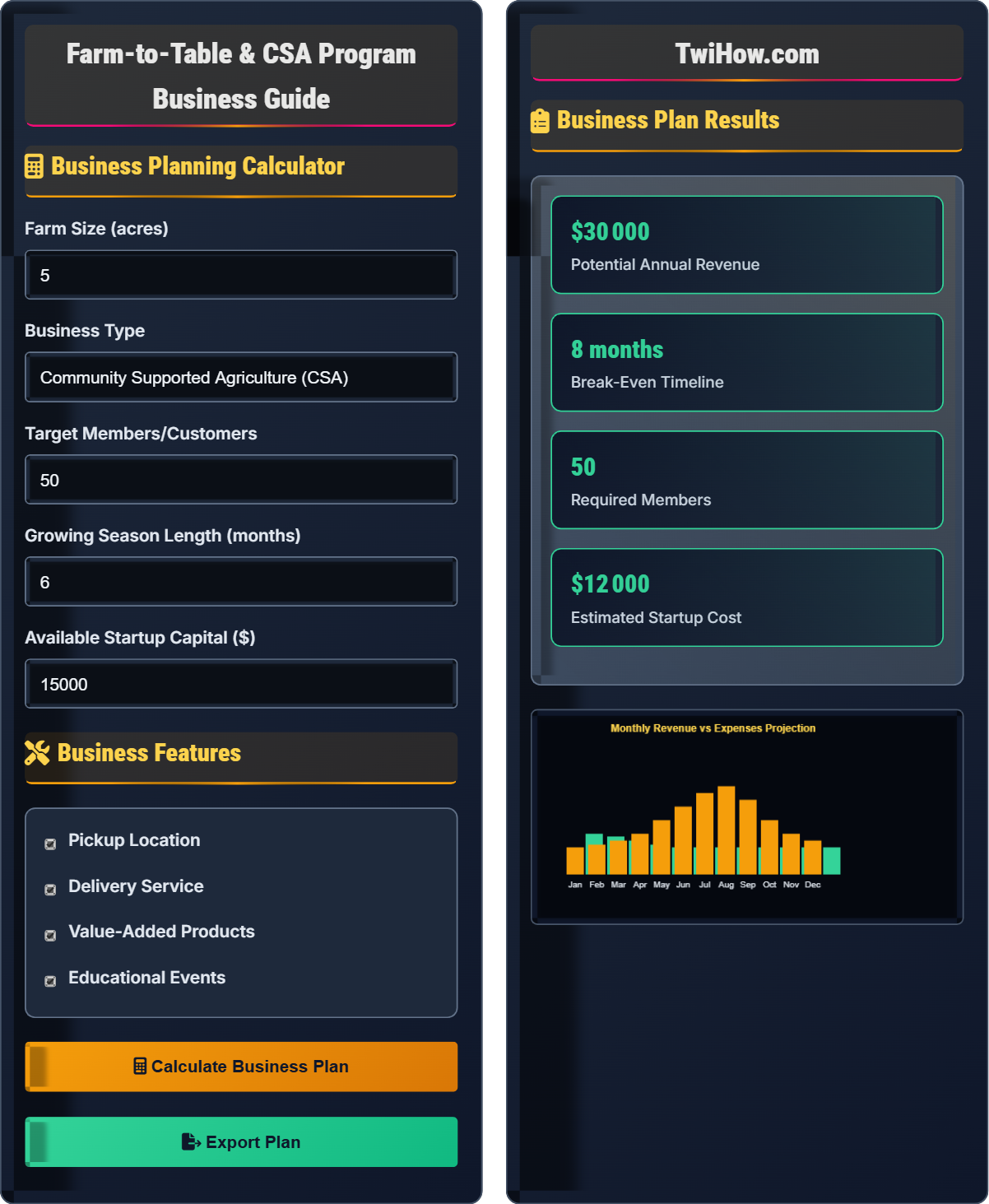
Business Planning Calculator
Business Features
Business Plan Results
| Expense Category | Cost | Timeline |
|---|---|---|
| Land Preparation | $3,000 | Month 1 |
| Equipment & Tools | $5,000 | Month 1-2 |
| Seeds & Supplies | $2,000 | Month 2-3 |
| Infrastructure | $4,000 | Month 2-4 |
| Marketing & Promotion | $1,500 | Month 3-5 |
| Insurance & Licensing | $1,000 | Month 1 |
| Operating Reserve | $1,500 | Month 1-6 |
Farm-to-Table Business Fundamentals
Farm-to-table is a direct marketing approach where farmers sell their products directly to restaurants, institutions, or consumers. This model eliminates intermediaries, allowing farmers to receive fair prices while providing customers with fresh, locally-sourced ingredients. The approach emphasizes transparency, sustainability, and community connection.
Different approaches to direct marketing:
- Restaurant Partnerships: Supplying fresh ingredients to local restaurants
- Institutional Sales: Selling to schools, hospitals, or corporate cafeterias
- Community Supported Agriculture (CSA): Customers subscribe for regular produce boxes
- Farmers Markets: Direct sales to consumers at local markets
- Online Sales: E-commerce platforms for direct-to-consumer delivery
Multiple income sources for sustainability:
- Produce Sales: Fresh vegetables, fruits, herbs, and flowers
- Value-Added Products: Preserves, pickles, jams, and processed foods
- Educational Programs: Workshops, farm tours, and classes
- Specialty Items: Seeds, plants, and farm-made products
- Event Hosting: Weddings, parties, and farm-to-table dinners
Environmental and social advantages:
- Reduced Transportation: Lower carbon footprint from local sourcing
- Seasonal Eating: Consuming produce at peak nutritional value
- Support for Small Farms: Economic viability for family farms
- Community Connection: Strengthening local food systems
- Reduced Packaging: Less processing and packaging waste
Community Supported Agriculture (CSA) Programs
Community Supported Agriculture involves customers purchasing shares of a farm's harvest upfront. Members pay for a season's worth of produce at the beginning of the growing season, sharing both the risks and rewards of farming. This model provides farmers with upfront capital while offering members fresh, seasonal produce throughout the growing season.
Various approaches to CSA share pricing:
- Fixed Price: Standard rate for all shares regardless of income
- Sliding Scale: Adjusted pricing based on member's ability to pay
- Work Share: Reduced cost in exchange for farm labor
- Multi-Season: Discount for signing up for multiple seasons
- Add-On Options: Additional items like eggs, meat, or flowers
Building strong relationships with CSA members:
- Communication: Regular newsletters, farm updates, and recipes
- Education: Information about growing practices and seasonal eating
- Events: U-pick days, harvest festivals, and farm tours
- Flexibility: Accommodating dietary restrictions and preferences
- Transparency: Open communication about challenges and successes
Business Model Comparison
- Payment: Invoice-based after delivery
- Volume: Consistent, predictable orders
- Relationship: Professional chef partnership
- Income: Steady monthly payments
- Planning: Menu-driven crop selection
- Payment: Upfront seasonal payment
- Volume: Variable based on harvest
- Relationship: Direct member engagement
- Income: Large upfront capital injection
- Planning: Seasonal crop planning
Farm-to-Table & CSA Business Quiz
What is the most important legal consideration when starting a farm-to-table business?
Food safety certifications and proper insurance are critical for farm-to-table businesses because they handle food products sold directly to consumers or restaurants. Liability insurance protects against potential foodborne illness claims, while food safety certifications (like GAP - Good Agricultural Practices) are often required by restaurants and institutions. These legal protections are essential for business sustainability and customer trust.
The answer is B) Obtaining proper insurance and food safety certifications.
This question emphasizes the importance of legal compliance in food businesses. The farm-to-table model involves direct sales of agricultural products, which carries inherent risks related to food safety. Understanding regulatory requirements is fundamental to business success and customer safety.
GAP Certification: Good Agricultural Practices for food safety
Product Liability Insurance: Protection against food-related claims
Food Safety Regulations: Standards for safe food handling
• Food safety certifications are often mandatory for restaurant sales
• Product liability insurance is essential for food businesses
• Local regulations may have specific requirements
• Contact local agricultural extension for certification requirements
• Research state and federal food safety regulations
• Consider joining a food hub for shared liability protection
• Starting business without proper insurance coverage
• Not understanding local food safety requirements
• Assuming small farms are exempt from regulations
Explain how to determine appropriate pricing for a CSA program and calculate the price per share if your total projected season costs are $20,000, you want a 30% profit margin, and you plan to serve 40 members.
Pricing Strategy: CSA pricing should cover all costs plus desired profit, distributed among members. Consider: production costs, labor, equipment depreciation, marketing, insurance, and administrative expenses.
Calculation:
Total costs = $20,000
Desired profit = 30% of total revenue
If costs represent 70% of revenue, then total revenue needed = $20,000 ÷ 0.70 = $28,571
Price per share = $28,571 ÷ 40 members = $714 per share
Alternative approach: Add profit to costs first: $20,000 + (0.30 × $20,000) = $26,000, then divide by members: $26,000 ÷ 40 = $650 per share.
Adjust pricing based on market rates, member affordability, and competitive positioning.
This calculation demonstrates the importance of understanding cost structures and profit margins in CSA pricing. The example shows how to ensure the business remains financially viable while providing fair value to members. Proper pricing is crucial for long-term sustainability.
Profit Margin: Percentage of revenue that is profit
Cost Recovery: Pricing that covers all business expensesCompetitive Pricing: Rates aligned with market standards
• Include all costs including opportunity cost of labor
• Consider member affordability and market rates
• Account for potential crop losses in pricing
• Research competitor pricing in your area
• Offer different share sizes for flexibility
• Consider payment plans for larger shares
• Not including all business costs in pricing
• Setting prices too low to attract members
• Not accounting for crop failures or weather risks
A CSA program with 60 members runs for 20 weeks. Each member expects 8-10 items per week. Calculate the total number of harvest units needed per season and recommend a crop planning strategy to ensure variety and consistent supply.
Calculation:
Minimum items per week: 60 members × 8 items = 480 items
Maximum items per week: 60 members × 10 items = 600 items
Season total (minimum): 480 × 20 weeks = 9,600 items
Season total (maximum): 600 × 20 weeks = 12,000 items
Crop Planning Strategy:
• Staple Crops: Lettuce, kale, chard (20-25% of items)
• Seasonal Specialties: Tomatoes, peppers, squash (30-35% of items)
• Herbs: Basil, cilantro, parsley (10-15% of items)
• Root Vegetables: Carrots, beets, radishes (20-25% of items)
• Storage Crops: Winter squash, potatoes (15-20% of items)
Plan succession plantings every 2-3 weeks for continuous harvests of quick-growing crops.
This problem demonstrates the complexity of CSA crop planning. Farmers must balance supply and demand while ensuring variety and consistency. The calculation shows the substantial volume required, emphasizing the need for careful planning and succession planting to maintain steady harvests throughout the season.
Succession Planting: Staggered plantings for continuous harvest
Season Extension: Techniques to lengthen growing seasons
Rotation Planning: Spacing crops throughout growing season
• Plan for 20% more than calculated needs for losses
• Include storage crops for late-season shares
• Diversify crops to reduce risk
• Create detailed planting calendar with dates
• Include fast-growing crops for flexibility
• Plan for seasonal transitions in varieties
• Not accounting for crop failures or weather
• Planting too much of early-season crops
• Not planning for succession plantings
A CSA program has a 30% member turnover rate. Members report dissatisfaction with inconsistent variety and too many unfamiliar vegetables. Develop a strategy to improve member satisfaction and retention.
Communication Strategy:
• Send weekly newsletters with recipes and preparation tips
• Include recipe cards with each box
• Host monthly educational sessions on seasonal eating
Production Strategy:
• Survey members for preferred vegetables
• Include familiar staples (carrots, lettuce) with specialty items
• Provide substitution options for disliked vegetables
Service Strategy:
• Offer different share sizes (small, medium, large)
• Create flexible pickup schedules
• Develop online platform for feedback and communication
Value-Added Services:
• Host farm tours and U-pick days
• Organize seasonal events and potlucks
• Create community forum for members
These strategies address the root causes of dissatisfaction and build stronger member relationships.
This problem illustrates the importance of customer relationship management in CSA programs. Success depends not just on growing good food, but on communicating effectively and meeting customer expectations. The solution shows how to address both operational and communication challenges.
Member Retention: Keeping existing members for subsequent seasons
Customer Satisfaction: Meeting or exceeding member expectations
Community Building: Creating relationships between members and farm
• Communication is as important as production
• Educate members about seasonal eating
• Listen to member feedback and adapt
• Create welcome packet for new members
• Ask for feedback at multiple points during season
• Build relationships through personal interactions
• Not educating members about seasonal eating
• Focusing only on production, not customer service
• Not gathering member feedback regularly
What is the biggest financial risk in starting a CSA program?
Weather-related crop failures pose the greatest financial risk because they can destroy the entire season's investment and production. Unlike other risks, weather cannot be controlled or predicted with certainty. A single season of crop failure can devastate a CSA program since members pay upfront for the entire season's produce. This risk is particularly acute for CSA programs because the business model depends on successful harvests to fulfill member commitments.
The answer is B) Weather-related crop failures.
This question highlights the unique risk profile of CSA programs compared to other business models. In traditional retail, businesses can adjust inventory based on demand. In CSA, the risk is shared between farmer and member, but weather remains an uncontrollable factor that can affect the entire season's success.
Uncontrollable Risk: Factors beyond farmer's control
Seasonal Investment: Upfront costs for entire growing season
Risk Sharing: Distribution of agricultural risks between parties
• Diversify crops to reduce weather risk
• Maintain emergency reserves for bad seasons
• Consider crop insurance for major investments
• Start with smaller membership to test market
• Include storage crops to extend season
• Build relationships with other farms for backup
• Not planning for crop failures
• Over-committing to members without backup
• Not diversifying crops and income sources
FAQ
Q: How much land do I need to start a profitable CSA program?
A: Land requirements depend on your production methods and goals. As a general guideline: 1-2 acres can support 25-50 CSA members with intensive growing methods. For 50-100 members, plan for 2-4 acres. Focus on high-value crops and intensive cultivation techniques. Consider that not all land will be productive (paths, infrastructure, etc.). Start small and expand based on demand. The key is efficient use of space through succession planting, intercropping, and season extension techniques. Quality and variety matter more than quantity.
Q: What should I look for when choosing a farm-to-table supplier?
A: Look for: reliable delivery schedule, consistent quality, food safety certifications (GAP, organic), diverse seasonal offerings, and clear communication. Visit the farm to understand their practices. Ask about their production methods, pest management, and harvest timing. Ensure they can meet your volume requirements and have backup plans for weather disruptions. Consider their willingness to customize products to your menu needs. Price should be fair but not the only factor - quality and reliability are more important. Establish clear contracts with delivery terms, quality standards, and payment schedules.