Seed Libraries & Seed Saving
Complete guide • Step-by-step instructions
Seed libraries and seed saving are essential practices for preserving biodiversity, maintaining genetic heritage, and promoting food security. These initiatives involve collecting, storing, and sharing seeds of heirloom and open-pollinated varieties. Seed saving empowers gardeners and farmers to maintain self-sufficiency while preserving valuable genetic diversity.
Seed libraries operate as community resources where members can "check out" seeds for free, grow them, and return harvested seeds to the library. This creates a sustainable cycle that preserves rare varieties and builds community resilience. Seed saving techniques vary by plant type and require knowledge of pollination, harvesting, and storage methods.
Key considerations:
- Plant Selection: Choosing appropriate open-pollinated varieties
- Isolation: Preventing cross-pollination between varieties
- Harvesting: Timing and methods for different plant types
- Storage: Proper conditions for long-term viability
Success depends on understanding plant biology, maintaining genetic purity, and following proper preservation techniques.
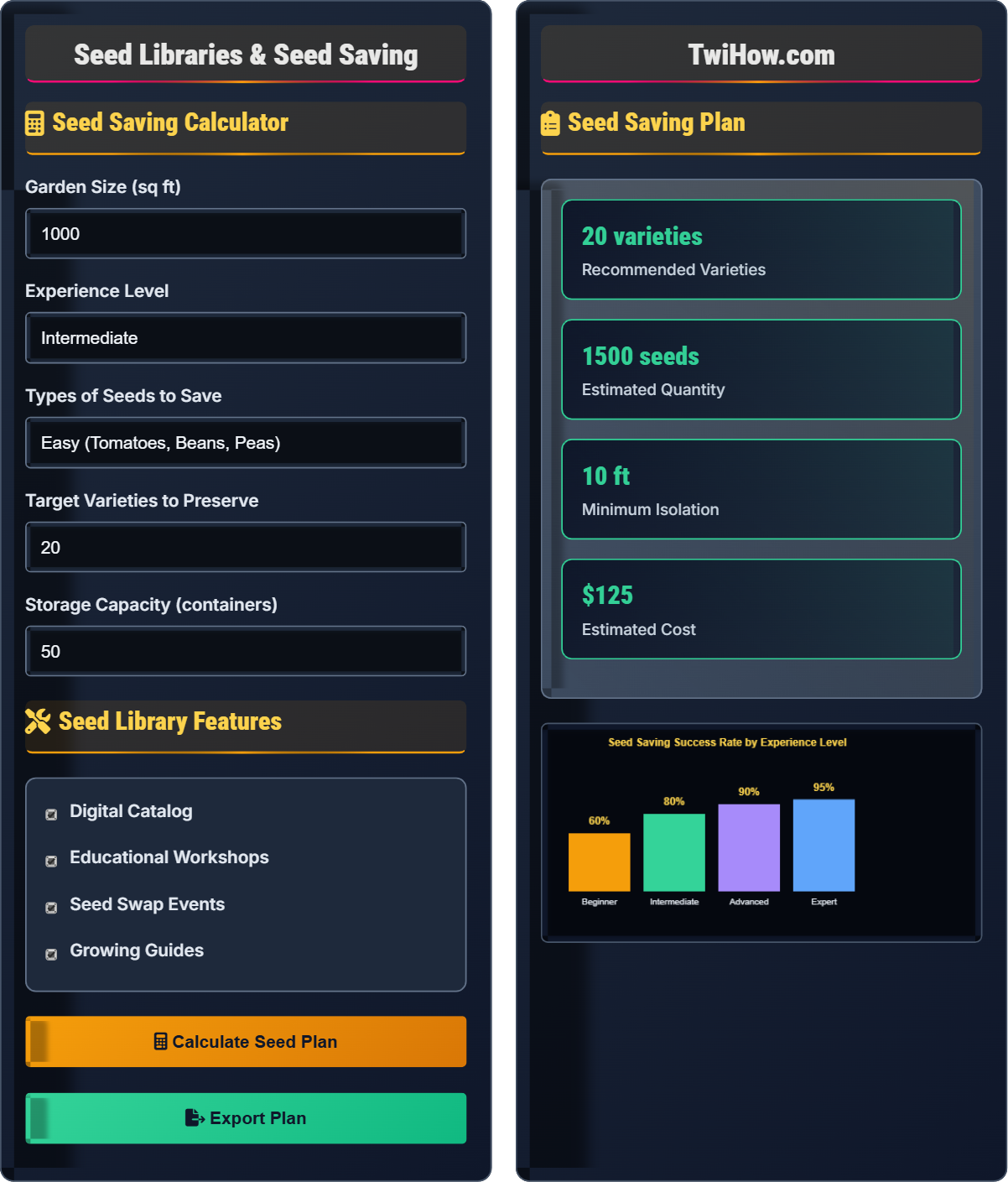
Seed Saving Calculator
Seed Library Features
Seed Saving Plan
| Seed Type | Difficulty | Isolation Distance |
|---|---|---|
| Tomatoes | Easy | 10 ft |
| Beans | Easy | 10 ft |
| Peas | Easy | 10 ft |
| Peppers | Moderate | 500 ft |
| Squash | Moderate | 1/4 mile |
Seed Saving Fundamentals
Seed libraries are community-based organizations that collect, preserve, and share seeds of heirloom and open-pollinated varieties. They operate similarly to traditional libraries where members "check out" seeds for free, grow them, and return harvested seeds to the library. This creates a sustainable cycle that preserves rare varieties and builds community resilience.
Seed saving preserves genetic diversity and maintains food security:
- Biodiversity: Preserves heirloom varieties at risk of extinction
- Adaptation: Allows plants to adapt to local growing conditions
- Self-Sufficiency: Reduces dependence on commercial seed suppliers
- Cost-Effectiveness: Saves money on seed purchases over time
- Cultural Heritage: Maintains varieties with cultural significance
Different plants require different isolation techniques:
- Self-Pollinating: Tomatoes, beans, peas (minimal isolation needed)
- Wind-Pollinated: Corn, spinach (requires significant distance)
- Insect-Pollinated: Squash, cucumbers (moderate isolation)
- Biennials: Carrots, onions (require vernalization for seed production)
Proper storage extends seed viability:
- Temperature: Cool (32-41°F) for longest storage life
- Moisture: Low humidity (below 50%) prevents mold
- Containers: Airtight containers prevent moisture absorption
- Labeling: Include variety, date collected, and source
- Rotation: Use oldest seeds first to maintain viability
Starting a Seed Library
Successful seed libraries require careful planning:
- Location: Accessible community space with proper storage conditions
- Partnerships: Collaboration with libraries, schools, or community centers
- Inventory: System for tracking seed varieties and quantities
- Education: Resources for teaching proper seed saving techniques
- Community: Engagement strategies to ensure participation
Effective seed library organization:
- Volunteers: Trained staff to assist members and maintain inventory
- Rules: Clear guidelines for borrowing and returning seeds
- Database: Digital catalog for easy variety identification
- Events: Workshops and seed swaps to engage community
- Documentation: Records of seed sources and performance
Seed libraries contribute to local food systems:
- Biodiversity: Preserves rare and heritage varieties
- Food Security: Increases local seed availability
- Knowledge Sharing: Connects experienced and novice growers
- Resilience: Builds community preparedness for food challenges
- Education: Teaches sustainable agriculture practices
Seed Saving Comparison
- True-to-Type: Offspring resemble parent plants
- Viability: 3-5 years under proper storage
- Genetics: Stable and predictable
- Adaptation: Evolves to local conditions over time
- Cost: Self-sustaining after initial purchase
- True-to-Type: Offspring vary significantly
- Viability: 2-3 years under proper storage
- Genetics: Unstable, not suitable for saving
- Adaptation: Maintains original characteristics
- Cost: Must be purchased annually
Seed Libraries & Seed Saving Quiz
Why is proper isolation distance important when saving seeds from different varieties of the same species?
Proper isolation distance is crucial to prevent cross-pollination between varieties of the same species. When different varieties cross-pollinate, the resulting seeds will not "breed true" and will produce offspring with mixed characteristics. Maintaining genetic purity ensures that saved seeds will produce plants identical to the parent variety.
The answer is B) To prevent cross-pollination and maintain genetic purity.
Understanding pollination biology is fundamental to successful seed saving. Cross-pollination occurs when pollen from one variety fertilizes flowers of another variety of the same species. This results in hybrid seeds that exhibit traits from both parent plants. Maintaining genetic purity is essential for preserving the unique characteristics of heirloom and open-pollinated varieties.
Cross-Pollination: Transfer of pollen between different varieties of same species
True-to-Type: Seeds that produce plants identical to parent
Genetic Purity: Maintaining original genetic characteristics
• Different plants require different isolation distances
• Wind-pollinated plants need greater distances than self-pollinated
• Isolation prevents genetic contamination
• Research specific isolation requirements for each crop
• Use physical barriers like row covers when distance isn't feasible
• Time plantings to avoid overlapping bloom periods
• Not maintaining adequate isolation distances
• Saving seeds from hybrid varieties
• Not understanding pollination methods
Explain the factors that affect seed viability and calculate the expected germination rate for properly stored tomato seeds after 4 years.
Factors Affecting Seed Viability:
• Moisture: Seeds stored at 5-8% moisture content have longest viability
• Temperature: Cool temperatures (32-41°F) extend seed life
• Light: Darkness preserves viability; light can cause deterioration
• Air Circulation: Proper ventilation prevents mold and overheating
• Seed Age: Germination rate decreases over time
Calculation: Tomato seeds have a 4-year viability rate of approximately 65-75%. Starting with 100% viability, after 4 years we expect 65-75% germination rate.
Formula: Expected germination = Initial viability × (0.95)^years
For tomatoes: 100% × (0.95)^4 ≈ 81% remaining after 4 years
However, actual storage conditions affect this rate significantly.
Seed viability follows an exponential decay model where germination rates decrease over time. Understanding this relationship helps seed savers plan for succession and replacement. The calculation demonstrates how proper storage can significantly extend seed life compared to poor storage conditions.
Viability: Percentage of seeds that will successfully germinate
Germination Rate: Proportion of seeds that sprout under ideal conditions
Seed Life: Duration seeds remain viable under storage conditions
• Cool, dry conditions maximize seed life
• Test germination annually for older seeds
• Use oldest seeds first in rotation
• Use airtight containers with desiccant packets
• Storing seeds in humid conditions
• Not labeling seeds with collection date
• Using plastic bags which trap moisture
A seed library starts with 500 seed packets representing 50 different varieties. Each packet contains 25 seeds on average. If members borrow 3 packets each and return 5 packets (with harvested seeds) after growing, how many varieties will the library have after one growing season if 20% of returned varieties are new to the collection?
Initial Inventory: 500 packets of 50 varieties
Members Borrow: 3 packets each (assume 100 members)
Total Borrowed: 100 × 3 = 300 packets
Returned: 100 × 5 = 500 packets
New Varieties: 20% of 50 = 0.20 × 50 = 10 new varieties
Total Varieties After Season: 50 + 10 = 60 varieties
Net Change in Packets: 500 returned - 300 borrowed = +200 packets
Final Inventory: 500 + 200 = 700 packets of 60 varieties
This demonstrates how seed libraries can expand their collections through community participation.
This problem demonstrates the regenerative nature of seed libraries. The mathematical model shows how community participation can expand both the quantity and diversity of seeds in the collection. The addition of new varieties through member contributions highlights the collaborative nature of seed preservation efforts.
Seed Library: Community organization for seed sharing and preservation
Collection Expansion: Adding new varieties through member contributions
Community Participation: Member involvement in library growth
• Seed libraries depend on member participation for success
• Proper record keeping tracks variety origins
• New varieties enhance collection diversity
• Encourage members to try new varieties
• Document origin and history of new varieties
• Maintain detailed inventory records
• Not tracking variety origins
• Allowing contamination of pure varieties
• Not maintaining adequate documentation
A gardener wants to save seeds from two varieties of squash: 'Butternut' and 'Acorn'. Both are Cucurbita moschata and are insect-pollinated. The gardener has a 500 sq ft garden. Recommend a strategy to prevent cross-pollination and explain the consequences if cross-pollination occurs.
Recommended Strategy:
• Temporal Isolation: Plant only one variety per year to avoid simultaneous blooming
• Physical Barrier: Use row covers during flowering period
• Manual Pollination: Hand-pollinate flowers and bag them to prevent insect access
• Distance: If space allows, separate varieties by 1/4 mile (too far for most home gardens)
Consequences of Cross-Pollination: Seeds produced will be hybrids with unpredictable characteristics. The resulting plants may have intermediate traits or entirely different characteristics from either parent. The fruit in the current season will be normal, but seeds saved from cross-pollinated plants will not breed true.
This example demonstrates the challenges of saving seeds from cross-pollinating crops. The solution shows how understanding plant biology informs practical strategies. The temporal isolation approach shows how seed savers can adapt to spatial limitations by using time instead of distance to prevent cross-pollination.
Cross-Pollination: Pollination between different varieties of same species
Hybrid Seeds: Seeds resulting from cross-pollination with mixed traitsTemporal Isolation: Separating plantings by time rather than space
• Insect-pollinated crops require significant isolation
• Cross-pollination affects next generation, not current fruit
• Manual pollination ensures genetic purity
• Keep detailed records of planting dates and bloom periods
• Use fine mesh row covers during flowering
• Label all flowers that are hand-pollinated
• Attempting to isolate insect-pollinated crops in small spaces
• Not understanding that cross-pollination affects seeds, not fruit
• Failing to maintain isolation during entire bloom period
What is the ideal moisture content for long-term seed storage and why?
The ideal moisture content for long-term seed storage is 5-8%. This low moisture level prevents mold and fungal growth while significantly slowing metabolic processes that lead to seed deterioration. Too little moisture (below 3%) can damage cell membranes, while too much moisture (above 10%) promotes microbial growth and accelerates aging.
The answer is B) 5-8% moisture to prevent mold and slow metabolism.
Understanding the relationship between moisture content and seed viability is crucial for successful preservation. The optimal range represents a balance between preventing microbial growth (which requires moisture) and avoiding cellular damage from excessive drying. This demonstrates how seed saving requires knowledge of plant physiology and biochemistry.
Moisture Content: Percentage of water in seeds by weight
Metabolic Rate: Speed of biochemical processes in seeds
Cellular Damage: Structural harm from excessive drying
• Monitor moisture levels with hygrometer
• Use desiccant packets to maintain low humidity
• Store in airtight containers to prevent moisture absorption
• Use moisture-proof containers like glass jars with tight lids
• Include silica gel packets to absorb excess moisture
• Check seeds periodically for signs of moisture damage
• Storing seeds in non-airtight containers
• Not monitoring moisture levels
• Storing in humid locations like basements
FAQ
Q: What's the difference between open-pollinated, heirloom, and hybrid seeds in terms of seed saving?
A: Open-pollinated seeds come from plants that are pollinated naturally by insects, birds, wind, or other natural mechanisms. When properly isolated, these seeds will "breed true" and produce offspring identical to the parent plant. Heirloom seeds are open-pollinated varieties that have been passed down through generations, often with historical significance and unique characteristics. Hybrid seeds result from cross-pollination between two different parent varieties. Hybrid seeds do not breed true and will produce offspring with mixed characteristics, so they're not suitable for seed saving. Only open-pollinated and heirloom varieties are appropriate for seed saving.
Q: How can I start a seed library in my community and what resources do I need?
A: To start a seed library: 1) Partner with a community organization like a public library, community center, or school. 2) Collect initial seed donations from local gardeners. 3) Create simple check-out procedures (no late fees, return policy). 4) Set up proper storage with cool, dry conditions. 5) Develop educational materials about seed saving. 6) Organize workshops and seed swap events. 7) Create a simple catalog system to track varieties. Essential resources: storage containers, labels, basic seed saving guides, and enthusiastic volunteers. Many successful seed libraries start with minimal budgets using donated supplies and volunteer labor.