How to Start a Small-Scale Farm or Market Garden
Complete farming guide • Step-by-step instructions
Farming Fundamentals:
Show Farming CalculatorStarting a small-scale farm or market garden involves careful planning, resource management, and sustainable practices. It combines agricultural science with business strategy to create a profitable operation while maintaining environmental health.
Key farming concepts:
- Land Preparation: Soil testing, composting, and bed creation
- Crop Planning: Seasonal rotation and companion planting
- Water Management: Irrigation systems and conservation
- Market Strategy: Direct sales and community engagement
Successful small farms focus on high-value crops, efficient operations, and direct marketing to consumers through farmers markets, CSAs, and local restaurants.
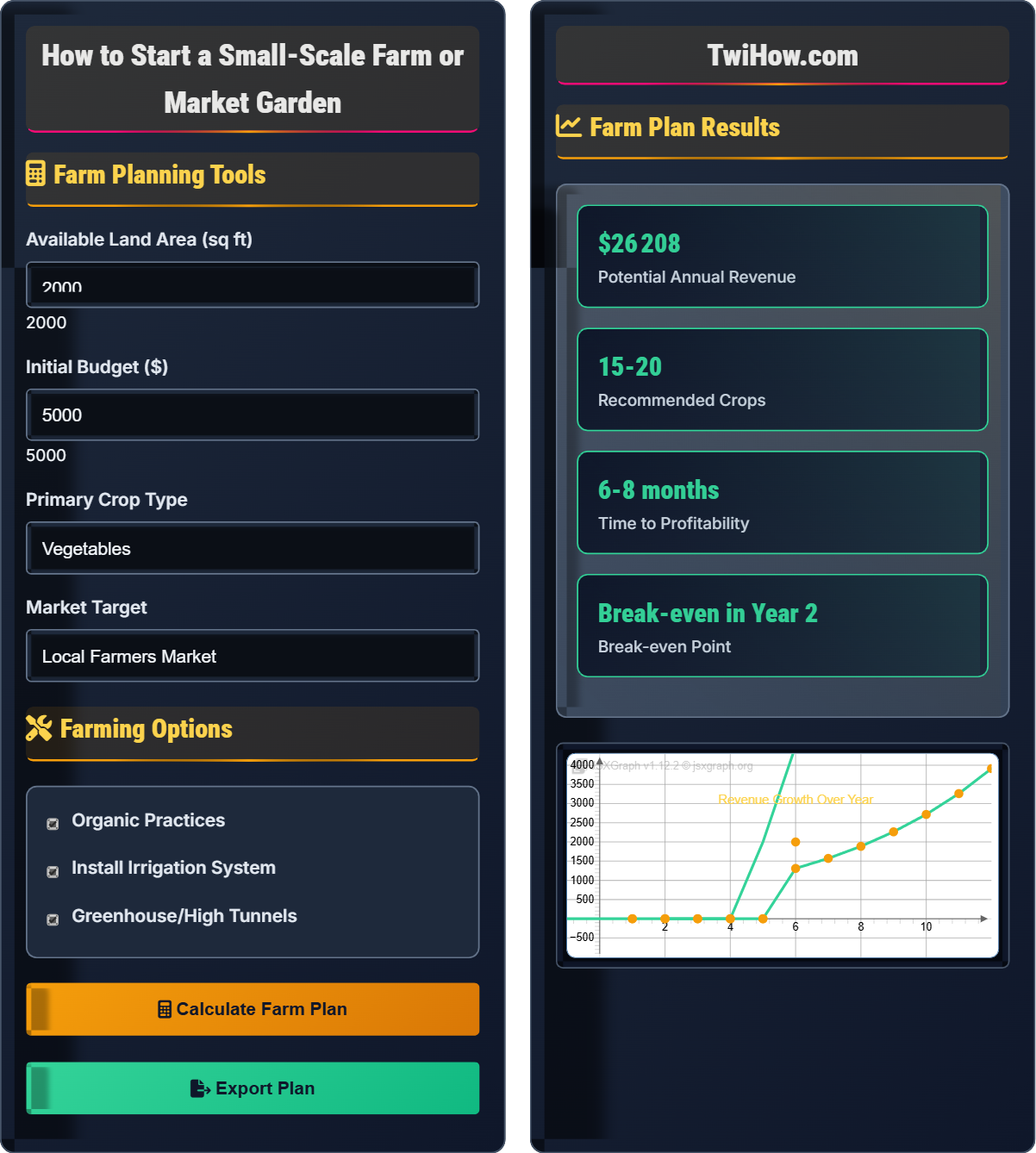
Farm Planning Tools
Farming Options
Farm Plan Results
| Month | Task | Cost | Expected Yield |
|---|---|---|---|
| Jan | Planning & Permits | $200 | - |
| Feb | Soil Preparation | $500 | - |
| Mar | Seed Purchase | $800 | - |
| Apr | Planting | $300 | - |
| May | Maintenance | $400 | - |
| Jun | First Harvest | $100 | $1,200 |
Farming Planning Explained
Small-scale farming and market gardening involve growing crops on a smaller scale, typically ranging from 1-10 acres, for direct sale to consumers. This approach emphasizes sustainable practices, high-value crops, and close relationships with customers.
Where:
- Yield per Acre: Expected harvest per area unit
- Price per Unit: Market price for produce
- Total Acres: Available growing space
Key areas where small-scale farming makes an impact:
- Food Security: Local food production and distribution
- Sustainability: Reduced transportation and packaging
- Economic Development: Rural employment and entrepreneurship
- Community Health: Access to fresh, nutritious foods
- Environmental Stewardship: Biodiversity and soil health
- Education: Teaching sustainable practices
- Composting: Recycling organic waste into soil amendment
- Companion Planting: Growing beneficial plant combinations
- Cover Cropping: Protecting soil between seasons
- Integrated Pest Management: Natural pest control methods
- Water Conservation: Efficient irrigation and rainwater harvesting
Farming Fundamentals
Soil preparation, crop selection, seasonal planning, sustainable practices, market research.
Potential Revenue = Yield per Acre × Price per Unit × Total Acres
Where Potential Revenue = expected income, Yield per Acre = harvest amount per area.
- Test soil quality before planting
- Start small and expand gradually
- Focus on high-value crops
Applications
Direct-to-consumer sales, Community Supported Agriculture (CSA), farmers markets, restaurant partnerships.
- Local food production
- Seasonal employment
- Community engagement
- Environmental stewardship
- Seasonal income fluctuations
- Physical labor demands
- Weather dependency
- Marketing requirements
Farming Learning Quiz
What is the minimum recommended land area for a profitable small-scale vegetable farm?
For a profitable small-scale vegetable farm, the minimum recommended area is typically 1/2 acre (2,178 sq ft). This provides enough space for diverse crops, rotation, and pathways while being manageable for intensive cultivation. Smaller plots may not generate sufficient income to justify the investment and labor, while larger operations require more capital and equipment.
The answer is B) 1/2 acre (2,178 sq ft).
Understanding the optimal farm size is crucial for success. Too small and you won't generate enough revenue to cover costs; too large and you'll need more resources than available. The half-acre recommendation balances productivity with manageability, allowing for intensive cultivation practices that maximize yields per square foot.
Intensive Cultivation: Maximizing yield per unit area through careful management
Rotation: Changing crop types to maintain soil health
Succession Planting: Planting crops at intervals for continuous harvest
• Start with manageable size
• Plan for expansion
• Consider your labor capacity
• Focus on high-value crops per square foot
• Use vertical growing techniques
• Plan for year-round production
• Starting too large
• Underestimating labor requirements
• Not accounting for pathways
Explain the steps involved in preparing soil for a new market garden and why each step is important for crop success.
Soil Testing: Begin with a comprehensive soil test to determine pH, nutrient levels, and organic matter content. This provides a baseline for amendments needed.
Amendment Application: Based on test results, add compost, aged manure, or other organic matter to improve soil structure, fertility, and water retention.
Tilling/Bed Creation: Loosen soil to 8-12 inches depth to promote root growth and drainage. Create raised beds if needed for better drainage.
Final Preparation: Rake smooth and level the soil surface before planting.
Each step is critical because healthy soil is the foundation of productive crops. Poor soil leads to weak plants, lower yields, and increased susceptibility to pests and diseases.
Soil preparation is often overlooked but is the most important step in farming. The soil provides nutrients, water, and physical support for plants. Investing time in proper preparation pays dividends throughout the growing season. Good soil structure allows roots to penetrate easily, holds moisture without becoming waterlogged, and contains beneficial organisms that help plants thrive.
Soil Structure: Physical arrangement of soil particles
pH Level: Measure of soil acidity or alkalinity
Organic Matter: Decomposed plant and animal materials
• Test soil annually
• Add organic matter regularly
• Maintain proper pH levels
• Compost kitchen scraps and yard waste
• Use cover crops during off-season
• Avoid walking on wet soil
• Skipping soil testing
• Working soil when too wet
• Not adding enough organic matter
A farmer has 1 acre (4,356 sq ft) of land and wants to grow tomatoes, lettuce, and herbs. Tomatoes require 1 sq ft per plant and yield $3 per plant, lettuce requires 0.5 sq ft per plant and yields $1.50 per plant, and herbs require 0.25 sq ft per plant and yield $2 per plant. If the farmer allocates 40% of the land to tomatoes, 35% to lettuce, and 25% to herbs, calculate the potential revenue and recommend whether this allocation is optimal.
Tomato Allocation: 40% of 4,356 sq ft = 1,742 sq ft = 1,742 plants × $3 = $5,226
Lettuce Allocation: 35% of 4,356 sq ft = 1,525 sq ft ÷ 0.5 sq ft/plant = 3,050 plants × $1.50 = $4,575
Herb Allocation: 25% of 4,356 sq ft = 1,089 sq ft ÷ 0.25 sq ft/plant = 4,356 plants × $2 = $8,712
Total Potential Revenue: $5,226 + $4,575 + $8,712 = $18,513
This allocation is suboptimal because herbs have the highest value per square foot ($2/sq ft) but receive the smallest allocation. A better strategy would increase herb allocation while reducing tomato allocation since tomatoes have the lowest value per square foot ($3/sq ft vs $3/sq ft for lettuce and $8/sq ft for herbs).
This problem demonstrates the importance of economic analysis in farming decisions. Simply allocating space equally or based on personal preference ignores the financial returns of different crops. Calculating value per square foot helps optimize space allocation for maximum profitability. Herbs typically offer the highest return per unit area, followed by specialty vegetables and then bulk commodities.
Value per Square Foot: Revenue generated per unit area
Space Optimization: Allocating area to maximize returns
Specialty Crops: High-value, niche market products
• Calculate value per square foot
• Allocate space based on returns
• Consider market demand
• Focus on high-value crops
• Plan for continuous harvest
• Consider season extension
• Not calculating economic returns
• Ignoring market prices
• Over-allocating to low-value crops
A new market gardener wants to implement sustainable practices but has a limited budget. Propose a phased approach to adopting sustainability measures, prioritizing those with the greatest impact and quickest return on investment.
Phase 1 (Immediate): Start composting kitchen scraps and yard waste to improve soil health at no cost. Implement mulching with free materials like leaves or grass clippings.
Phase 2 (Months 2-4): Establish a basic irrigation system with soaker hoses to conserve water and reduce labor. Start companion planting to reduce pest pressure.
Phase 3 (Months 5-8): Plant cover crops in fallow areas to improve soil. Install rain barrels for water conservation.
Phase 4 (Year 2): Build permanent composting system, install drip irrigation, and establish pollinator habitat.
This approach maximizes immediate benefits while building toward long-term sustainability.
Sustainable farming doesn't require expensive equipment from day one. Many effective practices are low-cost or free, such as composting, mulching, and companion planting. The key is to start with practices that provide immediate benefits (like improved soil fertility from composting) and gradually build more complex systems as resources allow. This approach reduces risk and allows for learning and adaptation.
Companion Planting: Growing beneficial plant combinations
Cover Cropping: Planting crops to protect soil between seasons
Integrated Pest Management: Natural pest control methods
• Start with no-cost improvements
• Focus on soil health first
• Plan for long-term sustainability
• Join local gardening groups
• Learn from experienced farmers
• Keep detailed records
• Over-investing in equipment early
• Neglecting soil health
• Not planning for seasons
Which marketing approach typically provides the highest profit margins for small-scale farmers?
Direct sales through farmers markets, CSAs, and roadside stands typically provide the highest profit margins for small-scale farmers because they eliminate middlemen and capture the full retail price. While these channels may have lower volume than wholesale, the higher margins often result in better overall profitability. Value-added products can also be profitable but require additional processing skills and equipment.
The answer is B) Farmers markets and direct sales.
Marketing strategy significantly impacts farm profitability. Traditional wholesale channels often pay only 10-20% of retail prices, while direct sales capture 100% of retail value. Small-scale farmers can't compete on price with industrial agriculture but can differentiate through quality, freshness, and personal connection with customers. Building customer relationships creates loyalty and allows premium pricing.
Direct Sales: Selling directly to consumers
CSA (Community Supported Agriculture): Prepaid share system
Value-Added Products: Processed items made from raw produce
• Capture retail margins
• Build customer relationships
• Differentiate through quality
• Emphasize freshness and quality
• Tell your story
• Offer unique varieties
• Accepting low wholesale prices
• Not developing customer base
• Ignoring branding opportunities
FAQ
Q: How much money do I need to start a small market garden?
A: The startup costs for a small market garden can vary widely depending on your goals and existing resources, but here's a realistic breakdown:
Low Budget Option ($500-1,500): Start with basic hand tools, seeds, compost, and minimal infrastructure. Focus on high-value crops and direct sales.
Moderate Budget ($2,000-5,000): Add basic irrigation, greenhouse structures, and more comprehensive tools. This allows for season extension and improved efficiency.
Full Setup ($5,000-15,000): Includes mechanized equipment, permanent infrastructure, and comprehensive systems.
Most successful small farmers start with a modest budget and reinvest profits to expand operations gradually.
Q: What are the most profitable crops for a small market garden?
A: Profitability depends on your local market, but generally, the most profitable crops per square foot are:
Herbs: Basil, cilantro, parsley, and specialty herbs command premium prices and can be harvested multiple times.
Microgreens: Extremely high-value crops that sell for $20-40 per pound and have quick turnaround times.
Specialty Greens: Arugula, kale, and Asian greens often sell for 2-3 times the price of lettuce.
Heirloom Tomatoes: Premium varieties can sell for $4-8 per pound compared to $1-2 for standard varieties.
Peppers and Hot Peppers: High-value crops with good yields and extended harvest periods.
Focus on crops that are difficult to find locally and command premium prices at farmers markets.