How to Start Composting and Enrich Soil
Sustainable farming guide • Step-by-step explanations
Composting Overview:
Show Composting SimulatorComposting is the natural process of decomposing organic waste into nutrient-rich soil amendment called compost. This sustainable practice transforms kitchen scraps, yard waste, and other organic materials into "black gold" for your garden. Composting reduces waste, enriches soil, and supports beneficial microorganisms that promote healthy plant growth.
Key composting principles include:
- Carbon-Nitrogen Balance: Maintaining 30:1 C:N ratio for optimal decomposition
- Aeration: Providing oxygen for aerobic decomposition
- Moisture: Maintaining proper water content (40-60%)
- Temperature: Managing heat for pathogen elimination
Proper composting creates rich, crumbly soil amendment that improves soil structure, water retention, and nutrient availability.
Composting Calculator
Advanced Options
Composting Results
| Material | Type | Ratio | Contribution |
|---|---|---|---|
| Kitchen Scraps | Nitrogen | 30% | Green material |
| Fallen Leaves | Carbon | 50% | Brown material |
| Paper/Cardboard | Carbon | 15% | Carbon source |
| Grass Clippings | Nitrogen | 5% | Nitrogen boost |
Setup
Active
Maturation
Harvest
Use
Composting Process Explained
The ideal Carbon:Nitrogen ratio for composting is approximately 30:1, calculated as:
Where carbon sources (browns) provide energy and nitrogen sources (greens) provide protein for decomposers.
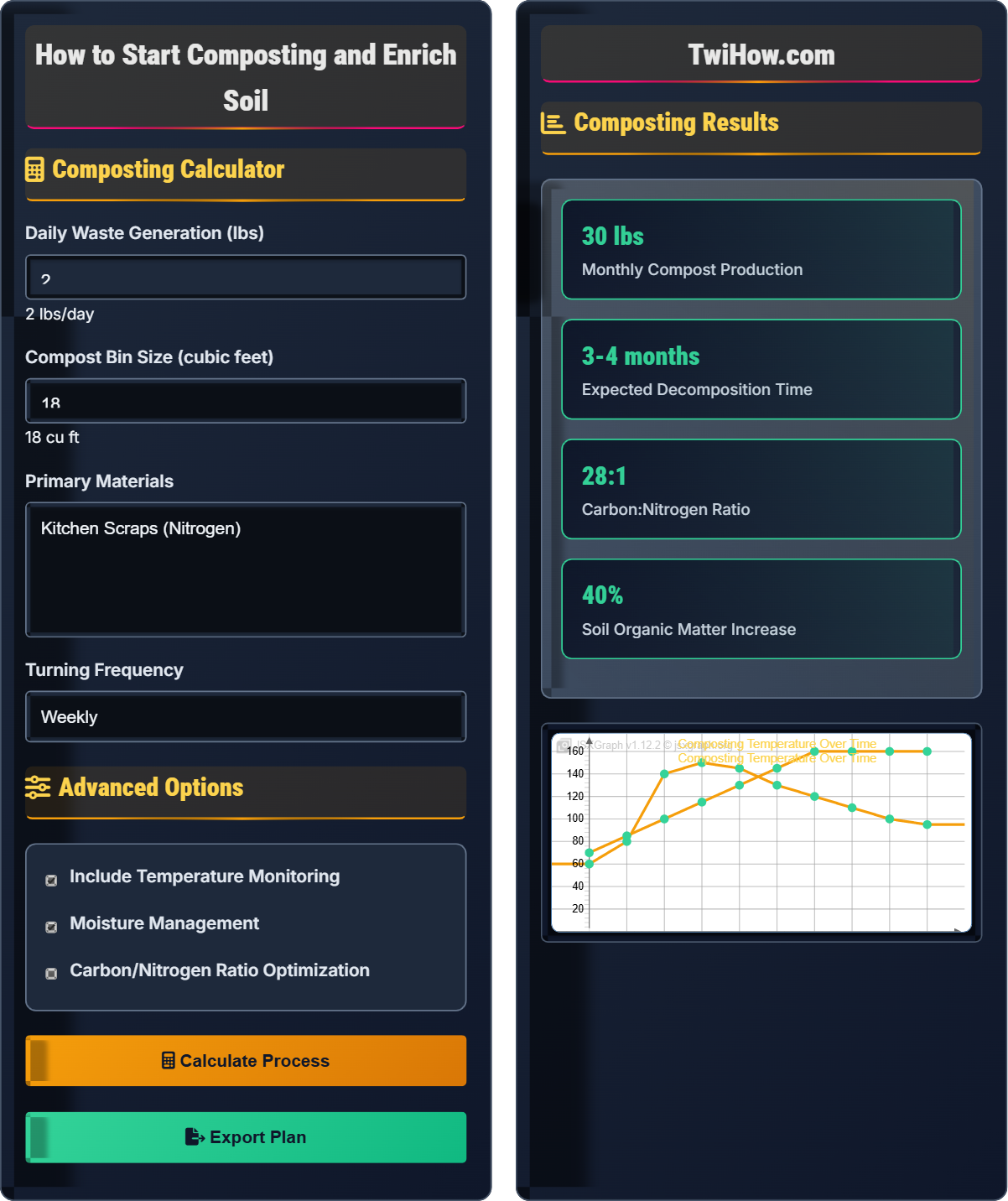
Composting generates heat through microbial activity:
- Active Phase: 130-160°F (kill pathogens and weed seeds)
- Maturation Phase: 100-130°F (stable decomposition)
- Cooling Phase: Below 100°F (ready for use)
- Turning: Aerates pile and redistributes heat
Proper moisture levels are crucial for composting:
- Optimal: 40-60% moisture content
- Too dry: Decomposition slows significantly
- Too wet: Creates anaerobic conditions and odors
- Test: Squeeze handful - should barely release a drop
Moisture helps maintain microbial activity and proper decomposition.
- Mesophilic Bacteria: Initial decomposition at moderate temperatures
- Thermophilic Bacteria: Heat-loving bacteria during active phase
- Actinomycetes: Break down tough materials like cellulose
- Fungi: Decompose woody materials and lignin
Composting Fundamentals
Carbon:nitrogen ratio, decomposition, organic matter, microbial activity, aeration, moisture management.
Optimal C:N = (Carbon Sources + Nitrogen Sources) / Total Volume = 30:1
Where carbon provides energy and nitrogen provides protein for decomposers.
- Maintain 30:1 C:N ratio
- Keep moisture at 40-60%
- Aerate regularly
- Turn every 1-2 weeks
Composting Materials
Kitchen scraps, grass clippings, coffee grounds, fresh plant material, manure.
- Fallen leaves
- Paper/cardboard
- Wood chips
- Dry grass
- Meat and dairy products
- Diseased plants
- Weeds with seeds
- Chemically treated materials
Composting Materials
Composting Process Visualization
Composting Learning Quiz
What is the ideal Carbon:Nitrogen ratio for efficient composting?
The ideal Carbon:Nitrogen ratio for composting is 30:1. This ratio provides the optimal balance of carbon (energy source) and nitrogen (protein source) for decomposer organisms. Ratios that are too high (too much carbon) slow decomposition, while ratios that are too low (too much nitrogen) cause odors and nitrogen loss.
The answer is C) 30:1.
The C:N ratio is fundamental to successful composting because it determines the efficiency of decomposition. Carbon provides energy for microorganisms, while nitrogen provides the protein needed for their reproduction and enzyme production. The 30:1 ratio allows for rapid, odor-free decomposition while retaining nutrients in the compost.
Carbon:Nitrogen Ratio: Balance of energy and protein for decomposers
Decomposers: Microorganisms that break down organic matter
Composting: Controlled decomposition of organic materials
• Maintain 30:1 C:N ratio
• Layer brown and green materials
• Monitor and adjust as needed
• Use 2 parts browns to 1 part greens
• Chop materials for faster decomposition
• Monitor temperature regularly
• Too much nitrogen causing odors
• Not turning pile regularly
• Incorrect moisture levels
Explain the temperature phases of composting and calculate the composting time for a pile that reaches 150°F during the active phase. Assume active phase lasts 2 weeks and maturation phase takes 6 weeks. What is the total composting time and why is the high temperature important?
Temperature Phases:
1. Initial Phase: Mesophilic bacteria (100-110°F)
2. Active Phase: Thermophilic bacteria (130-160°F)
3. Maturation Phase: Cooling and stabilization (below 100°F)
Calculation: Active phase: 2 weeks + Maturation phase: 6 weeks = 8 weeks total composting time
High Temperature Importance: Kills pathogens, weed seeds, and fly larvae while accelerating decomposition.
Temperature management is critical for safe and efficient composting. The high temperatures achieved during the active phase are essential for sanitizing the compost by eliminating harmful pathogens and weed seeds. The thermophilic phase also accelerates decomposition by providing optimal conditions for heat-loving microorganisms that break down complex organic compounds.
Mesophilic Bacteria: Moderate-temperature organisms
Thermophilic Bacteria: Heat-loving organisms
Pathogen Elimination: Killing harmful microorganisms
• Reach 130-160°F for pathogen kill
• Maintain for 3+ days
• Monitor temperature daily
• Use compost thermometer
• Turn when temp drops below 100°F
• Maintain proper moisture
• Not achieving high enough temperatures
• Turning too frequently
• Not monitoring temperature
A family generates 3 pounds of organic waste daily. They want to maintain a 30-day accumulation period before turning the pile. Calculate the minimum bin size needed if organic waste has a density of 15 lbs/cu ft. Also calculate how much finished compost they would produce monthly if the volume reduces by 50% during decomposition.
Waste Accumulation: 3 lbs/day × 30 days = 90 lbs
Bin Size: 90 lbs ÷ 15 lbs/cu ft = 6 cu ft minimum
Finished Compost: 90 lbs × 0.50 = 45 lbs of finished compost
Volume of Finished Compost: 45 lbs ÷ 15 lbs/cu ft = 3 cu ft
Recommend a 9-12 cu ft bin to allow for proper aeration and working space.
Proper bin sizing ensures adequate space for decomposition while maintaining proper aeration. The volume reduction during composting (typically 50-70%) occurs as organic matter is broken down and compacted. Having sufficient space allows for proper mixing and aeration, which are essential for aerobic decomposition and odor control.
Organic Density: Weight per unit volume of organic materials
Volume Reduction: Decrease in size during decomposition
Working Space: Room for mixing and aeration
• Size bin for 2-3x waste accumulation
• Consider expansion needs
• Build in modular sections
• Allow for expansion
• Consider mobility needs
• Underestimating waste volume
• Not allowing for expansion
• No working space for turning
A compost pile is not heating up after 2 weeks, smells like ammonia, and appears too wet. Diagnose the problem and provide a solution. If the pile contains 60% kitchen scraps and 40% leaves, calculate the new ratio needed to achieve 30:1 C:N, assuming kitchen scraps have 15:1 C:N and leaves have 60:1 C:N.
Diagnosis: Too much nitrogen (kitchen scraps) causing ammonia smell and excess moisture. Pile is likely anaerobic due to high nitrogen content.
Current C:N: (0.6 × 15) + (0.4 × 60) = 9 + 24 = 33:1 (close to target)
Solution: Add more carbon materials (dry leaves, paper, cardboard) and turn to aerate. Stop adding nitrogen-rich materials temporarily.
New Ratio: Need more carbon - aim for 70% browns, 30% greens.
Ammonia smell indicates excess nitrogen in the compost pile, which creates alkaline conditions and can harm beneficial microorganisms. The high moisture content prevents proper aeration, leading to anaerobic conditions. Adding carbon-rich materials absorbs excess moisture and restores the proper C:N balance needed for efficient decomposition.
Aerobic Decomposition: Oxygen-dependent breakdown
Ammonia Smell: Indicator of excess nitrogen
Carbon Materials: High-carbon "brown" materials
• Stop adding greens when troubleshooting
• Add carbon materials gradually
• Turn pile to aerate
• Keep carbon materials on hand
• Monitor moisture daily
• Test temperature regularly
• Adding more nitrogen when pile stinks
• Not turning pile enough
• Ignoring moisture levels
Which of the following is NOT a benefit of using finished compost in soil?
Finished compost does NOT dramatically increase soil pH. Compost typically has a neutral to slightly acidic pH (6.5-7.5) and tends to buffer soil pH rather than dramatically alter it. The other options are all true benefits: compost improves soil structure, adds beneficial microorganisms, and provides nutrients though it releases them slowly over time rather than immediately available.
The answer is D) Increases soil pH dramatically.
Compost acts as a pH buffer rather than a pH modifier. It helps stabilize soil pH within the optimal range for plant growth (6.0-7.0) rather than dramatically changing it. This buffering effect is one of compost's valuable properties, as it helps maintain consistent growing conditions. The slow release of nutrients from compost provides sustained nutrition rather than the quick burst from synthetic fertilizers.
pH Buffering: Resistance to pH changes
Slow Release: Gradual nutrient availability
Soil Structure: Physical arrangement of soil particles
• Compost buffers rather than changes pH
• Provides slow-release nutrients
• Improves physical soil properties
• Test compost pH before use
• Mix compost with soil gradually
• Use as soil amendment, not replacement
• Expecting immediate nutrient release
• Using compost as pH adjuster
• Not aging compost properly
Composting Troubleshooting
FAQ
Q: How long does it take to make finished compost?
A: Composting time varies based on methods and conditions:
• Hot Composting: 2-4 months with proper management
• Cold Composting: 6-12 months with minimal intervention
• Vermicomposting: 3-6 months with worms
• Tumbler Systems: 6-10 weeks with frequent turning
Factors affecting time include C:N ratio, moisture, aeration, and particle size.
Q: What's the difference between composting and mulching?
A: The key differences are:
Composting: Decomposition of organic materials to create nutrient-rich soil amendment. Involves controlled biological processes to break down materials into humus.
Mulching: Applying materials (composted or raw) to soil surface to retain moisture, suppress weeds, and regulate temperature. Mulch may be composted or uncomposted materials.
Compost is typically incorporated into soil, while mulch remains on the surface.