Best Crops for Beginners to Grow at Home
Sustainable farming guide • Step-by-step explanations
Beginner Gardening Overview:
Show Crop PlannerStarting a garden can be incredibly rewarding and manageable when you choose the right crops. Beginner-friendly plants are those that are forgiving of mistakes, grow quickly, and provide satisfying results with minimal effort. These crops help build confidence while teaching essential gardening skills that can be applied to more challenging plants later.
Best beginner crops include:
- Fast-Growing Greens: Lettuce, spinach, radishes
- Hardy Herbs: Basil, parsley, chives
- Easy Vegetables: Tomatoes, peppers, beans
- Low-Maintenance Options: Zucchini, peas, carrots
Success with these crops builds gardening confidence and provides fresh, nutritious food for your family.
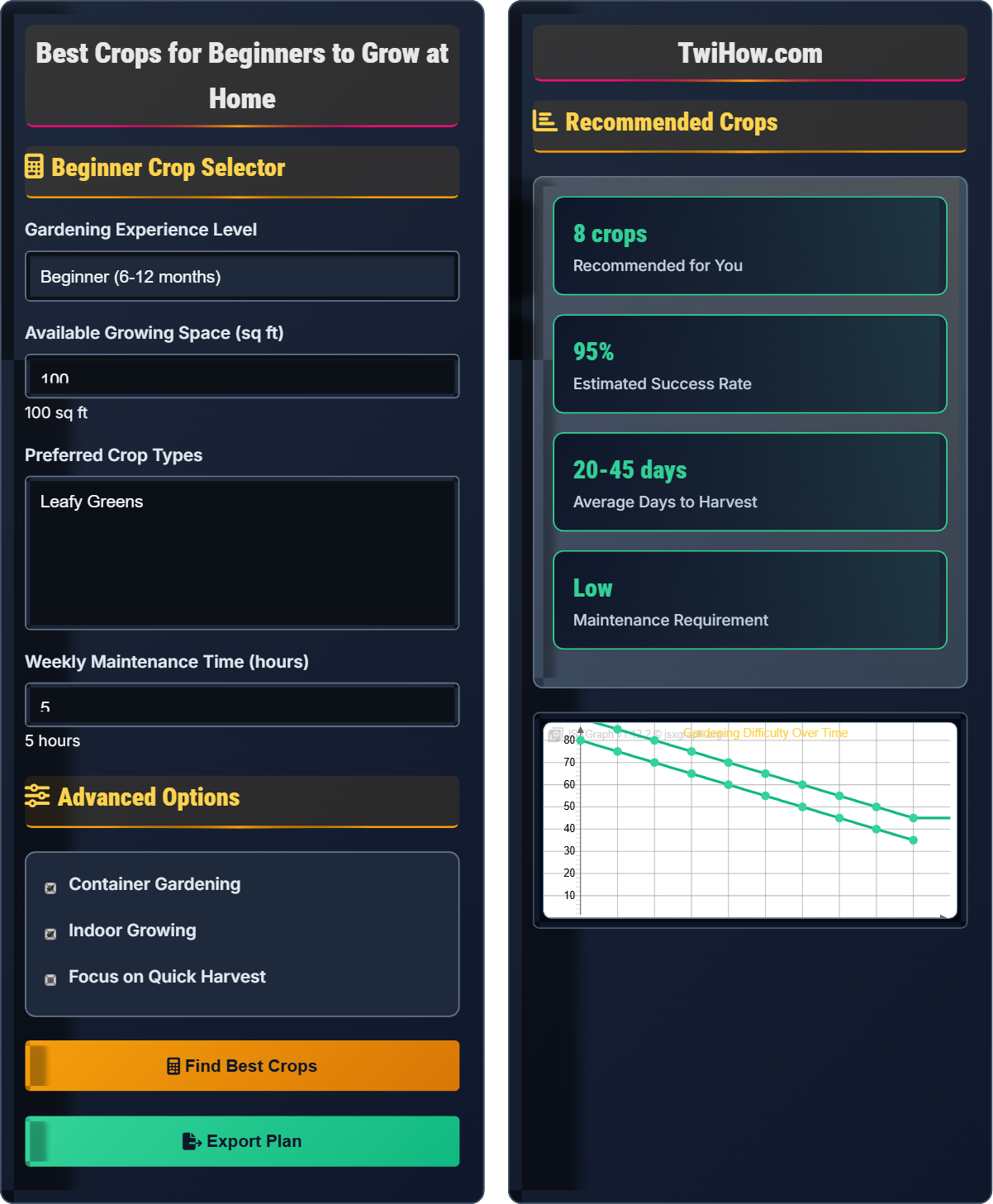
Beginner Crop Selector
Advanced Options
Recommended Crops
| Crop | Difficulty | Days to Harvest | Space Required |
|---|---|---|---|
| Lettuce | Easy | 30-45 | 1 sq ft |
| Radishes | Easy | 25-30 | 1 sq ft |
| Green Beans | Easy | 50-60 | 2 sq ft |
| Tomatoes | Medium | 60-80 | 4 sq ft |
Beginner Gardening Essentials
The gardening success rate can be estimated as:
Where each factor is rated on a 0-100 scale based on crop choice and growing conditions.
Beginner-friendly crops have predictable growth patterns:
- Quick Harvest: 20-45 days (radishes, lettuce, herbs)
- Medium Term: 45-70 days (beans, peas, tomatoes)
- Long Term: 70+ days (squash, corn, potatoes)
Start with quick-harvest crops to build confidence.
Most beginner crops need:
- Frequency: 1-2 inches per week including rainfall
- Method: Water at soil level, not on leaves
- Timing: Early morning is best
- Signs: Wilting, yellowing, slow growth
Consistent moisture promotes healthy growth.
- Full Sun: 6+ hours daily (tomatoes, peppers, beans)
- Partial Shade: 3-6 hours (lettuce, spinach, herbs)
- Full Shade: 0-3 hours (some herbs, leafy greens)
Match crops to your available light conditions.
Beginner Gardening Fundamentals
Soil preparation, watering, sunlight, spacing, germination, harvesting, pest management.
Success Rate = (Crop Difficulty + Growing Conditions + Time Investment) / 3
Where easier crops and better conditions increase success probability.
- Start with easy crops
- Match plants to conditions
- Water consistently
- Harvest regularly
Essential Beginner Crops
Lettuce, radishes, green beans, herbs, cherry tomatoes, peas.
- Choose fast-growing varieties
- Prioritize forgiving plants
- Consider your space
- Match to your climate
- Read seed instructions
- Start small
- Keep records
- Learn from mistakes
Beginner-Friendly Crops
Gardening Visualization
Beginner Gardening Learning Quiz
Which of the following crops is considered the easiest for complete beginners?
Radishes are among the easiest crops for beginners. They grow very quickly (20-30 days), are forgiving of growing conditions, require minimal care, and provide immediate gratification with visible results. Corn requires a lot of space and pollination knowledge, broccoli needs specific timing and conditions, and artichokes are quite challenging for beginners.
The answer is B) Radishes.
Starting with fast-growing, forgiving crops builds confidence and provides immediate rewards. Radishes are ideal because they germinate quickly, grow rapidly, and can be harvested in as little as 20-30 days. This quick turnaround helps beginners see the connection between their actions and results, encouraging continued gardening.
Germination: Seed sprouting process
Forgiving Crops: Plants tolerant of beginner mistakes
Immediate Gratification: Quick visible results
• Start with quick-harvest crops
• Choose forgiving varieties
• Build confidence gradually
• Plant radishes every 2 weeks
• They grow in most conditions
• Great for children to grow
• Starting with too difficult crops
• Not reading seed instructions
• Expecting instant results
Explain proper watering techniques for beginner crops and calculate the weekly water requirement for a 50 sq ft garden. If most vegetables need 1-2 inches of water per week, how many gallons of water does this garden need weekly? (Hint: 1 inch of water over 1 sq ft equals 0.623 gallons)
Watering Techniques:
• Water at soil level, not on leaves
• Water deeply but less frequently
• Early morning is best time
• Check soil moisture before watering
Water Calculation: 50 sq ft × 1.5 inches × 0.623 gal/sq ft/inch = 46.7 gallons per week (average of 1-2 inches)
Most beginner crops thrive with consistent, deep watering rather than frequent shallow watering.
Proper watering is crucial for beginner success. Watering at soil level prevents leaf diseases and ensures water reaches the root zone where plants can access it. Deep, infrequent watering encourages deep root growth, making plants more drought-resistant. Consistent moisture prevents stress-related problems that beginners often attribute to other causes.
Deep Watering: Thorough soaking to reach root zone
Root Zone: Area where plant roots absorb water
Consistent Moisture: Even water availability
• Water at soil level
• Check soil before watering
• Water early morning
• Use finger test for soil moisture
• Mulch to retain moisture
• Install drip irrigation
• Watering leaves instead of soil
• Overwatering or underwatering
• Watering in afternoon heat
A beginner has a 4x8 ft raised bed (32 sq ft) and wants to plant lettuce, radishes, and green beans. Lettuce needs 1 sq ft per plant, radishes need 0.25 sq ft per plant, and beans need 2 sq ft per plant. If the gardener wants 8 lettuce plants, 20 radish plants, and 6 bean plants, calculate the total space required and determine if it fits in the raised bed. What percentage of the bed will be utilized?
Space Calculations:
• Lettuce: 8 plants × 1 sq ft = 8 sq ft
• Radishes: 20 plants × 0.25 sq ft = 5 sq ft
• Beans: 6 plants × 2 sq ft = 12 sq ft
Total Space Required: 8 + 5 + 12 = 25 sq ft
Bed Utilization: (25 ÷ 32) × 100 = 78% of the bed will be utilized
Yes, the plants will fit with room to spare.
Proper spacing is crucial for beginner success. Overcrowding leads to poor growth, increased disease susceptibility, and disappointing yields. Calculating space requirements helps beginners plan effectively and understand why proper spacing is important. The 78% utilization leaves room for pathways and future plantings while maximizing the available space.
Spacing: Distance between plants
Utilization: Percentage of space used
Crowding: Insufficient space between plants
• Follow spacing recommendations
• Plan before planting
• Use seed packet spacing
• Make a garden map
• Consider succession planting
• Planting too densely
• Not following spacing guidelines
• Forgetting growth space
A beginner wants to have continuous lettuce harvests for 3 months. Lettuce matures in 30 days and can be planted every 2 weeks. Calculate how many lettuce plantings are needed for continuous harvest and determine the planting schedule for a 12-week period. If each planting requires 2 sq ft and produces 1 head of lettuce, how much space is needed for year-round lettuce production?
Planting Frequency: Every 2 weeks for 12 weeks = 6 plantings
Space Needed: 6 plantings × 2 sq ft = 12 sq ft
Harvest Schedule: Every 2 weeks, one planting matures and is harvested
Year-Round Calculation: 52 weeks ÷ 2 weeks = 26 plantings needed annually
Space for year-round: 26 × 2 sq ft = 52 sq ft total space needed.
Succession planting is a valuable technique that ensures continuous harvests. For beginners, lettuce is ideal because it grows quickly and can be harvested multiple times. By staggering plantings, gardeners can enjoy fresh produce throughout the growing season rather than having all crops mature at once. This approach also spreads the workload and reduces waste.
Succession Planting: Staggered plantings for continuous harvest
Continuous Harvest: Ongoing crop production
Staggered Plantings: Timed seedings
• Calculate based on maturity time
• Stop before first frost
• Plan space requirements
• Use a planting calendar
• Mark planting dates
• Start with easy crops
• Not calculating maturity time
• Planting too close to frost
• Not enough space planning
Which of the following beginner crops requires the most sunlight (full sun - 6+ hours daily)?
Tomatoes require full sun (6+ hours daily) to produce well and develop proper fruit. They are heat-loving plants that need intense sunlight for optimal growth and fruit production. Spinach and lettuce prefer partial shade, especially in hot weather, while chives can tolerate partial shade. Matching crops to available light conditions is crucial for beginner success.
The answer is C) Tomatoes.
Sun requirements are critical for plant success. Full-sun crops like tomatoes, peppers, and beans need intense light for photosynthesis and fruit development. Leafy greens like lettuce and spinach actually prefer partial shade, especially in hot weather, as too much sun can cause them to bolt (go to seed) prematurely. Understanding light requirements helps beginners match plants to their growing conditions.
Full Sun: 6+ hours of direct sunlight
Partial Shade: 3-6 hours of sunlight
Photosynthesis: Light-to-energy conversion
• Assess your light conditions
• Match crops to available light
• Consider seasonal changes
• Observe your garden's light
• Use morning sun for greens
• Reserve sunny spots for fruiting
• Planting sun lovers in shade
• Not assessing light conditions
• Ignoring seasonal changes
Essential Beginner Techniques
FAQ
Q: What's the difference between seeds and seedlings?
A: The key differences are:
Seeds: Plant embryos in protective coats. Require more time and attention to grow into plants. Better for crops like radishes, beans, and carrots.
Seedlings: Young plants that have already germinated and developed first leaves. Faster way to get plants growing. Better for tomatoes, peppers, and other longer-season crops.
For beginners, seedlings are often easier since you skip the germination phase.
Q: How do I know when to harvest my crops?
A: Harvest timing varies by crop:
Leafy Greens: When leaves are large enough to eat but still tender
Root Vegetables: When roots reach desired size (check seed packet)
Fruiting Crops: When fruits change color and feel firm
Herbs: Before flowering for best flavor
Harvest in early morning when plants are hydrated and temperatures are cool.