Integrated Pest Management (IPM) Best Practices
Complete guide • Step-by-step instructions
Integrated Pest Management (IPM) is a comprehensive approach to pest control that combines biological, cultural, physical, and chemical tools in a coordinated way. IPM emphasizes prevention, monitoring, and intervention thresholds to manage pests while minimizing risks to human health, beneficial organisms, and the environment.
IPM strategies prioritize non-chemical methods first, using targeted treatments only when pest populations exceed economic thresholds. This approach reduces pesticide use, promotes ecological balance, and creates sustainable pest management systems that adapt to changing conditions.
Key components:
- Monitoring: Regular scouting and pest identification
- Thresholds: Economic and action thresholds for treatment
- Prevention: Cultural and physical controls
- Control: Targeted interventions when necessary
- Evaluation: Assessing effectiveness and adapting strategies
Success depends on understanding pest biology, implementing multiple control methods, and maintaining detailed records.
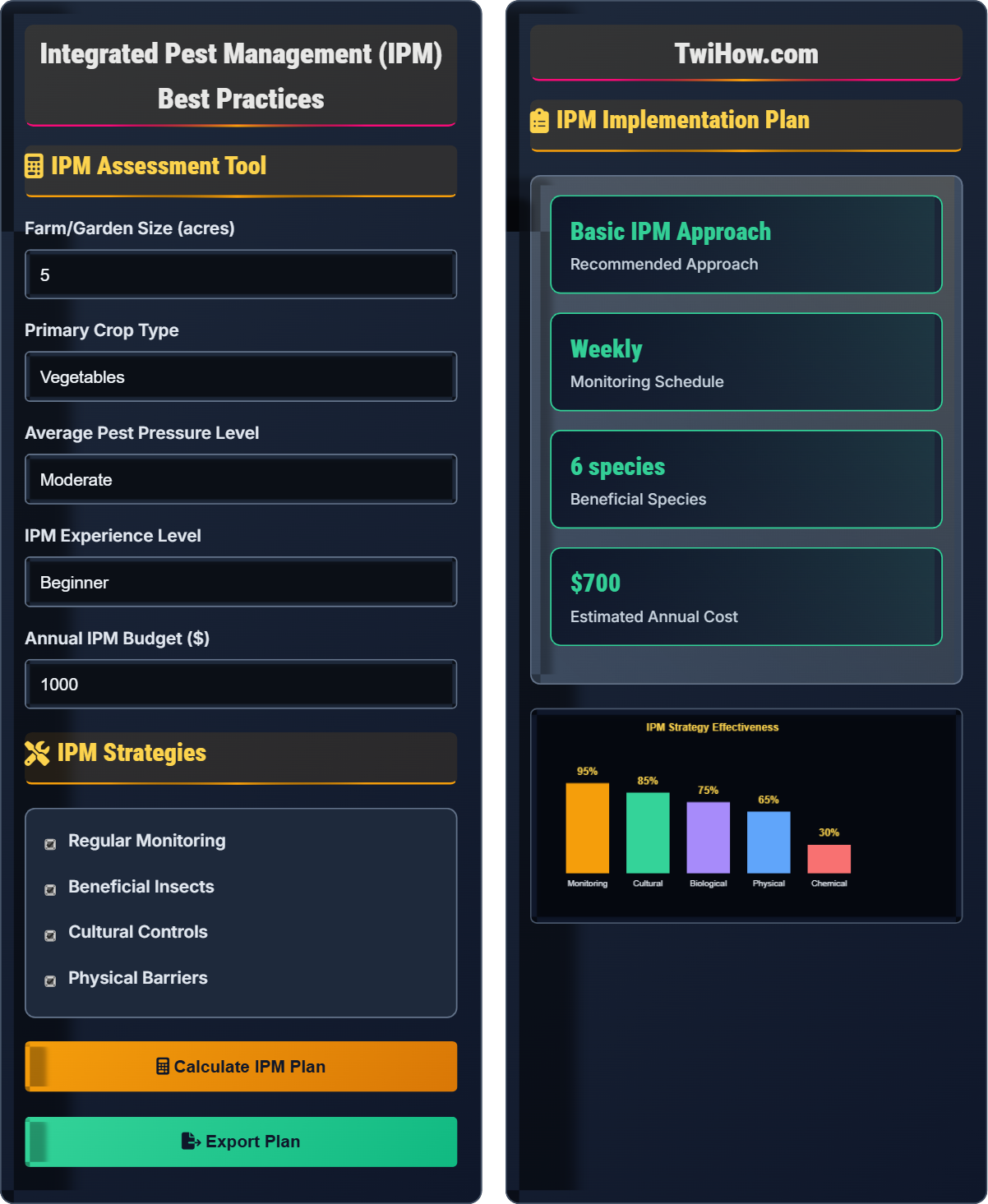
IPM Assessment Tool
IPM Strategies
IPM Implementation Plan
| Strategy | Priority | Implementation |
|---|---|---|
| Monitoring | High | Daily visual inspection |
| Cultural Controls | High | Crop rotation, sanitation |
| Beneficial Insects | Medium | Release and habitat |
| Physical Barriers | Medium | Row covers, traps |
| Biological Controls | Low | Targeted when needed |
IPM Fundamentals
Integrated Pest Management (IPM) is a sustainable approach to managing pests by combining biological, cultural, physical, and chemical tools in a coordinated way. IPM emphasizes the use of all available pest management techniques and integrates them into a comprehensive program. The goal is to keep pest populations below economically damaging levels while minimizing risks to human health and the environment.
IPM consists of four main components:
- Monitoring: Regular observation and identification of pest populations
- Thresholds: Economic and action thresholds that determine when intervention is needed
- Prevention: Cultural, physical, and biological controls to prevent pest problems
- Control: Targeted interventions using the most effective and least risky methods
IPM relies on economic thresholds to determine when control measures are justified:
- Economic Injury Level (EIL): The lowest population density that will cause economic damage
- Economic Threshold (ET): The population level at which control measures should be initiated
- Action Threshold: The point at which management action is taken before economic injury occurs
IPM offers numerous advantages:
- Reduced Pesticide Use: Minimizes environmental impact and health risks
- Cost-Effectiveness: Reduces unnecessary treatments and associated costs
- Resistance Management: Slows development of pesticide-resistant pests
- Beneficial Conservation: Protects natural enemies and pollinators
- Sustainability: Creates long-term pest management solutions
IPM Strategies & Tactics
Cultural practices that reduce pest pressure:
- Crop Rotation: Disrupts pest life cycles and reduces soil-borne diseases
- Sanitation: Removes pest breeding sites and overwintering locations
- Resistant Varieties: Plants bred to resist specific pests
- Timing: Planting and harvesting schedules to avoid peak pest activity
- Spacing: Proper plant spacing to reduce humidity and disease pressure
Using natural enemies to manage pests:
- Parasitoids: Wasps and flies that parasitize pest insects
- Predators: Ladybugs, lacewings, spiders, and birds
- Pathogens: Bacteria, fungi, and viruses that infect pests
- Conservation: Providing habitat for beneficial organisms
- Augmentation: Releasing beneficial insects when needed
When other methods are insufficient:
- Selective Pesticides: Target specific pests while sparing beneficials
- Spot Treatments: Apply only where needed, not broadcast
- Rotation: Alternate modes of action to prevent resistance
- Timing: Apply at most vulnerable life stage
- Compatibility: Ensure safety for beneficial organisms
IPM vs. Conventional Pest Control
- Monitoring: Regular scouting and identification
- Thresholds: Action taken at predetermined levels
- Multiple Methods: Combines biological, cultural, and chemical
- Environmental: Considers ecosystem impacts
- Long-term: Sustainable and adaptive
- Monitoring: Limited or reactive
- Thresholds: Often treated preventively
- Methods: Primarily chemical
- Environmental: May ignore ecosystem effects
- Short-term: Focus on immediate control
IPM Best Practices Quiz
Which of the following represents the correct sequence of IPM decision-making steps?
The correct sequence for IPM decision-making is: Identify (correctly identify pests), Monitor (regular observation), Assess (evaluate economic threshold), Intervene (take action when needed), and Evaluate (assess effectiveness and adjust). This systematic approach ensures that control measures are only implemented when necessary and are appropriate for the situation.
The answer is B) Identify, Monitor, Assess, Intervene, Evaluate.
This question tests understanding of the fundamental IPM decision-making process. The systematic approach ensures that pest management decisions are evidence-based rather than reactive. Each step builds upon the previous one, creating a logical sequence that maximizes effectiveness while minimizing unnecessary interventions.
IPM Decision-Making: Systematic approach to pest management
Threshold-Based: Decisions made based on predetermined levels
Integrated Approach: Combining multiple control methods
• Correct identification is the foundation of IPM
• Monitoring provides the data for informed decisions
• Intervention should only occur when thresholds are exceeded
• Keep detailed records of all monitoring activities
• Use standardized scouting forms for consistency
• Regular training ensures proper identification skills
• Taking action without proper identification
• Not establishing economic thresholds
• Skipping evaluation steps in the process
Explain the concept of economic thresholds in IPM and calculate the economic threshold for aphids on lettuce if the cost of treatment is $25/acre, the value of the crop is $200/acre, and treatment reduces yield loss from 30% to 5%.
Economic Threshold Concept: Economic thresholds are pest population levels at which control measures should be initiated to prevent economic losses. They consider the cost of treatment versus the value of prevented crop loss.
Calculation:
Benefit from treatment = Value of crop × (Yield loss without treatment - Yield loss with treatment)
Benefit = $200 × (30% - 5%) = $200 × 0.25 = $50/acre
Since benefit ($50) > cost ($25), treatment is justified.
Economic threshold = Cost of treatment ÷ (Value of crop × Difference in yield loss)
In this case, the threshold would be when treatment costs equal benefits, which occurs at a lower pest pressure than the current situation.
Economic thresholds represent the intersection of agricultural economics and pest management. The calculation demonstrates how IPM balances the cost of control with potential crop losses. This quantitative approach ensures that management decisions are financially justified rather than purely reactive.
Economic Threshold (ET): Population level triggering control action
Economic Injury Level (EIL): Lowest density causing economic damage
Cost-Benefit Analysis: Evaluating treatment costs vs. prevented losses
• ET should be below EIL to prevent economic damage
• Thresholds vary by crop, pest, and economic conditions
• Regular review of thresholds is necessary as conditions change
• Update thresholds based on current market prices
• Consider non-economic factors in threshold setting
• Use research-based thresholds when available
• Setting thresholds too high, missing economic damage
• Not adjusting thresholds for changing economic conditions
• Using arbitrary numbers instead of economic calculations
A vegetable farmer implements an IPM program for cucumber beetles. Before IPM, they spent $400/acre on pesticides and lost 25% of their crop to beetle damage. After implementing IPM, pesticide costs decreased to $150/acre, and crop loss reduced to 8%. If the crop value is $1,200/acre, calculate the net savings per acre from implementing IPM.
Before IPM:
Pesticide cost = $400/acre
Crop loss = 25% × $1,200 = $300/acre
Total cost = $400 + $300 = $700/acre
After IPM:
Pesticide cost = $150/acre
Crop loss = 8% × $1,200 = $96/acre
Total cost = $150 + $96 = $246/acre
Net Savings:
Savings = $700 - $246 = $454/acre
The IPM program resulted in $454 net savings per acre, demonstrating the economic benefits of integrated pest management.
This calculation demonstrates the economic justification for IPM adoption. The example shows how reducing pesticide costs while simultaneously decreasing crop losses creates a double benefit. The quantitative approach illustrates that IPM can be both environmentally beneficial and economically advantageous.
Net Savings: Total benefit minus total cost
Economic Benefit: Financial gain from IPM implementation
Cost-Benefit Analysis: Comparing costs to benefits of IPM
• IPM should reduce both costs and losses
• Economic benefits may take time to realize
• Record keeping is essential for economic analysis
• Track all costs and benefits over multiple seasons
• Include indirect benefits like reduced labor
• Consider long-term sustainability in economic analysis
• Not accounting for all costs in the analysis
• Ignoring the value of reduced environmental impact
• Focusing only on immediate rather than long-term benefits
A greenhouse manager notices an aphid outbreak and decides to introduce ladybugs for biological control. The aphid population is currently 500 per plant, and the economic threshold is 100 per plant. If each ladybug can consume 50 aphids per day, how many ladybugs should be released per plant to reduce the population to the economic threshold within 5 days?
Problem Analysis:
Current aphid population = 500 per plant
Target population = 100 per plant
Aphids to be eliminated = 500 - 100 = 400 per plant
Time frame = 5 days
Aphids consumed per ladybug per day = 50
Calculation:
Aphids to be consumed per day = 400 ÷ 5 = 80 aphids per day
Ladybugs needed = 80 aphids per day ÷ 50 aphids per ladybug per day = 1.6 ladybugs
Since partial ladybugs aren't possible, round up to 2 ladybugs per plant.
Considerations: This is a simplified calculation. In reality, factors like ladybug survival, reproduction, and aphid reproduction would need to be considered.
This problem demonstrates the quantitative thinking required for biological control implementation. While the calculation provides a theoretical minimum, real-world biological control requires consideration of population dynamics, environmental factors, and predator-prey relationships. The example shows how IPM requires both scientific knowledge and practical application.
Biological Control: Using natural enemies to manage pests
Predator-Prey Dynamics: Relationships between beneficial insects and pestsRelease Rate: Number of beneficial insects to introduce
• Match beneficial insects to target pests
• Consider timing of releases for effectiveness
• Provide habitat for beneficial insects
• Release beneficials when pest populations are low to moderate
• Provide alternative food sources for beneficial insects
• Avoid broad-spectrum pesticides that harm beneficials
• Releasing beneficials when pest populations are too high
• Not considering environmental conditions for beneficials
• Using pesticides incompatible with biological control
In an IPM program, which of the following should be prioritized first?
The first step in any IPM program is to correctly identify the pest and assess the situation. Without proper identification, any control measures may be ineffective or even harmful. IPM emphasizes evidence-based decision making, starting with accurate pest identification, followed by monitoring and assessment before determining appropriate control measures.
The answer is B) Correctly identify the pest and assess the situation.
This question emphasizes the foundational principle of IPM: accurate identification and assessment before action. The systematic approach prevents misdiagnosis and inappropriate treatments. This demonstrates how IPM differs from conventional pest control by emphasizing knowledge and assessment over immediate treatment.
Pest Identification: Correctly determining pest species
Evidence-Based: Decisions based on observation and data
Systematic Approach: Following established IPM protocols
• Proper identification is essential for effective control
• Assessment must precede intervention
• Treatment should be targeted and specific
• Use diagnostic keys and expert resources for identification
• Take photos for later consultation
• Consult extension services for difficult identifications
• Treating symptoms without identifying the cause
• Using broad-spectrum treatments for unknown pests
• Not verifying pest presence before treatment
FAQ
Q: How do I know if my IPM program is working effectively?
A: Monitor these key indicators: 1) Pest populations staying below economic thresholds, 2) Reduced pesticide applications compared to previous years, 3) Lower crop losses due to pests, 4) Increased presence of beneficial insects, 5) Cost savings from reduced pesticide use, and 6) Improved environmental health indicators. Keep detailed records of pest counts, treatments applied, crop yields, and costs. Conduct regular assessments comparing pre-IPM and post-IPM data. Successful IPM programs show declining pest pressure over time as biological controls become established and cultural practices reduce pest habitats.
Q: Can IPM be used effectively in home gardens, and what are the easiest practices to start with?
A: Absolutely! Home garden IPM is very effective and environmentally friendly. Start with these easy practices: 1) Regular monitoring - walk through your garden weekly looking for pests and beneficials, 2) Cultural controls - rotate crops, remove diseased plants, maintain proper spacing, 3) Physical barriers - row covers, collars for cutworms, 4) Beneficial habitat - plant flowers that attract predators, 5) Handpicking - remove large pests manually, 6) Sanitation - clean up plant debris. Begin with one or two practices and gradually add more. Focus on prevention rather than reaction, and only use targeted treatments when absolutely necessary. Home gardens are ideal for IPM because you can closely monitor and respond to changes.