What are the best practices for no-till or low-till farming?
Complete no-till farming guide • Step-by-step implementation
No-Till Farming Fundamentals:
Show No-Till CalculatorNo-till and low-till farming are conservation practices that minimize soil disturbance to preserve soil structure, organic matter, and biological activity. These methods involve planting directly into undisturbed soil, leaving crop residues on the surface, and using specialized equipment to create planting slots.
Key no-till practices:
- Residue Management: Maintaining protective cover on soil surface
- Specialized Equipment: No-till planters and drills
- Herbicide Use: Managing weeds without tillage
- Soil Biology: Enhancing microbial activity and earthworms
- Water Conservation: Improving infiltration and retention
- Carbon Sequestration: Storing carbon in soil
Benefits include improved soil health, reduced erosion, increased water retention, and enhanced biodiversity.
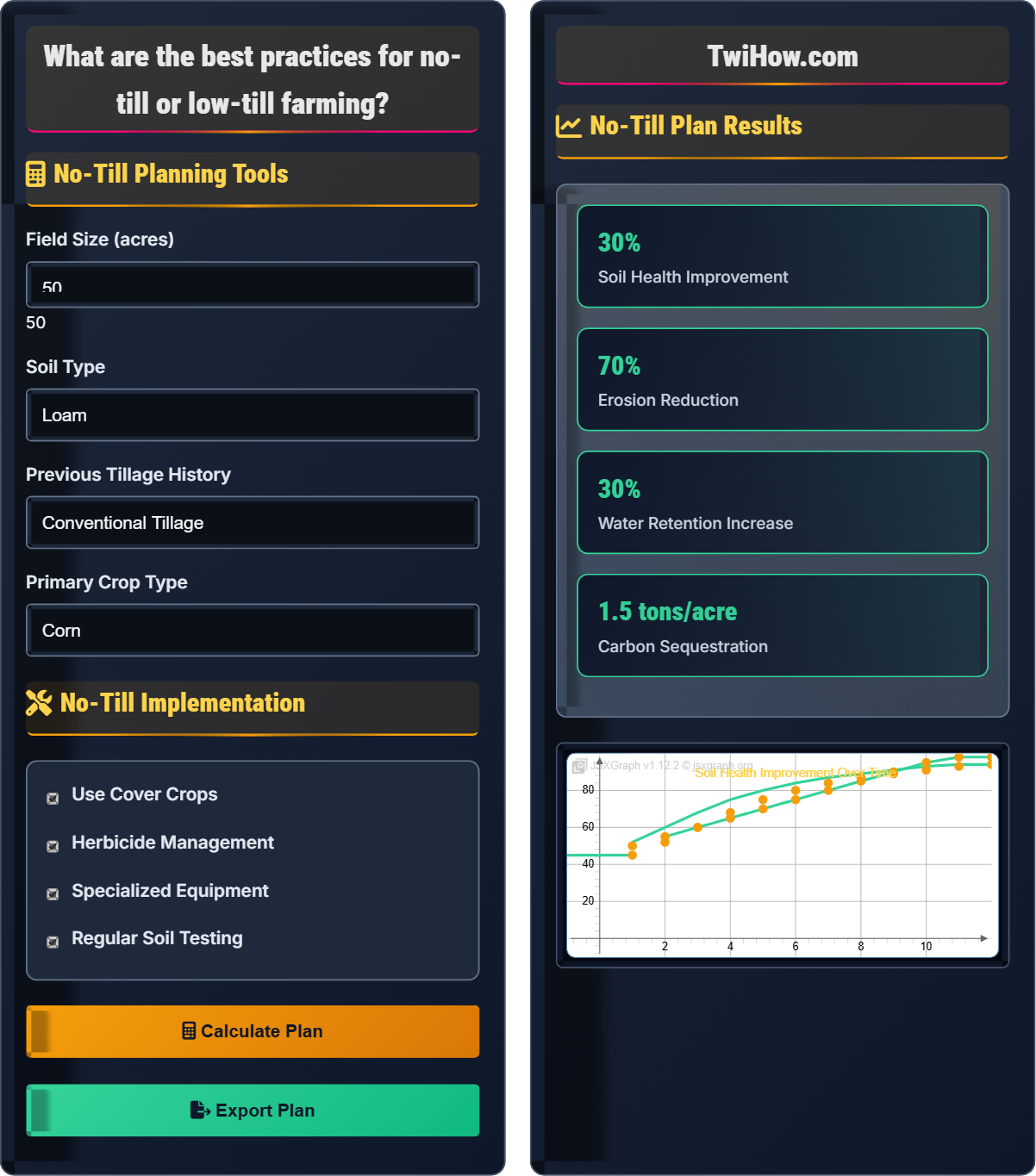
No-Till Planning Tools
No-Till Implementation
No-Till Plan Results
| Practice | Implementation | Timeline | Benefits |
|---|---|---|---|
| Residue Management | Leave 30% cover | Immediate | Soil protection |
| Equipment Setup | No-till planter | Before planting | Minimize disturbance |
| Herbicide Program | Pre-emergent | Pre-planting | Weed control |
| Soil Testing | Annual sampling | Ongoing | Nutrient management |
Implementation Timeline
-
Year 1: Transition to no-till, establish cover crops
-
Years 2-3: Adjust equipment and management practices
-
Years 4-5: Full benefits realized, optimize systems
-
Ongoing: Continuous monitoring and improvement
No-Till Farming Planning Explained
No-till and low-till farming are conservation practices that minimize soil disturbance to preserve soil structure, organic matter, and biological activity. These methods involve planting directly into undisturbed soil, leaving crop residues on the surface, and using specialized equipment to create planting slots. The goal is to maintain soil health while achieving productive agricultural outcomes.
Where:
- Organic Matter: Percentage of soil organic carbon
- Water Retention: Available water holding capacity
- Biological Activity: Microbial biomass and diversity
- Erosion Susceptibility: Soil erodibility factor
Key areas where no-till farming makes an impact:
- Soil Conservation: Reducing erosion and preserving topsoil
- Water Management: Improving infiltration and retention
- Carbon Sequestration: Storing atmospheric carbon in soil
- Biodiversity: Supporting soil organisms and wildlife
- Energy Efficiency: Reducing fuel consumption
- Economic Returns: Lowering operational costs
- Residue Management: Maintain adequate cover to protect soil
- Equipment Calibration: Ensure proper seed placement and depth
- Nutrient Management: Adjust fertilizer application for no-till conditions
- Compaction Prevention: Avoid field operations when soils are too wet
- Pest Management: Monitor for diseases and pests in residue
No-Till Farming Fundamentals
Soil conservation, residue management, cover crops, soil biology, water infiltration, carbon sequestration.
Soil Health Index = (Organic Matter + Water Retention + Biological Activity) / Erosion Susceptibility
Where Soil Health Index = measure of overall soil condition and sustainability.
- Maintain 30% soil cover
- Use specialized equipment
- Manage herbicides properly
Applications
Soil conservation, water management, carbon sequestration, biodiversity enhancement.
- Erosion control
- Water conservation
- Soil health improvement
- Climate change mitigation
- Initial transition challenges
- Equipment investment
- Herbicide management
- Soil compaction risks
No-Till Farming Learning Quiz
What is the primary mechanism by which no-till farming improves soil health?
No-till farming improves soil health primarily by preserving soil structure and organic matter. By minimizing soil disturbance, the natural aggregation of soil particles is maintained, creating stable pore spaces that allow for water infiltration and air movement. The retention of crop residues on the surface adds organic matter and provides habitat for beneficial soil organisms.
The answer is B) Preservation of soil structure and organic matter.
Traditional tillage disrupts soil structure by breaking apart natural aggregates and burying organic matter. No-till farming preserves these natural formations, which are crucial for soil health. The undisturbed soil structure allows for better water infiltration, root penetration, and habitat for beneficial organisms. This is the fundamental principle behind conservation tillage systems.
Soil Structure: Arrangement of soil particles into aggregates
Soil Aggregates: Clusters of soil particles held together
Organic Matter: Decomposed plant and animal materials in soil
• Minimize soil disturbance
• Maintain soil structure
• Preserve organic matter
• Leave crop residues on surface
• Use cover crops to add organic matter
• Avoid field operations when wet
• Disturbing soil structure
• Removing all crop residues
• Operating equipment when too wet
Explain how herbicide management differs in no-till systems compared to conventional tillage and why it's critical for success.
Differences: In no-till systems, herbicides become the primary tool for weed control since mechanical cultivation is eliminated. Pre-emergent herbicides are applied to control weeds before they emerge, and post-emergent herbicides target weeds after emergence.
Application Timing: Herbicides are often applied at different times in no-till systems, frequently before planting to control existing weeds and then during the growing season.
Critical Success Factor: Effective herbicide management is crucial because weeds that emerge in no-till systems compete directly with crops for nutrients, water, and light, with no mechanical option to remove them later in the season.
Resistance Management: Rotating herbicide modes of action is essential to prevent resistance development.
Herbicide management in no-till systems requires a proactive approach since the mechanical option for weed control is removed. Farmers must rely on chemical and cultural practices to manage weeds. This often means more strategic planning around herbicide applications and understanding how different products work in the presence of crop residues that remain on the soil surface.
Pre-emergent Herbicide: Applied before weeds emerge to prevent germination
Post-emergent Herbicide: Applied after weeds emerge to kill existing plants
Herbicide Resistance: Weeds that survive herbicide applications
• Apply herbicides strategically
• Rotate modes of action
• Monitor for resistance
• Use burndown applications
• Combine multiple herbicide sites of action
• Scout fields regularly
• Not planning herbicide applications
• Using same mode of action repeatedly
• Ignoring herbicide resistance
A farmer is considering switching from conventional tillage to no-till farming on 200 acres. Conventional tillage costs $35 per acre in fuel and labor. No-till requires a $40,000 planter investment but reduces fuel/labor costs to $15 per acre. Calculate the break-even point for the transition, assuming the planter lasts 10 years and the farmer saves $20 per acre annually.
Annual Savings: ($35 - $15) × 200 acres = $4,000 per year
Initial Investment: $40,000 for planter
Break-even Time: $40,000 ÷ $4,000 per year = 10 years
Additional Benefits: Soil health improvement, erosion reduction, and potential government incentives are not included in this basic calculation but add significant value. Over 10 years, the farmer saves $40,000 in operational costs, offsetting the equipment investment, with additional benefits continuing beyond the break-even point.
This problem demonstrates the economic trade-offs in transitioning to no-till farming. While there are significant upfront equipment costs, the ongoing operational savings can make the transition financially viable. The break-even analysis shows that the investment pays for itself over time, with continued benefits thereafter. This type of analysis is critical for farmers considering conservation practices.
Break-even Point: When cumulative savings equal initial investment
Operational Costs: Annual expenses for running the farm
Capital Investment: One-time equipment purchases
• Calculate total cost of ownership
• Consider all benefits
• Factor in government incentives
• Look for cost-share programs
• Consider used equipment options
• Calculate long-term benefits
• Only considering first-year costs
• Not factoring in soil benefits
• Ignoring government incentives
A farmer wants to convert to no-till but has clay soil prone to compaction. What equipment specifications should they prioritize and why? What adjustments might be needed compared to sandy soil?
For Clay Soil: Prioritize equipment with:
Row Cleaners: To move residue and expose soil for warming
Downforce Systems: Variable downforce to handle dense clay conditions
Penetration Points: Sharp, heavy-duty opening disks to cut through compacted layers
Residue Managers: To handle high-residue conditions in clay
Adjustments: Operate only when soil is dry enough to prevent smearing. In sandy soils, less downforce is needed, and residue managers might be less critical. Clay soils require more attention to soil moisture conditions to avoid sidewall compaction.
Equipment selection in no-till farming must account for soil-specific conditions. Clay soils behave differently than sandy soils, requiring different equipment specifications and operating procedures. Understanding soil physics is crucial for successful no-till implementation. The wrong equipment or settings can lead to poor seed-to-soil contact and reduced germination.
Downforce: Vertical force applied to planter units
Row Cleaner: Device that moves residue from seed furrow
Sidewall Compaction: Compression of furrow walls during planting
• Match equipment to soil type
• Monitor soil moisture
• Adjust settings seasonally
• Calibrate equipment regularly
• Check seed placement depth
• Monitor for wear parts
• Using same settings for all soil types
• Operating when soil is too wet
• Not monitoring seed placement
Which environmental benefit of no-till farming has the most significant impact on climate change mitigation?
Carbon sequestration in soil is the most significant environmental benefit of no-till farming for climate change mitigation. By minimizing soil disturbance, no-till farming allows organic matter to accumulate and remain in the soil profile rather than decomposing and releasing CO2 into the atmosphere. This process removes atmospheric carbon and stores it in the soil for extended periods.
The answer is B) Carbon sequestration in soil.
While all the listed benefits are important, carbon sequestration directly addresses climate change by removing CO2 from the atmosphere. No-till farming can sequester 0.3-0.6 tons of carbon per acre per year, which translates to 1.1-2.2 tons of CO2 per acre annually. When implemented on a large scale, this represents a significant contribution to climate change mitigation efforts.
Carbon Sequestration: Long-term storage of atmospheric carbon in soil
Climate Change Mitigation: Actions that reduce greenhouse gas emissions
Soil Organic Carbon: Carbon stored in soil organic matter
• Minimize soil disturbance
• Maintain soil cover
• Add organic matter
• Use cover crops to add carbon
• Maintain living roots year-round
• Reduce tillage frequency
• Frequent tillage operations
• Not maintaining soil cover
• Removing crop residues
FAQ
Q: How long does it take to see benefits from no-till farming?
A: Benefits appear at different times:
Year 1: Reduced fuel and labor costs, initial erosion reduction
Years 2-3: Improved soil structure, better water infiltration
Years 4-5: Noticeable increases in organic matter and biological activity
Years 5+: Full benefits realized including significant carbon sequestration and enhanced yields
The transition period may show reduced yields initially as the soil ecosystem adjusts, but benefits compound over time leading to more resilient and productive systems.
Q: What are the main challenges in transitioning to no-till farming?
A: Key challenges include:
Equipment: Need for specialized no-till planters and residue management tools
Weed Management: Reliance on herbicides instead of mechanical cultivation
Soil Compaction: Risk of surface compaction without tillage to break it up
Yield Drag: Potential initial yield reductions during transition period
Learning Curve: New management practices and timing requirements
Residue Management: Dealing with crop residue that previously was incorporated
However, with proper planning and management, these challenges can be overcome, leading to sustainable long-term benefits.