Organic Certification & Labeling Guide
Complete guide • Step-by-step instructions
Organic certification is a rigorous process that verifies agricultural products meet national organic standards. Certification allows producers to use the USDA organic seal and market their products as organic. The process involves detailed record keeping, inspections, and compliance with strict regulations governing production methods, inputs, and handling practices.
Organic labeling has specific requirements based on the percentage of organic ingredients. Products must contain at least 95% organic ingredients to use the "USDA Organic" seal. The certification process typically takes 6-12 months and requires a three-year transition period for previously non-organic land.
Key considerations:
- Transition Period: 36 months before first harvest can be certified organic
- Record Keeping: Detailed documentation of all inputs and practices
- Inspections: Annual on-site inspections by accredited certifiers
- Costs: Certification fees ranging from $400-$2,000+ annually
- Market Access: Premium prices and expanded market opportunities
Success depends on understanding regulations, maintaining detailed records, and implementing compliant practices.
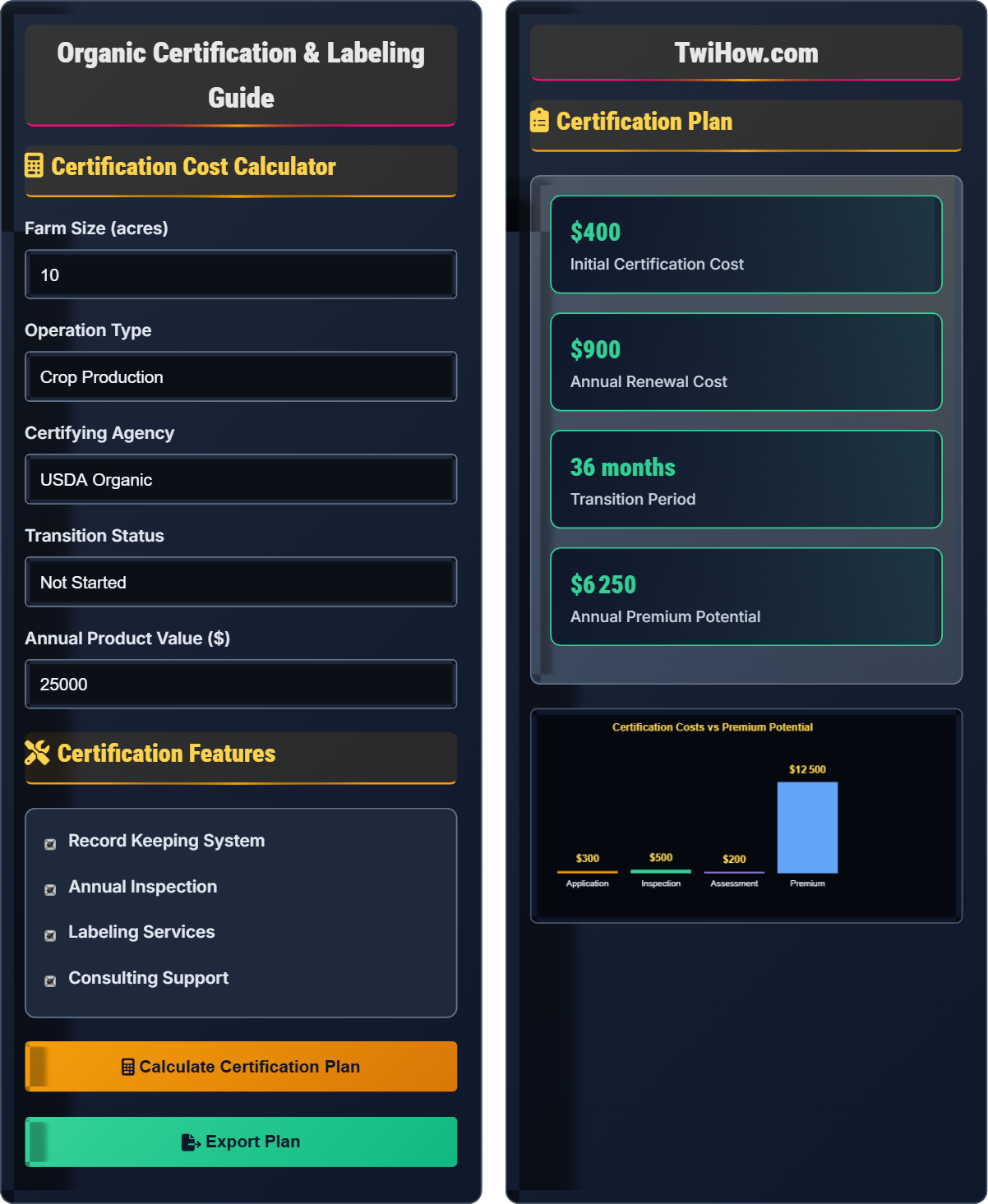
Certification Cost Calculator
Certification Features
Certification Plan
| Cost Item | Amount | Frequency |
|---|---|---|
| Application Fee | $300 | One-time |
| Inspection Fee | $500 | Annual |
| Annual Assessment | $350 | Annual |
| Record Keeping | $200 | Annual |
| Labeling & Marketing | $150 | Annual |
| Consulting | $300 | Annual |
Organic Certification Fundamentals
Organic certification is a legally regulated process that verifies agricultural products meet national organic standards. The National Organic Program (NOP), administered by the USDA, sets the standards for organic production and handling. Certification allows producers to use the USDA Organic seal and market their products as organic. The process involves detailed record keeping, inspections, and compliance with strict regulations governing production methods, inputs, and handling practices.
Key requirements for organic certification:
- Prohibited Substances: No synthetic pesticides, herbicides, or fertilizers
- Allowed Inputs: Only approved substances listed in the National List
- Soil Health: Emphasis on organic matter, biological activity, and nutrient cycling
- Transition Period: 36 months before first harvest can be certified organic
- Record Keeping: Detailed documentation of all inputs and practices
- Inspections: Annual on-site inspections by accredited certifiers
Organic labeling categories based on organic content:
- 100% Organic: All ingredients are organic, may use USDA Organic seal
- Organic: 95% or more organic ingredients, may use USDA Organic seal
- Made with Organic: 70-94% organic ingredients, cannot use seal
- Less than 70%: Cannot use "organic" on principal display panel
Approved organic farming methods:
- Composting: Using approved organic matter for soil fertility
- Crop Rotation: Preventing pest buildup and maintaining soil health
- Biological Pest Control: Beneficial insects and natural predators
- Mechanical Cultivation: Physical weed control methods
- Natural Substances: Approved biological and mineral inputs
- Integrated Pest Management: Holistic pest management approach
Organic Labeling Requirements
Organic labeling is strictly regulated based on percentage of organic ingredients:
- 100% Organic: All ingredients are organic, may display USDA Organic seal
- Organic: At least 95% organic ingredients, may display USDA Organic seal
- Made with Organic [specific ingredients]: 70-94% organic, cannot use seal
- Specific organic ingredients: Less than 70% organic, list organic ingredients
Strict requirements for organic labeling:
- Ingredient Listing: All organic ingredients must be identified
- Percentage Claims: Accurate percentage of organic content required
- Certifying Agent: Name and address of certifying agent required
- Prohibited Terms: Cannot use "natural" or "eco" as substitutes for organic
- Country of Origin: Must indicate country of origin for imported products
- Processing Claims: Must specify processing methods used
Organic standards vary by country but share common principles:
- USDA NOP: US national organic standards
- EU Organic: European Union organic regulations
- Canada Organic: Canadian organic standards
- JAS: Japanese Agricultural Standards
- Australian: Australian organic certification standards
Certification Comparison
- Inputs: Synthetic pesticides and fertilizers allowed
- Record Keeping: Minimal documentation required
- Inspections: Limited regulatory oversight
- Labeling: No special certification requirements
- Transition: No transition period needed
- Inputs: Only approved organic substances allowed
- Record Keeping: Extensive documentation required
- Inspections: Annual third-party inspections required
- Labeling: Strict labeling requirements and standards
- Transition: 36-month transition period required
Organic Certification & Labeling Quiz
What is the required transition period for land to become certified organic?
The National Organic Program requires a 36-month transition period during which land must be managed according to organic standards before any products can be sold as organic. This period ensures that prohibited substances have sufficiently cleared the soil and that organic management practices are established. During this time, farmers must follow organic practices but cannot label products as organic.
The answer is C) 36 months.
This question tests understanding of one of the most fundamental requirements of organic certification. The 36-month transition period is based on the time needed to ensure that prohibited substances are no longer present in the soil and that organic management practices are fully implemented. This demonstrates how organic certification is based on scientific principles and time-tested practices.
Transition Period: Time required to convert land to organic management
Organic Standards: Regulations governing organic production practices
Prohibited Substances: Chemicals not allowed in organic production
• 36-month transition required for crop production
• No prohibited substances during transition period
• Start transition process early in planning
• Keep detailed records of all inputs during transition
• Consider staggered transition of different fields
• Starting transition without proper planning
• Using prohibited substances during transition
• Not maintaining adequate records during transition
Explain what an Organic System Plan is and why it's essential for organic certification.
Organic System Plan (OSP): A comprehensive written document that describes how an operation will comply with organic regulations. The OSP includes:
Production Practices: Detailed description of farming methods, crop rotations, and soil management.
Input Lists: All substances, fertilizers, and pesticides used in production.
Record Keeping System: Procedures for documenting all activities and inputs.
Preventive Practices: Methods to prevent contamination from prohibited substances.
Handling Procedures: Storage, processing, and packaging methods for organic products.
The OSP is essential because it serves as the blueprint for organic compliance, provides documentation for inspectors, and ensures consistent practices across the operation. It must be submitted to the certifying agency and updated annually.
The Organic System Plan represents the cornerstone of organic certification. It demonstrates that the operation has a systematic approach to meeting organic standards. The plan shows how the farmer will maintain organic integrity throughout the production and handling process, serving as both a planning tool and compliance document.
Organic System Plan: Written document describing organic practices
Compliance: Adherence to organic regulations
Organic Integrity: Maintaining organic status throughout operations
• OSP must be approved before certification
• Plans must be updated annually
• All practices must be documented in the plan
• Include detailed maps of production areas
• List all inputs with brand names and EPA numbers
• Plan for preventive practices to avoid contamination
• Incomplete input lists
• Not updating plans annually
• Omitting preventive practices
A farmer with 20 acres of vegetables wants to get organic certification. The certifying agency charges $300 application fee, $400 annual inspection fee, $200 annual assessment, and $10 per acre for land certification. Calculate the total first-year cost and explain why this investment is beneficial.
Calculation:
Application Fee: $300
Annual Inspection: $400
Annual Assessment: $200
Land Certification: 20 acres × $10 = $200
Total First-Year Cost: $300 + $400 + $200 + $200 = $1,100
Benefits: Organic products typically command 20-40% price premiums. For a $50,000 annual production value, a 25% premium would provide $12,500 additional revenue, easily offsetting the $1,100 certification cost. The investment pays for itself in the first year.
This calculation demonstrates the economic rationale for organic certification. The example shows how the initial investment in certification can be quickly recovered through premium pricing. The economic benefits often justify the certification costs, especially in markets where consumers value organic products.
Price Premium: Additional revenue from organic certification
Return on Investment: Financial benefit relative to certification cost
Market Value: Economic value of organic products
• Certification costs vary by agency and operation size
• Premiums vary by product and market
• Economic benefits often outweigh certification costs
• Research market premiums before certifying
• Compare certification costs among agencies
• Consider staggered certification of different crops
• Not researching market demand before certifying
• Underestimating certification costs
• Not planning for ongoing compliance costs
A processor wants to label their granola as "organic" but it contains 85% organic ingredients. The remaining 15% includes non-organic salt and non-organic vanilla extract. Can they use the USDA Organic seal? What are the correct labeling options?
Analysis: The product contains 85% organic ingredients, which is less than the 95% required for the USDA Organic seal.
Correct Options:
• Option 1: "Made with Organic Oats, Honey, and Nuts" (listing specific organic ingredients)
• Option 2: List organic ingredients in the ingredient statement with "(Organic)" designation
Cannot Do:
• Use "Organic" on the principal display panel
• Use the USDA Organic seal
• Use "100% Organic" claim
The processor must accurately represent the organic content and follow specific labeling requirements for products with 70-94% organic ingredients.
This problem illustrates the importance of precise labeling requirements. The example shows how the percentage of organic ingredients determines what claims can be made. It demonstrates the regulatory framework that protects consumers and maintains organic integrity.
Principal Display Panel: Main panel consumers see first
Ingredient Statement: Complete list of product ingredients
Organic Content: Percentage of organic ingredients by weight
• 95%+ organic for "organic" claim and seal
• 70-94% for "made with organic" claims
• Less than 70% cannot use organic on principal panel
• Calculate organic percentage by weight
• Consult certifier for labeling guidance
• Review labels carefully before printing
• Misunderstanding percentage requirements
• Using seal without proper organic percentage
• Not consulting certifier before labeling
Which of the following records must be maintained for organic certification?
Organic certification requires comprehensive record keeping to verify compliance with organic standards. This includes detailed records of all inputs applied, production practices followed, harvest activities, storage and handling procedures, and sales. These records must be maintained for at least five years and be available for inspection. The extensive record keeping ensures traceability and verifies that organic standards are being followed.
The answer is B) All inputs, practices, and harvest records.
This question emphasizes the critical role of documentation in organic certification. The requirement for comprehensive records demonstrates how organic certification relies on verifiable compliance rather than just good intentions. The record-keeping requirement ensures transparency and accountability in organic production.
Traceability: Ability to track products from farm to consumer
Compliance Records: Documentation of adherence to organic standards
Inspection Readiness: Maintaining records for inspector review
• Maintain records for 5 years minimum
• Records must be accurate and complete
• Records must be available for inspection
• Use digital record keeping systems
• Update records immediately after activities
• Train all personnel on record keeping
• Incomplete record keeping
• Not updating records regularly
• Losing records during inspections
FAQ
Q: How much does organic certification typically cost and what factors affect the price?
A: Organic certification costs typically range from $400-$2,000+ annually, depending on operation size and complexity. Factors affecting cost include: farm size (per-acre fees), operation type (crop vs. livestock vs. processing), certifying agency fees, inspection complexity, and additional services like consulting. Larger operations often have lower per-acre costs. Costs include application fees, annual assessments, inspection fees, and record-keeping expenses. Many farmers find that organic premiums exceed certification costs.
Q: Can I sell my products as organic during the transition period?
A: No, you cannot sell products as organic during the 36-month transition period. However, you can market them as "in transition to organic" or "organically grown" with specific restrictions. You must follow organic practices during transition but cannot use the USDA Organic seal or claim products are organic. Some buyers may pay premium prices for transition products, but this must be clearly labeled as "in transition." The transition period allows you to implement organic practices while building customer relationships for when you achieve full certification.