What are the considerations for raising backyard chickens or small livestock?
Complete livestock guide • Step-by-step instructions
Livestock Fundamentals:
Show Livestock CalculatorRaising backyard chickens or small livestock involves careful planning around housing, feeding, health, legal requirements, and sustainability. Success requires understanding animal behavior, nutritional needs, and environmental considerations while complying with local regulations.
Key livestock considerations:
- Housing Requirements: Coop construction, ventilation, predator protection
- Feeding & Nutrition: Balanced diets, supplements, feeding schedules
- Health Management: Vaccinations, parasite control, veterinary care
- Legal Compliance: Zoning, permits, noise ordinances
Successful small livestock operations focus on animal welfare, sustainable practices, and integration with household/garden systems.
Livestock Planning Tools
Livestock Options
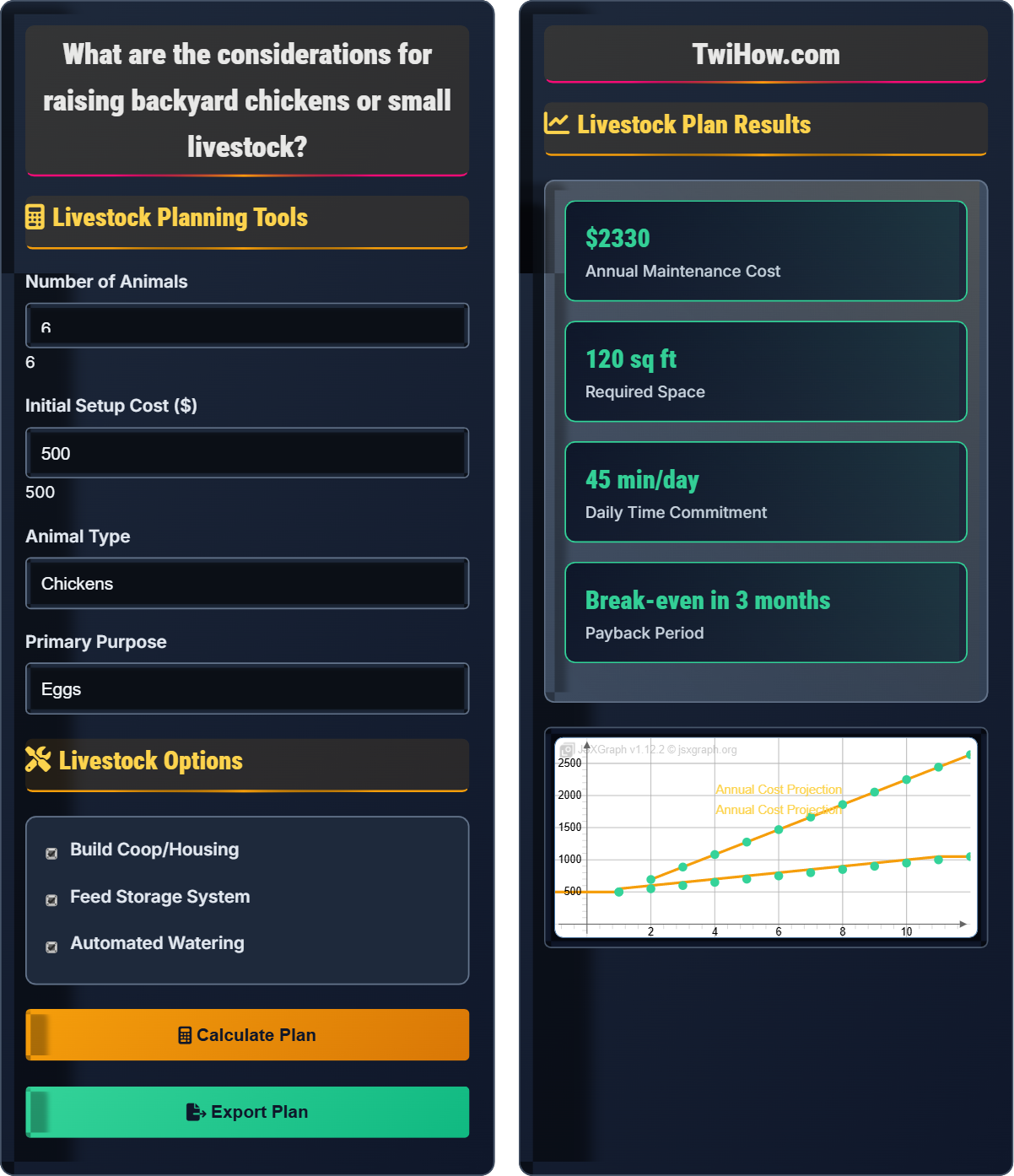
Livestock Plan Results
| Item | Cost | Frequency | Notes |
|---|---|---|---|
| Initial Setup | $500 | One-time | Coop, feeders, waterers |
| Feed | $300 | Monthly | Based on animal count |
| Veterinary | $100 | Quarterly | Checkups and vaccines |
| Bedding | $50 | Monthly | Shavings or straw |
| Supplements | $25 | Monthly | Vitamins, grit, oyster shell |
| Repairs | $75 | Annually | Coop maintenance |
Livestock Planning Explained
Raising backyard chickens or small livestock involves careful planning around housing, feeding, health, legal requirements, and sustainability. Success requires understanding animal behavior, nutritional needs, and environmental considerations while complying with local regulations.
Where:
- Initial Setup: Coop, equipment, and supplies
- Monthly Feed: Cost of feed for animals
- Veterinary: Healthcare and preventive care
- Bedding: Litter and cleaning materials
Key areas where backyard livestock makes an impact:
- Food Security: Fresh eggs, meat, and dairy
- Gardening: Manure for soil improvement
- Waste Reduction: Kitchen scraps recycling
- Educational: Teaching children responsibility
- Therapeutic: Stress reduction and companionship
- Self-Sufficiency: Reducing dependence on commercial sources
- Appropriate Housing: Protection from weather and predators
- Balanced Nutrition: Species-appropriate diet
- Health Monitoring: Regular observation and veterinary care
- Enrichment: Opportunities for natural behaviors
- Humane Handling: Gentle, stress-free interactions
Livestock Fundamentals
Housing requirements, feeding protocols, health management, legal compliance, animal welfare.
Annual Cost = Initial Setup + (Monthly Feed × 12) + (Veterinary × 4) + (Bedding × 12)
Where Annual Cost = total yearly expenses, Initial Setup = startup costs.
- Check local ordinances first
- Provide adequate space per animal
- Maintain consistent feeding schedule
Applications
Egg production, meat production, fertilizer generation, garden pest control.
- Food security
- Soil improvement
- Waste management
- Educational opportunities
- Seasonal care requirements
- Long-term commitment
- Neighbor relations
- Zoning restrictions
Livestock Learning Quiz
According to best practices, what is the minimum recommended indoor space per laying hen?
The minimum recommended indoor space for laying hens is 2-3 square feet per bird. This allows for comfortable movement, roosting, and nesting without overcrowding. Overcrowding leads to stress, aggression, reduced egg production, and increased disease transmission. Additionally, outdoor space should be provided at a rate of 10 square feet per bird for optimal health and welfare.
The answer is B) 2-3 square feet per bird.
Proper space allocation is fundamental to animal welfare and productivity. Chickens need adequate room to perform natural behaviors like dust bathing, perching, and foraging. When space is insufficient, birds become stressed, which compromises their immune systems and reduces egg production. The 2-3 sq ft indoor space recommendation accounts for all necessary activities while preventing overcrowding.
Roosting: Birds perching on elevated bars to sleep
Dust Bathing: Natural cleaning behavior using dirt
Overcrowding: Excessive population density causing stress
• Provide 2-3 sq ft indoor space
• Provide 10 sq ft outdoor space
• Allow for natural behaviors
• Add extra space during molting season
• Consider breed size variations
• Plan for flock expansion
• Underestimating space needs
• Not accounting for outdoor run
• Ignoring seasonal requirements
Explain the proper feeding regimen for laying hens and why each component is important for egg production and health.
Layer Feed: Hens require a complete layer feed with 16-18% protein and 3-4% calcium for strong eggshells. This should make up 85-90% of their diet.
Free Choice Grit: Hens need grit (small stones) to help grind food in their gizzard since they don't have teeth.
Calcium Supplement: Oyster shells or crushed eggshells provide additional calcium for shell formation.
Scratch Grains: Limited amounts as treats only (not exceeding 10% of diet) to avoid nutritional imbalances.
Fresh Water: Constant access to clean water, as hens need about 1 cup per day for every 4 lbs of body weight.
Each component supports optimal egg production and bird health. Deficiencies can lead to soft-shelled eggs, reduced production, or health issues.
Proper nutrition is the foundation of healthy, productive hens. Laying hens have specific nutritional requirements that change throughout their lives. The high calcium requirement is particularly important since forming an eggshell requires significant calcium. A balanced diet prevents deficiencies that can cause behavioral problems, health issues, and reduced egg quality.
Layer Feed: Specially formulated feed for egg-laying hens
Gizzard: Muscular stomach organ that grinds food
Calcium Carbonate: Primary component of eggshells
• Provide complete layer feed
• Always offer fresh water
• Supplement with calcium
• Adjust feed based on season
• Monitor body condition
• Provide variety safely
• Feeding too many treats
• Not providing enough calcium
• Irregular feeding schedule
A family wants to raise 8 laying hens for eggs. Each hen costs $25 initially, and they estimate $3 per week in feed costs for the entire flock. Eggs sell for $6 per dozen. Assuming each hen lays 5 eggs per week, calculate the monthly egg production, revenue, and break-even point for the initial investment of $200 (coops, feeders, etc.) plus the cost of the hens.
Initial Investment: 8 hens × $25 = $200 + $200 for setup = $400 total
Weekly Egg Production: 8 hens × 5 eggs = 40 eggs per week
Monthly Egg Production: 40 eggs/week × 4 weeks = 160 eggs
Monthly Revenue: 160 eggs ÷ 12 eggs/dozen × $6/dozen = $80/month
Monthly Feed Cost: $3/week × 4 weeks = $12/month
Net Monthly Revenue: $80 - $12 = $68/month
Break-even Time: $400 ÷ $68/month = 5.9 months
The family will recover their investment in approximately 6 months and earn $68 profit per month thereafter.
This problem demonstrates the economic viability of backyard chickens. By calculating production rates, costs, and revenues, families can determine if the investment makes financial sense. The key is balancing the initial setup costs against ongoing operational expenses and expected returns. This type of analysis helps ensure that livestock projects are sustainable in the long term.
Break-even Point: When total revenue equals total costs
Return on Investment: Profit relative to initial investmentOperational Costs: Recurring expenses like feed
• Calculate all costs upfront
• Estimate realistic production
• Plan for unexpected expenses
• Account for seasonal variations
• Factor in veterinary costs
• Consider time investment
• Underestimating costs
• Overestimating production
• Ignoring maintenance costs
A city dweller wants to raise 10 chickens in their backyard. Research local ordinances typically include requirements for setback distances, number limits, rooster restrictions, and permit requirements. Propose a compliance strategy and potential challenges they might face.
Compliance Strategy: Research local zoning codes, contact city planning office, apply for permits if required, ensure setback compliance (typically 25-50 feet from neighbors), and confirm number limits (often 6-12 hens maximum).
Potential Challenges: Neighborhood covenants restricting livestock, HOA opposition, neighbor complaints about noise or odors, permit fees, and inspection requirements.
Mitigation Approaches: Engage with neighbors proactively, choose quiet breeds, maintain clean coops, install proper fencing, and join local poultry groups for support and advocacy.
Understanding local regulations before starting prevents costly violations and ensures a positive relationship with the community.
Legal compliance is often the most overlooked aspect of backyard livestock. Regulations vary significantly between municipalities and can change over time. Proactive compliance protects both the owner and the animals while fostering positive community relations. Building relationships with local officials and neighbors before starting can prevent conflicts later.
Setback Distance: Required distance from property lines
Zoning Ordinance: Local law governing land use
HOA Restrictions: Homeowner association rules
• Research regulations first
• Apply for permits if required
• Maintain good neighbor relations
• Contact extension office for guidance
• Join local poultry groups
• Document compliance efforts
• Starting before checking regulations
• Not maintaining permits
• Ignoring neighbor concerns
Which of the following is the most important daily health monitoring activity for backyard chickens?
Observing behavior and appearance is the most important daily health monitoring activity. Healthy chickens are alert, active, have bright eyes, clean vents, and regular eating/drinking habits. Changes in behavior, appetite, or appearance are often the first signs of illness. While all listed activities are important, daily observation provides the earliest warning of health issues.
The answer is B) Observing behavior and appearance.
Preventive health monitoring is crucial for small livestock. Daily observation allows for early detection of problems when they're easier and less expensive to treat. Chickens often hide illness until it's severe, so subtle changes in behavior can indicate significant health issues. Developing familiarity with normal behavior patterns enables quick identification of problems.
Preventive Care: Measures taken to prevent illness
Behavioral Indicators: Signs of health in animal actions
Early Detection: Identifying problems before they worsen
• Observe daily
• Look for changes
• Act quickly on issues
• Establish baseline behavior
• Check during feeding time
• Keep health records
• Not observing consistently
• Waiting for obvious symptoms
• Overlooking subtle changes
FAQ
Q: How much time does it take to care for backyard chickens daily?
A: Daily chicken care typically takes 10-15 minutes for a small flock of 6-8 birds. This includes:
Morning Tasks: Opening coop door, filling waterers, collecting eggs, checking feed levels (5-8 minutes)
Evening Tasks: Closing coop door, checking for injuries, ensuring water availability (5-7 minutes)
Additional weekly tasks include cleaning waterers/feeders (15-20 minutes) and monthly tasks like deep cleaning coops (30-60 minutes). The time commitment increases with flock size but not proportionally since many tasks can be done simultaneously for all birds.
Q: Will chickens be noisy and disturb my neighbors?
A: Hens are relatively quiet animals that only make sounds during specific times:
Egg-Laying Calls: Brief vocalization when laying an egg (1-2 minutes, usually mid-morning)
Alarm Calls: Short sounds when detecting predators or threats
Contentment Sounds: Soft clucking when content or moving around
Rooster Issues: Only roosters crow loudly, especially at dawn. Most cities prohibit roosters due to noise. With hens only, noise levels are comparable to dogs barking occasionally. Proper coop placement away from neighbor windows and choosing quieter breeds minimizes any potential issues.