Urban Farming & Vertical Growing Considerations
Complete guide • Step-by-step instructions
Urban farming and vertical growing represent innovative approaches to food production in densely populated areas. These methods maximize limited space through multi-level growing systems, controlled environments, and efficient resource utilization. They offer solutions to food security challenges while reducing transportation costs and environmental impact.
Vertical farming systems use stacked layers to grow crops in controlled indoor environments, while urban farming encompasses various techniques adapted for city settings. Both approaches require careful consideration of space, lighting, water, nutrients, and energy efficiency.
Key considerations:
- Space Optimization: Efficient use of limited urban real estate
- Technology Integration: Hydroponics, aeroponics, LED lighting systems
- Energy Efficiency: Sustainable power sources and consumption
- Economic Viability: Cost-benefit analysis and market access
Success depends on selecting appropriate crops, managing resources efficiently, and adapting to urban environmental constraints.
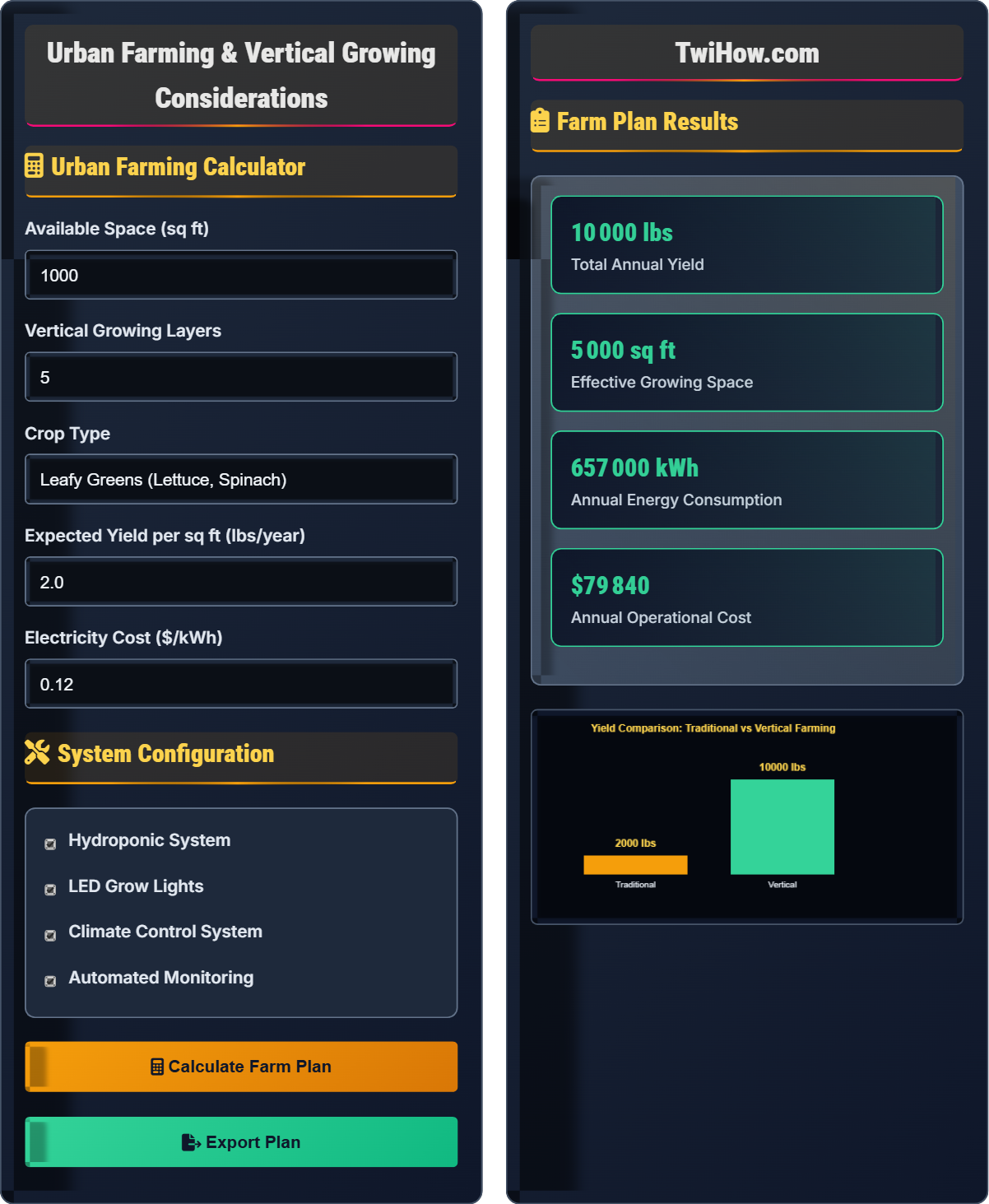
Urban Farming Calculator
System Configuration
Farm Plan Results
| Factor | Value | Impact |
|---|---|---|
| Space Efficiency | 5x multiplier | Maximizes yield per square foot |
| Water Usage | 90% reduction | Compared to traditional farming |
| Grow Cycle | Continuous | Year-round production |
| Harvest Frequency | Every 30 days | Fast turnaround |
Urban Farming Fundamentals
Urban farming refers to the practice of cultivating, processing, and distributing food in or around urban areas. It utilizes unconventional growing spaces such as rooftops, balconies, vacant lots, warehouses, and even indoors. Urban farming addresses food security, reduces transportation costs, and reconnects city dwellers with food production.
Vertical farming maximizes space efficiency through multi-level growing platforms:
- Tower Gardens: Stackable units with rotating irrigation
- Shelf Systems: Horizontal layers with integrated lighting
- Wall Systems: Vertical panels for leafy greens
- Container Farms: Repurposed shipping containers
Different cultivation techniques suit various urban environments:
- Hydroponics: Soil-free method using nutrient-rich water solution
- Aeroponics: Roots suspended in air, misted with nutrients
- Aquaponics: Combines fish farming with plant cultivation
- Traditional Containers: Pots and raised beds for simpler setups
Urban farming provides significant environmental advantages:
- Reduced Transportation: Lower carbon footprint from local production
- Water Conservation: 90% less water than traditional farming
- Land Preservation: Reduces pressure on rural farmland
- Waste Reduction: Composting and recycling organic waste
- Air Quality: Plants filter pollutants and produce oxygen
Vertical Growing Techniques
Vertical growing systems offer unique benefits for urban environments:
- Space Efficiency: Up to 10 times more yield per square foot
- Year-Round Production: Climate-controlled environments
- Reduced Pesticides: Controlled conditions minimize pest issues
- Water Efficiency: Closed-loop irrigation systems
- Quality Control: Consistent growing conditions
Proper lighting is crucial for vertical farming success:
- LED Spectrum: Full-spectrum lights tailored to plant needs
- Photoperiod Control: Regulated light/dark cycles
- Intensity Management: Adjusted for different growth stages
- Energy Efficiency: Modern LEDs consume 75% less energy than traditional bulbs
Certain crops are better suited for vertical systems:
- Ideal Crops: Leafy greens, herbs, strawberries, microgreens
- Considerations: Growth habit, space requirements, market demand
- Profitability: Premium pricing for fresh, local produce
- Rotation: Fast-growing crops for continuous harvest
System Comparison
- Space: Requires large horizontal areas
- Water: Significant water usage (often inefficient)
- Weather: Dependent on seasonal conditions
- Pests: More susceptible to diseases and insects
- Transport: Long distances to market
- Space: Maximizes vertical dimensions
- Water: 90% less with recirculating systems
- Climate: Year-round controlled environment
- Protection: Disease-free, pesticide-free growing
- Local: Direct to consumer distribution
Urban Farming & Vertical Growing Quiz
What is the primary advantage of vertical farming compared to traditional farming in terms of space utilization?
Vertical farming's main advantage is its ability to maximize production in limited horizontal space by utilizing vertical dimensions. Through stacked growing systems, vertical farms can achieve significantly higher yields per square foot compared to traditional farming, which spreads horizontally across land.
The answer is B) Up to 10 times more yield per square foot.
Space efficiency is the fundamental concept behind vertical farming. In urban environments where land is expensive and limited, vertical farming offers a solution by multiplying the effective growing area through height. This demonstrates how innovative design can overcome physical constraints in agriculture.
Space Efficiency: Maximizing output per unit of space used
Yield Density: Amount of produce generated per square foot
Vertical Integration: Using three-dimensional space for production
• Vertical farming multiplies growing space through stacking
• Height utilization is key to urban agriculture success
• Space efficiency correlates directly with profitability
• Calculate effective growing space by multiplying floor area by number of layers
• Consider structural load capacity when planning vertical systems
• Optimize layer spacing for plant growth and access
• Underestimating space multiplication potential
• Not accounting for structural requirements
• Overcrowding plants to maximize space
Explain the key components of climate control in vertical farming systems and their importance for plant growth.
Temperature Control: Maintaining 65-75°F optimizes metabolic processes in plants. Too hot or cold affects enzyme activity and growth rates.
Humidity Management: Levels between 40-70% prevent fungal diseases while allowing proper transpiration. Higher humidity can cause rot, lower humidity stresses plants.
Air Circulation: Gentle airflow strengthens stems and prevents stagnant conditions that encourage pathogens. Proper ventilation removes excess heat and CO2.
CO2 Enrichment: Increasing CO2 concentration (to 800-1200 ppm) accelerates photosynthesis and increases yields significantly.
These components work together to create optimal growing conditions that surpass what's possible outdoors, enabling faster growth and higher yields year-round.
Climate control in vertical farming demonstrates the concept of environmental manipulation for agricultural benefit. By controlling temperature, humidity, air flow, and CO2 levels, farmers can optimize every aspect of plant growth. This shows how technology can create ideal conditions that exceed natural limitations, leading to more efficient food production.
Transpiration: Process of water movement through plants and evaporation
Enzyme Activity: Chemical reactions that drive plant metabolism
Photosynthesis: Conversion of light energy to chemical energy
• Temperature directly affects metabolic rates
• Humidity impacts water uptake and disease prevention
• Air circulation prevents pathogen development
• Install multiple sensors for accurate monitoring
• Use programmable controllers for consistent conditions
• Plan for redundancy in critical systems
• Single-point failures in climate systems
• Not accounting for heat from LED lights
• Poor ventilation design causing hot spots
A vertical farm has 2,000 sq ft of floor space with 6 growing layers. The system uses 0.15 kWh per sq ft of growing space per day for LED lighting. Calculate the daily and annual electricity consumption for lighting alone, and determine the annual cost if electricity costs $0.12 per kWh.
Effective Growing Space: 2,000 sq ft × 6 layers = 12,000 sq ft
Daily Electricity Consumption: 12,000 sq ft × 0.15 kWh/sq ft = 1,800 kWh/day
Annual Electricity Consumption: 1,800 kWh/day × 365 days = 657,000 kWh/year
Annual Electricity Cost: 657,000 kWh × $0.12/kWh = $78,840/year
This represents a significant operational cost that must be factored into the farm's financial planning.
This calculation demonstrates the energy intensity of vertical farming systems. While vertical farms offer many advantages, energy costs are substantial due to LED lighting and climate control systems. This example illustrates the importance of energy efficiency and renewable energy options for sustainable vertical farming operations.
kWh: Kilowatt-hour, a unit of energy consumption
Energy Density: Amount of energy consumed per unit of growing space
Operational Costs: Recurring expenses for running the farm
• Energy costs can represent 20-30% of total operational expenses
• LED efficiency improvements reduce long-term costs
• Renewable energy integration is crucial for sustainability
• Consider solar panel installation on roof space
• Use smart controls to optimize lighting schedules
• Factor in utility rebates for energy-efficient equipment
• Underestimating energy consumption in planning
• Not budgeting for peak demand charges
• Overlooking time-of-use electricity rates
A vertical farm operator must decide between growing tomatoes or lettuce. Tomatoes have higher profit margins but require more space, longer growing cycles, and additional structural support. Lettuce grows quickly, requires minimal space, but has lower profit margins. Analyze the trade-offs and recommend a strategy for maximizing profitability.
Tomatoes: Higher profit per plant, but slower turnover and greater resource requirements. Need 2-3 sq ft per plant, 60-90 day harvest cycle, and trellising support.
Lettuce: Lower profit per plant, but rapid turnover and efficient space use. Need 0.25 sq ft per plant, 30-day harvest cycle, minimal support.
Recommended Strategy: A mixed approach that includes both crops. Dedicate 70% of space to lettuce for consistent cash flow and 30% to tomatoes for higher margins. This balances quick returns with premium products while optimizing space and resources.
Alternatively, focus on lettuce for first-year operations to establish market relationships and cash flow, then expand to tomatoes once systems are optimized.
This scenario demonstrates the complexity of agricultural business decisions. Success requires balancing multiple factors: profit margins, space efficiency, growth cycles, and market demand. The mixed approach shows how diversification can optimize both short-term cash flow and long-term profitability, a key principle in agricultural economics.
Turnover Rate: Frequency of harvest and replanting cycles
Space Utilization: Efficiency of area usage for production
Profit Margin: Revenue minus costs as percentage of revenue
• Balance high-margin with high-volume crops
• Consider market demand and seasonality
• Factor in operational complexity and labor
• Start with fast-growing crops to establish operations
• Research local market prices and demand
• Consider complementary crops that share resources
• Chasing high-margin crops without operational capacity
• Not considering market saturation
• Overcomplicating operations initially
How much water can vertical farming systems typically save compared to traditional agriculture?
Vertical farming systems use closed-loop irrigation systems that recirculate water, preventing runoff and evaporation losses common in traditional farming. Precise delivery directly to plant roots minimizes waste, and controlled environments reduce transpiration losses. This results in approximately 90% less water usage compared to traditional agriculture.
The answer is C) 90% water reduction.
This demonstrates the dramatic efficiency gains possible through technological innovation in agriculture. Traditional farming loses significant water to evaporation, runoff, and inefficient distribution. Vertical farming's controlled environment and precise delivery systems eliminate most of these losses, showing how engineering solutions can address resource scarcity.
Recirculating System: Water reused continuously in closed loop
Evapotranspiration: Combined evaporation and transpiration water loss
Water Efficiency: Ratio of productive water use to total water input
• Closed-loop systems minimize water waste
• Precise delivery reduces excess water use
• Controlled environments reduce evaporation
• Monitor water quality regularly in recirculating systems
• Use sensors to optimize irrigation timing
• Consider rainwater collection for supplementation
• Not accounting for water recycling in planning
• Poor water quality management in closed loops
• Overlooking backup water supply needs
FAQ
Q: What are the structural requirements for converting a building into a vertical farm?
A: Converting a building for vertical farming requires careful structural assessment:
1. Load Capacity: Each growing layer adds 50-100 lbs per sq ft including water, growing medium, and plants
2. Waterproofing: Floors must be sealed to prevent leaks between levels
3. Ventilation: Adequate HVAC systems for temperature and humidity control
4. Electrical: Sufficient capacity for LED lights and equipment (typically 10-15 watts per sq ft)
5. Access: Staging areas for equipment and harvest logistics
A structural engineer should evaluate the building to ensure it can safely support these loads and modifications.
Q: How does vertical farming compare environmentally to traditional agriculture?
A: Vertical farming has several environmental advantages:
Positive Impacts:
- 90% reduction in water usage through recirculating systems
- Zero pesticide use due to controlled environments
- Elimination of agricultural runoff and soil erosion
- Reduced transportation emissions through local production
Challenges:
- Higher energy consumption for lighting and climate control
- Manufacturing of growing systems and materials
- Carbon footprint depends on electricity source
Overall, vertical farming is more environmentally sustainable when powered by renewable energy, particularly for leafy greens and herbs with short growing cycles.