What is agroforestry and how can it benefit my land?
Complete agroforestry guide • Step-by-step implementation
Agroforestry Fundamentals:
Show Agroforestry CalculatorAgroforestry is the intentional integration of trees and shrubs with crops and/or livestock to create more diverse, productive, and sustainable land-use systems. It combines agricultural and forestry technologies to create more integrated, diverse, and productive land-use systems.
Key agroforestry practices:
- Alley Cropping: Crops grown between rows of trees
- Silvopasture: Trees integrated with livestock grazing
- Forest Farming: Crops grown under forest canopy
- Windbreaks: Tree barriers to protect crops and soil
- Riparian Buffers: Trees along waterways for erosion control
Benefits include improved soil health, enhanced biodiversity, carbon sequestration, and diversified income streams.
Agroforestry Planning Tools
Agroforestry Options
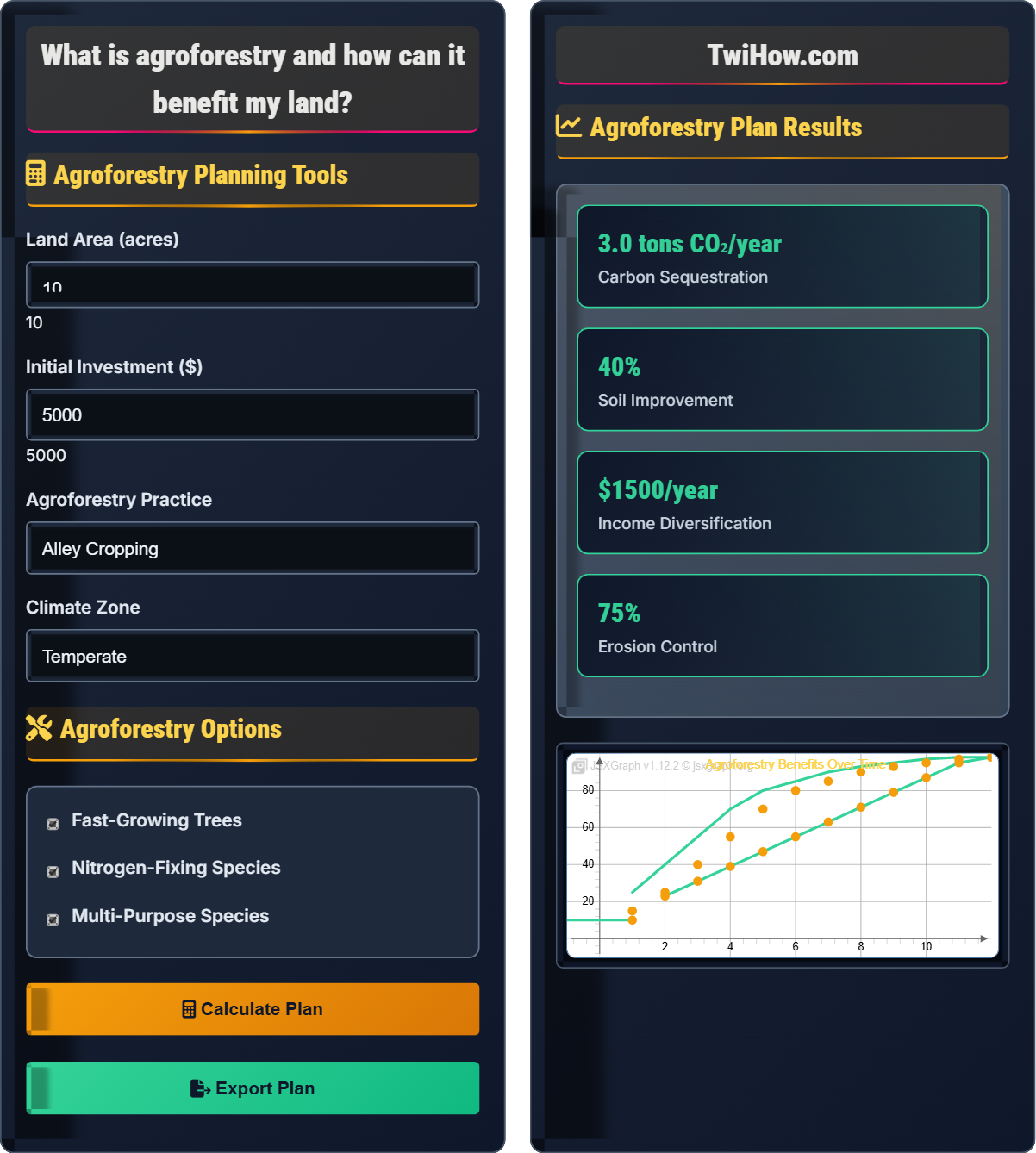
Agroforestry Plan Results
| Benefit | Value | Timeline | Description |
|---|---|---|---|
| Carbon Sequestration | 2.5 tons CO₂ | Year 5+ | Tree biomass accumulation |
| Soil Improvement | 40% increase | Year 3+ | Organic matter and structure |
| Income Diversification | $1,200/year | Year 4+ | Tree products and timber |
| Erosion Control | 75% reduction | Year 2+ | Root systems and canopy |
Agroforestry Planning Explained
Agroforestry is the intentional integration of trees and shrubs with crops and/or livestock to create more diverse, productive, and sustainable land-use systems. It combines agricultural and forestry technologies to create more integrated, diverse, and productive land-use systems that can provide both economic and environmental benefits.
Where:
- Carbon Sequestration: CO₂ captured by trees and soil
- Soil Improvement: Enhancement of soil health and fertility
- Income Diversification: Additional revenue streams from tree products
- Erosion Control: Reduction in soil loss and water runoff
Key areas where agroforestry makes an impact:
- Climate Mitigation: Carbon sequestration and climate resilience
- Soil Health: Improved fertility, structure, and water retention
- Biodiversity: Habitat creation and ecosystem enhancement
- Economic Diversification: Multiple income streams from land
- Water Management: Reduced runoff and improved quality
- Erosion Control: Soil conservation and stability
- Species Compatibility: Choose complementary species
- Spatial Arrangement: Optimize spacing and layout
- Temporal Sequencing: Manage growth stages appropriately
- Management Integration: Coordinate practices across components
- Monitoring: Track performance and adapt as needed
Agroforestry Fundamentals
Agroforestry, sustainable agriculture, carbon sequestration, soil health, biodiversity, integrated systems.
Total Benefits = Carbon Sequestration + Soil Improvement + Income Diversification + Erosion Control
Where Total Benefits = combined environmental and economic advantages.
- Select compatible species
- Plan spatial arrangements
- Consider temporal sequencing
Applications
Alley cropping, silvopasture, forest farming, windbreaks, riparian buffers.
- Carbon sequestration
- Soil conservation
- Income diversification
- Biodiversity enhancement
- Initial investment costs
- Long-term commitment
- Management complexity
- Market development
Agroforestry Learning Quiz
Which agroforestry practice involves growing crops between rows of trees?
Alley cropping is an agroforestry practice where crops are grown in the "alleys" or spaces between rows of trees. This system allows for the production of annual crops while establishing long-term woody perennial crops. The trees provide benefits such as wind protection, nitrogen fixation, and eventual timber or fruit production.
The answer is B) Alley Cropping.
Understanding different agroforestry systems is crucial for selecting the right approach for your land. Each system has specific advantages and management requirements. Alley cropping is particularly effective for transitioning from conventional agriculture to agroforestry because it maintains crop production while introducing trees. The spacing between tree rows is critical for optimizing light availability and managing competition between trees and crops.
Alley Cropping: Crops grown between rows of trees
Silvopasture: Trees integrated with livestock grazing
Forest Farming: Crops grown under forest canopy
• Match system to land characteristics
• Consider management intensity
• Plan for long-term goals
• Start with compatible species
• Plan spacing carefully
• Monitor tree-crop interactions
• Choosing incompatible species
• Incorrect spacing
• Not planning management
Explain the environmental and economic benefits of agroforestry systems compared to monoculture farming.
Environmental Benefits: Agroforestry systems provide superior soil conservation through tree root systems and canopy cover, reducing erosion by 50-90%. Trees sequester carbon in both biomass and soil, contributing to climate change mitigation. Biodiversity increases as trees provide habitat for wildlife and beneficial insects. Water infiltration improves, reducing runoff and enhancing groundwater recharge.
Economic Benefits: Diversified income streams from timber, nuts, fruits, and other tree products alongside traditional crops. Risk reduction through multiple revenue sources. Reduced input costs for fertilizers (nitrogen-fixing trees) and erosion control. Premium prices for environmentally certified products.
Comparison: While monocultures may offer short-term simplicity, agroforestry provides long-term sustainability and resilience.
Agroforestry systems exemplify the principle of ecological intensification—increasing productivity while enhancing environmental services. The synergistic interactions between trees, crops, and livestock create more resilient systems that can withstand environmental stresses better than monocultures. This approach aligns with sustainable agriculture principles by building soil health, supporting biodiversity, and sequestering carbon while maintaining productive capacity.
Monoculture: Single crop species grown over large area
Carbon Sequestration: Capture and storage of atmospheric carbon
Ecological Intensification: Increasing productivity through ecological processes
• Plan for multiple benefits
• Consider long-term returns
• Balance competition and synergy
• Start small and expand gradually
• Select nitrogen-fixing species
• Monitor soil health improvements
• Expecting immediate returns
• Not planning for tree establishment
• Ignoring species compatibility
A farmer is considering converting 20 acres of cropland to alley cropping with black walnut trees. Currently, the land generates $300 per acre from corn. Walnut trees will be planted in rows with 40-foot spacing, yielding 40 trees per acre. At maturity (year 20), each tree produces 50 lbs of nuts worth $8 per lb. Calculate the break-even time for the investment if establishment costs are $2,000 per acre and annual maintenance is $100 per acre.
Initial Investment: 20 acres × $2,000/acre = $40,000
Annual Opportunity Cost: 20 acres × $300/acre = $6,000 lost corn income
Annual Maintenance: 20 acres × $100/acre = $2,000
Total Annual Cost: $6,000 + $2,000 = $8,000 per year
Walnut Revenue (Year 20): 20 acres × 40 trees/acre × 50 lbs/tree × $8/lb = $320,000 annually
Break-even: With walnut revenue of $320,000 and continuing corn revenue of $6,000, the investment pays off by Year 20. Actual break-even occurs earlier as walnuts begin producing in Years 5-10, generating partial income.
This problem illustrates the long-term nature of agroforestry investments. While there are significant upfront costs and opportunity costs during establishment, the long-term returns can be substantial. The key is understanding that agroforestry systems provide both immediate environmental benefits (erosion control, wind protection) and long-term economic returns (timber, nuts). Financial planning must account for the transition period when traditional income is reduced.
Opportunity Cost: Income foregone from alternative use
Establishment Period: Time from planting to productive maturity
Transition Period: Phase of reduced income during establishment
• Account for opportunity costs
• Plan for transition period
• Consider multiple revenue streams
• Diversify with faster-returning species
• Apply for cost-share programs
• Plan phased implementation
• Not accounting for opportunity costs
• Underestimating establishment costs
• Ignoring transition period needs
A farmer in a temperate climate wants to implement silvopasture with cattle. Recommend appropriate tree species and explain how to manage the interactions between trees, pasture, and livestock.
Tree Selection: Black locust (nitrogen-fixing, durable), honey locust (open canopy, edible pods), oak species (acorns for livestock, timber), maple (shade and syrup potential).
Management Strategies: Plant trees in rows spaced 40-60 feet apart to allow for grazing and machinery. Provide temporary fencing around young trees until established. Manage grazing intensity to prevent soil compaction and tree damage. Plan for seasonal shade patterns affecting pasture growth.
Benefits: Cattle benefit from shade and wind protection, trees improve soil fertility through nitrogen fixation, and the system provides diversified income from timber and livestock.
Silvopasture requires careful management of complex interactions. The key is balancing the needs of all three components: trees need protection during establishment, pasture requires appropriate light and grazing pressure, and livestock need adequate space and protection. The goal is to create synergistic relationships where each component enhances the others rather than competing.
Silvopasture: Integration of trees, forage, and livestock
Canopy Cover: Percentage of ground shaded by trees
Grazing Management: Controlling livestock distribution and intensity
• Select appropriate species for climate
• Plan spacing for management access
• Protect young trees from livestock
• Use temporary electric fencing
• Rotate grazing areas
• Monitor pasture health
• Planting trees too densely
• Not protecting young trees
• Overgrazing under trees
How does agroforestry contribute to climate change mitigation?
Agroforestry contributes to climate change mitigation through multiple mechanisms: trees sequester carbon in their biomass, and the organic matter from leaf litter and root systems increases soil carbon storage. Additionally, nitrogen-fixing trees reduce the need for synthetic fertilizers, which are energy-intensive to produce. The improved soil structure and water retention also enhance resilience to climate extremes.
The answer is D) Both B and C.
Agroforestry systems address climate change through both mitigation (reducing emissions) and adaptation (increasing resilience). The carbon sequestration occurs in multiple pools: above-ground biomass (trees), below-ground biomass (roots), and soil organic matter. The reduced need for external inputs like fertilizers and pesticides lowers the carbon footprint of agricultural production. The diverse, complex structure of agroforestry systems also provides greater resilience to extreme weather events.
Carbon Sequestration: Long-term storage of atmospheric carbon
Climate Mitigation: Reducing greenhouse gas emissions
Climate Adaptation: Adjusting to climate impacts
• Consider multiple climate benefits
• Plan for long-term carbon storage
• Select appropriate species
• Choose native species when possible
• Maximize tree survival rates
• Maintain soil health
• Underestimating carbon storage potential
• Not considering long-term management
• Ignoring soil carbon benefits
FAQ
Q: How long does it take to see benefits from agroforestry practices?
A: Benefits appear at different times depending on the system:
Immediate (Year 1-2): Wind protection, reduced erosion, improved soil structure from root growth.
Short-term (Year 3-5): Nitrogen fixation from trees, improved soil fertility, beginning of carbon sequestration.
Medium-term (Year 5-10): Significant carbon storage, beginning of tree product harvests (nuts, fruits).
Long-term (Year 10+): Full timber harvest potential, maximum soil health benefits, mature ecosystem services.
While financial returns take longer, environmental benefits begin immediately and compound over time.
Q: What are the main challenges in implementing agroforestry systems?
A: Key challenges include:
Knowledge Gaps: Complex systems require specialized knowledge of tree-crop interactions, timing of management activities, and species selection.
Initial Investment: Higher upfront costs for tree planting, establishment, and specialized equipment.
Management Complexity: Balancing needs of trees, crops, and livestock requires more sophisticated management.
Market Development: Limited markets for tree products and certification systems for agroforestry products.
Policy Barriers: Some agricultural policies favor monocultures over diversified systems.
However, these challenges are increasingly being addressed through research, extension services, and policy reforms.