What is Permaculture and How to Apply Its Principles
Sustainable farming guide • Step-by-step explanations
Permaculture Overview:
Show Permaculture DesignerPermaculture is a design philosophy and practice that creates sustainable, self-sufficient ecosystems by mimicking natural patterns and relationships. Developed by Bill Mollison and David Holmgren, permaculture integrates land, resources, people, and the environment through mutually beneficial synergies. The practice emphasizes working with nature rather than against it, creating regenerative systems that provide food, energy, shelter, and other needs sustainably.
Core permaculture principles include:
- Observe and Interact: Understanding natural patterns before designing
- Catch and Store Energy: Harvesting resources when abundant
- Obtain a Yield: Ensuring systems produce outputs
- Apply Self-Regulation: Limiting consumption and waste
Permaculture designs create resilient, productive systems that regenerate rather than deplete natural resources.
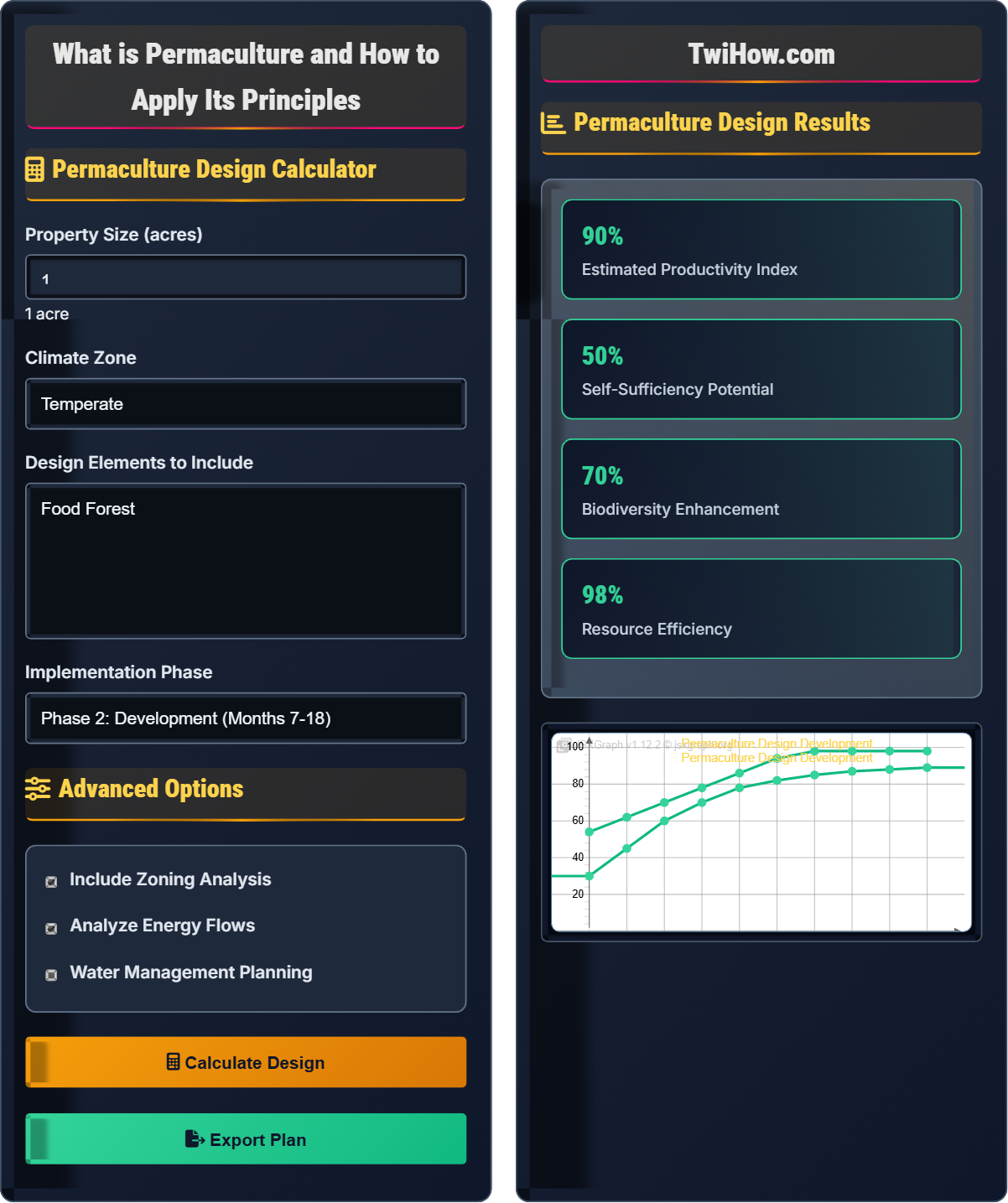
Permaculture Design Calculator
Advanced Options
Permaculture Design Results
| Element | Location | Function | Integration |
|---|---|---|---|
| Food Forest | South side | Food production | High |
| Water System | Low areas | Hydration | High |
| Composting | Central | Waste cycling | Medium |
| Animal Area | West side | Integration | High |
House
Garden
Food Forest
Wildlife
Nature
Permaculture Principles Explained
The permaculture design index is calculated as:
Where each component is evaluated on a 0-100 scale based on system design and implementation.
Permaculture is guided by three core ethics:
- Care for the Earth: Preserving and regenerating natural systems
- Care for People: Supporting human health and well-being
- Fair Share: Distributing surplus and limiting consumption
Permaculture zoning arranges elements by frequency of use and maintenance needs:
- Zone 1: Daily use (kitchen garden, herbs)
- Zone 2: Weekly use (fruit trees, chickens)
- Zone 3: Monthly use (main crops, orchards)
- Zone 4: Seasonal use (woodlots, foraging)
- Zone 5: Wilderness (nature conservation)
- Harvest: Collect rainwater from roofs and surfaces
- Store: Use tanks, ponds, and swales
- Infiltrate: Direct water to recharge groundwater
- Recycle: Use greywater systems
Permaculture Fundamentals
Permaculture design, zones and sectors, guilds, succession, edge effects, natural patterns.
PDI = (P + R + B + I) / 4
Where P = Productivity, R = Resilience, B = Biodiversity, I = Integration.
- Observe before designing
- Start small and expand
- Stack functions
- Use renewable resources
Permaculture Ethics
Care for Earth, Care for People, Fair Share.
- Care for the Earth
- Care for People
- Fair Share/Limit Surplus
- Regenerate ecosystems
- Support community
- Share abundance
- Limit consumption
Design Elements
Ecosystem Design Visualization
Permaculture Learning Quiz
Which of the following is NOT one of the three core ethics of permaculture?
The three core ethics of permaculture are: 1) Care for the Earth, 2) Care for People, and 3) Fair Share (or setting limits to population and consumption). Profit maximization is not a core ethic of permaculture, which emphasizes sustainability and regeneration over pure economic gain. The three ethics form the foundation for all permaculture design decisions.
The answer is D) Profit Maximization.
The three core ethics provide the moral and philosophical foundation for permaculture design. They ensure that all design decisions consider environmental impact, human welfare, and equitable resource distribution. These ethics guide practitioners to create systems that are not only productive but also ecologically sound and socially just.
Permaculture Ethics: Moral guidelines for sustainable design
Care for Earth: Preserving natural systems
Fair Share: Distributing surplus and limiting consumption
• All designs must honor the three ethics
• Balance environmental and social needs
• Consider long-term impacts
• Start with ethics in mind
• Consider multiple perspectives
• Plan for future generations
• Ignoring environmental impact
• Focusing only on productivity
• Not considering community needs
Explain the permaculture zoning system and calculate the optimal placement for a chicken coop that requires daily care and provides eggs daily. If the house is located at coordinates (0,0), what would be the ideal distance range for Zone 2 placement considering daily access requirements?
Zoning System: Permaculture zones arrange elements by frequency of use and maintenance needs:
• Zone 1: Daily access (kitchen garden, herbs)
• Zone 2: Daily to weekly access (chickens, small fruit trees)
• Zone 3: Weekly to monthly access (main crops, orchards)
• Zone 4: Seasonal access (woodlots, foraging)
• Zone 5: Wilderness (no human intervention)
Chicken Coop Placement: Zone 2 is ideal for chickens requiring daily care. Optimal distance from house: 10-50 feet (3-15 meters) for convenient daily access while maintaining appropriate separation.
The zoning system minimizes energy expenditure by placing frequently accessed elements close to the home while allowing less frequently accessed elements to be farther away. This reduces walking distances and optimizes daily routines. The zoning principle ensures that systems requiring daily attention are placed where they can be easily monitored and maintained.
Zoning: Arranging elements by frequency of use
Energy Efficiency: Minimizing effort for access
Access Patterns: Human movement and maintenance needs
• Place daily needs closest
• Consider maintenance frequency
• Minimize walking distances
• Map your daily routine
• Consider seasonal needs
• Plan for accessibility
• Placing daily needs too far
• Not considering growth patterns
• Ignoring microclimates
A permaculture designer wants to create a food forest with 7 layers. Calculate the space allocation for each layer in a 1000 sq ft plot if the canopy trees need 40% of the space, understory trees need 20%, shrubs need 15%, herbaceous plants need 10%, root crops need 8%, vines need 5%, and ground covers need 2%. Verify that the percentages total 100% and calculate the actual sq ft for each layer.
Verification: 40% + 20% + 15% + 10% + 8% + 5% + 2% = 100% ✓
Calculations:
• Canopy Trees: 1000 × 0.40 = 400 sq ft
• Understory Trees: 1000 × 0.20 = 200 sq ft
• Shrubs: 1000 × 0.15 = 150 sq ft
• Herbaceous: 1000 × 0.10 = 100 sq ft
• Root Crops: 1000 × 0.08 = 80 sq ft
• Vines: 1000 × 0.05 = 50 sq ft
• Ground Covers: 1000 × 0.02 = 20 sq ft
Total: 1000 sq ft
The seven-layer food forest mimics natural forest succession, maximizing productivity while creating diverse habitats. Each layer serves different functions: canopy provides shade and nuts/fruits, understory fills gaps, shrubs provide berries, herbaceous plants offer herbs/vegetables, root crops utilize underground space, vines use vertical space, and ground covers prevent erosion and suppress weeds.
Food Forest: Multi-layered edible ecosystem
Succession: Natural progression of plant communities
Canopy Layer: Tallest trees providing shade
• Plan for mature tree sizes
• Consider light requirements
• Allow for growth over time
• Start with canopy trees first
• Plan for 20-year growth
• Include nitrogen fixers
• Overcrowding the canopy
• Not considering mature sizes
• Ignoring root competition
A property has a 2000 sq ft roof area and receives 30 inches of annual rainfall. Calculate the potential rainwater harvest using the formula: Roof Area × Rainfall × 0.623. If the household needs 500 gallons monthly, what percentage of water needs could be met by rainwater harvesting? Assume 80% collection efficiency.
Rainwater Harvest: 2000 sq ft × 30 inches × 0.623 = 37,380 gallons annually
After Collection Efficiency: 37,380 × 0.80 = 29,904 gallons annually
Monthly Household Needs: 500 gallons × 12 months = 6,000 gallons annually
Percentage Met: (29,904 ÷ 6,000) × 100 = 498% - More than sufficient!
The rainwater harvest could meet 498% of annual water needs, demonstrating excellent water independence potential.
Water harvesting is a fundamental permaculture principle that captures and stores abundant resources for use during scarcity. The 0.623 factor converts roof area and rainfall to gallons of water. Collection efficiency accounts for losses from evaporation, first-flush diversions, and system inefficiencies. This calculation demonstrates how permaculture systems can achieve water independence while managing stormwater runoff.
Water Harvesting: Capturing and storing rainwater
Collection Efficiency: Percentage of available water captured
First-Flush Diverter: System to remove initial contaminated water
• Size storage appropriately
• Account for seasonal variations
• Include overflow systems
• Connect multiple downspouts
• Install filters and screens
• Use dark containers to prevent algae
• Undersizing storage tanks
• Not planning for overflow
• Ignoring water quality
In a permaculture guild centered around an apple tree, which combination of plants would provide the most beneficial functions?
Comfrey, chives, and nasturtiums provide complementary functions: Comfrey acts as a dynamic accumulator (mining deep nutrients), chives repel pests and provide culinary use, and nasturtiums act as trap crops and provide edible flowers. This combination supports the apple tree while providing multiple yields and functions.
The answer is B) Comfrey, chives, and nasturtiums.
Permaculture guilds are groups of plants that support each other through beneficial relationships. Each plant in a guild should provide multiple functions: attracting beneficial insects, repelling pests, fixing nitrogen, accumulating nutrients, providing food, or improving soil. The guild design maximizes beneficial interactions while minimizing competition and negative effects.
Guild: Beneficial plant community
Dynamic Accumulator: Plant mining deep nutrients
Trap Crop: Plant luring pests away from main crop
• Each plant should serve multiple functions
• Consider root and canopy interactions
• Plan for succession and growth
• Research plant compatibility
• Consider seasonal needs
• Plan for mature plant sizes
• Including competitive plants
• Not considering allelopathy
• Ignoring growth habits
Permaculture Design Elements
FAQ
Q: How long does it take to see results from permaculture design?
A: Permaculture results appear in stages:
• Immediate (Months 1-6): Soil improvement, initial plant establishment
• Short-term (6-18 months): Increased biodiversity, reduced maintenance
• Medium-term (1-3 years): Food production, system integration
• Long-term (3+ years): Mature ecosystems, self-regulation
Patience and observation are key to permaculture success.
Q: What's the difference between permaculture and organic farming?
A: Key differences:
Organic Farming: Focuses on avoiding synthetic inputs while maintaining conventional agricultural practices.
Permaculture: Designs whole systems that mimic natural ecosystems, integrating food production with other functions like water management, energy, and habitat.
Permaculture is broader, encompassing not just food production but entire sustainable human settlements.