What is Regenerative Agriculture and How to Practice It?
Sustainable farming guide • Step-by-step explanations
Regenerative Agriculture Overview:
Show Regenerative Farming SimulatorRegenerative agriculture is a holistic farming approach that focuses on restoring and revitalizing degraded farmland through practices that enhance biodiversity, enrich soils, improve watersheds, and capture carbon from the atmosphere. Unlike conventional farming that often depletes resources, regenerative agriculture works with natural ecosystems to create resilient, productive systems.
Key principles include:
- Soil Health: Building organic matter and promoting beneficial microorganisms
- Biodiversity: Creating habitat for diverse species
- Water Cycles: Enhancing water infiltration and retention
- Carbon Sequestration: Capturing atmospheric carbon in soil
Regenerative practices restore ecosystem services while maintaining or improving farm productivity and profitability.
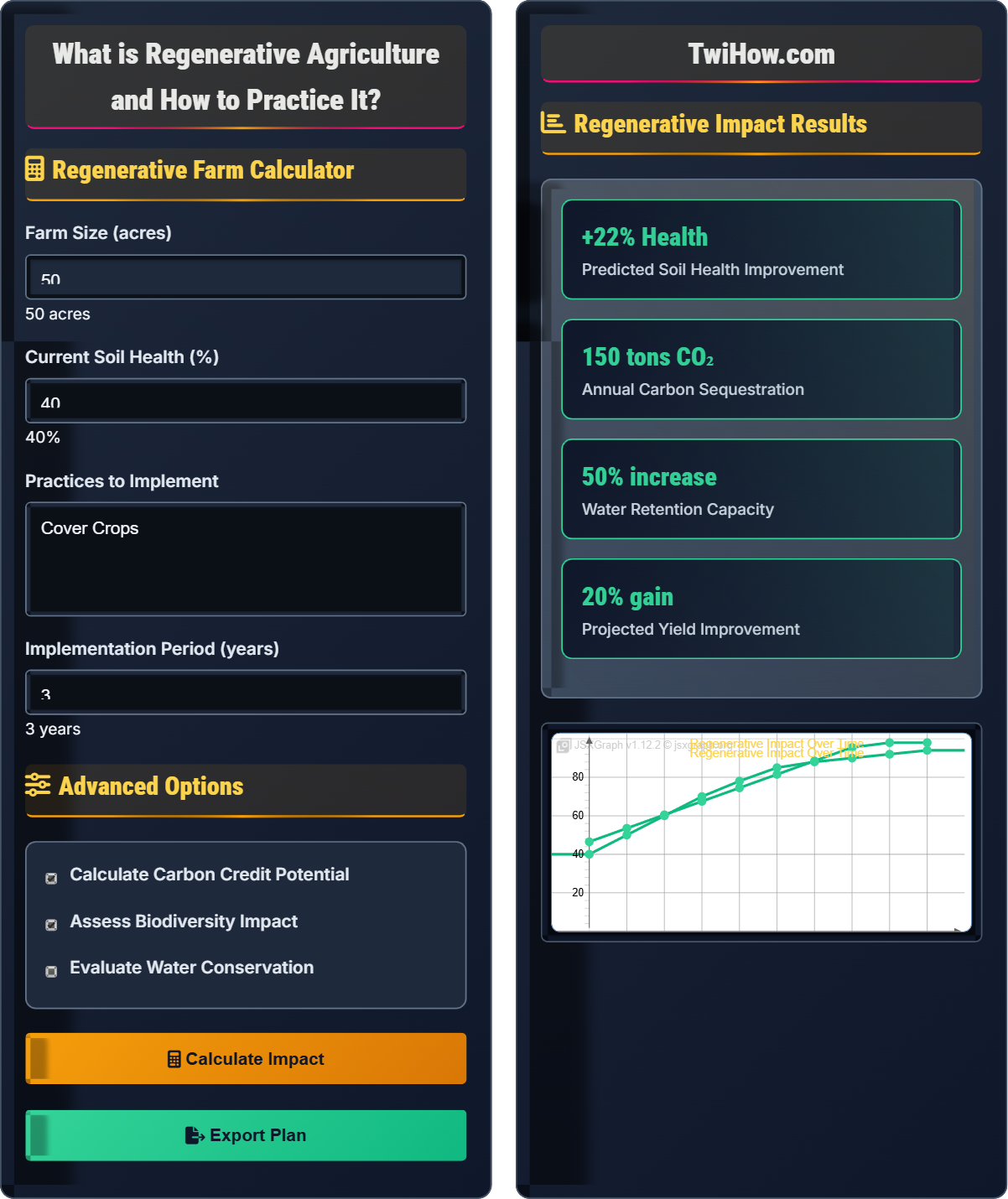
Regenerative Farm Calculator
Advanced Options
Regenerative Impact Results
| Practice | Implementation | Benefits | Cost/Benefit |
|---|---|---|---|
| Cover Crops | Every season | +2% OM/year | High ROI |
| Rotation | Annually | Break cycles | Medium ROI |
| No-Till | All fields | Soil structure | High ROI |
| Compost | 2x/year | Nutrient boost | Medium ROI |
Setup
Implement
Monitor
Expand
Optimize
Regenerative Agriculture Principles Explained
Regenerative agriculture follows five core principles that work synergistically:
These principles focus on building soil organic matter, increasing biodiversity, improving water cycles, and enhancing ecosystem resilience.
Regenerative practices can sequester 1-3 tons of CO₂ per acre annually through:
- Soil Organic Matter: Stores carbon in stable forms
- Root Systems: Deposit carbon below ground
- Mycorrhizae: Fungal networks store carbon
- Biomass Accumulation: Above-ground carbon storage
Regenerative practices improve water infiltration and retention:
- Increased organic matter improves water holding capacity
- Reduced erosion prevents runoff
- Enhanced soil structure allows deeper water penetration
- Better watershed function reduces flooding
Healthy soil can hold 20,000+ gallons of water per acre.
- Soil Life: Increase beneficial microorganisms
- Wildlife Habitat: Create corridors and nesting sites
- Pollinator Support: Establish flowering plants
- Genetic Diversity: Preserve heirloom varieties
Regenerative Agriculture Fundamentals
Soil health, carbon sequestration, biodiversity, water cycle, ecosystem resilience, holistic management.
RI = (SH + B + WC + CS + R) / 5
Where RI = Regenerative Index, SH = Soil Health, B = Biodiversity, WC = Water Cycle, CS = Carbon Storage, R = Resilience.
- Always keep soil covered
- Maintain living roots year-round
- Maximize biodiversity
- Integrate livestock when possible
Key Regenerative Practices
Cover crops, crop rotation, no-till farming, composting, rotational grazing, agroforestry.
- Start with soil testing and assessment
- Implement cover crops in rotation
- Reduce or eliminate tillage
- Add organic matter regularly
- Introduce beneficial insects
- Build organic matter gradually
- Work with natural systems
- Monitor continuously
- Adapt to local conditions
Regenerative Practices
Ecosystem Cycles
Regenerative Agriculture Learning Quiz
Which of the following is NOT one of the core principles of regenerative agriculture?
While minimizing tillage is a goal of regenerative agriculture, the principle is not to eliminate all tillage immediately. Instead, regenerative agriculture advocates for a gradual reduction in tillage intensity, moving toward no-till or reduced-till methods. The four core principles are: 1) Keep soil covered, 2) Maintain living roots, 3) Maximize biodiversity, and 4) Integrate animals (where appropriate).
The answer is C) Eliminate all tillage immediately.
Regenerative agriculture emphasizes gradual transitions and working with existing systems. Sudden elimination of all tillage can cause issues if soil biology isn't ready. The approach focuses on building soil health incrementally, allowing beneficial organisms to establish themselves before making major changes.
Regenerative Agriculture: Farming that restores ecosystem health
Soil Cover: Protecting soil surface from erosion
Biodiversity: Variety of species in farming system
• Transition gradually to new practices
• Build soil biology slowly
• Monitor results continuously
• Start with cover crops in rotation
• Reduce tillage intensity gradually
• Test soil regularly
• Expecting immediate results
• Changing all practices at once
• Not monitoring soil health
Explain how regenerative agriculture practices contribute to carbon sequestration. Calculate the potential carbon sequestration for a 100-acre farm implementing comprehensive regenerative practices.
Carbon Sequestration Mechanisms: Regenerative practices sequester carbon through multiple pathways:
1. Soil Organic Matter: Plants photosynthesize CO₂ and deposit carbon in soil through roots
2. Root Systems: Deep roots create stable carbon compounds
3. Mycorrhizal Networks: Fungi store carbon in glomalin
4. Biomass Accumulation: Above-ground plant material
Calculation: Typical sequestration rates range from 1-3 tons CO₂/acre/year. For 100 acres: 100 acres × 2 tons/acre/year = 200 tons CO₂/year.
Carbon sequestration in regenerative agriculture represents a win-win scenario: farmers improve soil health and productivity while contributing to climate change mitigation. The carbon stored in soil organic matter also improves water retention, nutrient cycling, and soil structure, creating positive feedback loops.
Carbon Sequestration: Storing atmospheric carbon in soil
Photosynthesis: Converting CO₂ to organic compounds
Glomalin: Stable carbon compound from mycorrhizae
• Continuous living roots enhance sequestration
• Diverse plantings increase carbon input
• Minimize disturbance to preserve stored carbon
• Plant diverse cover crop mixes
• Extend growing season with living roots
• Maintain continuous ground cover
• Not maintaining year-round living roots
• Excessive tillage disrupting soil carbon
• Monocultures limiting carbon input diversity
A farmer manages 200 acres of corn-soybean rotation with declining yields (150 bu corn, 40 bu soybeans) and soil organic matter of 2%. The farmer considers transitioning to regenerative practices with projected costs: $75/acre for cover crop seed, $50/acre for reduced equipment maintenance, and $25/acre for soil testing. Calculate the 3-year net cost and estimate potential yield improvements based on regenerative agriculture research showing 10-15% yield increases after 3 years.
Annual Costs: ($75 + $50 - $25) × 200 acres = $20,000
3-Year Net Cost: $20,000 × 3 = $60,000
Projected Yield Improvements: Corn: 150 × 1.125 = 169 bu/acre; Soybeans: 40 × 1.125 = 45 bu/acre
Revenue Increase: Assuming $4/corn and $10/soybean: (19 × $4 × 200) + (5 × $10 × 200) = $25,200 annually
Payback Period: $60,000 ÷ $25,200 = 2.4 years
Regenerative agriculture often requires upfront investment but provides long-term economic benefits through improved soil health, reduced input costs, and increased yields. The transition period may involve temporary costs, but the compounding benefits of improved soil biology and structure typically result in positive returns within 3-5 years.
Soil Organic Matter: Decomposed plant and animal material
Yield Response: Crop production improvementReturn on Investment: Financial gain vs. cost
• Plan for 3-5 year transition period
• Monitor economic indicators
• Track soil health improvements
• Start with demonstration plots
• Join regenerative agriculture networks
• Document all changes and results
• Expecting immediate economic returns
• Not tracking financial metrics
• Changing too many practices at once
A farm currently has limited biodiversity with only 2-3 beneficial insect species per field. The farmer wants to implement regenerative practices to support 10-15 beneficial species. Design a plan incorporating habitat creation, plant diversity, and reduced chemical inputs to achieve this goal.
Habitat Creation: Establish hedgerows with native flowering plants, create beetle banks, and maintain field margins with diverse vegetation.
Plant Diversity: Implement diverse cover crop mixes, rotate crop families, and establish pollinator strips with native wildflowers.
Chemical Reduction: Adopt IPM strategies, reduce pesticide applications, and use targeted treatments when necessary.
Expected Outcome: Within 2-3 years, expect 10-15 beneficial species including ladybugs, lacewings, parasitic wasps, and predatory mites.
Biodiversity enhancement in regenerative agriculture creates natural pest control systems and improves ecosystem resilience. Diverse plant communities support diverse insect communities, which in turn provide natural pest suppression and pollination services. This reduces dependency on external inputs while improving farm sustainability.
Biodiversity: Variety of species in ecosystem
Beneficial Insects: Predators and pollinators
Integrated Pest Management: Holistic pest control
• Provide year-round habitat
• Support different life stages
• Minimize chemical disruption
• Plant native flowering species
• Create habitat corridors
• Time management for beneficials
• Not providing continuous bloom periods
• Using broad-spectrum pesticides
• Ignoring habitat quality
How does regenerative agriculture improve the water cycle compared to conventional farming?
Regenerative agriculture significantly improves water infiltration and retention through increased organic matter, improved soil structure, and enhanced aggregate stability. Healthy soil with 5% organic matter can hold 20,000+ gallons of water per acre, compared to 5,000-8,000 gallons in degraded soil. This reduces runoff, prevents erosion, and provides drought resilience.
The answer is C) Enhances infiltration and retention.
Water cycle enhancement is one of the most dramatic benefits of regenerative agriculture. Improved infiltration means less water runs off and erodes topsoil, while better retention means crops have access to water during dry periods. This creates resilience against both droughts and floods while reducing irrigation needs.
Water Infiltration: Water entering soil profile
Water Retention: Soil's ability to hold water
Soil Aggregation: Particle binding in soil
• Maintain continuous soil cover
• Build organic matter consistently
• Minimize compaction
• Test infiltration rates regularly
• Monitor soil moisture levels
• Observe water movement patterns
• Not monitoring water infiltration
• Ignoring compaction issues
• Over-applying amendments
Biodiversity Enhancement
FAQ
Q: How long does it take to see results from regenerative agriculture practices?
A: Results vary by practice and initial conditions, but typical timelines include:
• Year 1: Initial soil biology changes, improved water infiltration
• Years 2-3: Noticeable organic matter increases, enhanced biodiversity
• Years 3-5: Significant yield improvements, reduced input costs
• Years 5-10: Full ecosystem benefits, maximum resilience
Patience and consistent implementation are key to success.
Q: What's the difference between sustainable and regenerative agriculture?
A: The key differences are:
Sustainable Agriculture: Aims to maintain current resource levels without degradation. Focuses on preventing further damage and maintaining status quo.
Regenerative Agriculture: Actively restores and improves ecosystem health. Focuses on building soil, increasing biodiversity, and enhancing ecosystem function beyond current levels.
Regenerative agriculture goes beyond sustainability by creating positive environmental impacts and reversing degradation.