What is the impact of climate change on gardening and farming practices?
Complete climate impact guide • Step-by-step adaptation
Climate Change Impacts:
Show Climate Impact CalculatorClimate change significantly impacts gardening and farming through altered precipitation patterns, temperature fluctuations, extreme weather events, and shifting growing zones. Farmers and gardeners must adapt practices to maintain productivity and sustainability in changing conditions.
Key climate impacts:
- Temperature Changes: Altered growing seasons and heat stress
- Precipitation Patterns: Droughts and flooding events
- Extreme Weather: Storms, hail, and temperature swings
- Shifting Zones: Changed plant hardiness zones
- Pest Dynamics: Extended pest seasons and new threats
- Soil Health: Degradation and erosion
Successful adaptation requires resilient practices that enhance system stability and productivity.
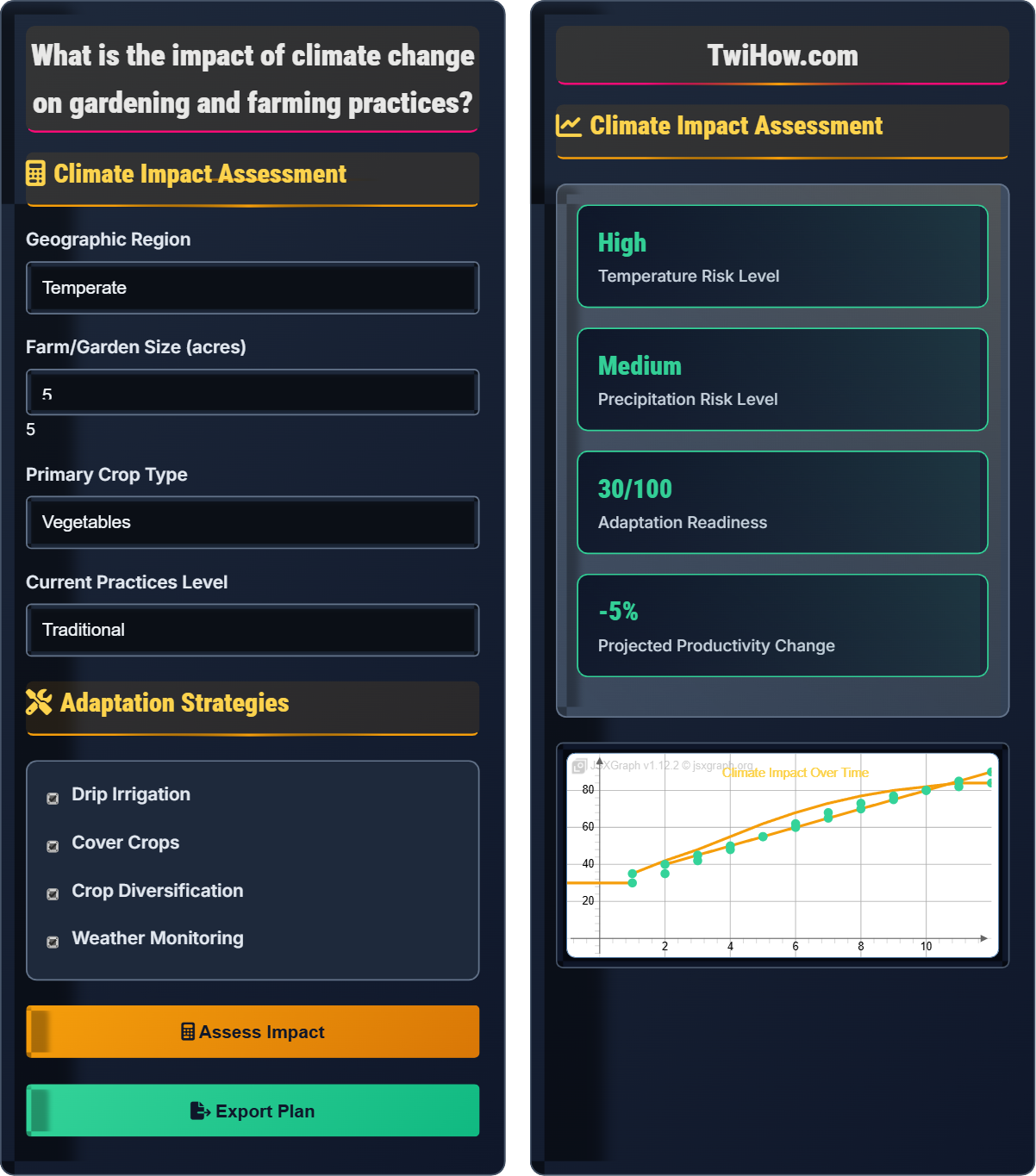
Climate Impact Assessment
Adaptation Strategies
Climate Impact Assessment
| Climate Factor | Current Impact | Future Projection | Adaptation Priority |
|---|---|---|---|
| Temperature | Increasing | +2-4°C | High |
| Precipitation | Erratic | Variable | High |
| Heat Waves | More frequent | Increasing | Medium |
| Droughts | More severe | Increasing | High |
Recommended Strategies
-
Plant heat-tolerant varieties and adjust planting schedules
-
Implement water conservation and efficient irrigation systems
-
Use cover crops and mulching to retain soil moisture
-
Diversify crops and implement rotation practices
Climate Change Impact Assessment Explained
Climate change significantly impacts gardening and farming through altered precipitation patterns, temperature fluctuations, extreme weather events, and shifting growing zones. Farmers and gardeners must adapt practices to maintain productivity and sustainability in changing conditions. Understanding these impacts helps in developing resilient strategies for food security.
Where:
- Exposure: Degree of climate hazard exposure
- Sensitivity: Degree to which system is affected
- Adaptive Capacity: Ability to adjust to climate impacts
- Climate Vulnerability: Overall risk assessment
Key areas where climate adaptation makes an impact:
- Water Management: Efficient use and conservation
- Soil Health: Maintaining fertility and structure
- Crop Selection: Choosing climate-resilient varieties
- Infrastructure: Building resilient systems
- Diversification: Reducing single-point-of-failure risks
- Technology: Using tools for precision agriculture
- Soil Conservation: Maintain organic matter and structure
- Water Efficiency: Implement smart irrigation systems
- Genetic Diversity: Use varied crop varieties
- Integrated Systems: Combine multiple adaptation strategies
- Monitoring: Track weather and system performance
Climate Change Fundamentals
Climate vulnerability, adaptation strategies, resilience, sustainability, water management, soil health.
Climate Vulnerability = (Exposure × Sensitivity) / Adaptive Capacity
Where Climate Vulnerability = overall risk assessment of climate impacts.
- Assess local climate trends
- Plan for extreme events
- Build adaptive capacity
Applications
Water conservation, soil health management, crop diversification, weather monitoring.
- Climate-smart agriculture
- Water-efficient systems
- Resilient crop varieties
- Sustainable soil practices
- Regional climate variations
- Cost of adaptation
- Knowledge requirements
- Implementation time
Climate Change Learning Quiz
How does rising temperature primarily affect crop yields?
Rising temperatures accelerate crop development, leading to shorter growing periods. While this may seem beneficial, it often reduces the time for grain filling and biomass accumulation, ultimately decreasing yields. Additionally, high temperatures can cause heat stress during critical growth phases like flowering, severely impacting reproductive success.
The answer is B) Accelerates crop maturation and reduces growing time.
Temperature affects crop development through physiological processes. Each crop has an optimal temperature range for growth. Beyond this range, especially at critical stages like pollination, high temperatures can cause sterility and reduced yields. Understanding thermal time (degree days) helps predict crop development and plan appropriate varieties and planting schedules.
Thermal Time: Accumulated heat units required for development
Heat Stress: Temperature-induced physiological disruption
Phenology: Timing of biological events in relation to climate
• Monitor temperature thresholds
• Adjust planting schedules
• Select heat-tolerant varieties
• Use degree-day models for planning
• Plant shade-tolerant varieties
• Implement cooling systems
• Ignoring critical temperature thresholds
• Not adjusting planting dates
• Using same varieties as before
Explain how changing precipitation patterns affect gardening and farming practices and what adaptations are needed.
Changing Patterns: Climate change causes more erratic rainfall with longer dry periods followed by intense storms. This increases both drought and flooding risks.
Impacts: Droughts stress plants and reduce yields, while heavy rains cause erosion, nutrient leaching, and root damage. Irregular timing disrupts planting and harvesting schedules.
Adaptations: Install water storage systems (rainwater harvesting), implement efficient irrigation (drip irrigation), use drought-resistant varieties, improve soil water retention through organic matter, and create drainage systems for excess water.
These changes require both infrastructure investments and management practice adjustments.
Water is the most critical resource for agriculture, and its availability and timing are fundamental to plant growth. Traditional farming systems were adapted to historical precipitation patterns, but changing patterns require new approaches. The key is building resilience through both conservation during wet periods and efficient use during dry periods.
Water Stress: Insufficient water for optimal plant growth
Leaching: Removal of nutrients by excess water
Runoff: Surface water flow that doesn't infiltrate soil
• Implement water conservation
• Improve soil water retention
• Plan for extreme events
• Install rain gauges
• Use mulch to retain moisture
• Build water storage systems
• Not planning for water storage
• Overwatering during dry spells
• Ignoring drainage needs
A farmer with 100 acres faces climate-related yield reductions of 20% due to irregular rainfall. Installing drip irrigation costs $2,000 per acre but reduces water usage by 40% and increases yields by 15%. Calculate the net benefit over 5 years if current annual revenue is $1,000 per acre and water costs are $100 per acre. Assume water costs increase 10% annually due scarcity.
Without Irrigation: 100 acres × $1,000 × 0.8 = $80,000/year
With Irrigation: 100 acres × $1,000 × 1.15 = $115,000/year
Water Cost Savings: Year 1: $10,000 × 0.4 = $4,000 saved
Water Cost Increase: Year 1: $6,000, Year 5: $6,000 × (1.1)^4 = $8,785
Annual Benefit: $115,000 - $80,000 = $35,000
Five-Year Benefit: $35,000 × 5 = $175,000
Installation Cost: 100 acres × $2,000 = $200,000
Net Benefit: $175,000 - $200,000 = -$25,000 in first 5 years, but long-term benefits continue.
This problem demonstrates the economic complexity of climate adaptation. While the initial investment is high, the benefits continue beyond the 5-year period. The analysis should also consider increased resilience to extreme weather, reduced risk, and potential government incentives. Climate adaptation often requires long-term thinking beyond immediate ROI calculations.
ROI: Return on investment calculation
Resilience: Ability to withstand and recover from stress
Externalities: Indirect benefits not captured in financial analysis
• Consider long-term benefits
• Factor in risk reduction
• Account for increasing costs
• Look for cost-share programs
• Calculate payback period
• Consider phased implementation
• Only considering direct costs
• Not accounting for risk reduction
• Ignoring inflation effects
A gardener in a region experiencing increased summer heat and drought needs to adapt their vegetable garden. Recommend specific crops and varieties that are resilient to these conditions, and explain the rationale for each recommendation.
Heat-Tolerant Vegetables: Okra, sweet potatoes, eggplant, and peppers thrive in high heat.
Drought-Resistant Varieties: 'Black Beauty' eggplant, 'Georgia Giant' okra, 'Carolina Reaper' peppers, and 'Beauregard' sweet potatoes.
Rationale: These crops originate from hot, dry climates and have natural adaptations like deep root systems, waxy leaf coatings, and efficient water use. They also have shorter growing seasons to complete their life cycle before extreme heat peaks.
Planting Strategies: Use shade cloth during peak heat, plant in early morning, and choose microclimates like north sides of buildings.
Climate-adapted crop selection involves understanding the plant's native environment and its evolutionary adaptations. Plants from arid or hot regions have developed mechanisms like CAM photosynthesis, deep taproots, and leaf modifications to survive harsh conditions. Matching these traits to local climate changes improves success rates.
Climate Adaptation: Traits that allow survival in specific conditions
Heat Tolerance: Ability to function normally at high temperatures
Drought Resistance: Ability to survive with limited water
• Match crops to climate zone
• Select appropriate varieties
• Consider growth requirements
• Start with heritage varieties
• Consult local extension
• Trial different varieties
• Using traditional varieties
• Not considering microclimates
• Ignoring plant spacing
How does climate change most directly impact soil health in agricultural systems?
Rising temperatures accelerate the decomposition of organic matter by increasing microbial activity. This leads to faster breakdown of soil organic carbon, reducing the soil's ability to retain nutrients and water. Combined with increased evaporation and erosion from extreme weather, this significantly impacts soil fertility and structure.
The answer is B) Accelerates organic matter decomposition.
Soil organic matter is the foundation of soil health, providing nutrients, water retention, and structure. Higher temperatures speed up the metabolic processes of soil microorganisms, causing them to break down organic matter more rapidly. This creates a negative feedback loop where less organic matter leads to reduced soil health, which affects plant growth and carbon sequestration.
Soil Organic Matter: Decomposed plant and animal materials in soil
Microbial Activity: Biological processes in soil ecosystem
Carbon Sequestration: Storage of atmospheric carbon in soil
• Maintain organic matter inputs
• Minimize soil disturbance
• Use cover crops
• Add compost regularly
• Use no-till practices
• Implement crop rotation
• Not replenishing organic matter
• Over-tilling the soil
• Removing crop residues
FAQ
Q: How do I know if my region's climate is changing?
A: Track these indicators:
Temperature: Record daily highs and lows to identify trends
Precipitation: Monitor rainfall amounts and patterns
Season Timing: Note changes in frost dates and growing seasons
Weather Extremes: Track frequency of heat waves, droughts, and storms
Biological Events: Record timing of flowering, migration, and fruiting
Compare your observations with historical data from local weather stations or online climate databases to confirm trends.
Q: What are the most effective climate adaptation strategies for small-scale farmers?
A: Most effective strategies include:
Diversification: Growing multiple crops and varieties to spread risk
Water Management: Rainwater harvesting, efficient irrigation, and mulching
Soil Health: Adding organic matter, cover crops, and reduced tillage
Flexible Timing: Adjusting planting schedules based on seasonal forecasts
Integrated Systems: Combining crops, livestock, and trees
Information Access: Using weather services and climate information
These strategies work best when implemented together as part of an integrated approach.