What is the Impact of Invasive Species and How Do I Manage Them?
Complete guide to invasive species • Management strategies • Sustainable farming
Invasive Species Management:
Show Risk AssessmentInvasive species are non-native organisms that cause harm to ecosystems, economies, or human health. In agriculture, they threaten crop yields, biodiversity, and farm profitability. Managing invasive species requires understanding their impacts, identifying threats early, and implementing integrated management strategies.
Key aspects of invasive species management:
- Identification: Recognizing invasive species and their impacts
- Assessment: Evaluating economic and ecological damage
- Prevention: Stopping introduction and spread
- Control: Physical, chemical, and biological methods
- Monitoring: Tracking effectiveness of management
Effective management balances ecological protection with agricultural productivity.
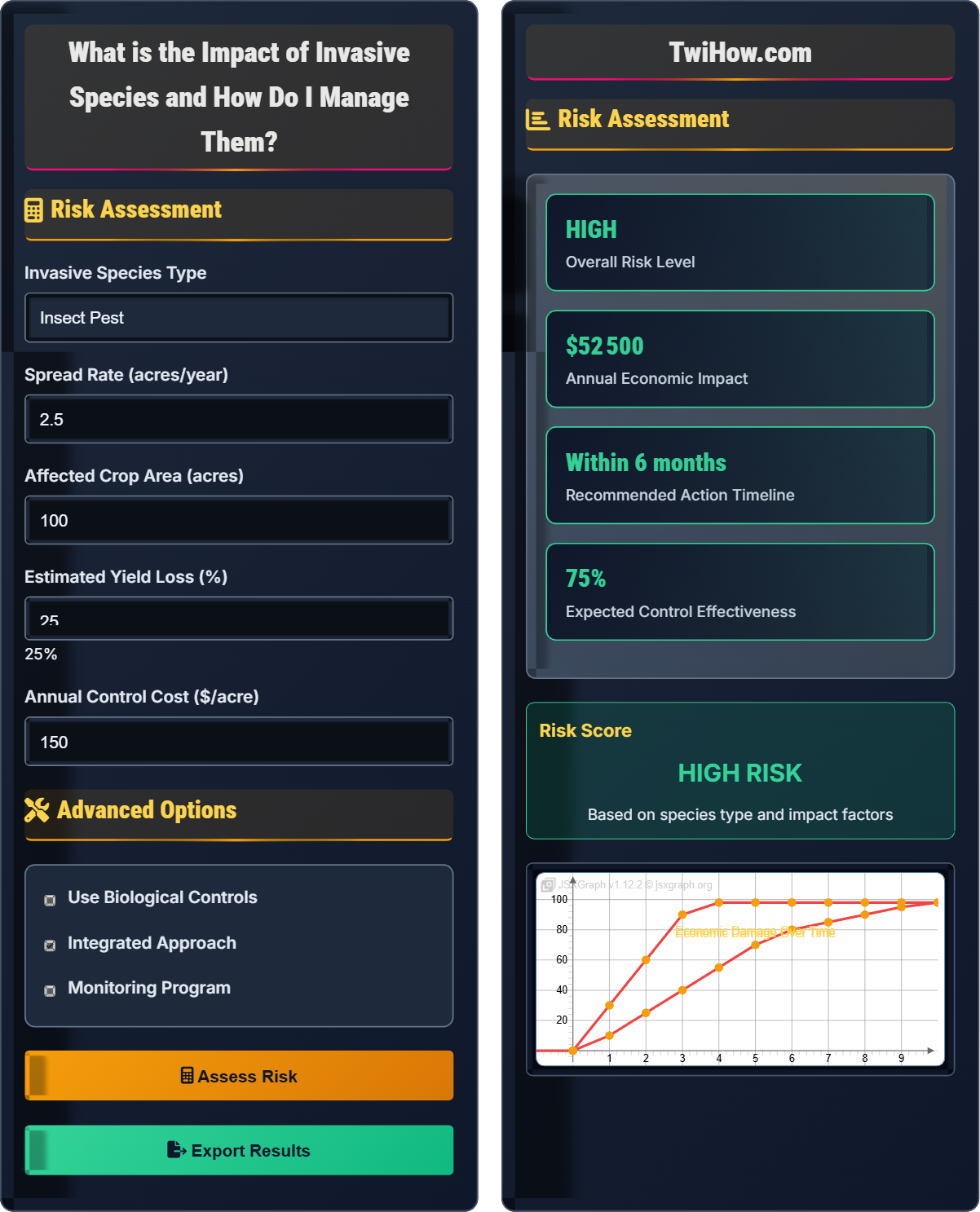
Risk Assessment
Advanced Options
Risk Assessment
Risk Score
Based on species type and impact factors
| Type | Severity | Impact | Priority |
|---|---|---|---|
| Yield Loss | High | 25% | 1 |
| Cost Increase | Medium | $15,000 | 2 |
| Biodiversity | High | Native plants | 3 |
| Water Use | Low | Increased | 4 |
Understanding Invasive Species
An invasive species is a non-native organism that causes harm to the environment, economy, or human health. These species often lack natural predators in their new habitat, allowing them to spread rapidly and outcompete native species.
Characteristics of invasive species:
- Fast Reproduction: High reproductive rates with minimal resources
- Competitive Advantage: Outcompete native species for resources
- Lack of Predators: Absence of natural enemies in new environment
- Environmental Tolerance: Adaptability to various conditions
Invasive species disrupt ecosystems by altering food webs, changing habitat structure, and reducing biodiversity. They can cause cascading effects throughout the ecosystem.
Major ecological consequences:
- Habitat Modification: Changing physical environment
- Resource Competition: Consuming nutrients, water, light
- Predation Pressure: Feeding on native species
- Disease Transmission: Spreading pathogens
Invasive species cause significant economic damage through reduced agricultural productivity, increased management costs, and infrastructure damage. Global costs exceed $1.4 trillion annually.
Early detection is crucial for effective management. Various methods help identify invasive species:
- Visual Inspection: Monitoring for unusual growth patterns
- Trapping: Using pheromones or attractants
- Environmental DNA: Detecting genetic material in soil/water
- Citizen Science: Public reporting through apps
Threat Levels
Introduction
Invasive species arrive through human activities, natural dispersal, or accidental transport.
Establishment
Small population begins reproducing and surviving in new environment.
Spread
Rapid expansion of population across landscape and ecosystems.
Impact
Significant ecological and economic damage becomes apparent.
Management Strategies
Ecosystem Impacts
Competition with native species for resources, leading to population declines and extinctions.
Altered hydrology and increased water consumption by invasive plants.
Changes in nutrient cycling and soil composition affecting plant growth.
Some invasive species increase fire frequency or intensity.
Invasive Species Quiz
Which of the following is NOT considered a primary impact of invasive species?
Invasive species typically decrease biodiversity by outcompeting native species and disrupting ecosystems. Increased biodiversity is not a primary impact of invasive species - rather, it's what we lose due to their presence.
The answer is C) Increased biodiversity.
Understanding the negative impacts of invasive species is crucial for developing effective management strategies. While some argue that introduced species can increase species richness locally, the overall effect is usually a net loss of native biodiversity due to competitive exclusion and habitat modification.
Invasive Species: Non-native organism causing harm to environment, economy, or health
Biodiversity: Variety of life forms in an ecosystem
Competitive Exclusion: Principle that two species competing for same resource cannot coexist
• Invasives reduce native biodiversity
• Economic costs are substantial
• Early detection is critical
• Learn local invasive species
• Report sightings promptly
• Use prevention methods
• Assuming all non-natives are harmful
• Underestimating economic costs
• Delaying management actions
Explain the principles of Integrated Pest Management (IPM) and how it applies to controlling invasive species in agricultural systems.
Integrated Pest Management (IPM) is a science-based approach that combines biological, cultural, physical, and chemical tools to manage pests while minimizing economic, health, and environmental risks.
Principles of IPM:
1. Prevention: Exclude pests through sanitation, barriers, and resistant varieties
2. Monitoring: Regular scouting to detect pests early
3. Action Thresholds: Economic injury levels for treatment decisions
4. Control Methods: Use least-risk options first
5. Assessment: Evaluate effectiveness of control measures
For invasive species, IPM emphasizes early detection and rapid response to prevent establishment and spread.
IPM is particularly valuable for invasive species management because it considers the unique challenges these organisms present. Unlike native pests, invasive species often lack natural controls, making prevention and early intervention critical. The IPM approach ensures that management strategies are economically viable and environmentally sustainable.
Integrated Pest Management (IPM): Coordinated use of multiple tactics for pest control
Economic Injury Level: Pest density causing economic loss
Threshold: Point requiring management action
• Use multiple control methods
• Monitor regularly
• Act before infestation spreads
• Start with least toxic options
• Document pest populations
• Consider biological controls
• Relying on single control method
• Not monitoring regularly
• Treating preventable problems
A farmer has 200 acres of corn affected by an invasive pest. Without control measures, the pest causes a 35% yield reduction. The average yield is 180 bushels/acre at $4.50/bushel. Control costs $85/acre annually. Should the farmer implement control measures? Calculate the economic benefit.
Without Control:
• Lost yield: 200 acres × 180 bu/acre × 0.35 = 12,600 bushels
• Lost revenue: 12,600 bu × $4.50/bu = $56,700
With Control:
• Control cost: 200 acres × $85/acre = $17,000
• Net benefit: $56,700 - $17,000 = $39,700
Yes, the farmer should implement control measures, saving $39,700 annually.
This calculation demonstrates the economic rationale for pest control. The cost of prevention and control is typically much lower than the cost of damages. Economic threshold analysis helps farmers make informed decisions about pest management investments. Understanding these calculations is crucial for sustainable farming operations.
Economic Threshold: Pest density requiring control action
Damage Assessment: Quantifying losses from pests
Cost-Benefit Analysis: Comparing control costs to potential losses
• Calculate before acting
• Consider all costs
• Plan ahead
• Track yield losses
• Compare control options
• Budget for prevention
• Underestimating losses
• Overlooking hidden costs
• Acting emotionally
A state has introduced a parasitic wasp to control an invasive aphid species. The wasp reduces aphid populations by 70% but also feeds on beneficial insects at 15% of the rate it feeds on aphids. If the original aphid population was 10,000 and beneficial insect population was 2,000, calculate the net effect after one year.
Aphid Reduction: 10,000 × 0.70 = 7,000 killed
• Remaining aphids: 10,000 - 7,000 = 3,000
Beneficial Insect Impact: 2,000 × 0.15 = 300 killed
• Remaining beneficials: 2,000 - 300 = 1,700
Net Effect: Significant aphid reduction with moderate impact on beneficials.
Biological control agents must be carefully evaluated for non-target effects. While the parasitic wasp effectively controls the aphid population, it also impacts beneficial insects. The goal is to maximize pest control while minimizing harm to beneficial species. This demonstrates the complexity of ecosystem management.
Biological Control: Using natural enemies to manage pests
Non-Target Effects: Impact on unintended organisms
Parasitoid: Organism that kills its host during development
• Test for non-target effects
• Monitor long-term impacts
• Consider ecosystem balance
• Use specific agents
• Monitor carefully
• Have contingency plans
• Not testing adequately
• Ignoring non-target effects
• Overestimating effectiveness
Which combination of prevention strategies is most effective for stopping invasive species introduction?
The most effective approach combines multiple prevention strategies, including physical barriers, regulatory controls, public education, and systematic monitoring. This multi-layered approach provides redundancy and increases the likelihood of intercepting invasive species before establishment.
The answer is D) Multiple barriers and monitoring.
Prevention is the most cost-effective strategy for invasive species management. Like a security system, multiple barriers and monitoring provide comprehensive protection. Each layer reduces the probability of successful invasion, and monitoring allows for rapid response if prevention fails. This approach recognizes that no single method is 100% effective.
Prevention: Actions to stop species introduction
Quarantine: Isolation to prevent spread
Multi-Barriers: Layered defense approach
• Prevention is most effective
• Multiple methods needed
• Continuous vigilance required
• Educate stakeholders
• Inspect thoroughly
• Report quickly
• Relying on single method
• Not educating staff
• Poor documentation
FAQ
Q: How can I identify invasive species on my farm before they become problematic?
A: Regular scouting is essential for early detection. Walk your fields weekly during growing season, paying attention to:
• Unusual plant growth patterns or unknown species
• Sudden changes in crop health or yield
• Presence of new insects or signs of feeding damage
• Use smartphone apps like EDDMapS or iNaturalist for identification
Also attend local workshops and connect with extension services to stay informed about emerging threats in your area.
Q: Are there any beneficial aspects of non-native species in agriculture?
A: Yes, many non-native species provide benefits when properly managed. Examples include:
• Pollinator plants that support beneficial insects
• Cover crops that improve soil health
• Natural enemies that control pests
• Food crops that provide nutrition
The key distinction is between non-native species that are beneficial or neutral versus invasive species that cause harm. The challenge is preventing beneficial species from becoming invasive through proper management and monitoring.