Monoculture vs Polyculture Impact on Ecosystem Health
Complete guide • Step-by-step instructions
The choice between monoculture and polyculture systems has profound impacts on ecosystem health. Monoculture involves growing a single crop species over large areas, while polyculture incorporates multiple species in the same space. Each approach creates different ecological conditions affecting biodiversity, soil health, pest management, and overall ecosystem stability.
Monoculture systems can simplify management but may increase vulnerability to pests, diseases, and environmental stresses. Polyculture systems often enhance ecosystem services, promote beneficial organisms, and create more resilient agroecosystems. The balance between productivity and ecological health is central to sustainable agriculture.
Key considerations:
- Biodiversity: Species richness and ecosystem stability
- Soil Health: Microbial diversity and nutrient cycling
- Pest Management: Natural enemy populations and pest suppression
- Resource Use: Water and nutrient efficiency
- Yield Stability: Resilience to environmental variations
Success depends on matching the system to local conditions and management goals.
Ecosystem Health Calculator
Ecosystem Factors
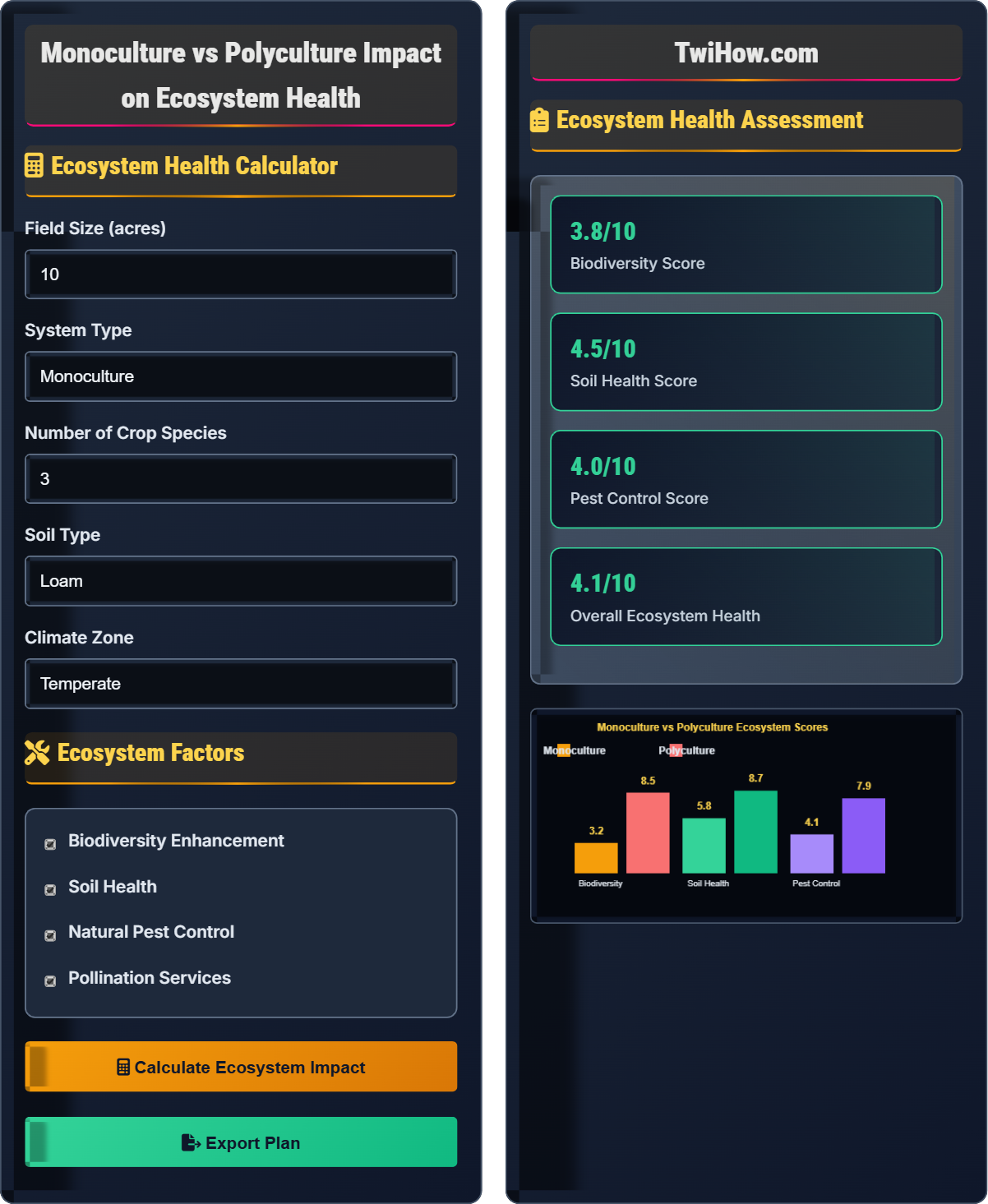
Ecosystem Health Assessment
| Factor | Monoculture | Polyculture | Comparison |
|---|---|---|---|
| Biodiversity | 3.2 | 8.5 | Polyculture superior |
| Soil Health | 5.8 | 8.7 | Polyculture superior |
| Pest Control | 4.1 | 7.9 | Polyculture superior |
| Resource Efficiency | 7.2 | 8.3 | Polyculture superior |
Monoculture vs Polyculture Fundamentals
Monoculture is the practice of growing a single crop species over large areas. This system simplifies management, harvesting, and marketing but can increase vulnerability to pests, diseases, and environmental stresses.
Polyculture involves growing multiple crop species in the same space. This system mimics natural ecosystems and can enhance biodiversity, improve soil health, and create more resilient agroecosystems.
Ecosystem health depends on several interconnected principles:
- Biodiversity: Greater species diversity increases ecosystem stability
- Functional Redundancy: Multiple species performing similar functions
- Complementarity: Species utilizing resources differently
- Niche Partitioning: Species occupying different ecological niches
- Trophic Interactions: Complex food webs supporting natural pest control
Polyculture systems typically support:
- Increased Plant Species: 3-10x more species than monocultures
- Enhanced Insect Diversity: 2-5x more beneficial insects
- Greater Microbial Diversity: More complex soil microbiomes
- Improved Bird Populations: More diverse habitat for avian species
- Enhanced Fungal Networks: More extensive mycorrhizal associations
Polyculture systems enhance soil health through:
- Organic Matter: Diverse plant residues increase soil carbon
- Root Architecture: Different root types improve soil structure
- Nutrient Cycling: Varied nutrient requirements and contributions
- Microbial Activity: Diverse inputs support complex microbial communities
- Erosion Control: Continuous ground cover reduces soil loss
Ecosystem Health Indicators
Key indicators of soil ecosystem health:
- Microbial Biomass: Amount of living microorganisms in soil
- Enzyme Activity: Biochemical processes indicating soil function
- Organic Carbon: Carbon content supporting soil structure
- Nutrient Availability: Balance of essential nutrients
- Soil Structure: Aggregate stability and porosity
Measures of ecosystem biodiversity:
- Species Richness: Number of different species present
- Species Evenness: Relative abundance of different species
- Shannon Diversity Index: Combined measure of richness and evenness
- Functional Groups: Different ecological roles filled by organisms
- Food Web Complexity: Interconnectedness of species interactions
Techniques to enhance ecosystem health:
- Companion Planting: Strategic pairing of compatible species
- Intercropping: Growing different crops simultaneously
- Agroforestry: Integrating trees with crops
- Rotational Grazing: Managing livestock to enhance plant diversity
- Integrated Pest Management: Combining multiple pest control methods
Monoculture vs Polyculture Comparison
- Advantages: Simplified management, mechanization, uniform harvest
- Disadvantages: Reduced biodiversity, pest vulnerability, soil degradation
- Biodiversity: Low species diversity
- Pest Pressure: Higher risk of outbreaks
- Soil Health: Potential degradation over time
- Management: Easier but less resilient
- Advantages: Enhanced biodiversity, resilience, ecosystem services
- Disadvantages: Complex management, harvest challenges
- Biodiversity: High species diversity
- Pest Pressure: Natural pest control
- Soil Health: Enhanced structure and fertility
- Management: More complex but more sustainable
Monoculture vs Polyculture Quiz
Which system typically supports greater biodiversity and why?
Polyculture systems support greater biodiversity because they provide diverse ecological niches, varied food sources, and multiple microhabitats. Different plant species create varied root systems, canopy structures, and flowering times, supporting a wider range of organisms. This diversity creates more complex food webs and ecological interactions.
The answer is B) Polyculture - provides diverse niches and resources.
This question tests understanding of the fundamental ecological principle that diversity begets diversity. The concept of niche partitioning explains how multiple species can coexist by utilizing different resources or occupying different ecological roles. This demonstrates how agricultural practices directly impact ecosystem structure and function.
Biodiversity: Variety of life forms in an ecosystem
Niche Partitioning: Species dividing resources to reduce competition
Ecological Niche: Role and position of a species in its environment
• Greater plant diversity leads to greater animal diversity
• Niche diversity supports complex food webs
• Resource availability drives species richness
• Plant species with different growth habits together
• Include plants that flower at different times
• Consider root architecture diversity
• Assuming uniform environments are beneficial
• Not considering the relationship between plant and animal diversity
• Overlooking the importance of temporal diversity
Explain how polyculture systems enhance soil health compared to monocultures and describe the specific mechanisms involved.
Root Architecture Diversity: Different plant species have varying root structures - taproots, fibrous roots, and lateral spreading roots access nutrients at different soil depths and improve soil structure.
Organic Matter Contributions: Diverse plant residues provide varied carbon inputs, supporting different microbial communities and improving soil aggregation.
Nutrient Cycling: Different plants have varying nutrient requirements and contributions. Legumes fix nitrogen, while others scavenge nutrients from deeper layers.
Soil Structure: Diverse root systems create channels for water infiltration and air movement, while continuous ground cover reduces erosion.
Microbial Diversity: Multiple plant species support diverse microbial communities that enhance nutrient availability and suppress soil-borne diseases.
These mechanisms create a more resilient and productive soil ecosystem compared to monocultures.
This example demonstrates the interconnected nature of above-ground and below-ground ecosystems. The relationship between plant diversity and soil health illustrates how agricultural practices can create positive feedback loops that enhance system productivity and sustainability.
Soil Aggregation: Clumping of soil particles into stable structures
Soil Microbiome: Community of microorganisms in soil
Nitrogen Fixation: Conversion of atmospheric nitrogen to plant-available forms
• Plant diversity enhances soil microbial diversity
• Root architecture affects soil physical properties
• Organic matter improves soil structure and fertility
• Include deep-rooted plants in polyculture systems
• Incorporate nitrogen-fixing plants
• Maintain living roots in soil year-round
• Not considering root system differences
• Overlooking the importance of continuous soil cover
• Ignoring the relationship between plant and soil health
A farmer is experiencing severe aphid infestations in their monoculture lettuce field. The same field, when planted with a polyculture of lettuce, basil, marigolds, and nasturtiums, shows significantly reduced aphid pressure. Calculate the expected reduction in pesticide applications if the polyculture reduces aphid populations by 70% and explain the ecological mechanisms.
Expected Reduction: If pesticide applications were needed every 2 weeks during aphid season (12 applications), a 70% reduction would mean only 3-4 applications per season.
Ecological Mechanisms:
1. Trap Cropping: Nasturtiums and marigolds attract aphids away from lettuce
2. Repellent Plants: Basil and marigolds repel aphids with volatile compounds
3. Beneficial Habitat: Diverse plantings support predatory insects like ladybugs
4. Visual Confusion: Mixed plantings make it harder for aphids to locate host plants
5. Chemical Signaling: Companion plants release compounds that deter aphids
This demonstrates how polyculture creates natural pest management systems.
This problem illustrates how polyculture systems can provide ecosystem services like natural pest control. The example shows multiple mechanisms working together to create effective pest management, demonstrating the power of ecological approaches to agriculture.
Trap Crop: Plant that attracts pests away from main crop
Companion Planting: Strategic placement of plants for mutual benefit
Biological Control: Use of natural enemies to manage pests
• Diverse plantings support beneficial insects
• Some plants repel specific pests
• Trap crops redirect pest pressure
• Research companion plant relationships
• Plan polycultures for specific pest problems
• Include flowering plants to support beneficial insects
• Not researching plant compatibility
• Overcrowding plants in polyculture
• Not considering timing of plant growth
A farmer wants to transition from a 50-acre corn monoculture to a corn-bean-squash polyculture (Three Sisters system). Calculate the expected changes in biodiversity index, soil organic matter, and pest pressure, and provide recommendations for implementation.
Expected Changes:
• Biodiversity Index: Increase from ~2.5 to ~4.0 (Shannon diversity index)
• Soil Organic Matter: Increase from 2.5% to 3.5-4.0% over 3-5 years
• Pest Pressure: 40-60% reduction in corn earworm and other pests
Implementation Recommendations:
1. Phase Transition: Convert 10-15 acres per year to allow learning
2. Planting Pattern: Mound system with corn in center, beans climbing corn, squash spreading around
3. Timing: Plant corn first, then beans when corn is 6 inches tall, squash after last frost
4. Harvest Strategy: Sequential harvest of different components
5. Marketing: Develop markets for beans and squash alongside corn
This transition will enhance ecosystem health while maintaining economic viability.
This example demonstrates how traditional polyculture systems like the Three Sisters have ecological benefits that modern agriculture can adopt. The gradual transition approach shows how farmers can implement sustainable practices while managing economic risks.
Shannon Diversity Index: Measure of species diversity and evenness
Three Sisters: Traditional Native American polyculture system
Gradual Transition: Phased conversion to minimize economic risk
• Plan transitions to minimize economic disruption
• Consider traditional knowledge and practices
• Monitor changes in ecosystem indicators
• Start with small trial plots
• Learn from experienced practitioners
• Document changes in soil and pest dynamics
• Converting entire farm at once
• Not researching proper planting techniques
• Ignoring market considerations for diverse crops
Which of the following ecosystem services is most enhanced by polyculture compared to monoculture systems?
While all ecosystem services are enhanced by polyculture, biodiversity support shows the most dramatic improvement. Polyculture systems typically support 3-10 times more species than monocultures, including plants, insects, microorganisms, and soil fauna. This enhanced biodiversity creates cascading benefits for all other ecosystem services.
The answer is B) Biodiversity support.
Biodiversity is often considered the foundation of ecosystem services because it creates the biological infrastructure that supports all other functions. Higher species diversity typically leads to greater functional redundancy and ecosystem stability, making biodiversity the most enhanced service in polyculture systems.
Ecosystem Services: Benefits provided by natural ecosystems
Biodiversity: Variety of life forms in an ecosystem
Functional Redundancy: Multiple species performing same ecological function
• Biodiversity underlies all other ecosystem services
• Greater diversity leads to greater stability
• Functional redundancy provides insurance against species loss
• Focus on increasing species diversity first
• Choose species with different ecological functions
• Consider temporal diversity (different seasons)
• Focusing on single ecosystem services
• Not considering species complementarity
• Overlooking the importance of functional diversity
FAQ
Q: Can polyculture systems be economically viable compared to monoculture?
A: Yes, polyculture systems can be economically viable, though the approach differs from monoculture. Benefits include: reduced input costs (less fertilizer and pesticides), diversified income streams, reduced risk from single-crop failure, and premium prices for sustainably-grown products. While yields per species may be lower than monoculture, total system productivity often equals or exceeds monoculture. Market factors like direct sales, community-supported agriculture, and organic premiums can significantly improve profitability. The key is matching the polyculture system to local market opportunities and management capabilities.
Q: How can I implement polyculture principles in a small home garden?
A: Start with simple companion planting combinations like the Three Sisters (corn, beans, squash) or tomato-basil-pepper combinations. Practice succession planting with different crops in the same space throughout the season. Include flowering plants to attract beneficial insects. Use vertical space with climbing plants and ground coverers. Create habitat strips with native plants. Focus on complementary relationships - plants that provide different benefits to each other. Examples: nitrogen-fixing plants near heavy feeders, pest-repelling plants near susceptible crops, and plants with different root depths to avoid competition.