Cover Crops for Soil Health & Erosion Control
Complete guide • Step-by-step instructions
Cover crops play a vital role in sustainable agriculture by protecting soil from erosion, improving soil health, and enhancing nutrient cycling. These plants are grown primarily to benefit the soil rather than for harvest, providing a protective barrier against wind and water erosion while contributing organic matter and nutrients back to the soil.
Cover crops offer multiple benefits: preventing soil loss, suppressing weeds, enhancing soil structure, fixing nitrogen (in leguminous varieties), and supporting beneficial soil organisms. They are planted between cash crop seasons or alongside main crops to maintain living roots in the soil year-round.
Key considerations:
- Species Selection: Matching crop types to specific soil needs
- Planting Timing: Ensuring adequate growing time before winter
- Management: Proper termination methods to avoid competition
- Integration: Coordination with main crop rotation
Success depends on selecting appropriate species, proper timing, and effective management practices.
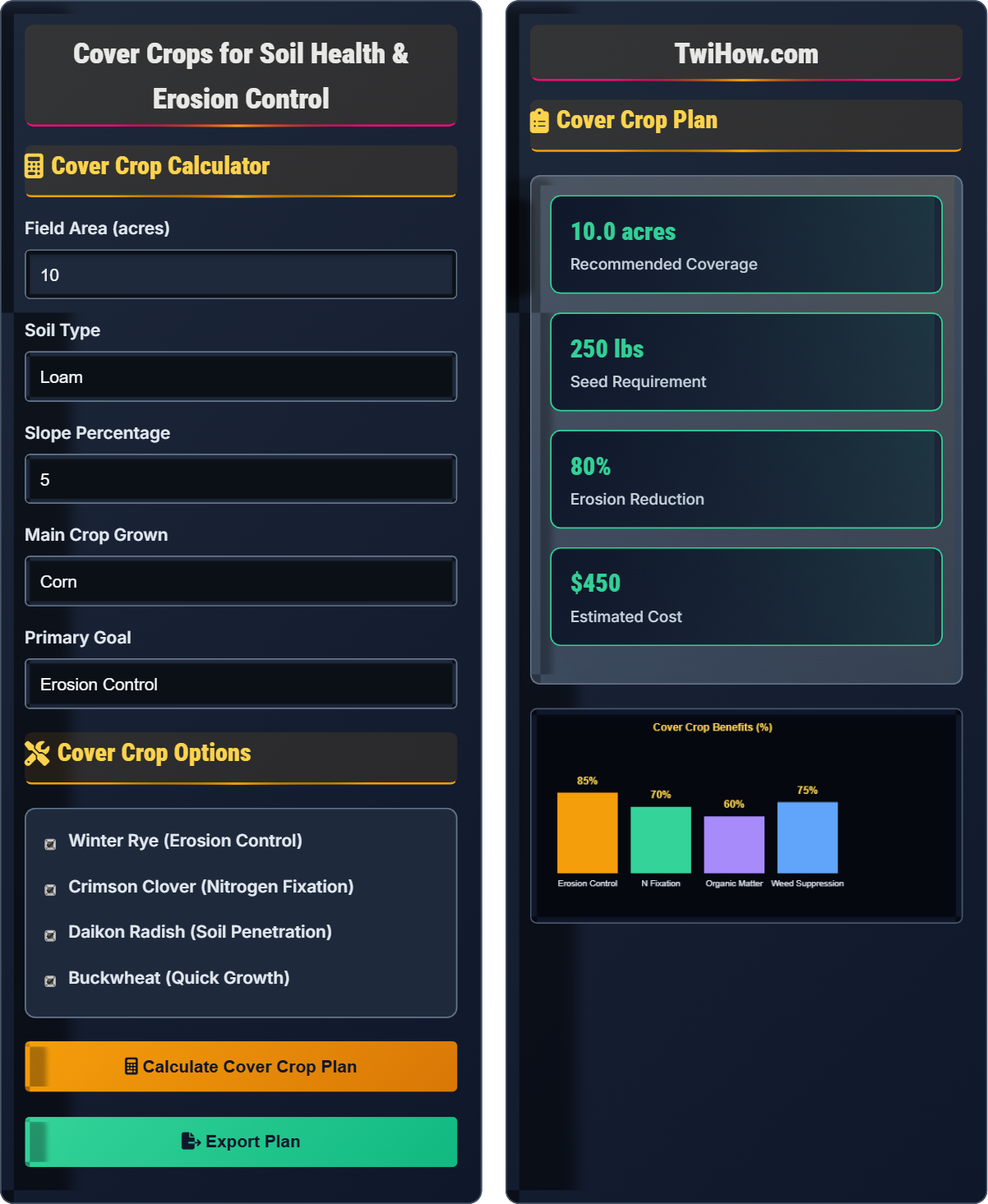
Cover Crop Calculator
Cover Crop Options
Cover Crop Plan
| Cover Crop | Seeding Rate | Benefits |
|---|---|---|
| Winter Rye | 2.5 lbs/acre | Erosion control, soil structure |
| Crimson Clover | 20 lbs/acre | Nitrogen fixation, pollinators |
| Daikon Radish | 8 lbs/acre | Compaction relief, scavenging |
Cover Crop Fundamentals
Cover crops are plants grown specifically to protect and enhance soil health rather than for harvest. They serve multiple purposes: preventing erosion, improving soil structure, adding organic matter, fixing nitrogen, suppressing weeds, and supporting beneficial soil organisms. Unlike cash crops, cover crops are typically terminated before maturity and incorporated into the soil.
Cover crops prevent soil erosion through several mechanisms:
- Canopy Protection: Leaves and stems break the impact of raindrops
- Root Structure: Root systems bind soil particles together
- Ground Cover: Dense vegetation shields soil surface from wind
- Water Infiltration: Improved soil structure allows water absorption
- Surface Roughness: Plant residues slow water runoff velocity
Different cover crop types offer varying levels of erosion protection:
- Winter Rye: Excellent erosion control, cold-hardy, fibrous root system
- Crimson Clover: Moderate erosion control, nitrogen fixation
- Daikon Radish: Good for compaction, less effective for erosion
- Annual Ryegrass: Excellent erosion control, good root system
- Hairy Vetch: Good nitrogen fixer, moderate erosion control
Cover crops improve soil health in multiple ways:
- Carbon Sequestration: Adds organic carbon to soil profile
- Water Retention: Improves soil's ability to hold moisture
- Nutrient Cycling: Scavenges nutrients from deeper soil layers
- Compaction Relief: Deep-rooted species break up compacted layers
- Microbial Diversity: Provides food for beneficial organisms
Cover Crop Types & Selection
Grass species excel in erosion control and soil structure improvement:
- Winter Rye: Most cold-hardy cereal grain, excellent erosion control
- Annual Ryegrass: Rapid establishment, good for erosion and compaction
- Oats: Non-winter hardy, good for quick growth and nitrogen scavenging
- Spring Barley: Fast establishment, good for early-season erosion control
Legumes provide nitrogen fixation and soil improvement:
- Crimson Clover: Attractive to pollinators, moderate nitrogen fixation
- Hairy Vetch: Excellent nitrogen fixer, good ground cover
- Austrian Winter Peas: Cold-tolerant, good nitrogen fixer
- Red Clover: Biennial option, persistent ground cover
Combining different species maximizes benefits:
- Rye + Crimson Clover: Erosion control + nitrogen fixation
- Rye + Radish + Vetch: Erosion + compaction + nitrogen
- Oats + Field Peas: Quick establishment + nitrogen
- Multi-species Mix: Comprehensive soil improvement
Erosion Control Comparison
- Erosion: 10-20 tons/acre/year soil loss
- Structure: Degraded soil structure
- Nutrients: Leaching and runoff
- Organic Matter: Declining levels
- Weeds: Increased weed pressure
- Erosion: 1-2 tons/acre/year soil loss
- Structure: Improved soil aggregation
- Nutrients: Retained in soil profile
- Organic Matter: Increasing levels
- Weeds: Reduced weed pressure
Cover Crops & Soil Health Quiz
Which cover crop provides the best erosion control and why?
Winter rye provides the best erosion control because it establishes quickly, produces abundant biomass, and develops an extensive fibrous root system that binds soil particles together. Its rapid growth creates a protective canopy, while its root system provides structural integrity to prevent soil movement.
The answer is B) Winter Rye - fibrous root system and quick establishment.
Understanding the physical mechanisms of erosion control is crucial for effective cover crop selection. The fibrous root system of grasses like winter rye creates a network that physically holds soil particles together, while the dense canopy protects the soil surface from the impact of raindrops. This demonstrates how plant morphology directly relates to function in soil conservation.
Fibrous Root System: Network of thin, branching roots that bind soil
Canopy Coverage: Above-ground plant material that shields soil
Soil Aggregation: Clumping of soil particles into stable structures
• Fibrous roots provide better erosion control than taproots
• Dense canopy offers surface protection
• Quick establishment is critical for fall planting
• Plant winter rye at least 4-6 weeks before first frost
• Use higher seeding rates for better erosion control
• Consider mixtures for combined benefits
• Planting too late for adequate establishment
• Using insufficient seeding rates
• Not considering local climate conditions
Explain the nitrogen fixation process in leguminous cover crops and calculate the approximate amount of nitrogen contributed to soil by a typical crimson clover stand.
Nitrogen Fixation Process: Leguminous cover crops form symbiotic relationships with Rhizobium bacteria in their root nodules. The bacteria convert atmospheric nitrogen (N₂) into ammonia (NH₃), which plants can use. The plant provides carbohydrates to the bacteria in exchange for fixed nitrogen.
Calculation: A well-established crimson clover stand can fix 70-150 lbs of nitrogen per acre. Using an average of 110 lbs/acre:
Formula: N fixed = (Root + Shoot biomass) × 0.04 (average N content)
For crimson clover: 110 lbs N/acre = approximately 2.75 tons dry matter × 0.04 N content
About 60-70% of this nitrogen becomes available to subsequent crops during the growing season.
The nitrogen fixation process exemplifies the principle of biological nitrogen cycling in sustainable agriculture. Rather than relying on synthetic fertilizers, legumes harness free atmospheric nitrogen through a mutually beneficial relationship with bacteria. This process demonstrates how nature provides solutions to agricultural challenges through biological processes.
Symbiosis: Mutualistic relationship between organisms
Rhizobium: Nitrogen-fixing bacteria in legume root nodules
Nitrogen Mineralization: Conversion of organic N to plant-available forms
• Legumes require specific Rhizobium strains for effective fixation
• N availability depends on decomposition rate
• Timing of termination affects N release
• Inoculate seeds with appropriate Rhizobium strain
• Allow 60+ days of growth for significant N fixation
• Terminate before flowering for maximum N contribution
• Not inoculating legume seeds with Rhizobium
• Terminating too early before significant N fixation
• Overestimating immediate N availability to next crop
A farmer has a 50-acre field with a 12% slope that experiences severe erosion (15 tons/acre/year without cover crops). They plan to plant winter rye at a rate of 2.5 lbs/acre. Calculate the expected reduction in soil loss and the amount of soil saved annually. Assume cover crops reduce erosion by 85%.
Current Soil Loss: 50 acres × 15 tons/acre/year = 750 tons/year
Expected Reduction: 85% of 750 tons = 0.85 × 750 = 637.5 tons/year
Remaining Soil Loss: 750 - 637.5 = 112.5 tons/year
Soil Saved: 637.5 tons/year
Cost-Benefit: Seed cost at $2.00/lb = 50 acres × 2.5 lbs/acre × $2.00 = $250
Value of soil saved at $10/ton = 637.5 tons × $10 = $6,375
This represents a significant return on investment for soil conservation.
This calculation demonstrates the economic value of soil conservation. The cost of seed is minimal compared to the value of soil preserved. This economic argument, combined with environmental benefits, makes a compelling case for cover crop adoption. The calculation shows how erosion control measures can provide both environmental and financial returns.
Soil Erosion: Removal of topsoil by water or wind
Topsoil Value: Economic worth of fertile soil layer
Return on Investment: Economic benefit relative to cost
• Steeper slopes require more aggressive erosion control
• Soil loss can be measured in tons per acre per year
• Economic benefits of soil conservation are significant
• Consider soil loss as an economic cost
• Use terracing for steep slopes in combination with cover crops
• Monitor erosion control effectiveness annually
• Underestimating the value of preserved topsoil
• Not accounting for long-term productivity losses
• Ignoring slope in erosion control planning
A farmer wants to plant cover crops on a field with compacted soil and low nitrogen levels. They need both erosion control and soil improvement. Recommend an appropriate mixture and explain the rationale for your selection.
Recommended Mixture: Winter Rye (50%) + Crimson Clover (40%) + Daikon Radish (10%)
Rationale:
• Winter Rye (2.5 lbs/acre): Provides excellent erosion control and fibrous root system for soil structure
• Crimson Clover (8 lbs/acre): Fixes nitrogen (70-120 lbs N/acre) and provides ground cover
• Daikon Radish (1 lb/acre): Breaks up compaction with deep taproot and scavenges nutrients
Benefits: Addresses all concerns - erosion control, nitrogen fixation, compaction relief, and organic matter addition. The mixture provides complementary benefits that single species cannot achieve.
This example demonstrates the concept of ecological intensification - using biodiversity to achieve multiple objectives simultaneously. Rather than selecting a single species, the mixture leverages different plant characteristics to address multiple soil issues. This approach mirrors natural ecosystems where diversity provides resilience and multiple ecosystem services.
Ecological Intensification: Using biodiversity to enhance agricultural systems
Complementary Benefits: Different species providing different advantages
Polyculture: Growing multiple species together
• Match species to specific soil problems
• Consider compatibility between species
• Balance seeding rates for desired outcomes
• Start with simple 2-species mixtures
• Adjust ratios based on primary goal
• Consider termination timing for different species
• Creating overly complex mixtures without clear purpose
• Not considering species compatibility
• Using equal seeding rates for all species
When should cover crops be terminated to maximize benefits while minimizing competition with the main crop?
Cover crops should be terminated 2-3 weeks before main crop planting. This timing allows for adequate decomposition of cover crop residues, releases nutrients for the main crop, and eliminates competition for water and nutrients. Terminating too close to planting can cause allelopathic effects and compete for resources.
The answer is B) 2-3 weeks before main crop planting.
Termination timing is critical for maximizing cover crop benefits while avoiding negative interactions with cash crops. The 2-3 week window allows for initial decomposition while ensuring that nutrients are released in time for main crop uptake. This demonstrates the importance of timing in agricultural management and the complex interactions between different plant species.
Termination: Killing or stopping growth of cover crop
Allelopathy: Chemical inhibition of one plant by another
Decomposition: Breakdown of organic matter by microorganisms
• Terminate before competition for resources
• Monitor weather for optimal termination conditions
• Terminating too late, causing competition with main crop
• Terminating too early, losing benefits
• Not accounting for weather delays in decomposition
FAQ
Q: How much do cover crops typically cost per acre and what's the return on investment?
A: Cover crop costs typically range from $25-75 per acre depending on seed mix and rate. Simple mixes like winter rye cost $20-30/acre, while complex nitrogen-fixing mixes can cost $50-80/acre. Return on investment comes from: reduced fertilizer needs (saving $20-50/acre), improved yields (2-10% increase), erosion prevention (avoiding soil replacement costs of $500-1000/acre), and improved soil health. Many farmers see positive ROI within 2-3 years, with long-term benefits continuing to accumulate.
Q: Can cover crops be used in small gardens and what are the best options?
A: Absolutely! Cover crops work well in small gardens. Best options include: buckwheat for quick summer coverage, winter rye for fall protection, crimson clover for nitrogen, and field peas for early spring. In small spaces, you can broadcast seeds by hand at rates of 1-2 lbs per 1000 sq ft. Cover crops suppress weeds, improve soil structure, and add organic matter. Just remember to cut them before flowering and incorporate into soil 2-3 weeks before planting your next crop.