Role of Pollinators and How to Support Them
Sustainable farming guide • Step-by-step explanations
Pollinator Support Overview:
Show Pollinator PlannerPollinators play a crucial role in ecosystems and agriculture, facilitating the reproduction of flowering plants and enabling the production of fruits, seeds, and nuts. Supporting pollinators through habitat creation, native plantings, and reduced pesticide use is essential for biodiversity conservation and food security. Pollinators include bees, butterflies, moths, birds, bats, and other beneficial insects that move pollen between flowers.
Key support strategies include:
- Native Plantings: Diverse flowering plants throughout growing season
- Habitat Creation: Nesting sites and overwintering locations
- Reduced Chemical Use: Pesticide-free growing practices
- Water Sources: Clean water for drinking and bathing
Creating pollinator-friendly environments benefits both wildlife and crop production.
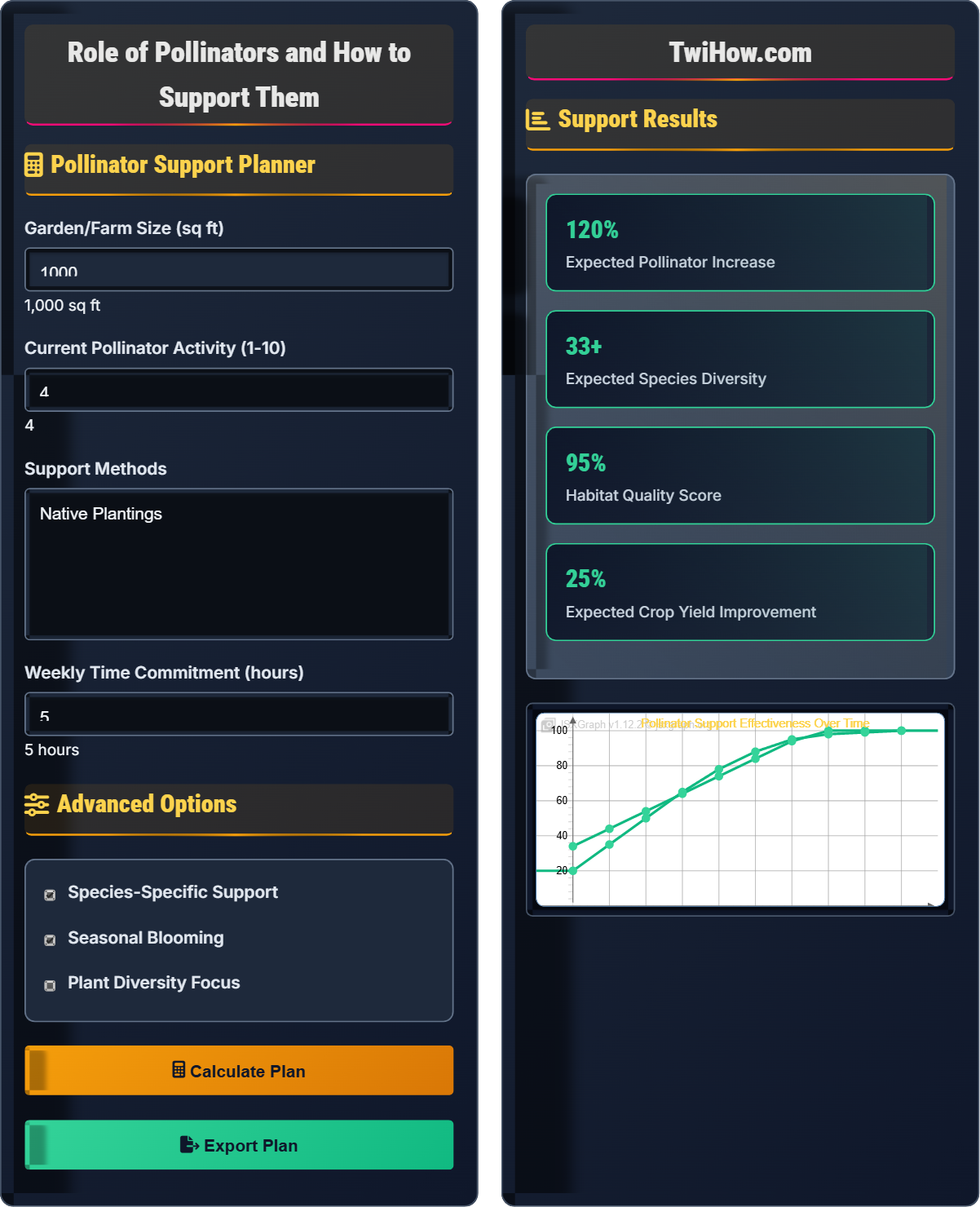
Pollinator Support Planner
Support Results
| Method | Impact | Time Required | Cost |
|---|---|---|---|
| Native Plantings | High | 2 hrs/week | Medium |
| Bee Houses | Medium | 1 hr/setup | Low |
| Water Sources | Medium | 0.5 hr/week | Low |
| Pesticide Reduction | High | 0 hrs | Low |
Pollinator Support Explained
The pollinator habitat effectiveness is calculated as:
Where PIE = Pollinator Impact Effectiveness, and each component is rated on a 0-100 scale.
Pollinators provide critical ecosystem services:
- Pollination: 75% of flowering plants depend on pollinators
- Food Security: 35% of global food production relies on pollinators
- Biodiversity: Supports plant reproduction and genetic diversity
- Economic Value: Estimated $235 billion annually worldwide
Native plants support pollinators through:
- Co-evolution: Adapted relationships with local pollinators
- Nectar Quality: Optimal nutritional content
- Timing: Bloom periods matching pollinator emergence
- Host Plants: Food sources for larval development
Native plants support 4-35 times more pollinator species than non-native plants.
- Floral Resources: Diverse blooming plants throughout season
- Nesting Sites: Ground nests, hollow stems, wood cavities
- Water Sources: Clean water for drinking and bathing
- Overwintering: Protected areas for dormant stages
Pollinator Support Fundamentals
Pollination, native plants, habitat creation, ecosystem services, biodiversity, co-evolution.
PIE = (FR + NS + SF) / 3
Where PIE = Pollinator Impact Effectiveness, FR = Floral Resources, NS = Nesting Sites, SF = Safety Factors.
- Plant native species
- Provide seasonal blooms
- Eliminate pesticide use
- Create diverse habitats
Support Strategies
Native plantings, bee houses, water sources, pesticide reduction, nesting sites.
- Assess current habitat
- Identify target species
- Choose appropriate methods
- Monitor and adjust
- Plant in clusters
- Provide continuous blooms
- Include host plants
- Offer water sources
Support Methods
Support Visualization
Pollinator Support Learning Quiz
What percentage of global food production relies on pollinators?
About 35% of global food production relies on pollinators. This includes many fruits, vegetables, nuts, and oilseed crops that require pollination to produce harvestable yields. Pollinators are essential for food security and agricultural productivity worldwide, making their conservation critical for sustainable food systems.
The answer is B) 35%.
Pollinators provide one of the most important ecosystem services for agriculture. Their role extends beyond just honey production to include the production of many foods that form the basis of human diets. Understanding the economic and ecological importance of pollinators helps emphasize why their conservation is essential for food security and biodiversity.
Pollination: Transfer of pollen between flowers
Ecosystem Service: Benefit provided by natural systems
Food Security: Reliable access to sufficient food
• Recognize pollinator importance
• Support their conservation
• Reduce harmful practices
• Plant native species
• Provide diverse blooms
• Eliminate pesticide use
• Underestimating pollinator importance
• Using harmful chemicals
• Not providing diverse resources
Explain why native plants are superior to non-native plants for supporting pollinators and calculate the expected increase in pollinator diversity. If a garden with non-native plants supports 5 pollinator species, and native plants support 4-35 times more species, what is the range of species expected with native plantings?
Native Plant Benefits:
• Co-evolution: Plants and pollinators have evolved together
• Nectar Quality: Optimal nutritional content
• Timing: Bloom periods match pollinator emergence
• Host Plants: Food sources for larval development
Calculation: Range: 5 × 4 = 20 species to 5 × 35 = 175 species
Expected range: 20-175 species with native plantings.
Native plants and pollinators have co-evolved over thousands of years, creating specialized relationships that are essential for both parties' survival. Native plants provide the specific nectar, pollen, and timing that local pollinators have adapted to depend on. This relationship is much more complex and beneficial than what can be achieved with non-native plants that haven't co-evolved with local pollinators.
Co-evolution: Mutual evolutionary adaptation
Specialization: Adapted relationships
Bloom Period: Flowering time frame
• Prioritize native species
• Research local varieties
• Plant in clusters
• Consult local extension offices
• Join native plant societies
• Start with easy natives
• Planting only ornamental exotics
• Not researching native varieties
• Mixing native and non-native
A farmer wants to install bee houses for solitary bees across a 2-acre farm. Research suggests installing 1 bee house per 0.25 acres. Each bee house costs $25 and can accommodate 20-30 bees. Calculate the total cost of installation and the potential bee accommodation capacity. If each bee pollinates 100 flowers per day, what is the daily pollination potential of the bee houses?
Number of Houses: 2 acres ÷ 0.25 acres/house = 8 houses
Total Cost: 8 houses × $25 = $200
Bee Capacity: Range: 8 × 20 = 160 bees to 8 × 30 = 240 bees
Daily Pollination: Range: 160 × 100 = 16,000 flowers to 240 × 100 = 24,000 flowers
Expected daily pollination: 16,000-24,000 flowers.
Solitary bees are highly efficient pollinators that don't live in colonies but nest individually. They are often more effective pollinators than honeybees because they visit more flowers per minute and carry pollen loosely on their bodies, making transfer more likely. Providing suitable nesting sites can significantly increase local pollinator populations and improve crop yields.
Solitary Bees: Non-colonial bee species
Efficient Pollinators: Bees that transfer pollen effectively
Nesting Sites: Locations for bee reproduction
• Install in appropriate locations
• Maintain cleanliness
• Monitor occupancy
• Face east for morning sun
• Provide nearby water
• Use proper hole sizes
• Installing too few houses
• Wrong hole sizes
• Not maintaining houses
A gardener wants to provide continuous blooms from March through October for pollinators. Calculate the minimum number of different plant species needed if each species blooms for 4-6 weeks and they want overlap between species. If the growing season is 24 weeks (March through October), and each plant provides 5 weeks of bloom with 2-week overlaps, how many species are needed?
Growing Season: March through October = 24 weeks
Effective Bloom Time per Species: 5 weeks bloom - 2 weeks overlap = 3 weeks of unique coverage
Number of Species Needed: 24 weeks ÷ 3 weeks per species = 8 species
Therefore, 8 different plant species are needed to provide continuous bloom coverage.
Continuous bloom provision is essential for supporting pollinators throughout their active season. Different pollinator species emerge and are active at different times, and providing consistent food sources helps maintain healthy populations. The overlap ensures that as one species finishes blooming, another begins, preventing gaps in nectar and pollen availability.
Continuous Blooms: Uninterrupted flowering period
Seasonal Availability: Resources throughout growing season
Overlap: Concurrent blooming periods
• Plan for seasonal succession
• Include early and late bloomers
• Research bloom times
• Create bloom calendars
• Include spring bulbs
• Add late-season flowers
• Not planning seasonal succession
• Missing early season blooms
• No late season flowers
Which of the following pesticide types has the most severe impact on pollinators?
Systemic neonicotinoids have the most severe impact on pollinators. These systemic pesticides are absorbed by plants and distributed throughout all tissues, including nectar and pollen. When pollinators consume these contaminated resources, they are exposed to sublethal doses that can impair navigation, memory, immune function, and reproduction. The systemic nature means exposure occurs even when pesticides aren't directly applied to blooming plants.
The answer is B) Systemic neonicotinoids.
Systemic pesticides are particularly dangerous because they persist in plant tissues long after application and can be consumed by pollinators visiting treated plants. Unlike contact pesticides that only affect insects directly sprayed, systemic pesticides provide continuous exposure through nectar and pollen. This sublethal exposure can weaken pollinators over time, making them more susceptible to diseases and reducing their ability to forage effectively.
Systemic Pesticides: Absorbed by plant tissues
Sublethal Effects: Non-lethal but harmful impacts
Contact Pesticides: Affect insects on contact
• Avoid systemic pesticides
• Choose pollinator-safe alternatives
• Read labels carefully
• Use integrated pest management
• Encourage beneficial insects
• Practice crop rotation
• Using systemic pesticides
• Not reading product labels
• Over-applying treatments
Support Techniques
FAQ
Q: What's the difference between native plants and pollinator plants?
A: The key differences are:
Native Plants: Species that naturally occur in your geographic region and have co-evolved with local pollinators.
Pollinator Plants: Any plants that provide nectar and pollen, whether native or non-native.
All native plants support pollinators, but not all pollinator plants are native. Native plants are typically more beneficial for local pollinator communities.
Q: How do I balance pest control with pollinator protection?
A: Balance through:
Integrated Pest Management: Biological controls, beneficial insects, cultural practices
Targeted Applications: Spot treatments only when necessary
Timing: Apply treatments when pollinators are inactive
Alternative Products: Use pollinator-safe formulations
This approach reduces harm while maintaining pest control effectiveness.