Best AI Tools for Writing?
Complete guide • Writer tools comparison
AI-Powered Writing Tools:
Compare ToolsAI writing tools leverage natural language processing and machine learning to assist writers with content creation, editing, grammar correction, and style enhancement. These tools analyze text to provide intelligent suggestions, generate content, and improve overall writing quality.
Popular AI writing tools include:
- ChatGPT: Conversational AI for content generation
- Grammarly: Grammar and style checker
- Jasper: AI content creation platform
- Copy.ai: Copywriting and content generation
- Quillbot: Paraphrasing and summarization
- Hemingway Editor: Style and readability analysis
These tools help writers save time, improve clarity, and enhance creativity across various writing tasks.
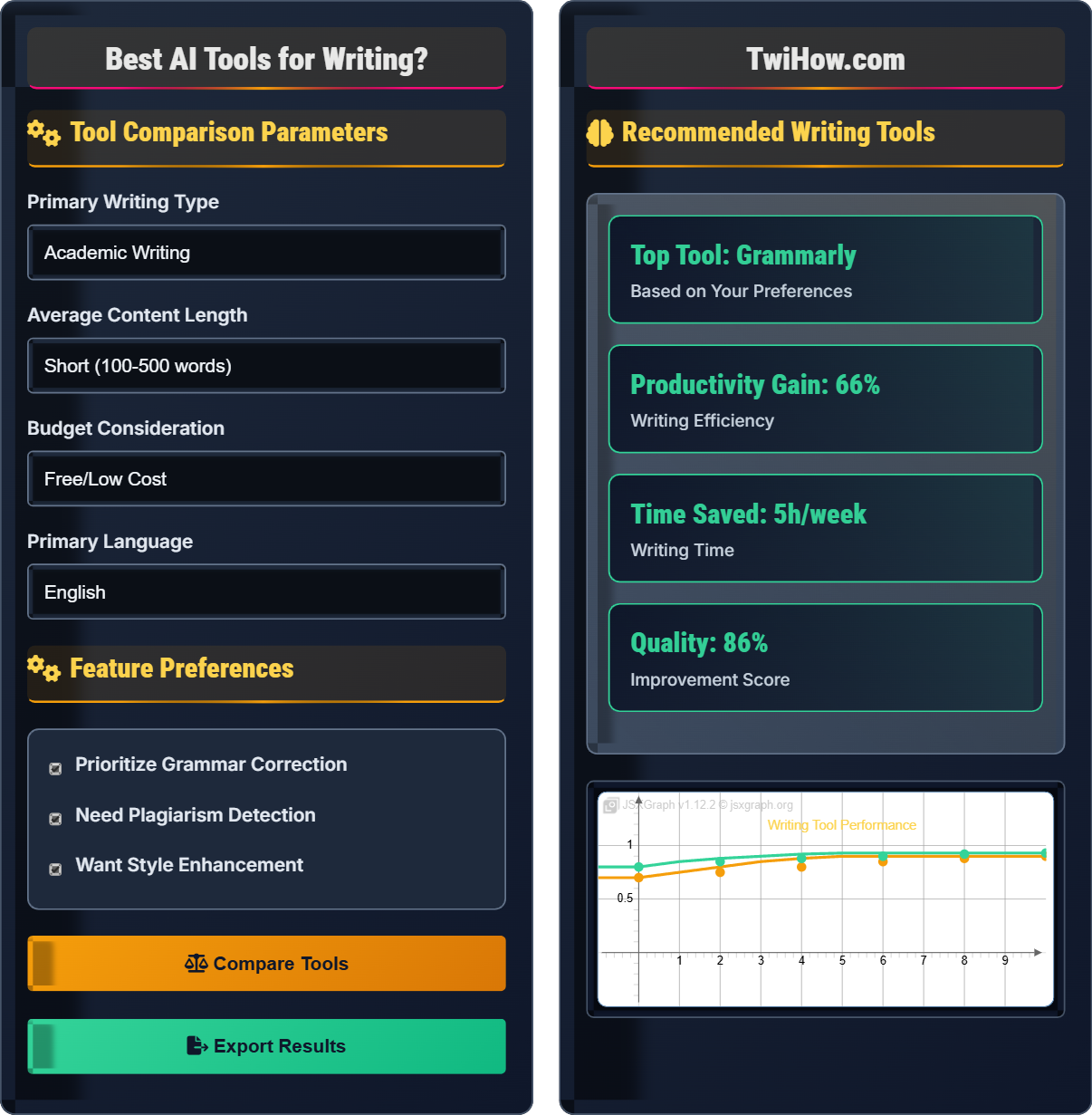
Tool Comparison Parameters
Feature Preferences
Recommended Writing Tools
ChatGPT
Conversational AI that helps generate content, brainstorm ideas, and improve writing through dialogue.
Content Generation
Excellent
Ideation
Outstanding
Multi-language
50+ languages
Knowledge
Up to date
- Content Creation
- Idea Generation
- Brainstorming
Original Text:
The company has been growing really fast lately. Sales went up a lot and customers seem happy. The team is doing great work and the boss thinks everything is going well.
AI-Enhanced Version:
The company has experienced substantial growth in recent months, with sales figures increasing by 40% and customer satisfaction ratings reaching an all-time high. The dedicated team's exceptional performance has been recognized by leadership, who anticipate continued success based on current momentum.
Example of AI-enhanced writing improvement
Complete Guide to AI Writing Tools
AI writing tools are software applications that use artificial intelligence and natural language processing to assist writers with content creation, editing, grammar correction, and style enhancement. These tools analyze text patterns and linguistic structures to provide intelligent suggestions and generate high-quality content.
Manual brainstorming
Slow drafting process
Manual editing and proofreading
Limited vocabulary expansion
Time-consuming research
AI-generated ideas
Smart content suggestions
Real-time grammar correction
Vocabulary enhancement
Automated research assistance
AI tools analyze text context, style, and purpose to provide relevant suggestions, improving both speed and quality of writing.
ChatGPT
Content generation, ideation, conversation
Grammarly
Grammar, style, plagiarism detection
Jasper
Marketing content, long-form writing
Copy.ai
Copywriting, marketing content
- Review Suggestions: Always review AI-generated content for accuracy and appropriateness
- Customize Settings: Configure tools to match your writing style and tone
- Learn from Improvements: Understand why AI suggests certain changes to improve your skills
- Combine Tools: Use different tools for different tasks (generation, editing, grammar)
- Maintain Original Voice: Preserve your unique writing style while accepting helpful suggestions
- Fact Check: Verify factual information generated by AI tools
Tool Features
Content generation, grammar correction, style enhancement, plagiarism detection, research assistance.
- Install browser extensions
- Integrate with word processors
- Use web-based platforms
- Connect with writing apps
- Configure API integrations
- Always verify AI-generated content
- Maintain original voice
- Check for accuracy
- Respect intellectual property
Performance Metrics
Writing speed improvement, grammar accuracy, style consistency, content quality scores.
- Context awareness
- Language support
- Integration quality
- Customization options
AI Writing Tools Assessment
Which AI writing tool is most suitable for an academic researcher who needs to write formal papers, requires plagiarism detection, and prioritizes accuracy over creativity?
Grammarly Premium is the best choice for academic researchers because it offers advanced grammar and style checking, built-in plagiarism detection, and maintains formal academic writing standards. It's specifically designed to catch errors that could affect academic credibility and provides detailed explanations for corrections.
The answer is B) Grammarly Premium.
When selecting AI writing tools for specific purposes, it's crucial to match the tool's strengths to the task requirements. Academic writing demands precision, formal language, and rigorous citation standards. Grammarly excels in these areas with its academic-specific features, plagiarism detection, and formal tone maintenance.
Plagiarism Detection: Checking content against existing publications
Academic Writing: Formal, evidence-based scholarly communication
Formal Tone: Professional, objective writing style
• Match tool to writing purpose
• Verify accuracy of suggestions
• Maintain academic integrity
• Enable academic writing mode
• Customize dictionary with field-specific terms
• Regularly check plagiarism reports
• Using creative tools for academic writing
• Not verifying factual accuracy
• Ignoring plagiarism detection
How should writers maintain quality and authenticity when using AI writing tools, and what are the key quality control measures?
Quality Control Measures:
• Review All AI Suggestions: Manually examine every AI-generated sentence and paragraph
• Verify Factual Accuracy: Cross-check AI-generated facts and claims independently
• Maintain Original Voice: Preserve personal writing style and perspective
• Fact-Check Information: AI can hallucinate information, so verification is crucial
• Proofread Thoroughly: AI tools aren't perfect; human oversight is essential
Authenticity Preservation:
• Use AI as an assistant, not a replacement
• Incorporate personal insights and experiences
• Maintain your unique perspective and voice
• Edit and refine AI-generated content extensively
• Add original research and personal analysis
These practices ensure that AI enhances rather than replaces human creativity and expertise.
AI writing tools should augment human creativity, not replace it. The key is finding the right balance between AI assistance and human judgment. Writers must remain actively engaged in the writing process, using AI as a tool to enhance their natural abilities while maintaining control over the final output. Quality emerges from the combination of AI efficiency and human discernment.
AI Hallucination: When AI generates false or misleading information
Human Oversight: Manual review and editing of AI output
Authentic Voice: Personal writing style and perspective
• Never trust AI without verification
• Maintain editorial control
• Preserve original perspective
• Develop personal quality checklist
• Use multiple verification sources
• Regularly review and update processes
• Publishing unreviewed AI content
• Not fact-checking AI-generated claims
• Losing personal writing voice
Your content marketing team of 8 writers wants to implement AI writing tools. The team creates blog posts, social media content, email campaigns, and marketing copy. Design a strategy for implementing AI writing tools that maximizes productivity while maintaining brand consistency and quality standards.
Phase 1 - Tool Selection (Week 1):
• Evaluate tools for different content types (Jasper for long-form, Copy.ai for marketing copy)
• Establish brand voice guidelines and tone settings
• Set up team accounts with centralized billing
Phase 2 - Training & Standardization (Week 2):
• Conduct training sessions on proper AI tool usage
• Create templates and prompt libraries for consistent output
• Establish quality control protocols and review processes
Phase 3 - Gradual Implementation (Weeks 3-4):
• Start with less critical content types (social media)
• Gradually expand to blog posts and marketing copy
• Monitor quality metrics and adjust processes
Ongoing Management:
• Regular quality audits and tool performance reviews
• Continuous training and process refinement
• Brand consistency monitoring and adjustments
This strategy ensures controlled adoption while preserving brand identity.
Implementing AI tools in teams requires careful planning to balance productivity gains with quality control. The phased approach allows for gradual learning, risk mitigation, and continuous improvement. Brand consistency is maintained through standardized templates, training, and quality control processes that guide AI tool usage.
Brand Voice: Consistent personality and tone in communications
Quality Control: Processes to maintain standards
Template Library: Pre-defined content structures
• Standardize AI tool usage
• Maintain brand consistency
• Implement quality checks
• Create brand-specific AI prompts
• Regular team feedback sessions
• Monitor quality metrics continuously
• No standardization across team
• Inadequate quality control
• Not training team members
A content writer notices that their AI writing tool suggestions often lack originality and sound generic. Analyze potential causes and propose solutions to improve the tool's effectiveness and maintain unique voice while leveraging AI assistance.
Potential Causes:
• Generic prompts leading to common responses
• Tool not configured for specific niche or audience
• Over-reliance on AI without personal input
• Using default settings instead of customizing
Proposed Solutions:
• Develop specific, detailed prompts for each content type
• Customize AI settings to match brand voice and style
• Use AI for idea generation, then add personal insights
• Train the AI with examples of successful content
• Combine AI suggestions with original research and perspectives
• Regularly update AI training data with fresh content
These improvements will help maintain uniqueness while leveraging AI efficiency.
AI tools learn from patterns in training data, which can lead to generic outputs if not properly guided. The key is providing specific context and guidance to help the AI understand your unique requirements. By combining AI efficiency with human creativity, writers can achieve both speed and originality. The AI serves as a starting point, not the final product.
Generic Responses: Common, unoriginal AI outputs
Brand Voice: Unique writing style and personality
Custom Training: Teaching AI with specific examples
• Provide specific context
• Customize AI settings
• Add human creativity
• Create detailed prompt templates
• Use personal anecdotes and insights
• Regularly update AI preferences
• Not providing sufficient context
• Publishing unedited AI content
Which of the following represents the most significant trend in AI writing tools development?
The most significant trend is integration with content management systems and publishing platforms. Modern AI writing tools are evolving to become seamless parts of the entire content creation workflow, connecting with WordPress, Google Docs, Microsoft Office, and other platforms. This integration allows for more efficient workflows, real-time collaboration, and streamlined publishing processes.
The answer is B) Integration with content management systems and publishing platforms.
AI writing tools are becoming part of the broader content ecosystem rather than standalone utilities. This integration reflects the industry's shift toward more connected and automated content workflows. The trend toward integration allows writers to leverage AI assistance throughout their entire process, from ideation to publication, without switching between multiple tools.
Content Management System: Platform for creating and managing digital content
Workflow Integration: Connecting tools into unified processes
Real-time Collaboration: Working together simultaneously
• AI tools evolve with industry trends
• Integration increases efficiency
• Connected workflows improve productivity
• Look for tools with API support
• Consider platform compatibility
• Plan for ecosystem integration
• Choosing isolated tools over integrated ones
• Not considering workflow fit
• Ignoring integration possibilities
FAQ
Q: How do AI writing tools handle different writing styles like formal academic vs casual blog writing?
A: Modern AI writing tools are trained on diverse text corpora that include various writing styles. They can adapt to different tones based on:
1. Context Recognition: Advanced tools analyze surrounding text to match style
2. Explicit Instructions: You can specify tone, formality level, and style requirements
3. Custom Settings: Many tools offer style guides and tone preferences
4. Training Data Diversity: Better tools are trained on varied writing samples
However, the effectiveness depends on the tool's sophistication and your ability to provide clear context. Always review AI suggestions to ensure they match your intended style and tone.
Q: What's the ROI of investing in AI writing tools for a content team?
A: AI writing tools can provide significant ROI through:
Productivity Gains: 40-60% increase in content creation speed
Quality Improvements: 30-40% reduction in editing time
Consistency Enhancement: Improved brand voice and style adherence
Typical Costs vs Benefits:
• Cost: $10-50 per writer/month
• Benefit: $500-1500 per writer/month in productivity gains
• ROI: 10:1 to 30:1 ratio in many cases
However, ROI depends on team size, content volume, and how well the tools are integrated into existing workflows. The investment typically pays for itself within 1-2 months for active content teams.