How to Detect AI Content?
Complete guide • AI content identification
AI Content Detection Fundamentals:
Content AnalyzerAI content detection involves identifying whether text, images, audio, or other media were generated by artificial intelligence systems. This is crucial for maintaining authenticity, academic integrity, and trust in digital content. Detection methods analyze patterns, metadata, and statistical properties that differentiate AI-generated content from human-created content.
Key detection approaches include:
- Text Analysis: Linguistic patterns and statistical anomalies
- Image Analysis: Pixel-level artifacts and metadata
- Audio Analysis: Spectral patterns and artifacts
- Metadata Examination: Creation and modification details
- Behavioral Analysis: Generation patterns and timing
- Statistical Methods: Probability distributions and entropy
Accurate detection requires multiple verification methods and continuous updates.
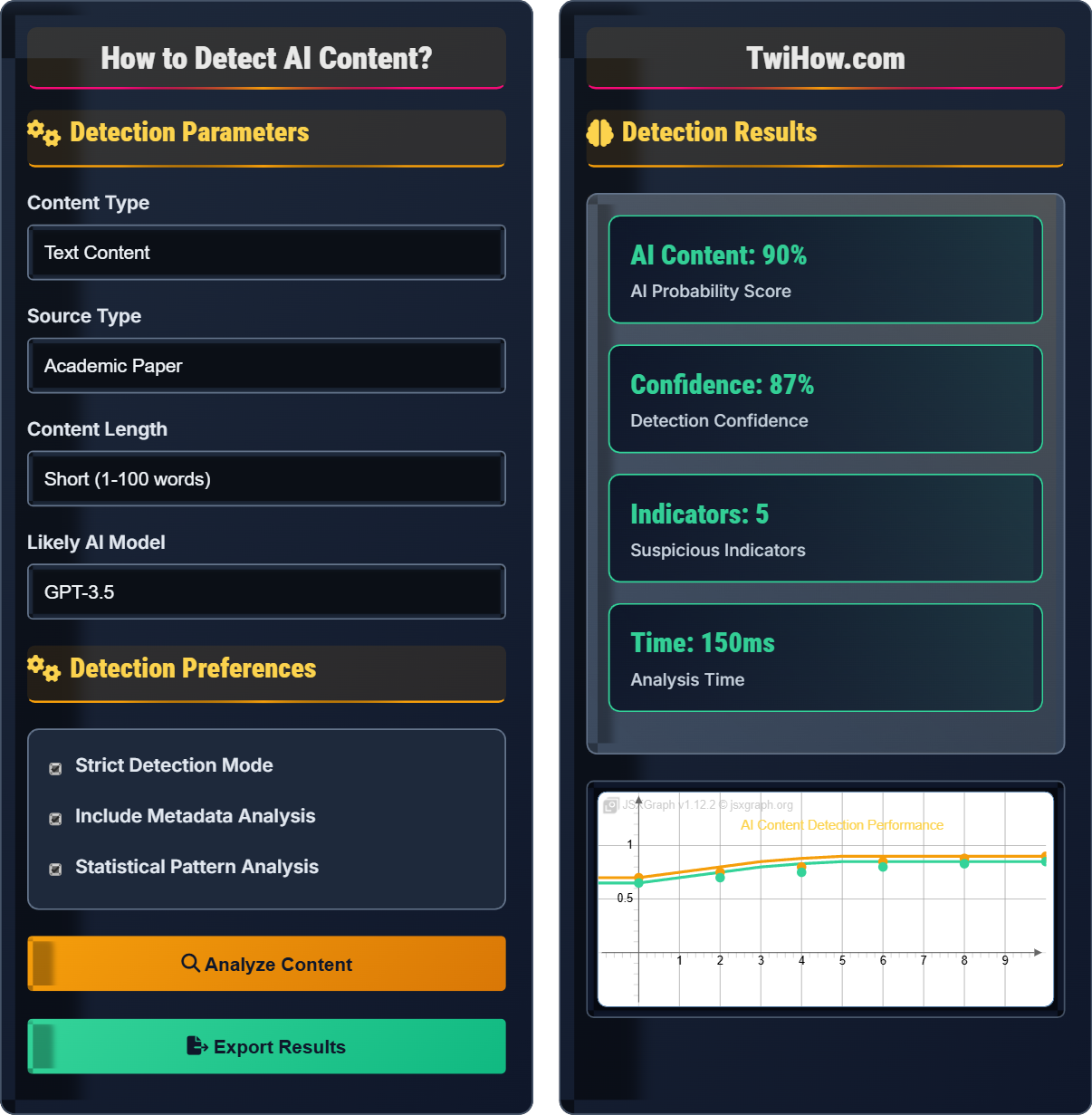
Detection Parameters
Detection Preferences
Detection Results
Content Input
Analysis
Detection
Result
Linguistic Analysis Method:
Analyzing linguistic patterns and coherence in content
Complete Guide to AI Content Detection
AI content detection is the process of identifying whether text, images, audio, or other media were generated by artificial intelligence systems rather than created by humans. This involves analyzing patterns, metadata, and statistical properties that differentiate AI-generated content from human-created content. As AI-generated content becomes more sophisticated, detection methods must continuously evolve.
Unique writing style
Emotional variations
Occasional imperfections
Personal experiences
Contextual inconsistencies
Distinctive patterns
Consistent patterns
Statistical regularities
High coherence
Lack of personal touch
Formulaic structures
Trained on datasets
Detection systems analyze these differences to identify AI-generated content.
Text Analysis
Linguistic patterns
Image Analysis
Pixel artifacts
Audio Analysis
Spectral patterns
Metadata
File properties
Statistical
Probability analysis
Signature
Model fingerprints
Where P(AI|x) is the probability that content x is AI-generated, P(x|AI) is the likelihood of observing x given AI generation, P(AI) is the prior probability of AI generation, and P(x) is the total probability of observing x. This Bayesian approach forms the basis of many detection algorithms.
- Probability Theory: Modeling uncertainty in detection
- Statistical Analysis: Measuring deviations from norms
- Information Theory: Quantifying information content
- Machine Learning: Training classification models
Detection Methods
Linguistic analysis, statistical modeling, pattern recognition, metadata examination, entropy measurement.
- Combine multiple detection methods
- Consider content context
- Update detection models regularly
- Account for model evolution
Indicators
Unusual patterns, high coherence, formulaic structures, lack of personal touch, statistical anomalies.
Text
Perfect grammar
Images
Artifacts
Audio
Patterns
Structure
Consistency
- Look for unnatural consistency
- Check for perfect coherence
- Examine metadata details
- Verify factual accuracy
AI Content Detection Assessment
Which detection technique analyzes the statistical properties and patterns that differentiate AI-generated content from human-written content?
Statistical analysis examines the statistical properties, distributions, and patterns in content that differentiate AI-generated content from human-written content. This includes analyzing word frequency distributions, sentence length patterns, and other statistical features that may reveal AI generation.
The answer is B) Statistical Analysis.
Statistical analysis looks for subtle patterns in content that are characteristic of AI generation. AI models tend to produce content with different statistical properties compared to human writing, such as more consistent sentence structures or specific word usage patterns. These statistical differences can be measured and analyzed to detect AI-generated content.
Statistical Analysis: Examining statistical properties of content
Pattern Recognition: Identifying recurring structures
Linguistic Analysis: Studying language characteristics
• Statistical properties reveal generation patterns
• AI models have different distributions
• Combined methods improve accuracy
• Use multiple statistical measures
• Compare against baseline distributions
• Look for unusual patterns
• Relying on single statistical measure
• Not considering content type variations
• Ignoring statistical significance
Explain the main challenges in detecting AI-generated content and how they affect detection accuracy.
Main Challenges in AI Content Detection:
• Model Evolution: AI models continuously improve, making older detection methods obsolete
• Adversarial Attacks: AI systems can be trained to evade detection methods
• Quality Improvement: Modern AI generates increasingly human-like content
• Context Dependency: Detection effectiveness varies by content type and domain
• False Positives: Legitimate human content may be flagged as AI-generated
• False Negatives: AI content may pass undetected
Impact on Accuracy:
• Requires continuous model updates
• Needs multiple verification methods
• Demands high computational resources
• Reduces confidence in detection results
These challenges necessitate evolving detection strategies and continuous improvement.
AI content detection faces an ongoing arms race with AI generation technology. As AI models become more sophisticated, they better mimic human writing patterns, making detection increasingly difficult. This creates a dynamic environment where detection methods must constantly evolve to keep pace with generation capabilities.
Adversarial Attack: Deliberate attempts to fool detection systems
False Positive: Human content incorrectly identified as AI
False Negative: AI content incorrectly identified as human
• Detection systems must evolve continuously
• Multiple methods improve accuracy
• Context affects detection effectiveness
• Use ensemble methods
• Regular model updates
• Combine multiple techniques
• Using outdated detection methods
• Relying on single detection approach
• Not accounting for model evolution
A university wants to implement an AI content detection system to maintain academic integrity. The system must handle essays, research papers, and homework assignments. Design a comprehensive detection strategy that addresses the specific needs of academic content.
Comprehensive Academic Detection Strategy:
1. Multi-Method Approach:
• Linguistic analysis for writing style consistency
• Statistical analysis for pattern detection
• Citation pattern analysis for authenticity
• Reference verification against academic databases
2. Context-Aware Analysis:
• Subject-specific language models
• Academic writing style detection
• Citation and bibliography verification
• Knowledge depth assessment
3. Metadata and Behavioral Analysis:
• Document creation timeline analysis
• Writing speed and edit patterns
• File modification history
• Submission timing analysis
4. Integration with Academic Systems:
• Learning management system integration
• Real-time detection during writing
• Instructor dashboard for results
• Student feedback mechanisms
Implementation:
• Use ensemble of detection models
• Regular training on academic datasets
• Clear policies and student education
• Appeals process for disputed cases
This strategy balances accuracy with educational fairness.
Academic AI detection requires special considerations due to the nature of educational content. Academic writing has specific characteristics, citation patterns, and knowledge requirements that differ from general content. The system must account for legitimate academic practices while detecting inappropriate AI usage.
Academic Writing: Formal educational content with specific conventions
Citation Pattern: Standard referencing practices
Knowledge Depth: Level of subject understanding
• Academic context requires special handling
• Student privacy and rights must be protected
• Educational goals should be preserved
• Use domain-specific models
• Include citation analysis
• Educate students on proper usage
• Not considering legitimate academic practices
• Lacking proper appeals process
A news organization needs to develop an AI content detection system to verify article authenticity. The system must handle various content types, detect deepfakes, and maintain editorial standards. Analyze the requirements and propose a solution.
Requirements Analysis:
• Real-time processing capabilities
• High accuracy for credibility
• Multi-modal content analysis
• Editorial workflow integration
Proposed Solution: Multi-Modal Verification System
• Text Analysis: Linguistic patterns and factual verification
• Image/Video Analysis: Deepfake detection and metadata verification
• Audio Analysis: Voice synthesis detection
• Source Verification: Cross-reference with credible sources
• Temporal Analysis: Check for timeline consistency
• Geographic Analysis: Verify location claims
• Human Review: Editorial oversight for flagged content
• Database Integration: Connect to fact-checking repositories
Implementation Features:
• Real-time processing pipeline
• Confidence scoring system
• Detailed analysis reports
• Editorial dashboard integration
This solution ensures journalistic integrity while maintaining speed.
News verification systems require sophisticated detection capabilities due to the serious implications of misinformation. The system must handle multiple content types while maintaining the rapid turnaround times required in newsrooms. Multiple verification layers increase accuracy while reducing false positives.
Multi-Modal: Analysis of multiple content types
Deepfake: AI-generated fake media
Source Verification: Confirming information origin
• Speed vs accuracy tradeoff
• Multiple verification sources
• Clear reporting for humans
• Use authoritative news sources
• Implement real-time processing
• Monitor system performance
• Relying on single verification source
• Not considering context
• Ignoring temporal relevance
Which approach shows the most promise for improving AI content detection accuracy?
Ensemble methods combine multiple detection approaches to improve accuracy. By using different models and techniques, ensemble methods can compensate for individual weaknesses and provide more robust detection results.
The answer is B) Ensemble methods.
Ensemble methods leverage the principle that combining multiple weak detectors can create a strong detector. Each method may catch different types of AI-generated content or have different strengths, so combining them provides more comprehensive coverage than any single approach.
Ensemble Method: Combination of multiple detection models
Weak Detector: Individual method with limitations
Robust Detection: Reliable and accurate results
• Multiple methods improve accuracy
• Diversity in approaches helps
• Continuous model updates needed
• Use diverse detection methods
• Regular model updates
• Monitor ensemble performance
• Relying on single method
• Not updating detection models
• Ignoring ensemble approaches
FAQ
Q: How accurate are current AI content detection tools?
A: Current AI content detection accuracy varies significantly:
Traditional AI Models:
• GPT-3.5: 80-90% accuracy
• GPT-2: 85-95% accuracy
• Older models: 90-95% accuracy
Newer AI Models:
• GPT-4: 60-75% accuracy
• Claude: 65-80% accuracy
• Gemini: 70-85% accuracy
Factors Affecting Accuracy:
• Content length and complexity
• Model sophistication
• Detection method used
• Training data quality
• Context and domain specificity
Accuracy continues to evolve as both generation and detection improve.
Q: What are the limitations of AI content detection in educational settings?
A: AI content detection in education faces several limitations:
Technical Limitations:
• False positives on legitimate student work
• Difficulty with non-native English speakers
• Challenges with collaborative work
• Issues with paraphrasing and citations
Educational Considerations:
• Student privacy concerns
• Academic freedom implications
• Learning and development impact
• Equity and access issues
Practical Challenges:
• Integration with existing systems
• Faculty training requirements
• Appeals and dispute resolution
• Policy development and enforcement
Educational institutions must balance integrity with pedagogical goals.