How to Start Learning AI?
Complete beginner's guide • Step-by-step roadmap
Beginner's AI Learning Path:
Show Learning PlannerStarting your AI journey requires a structured approach that builds foundational skills progressively. Begin with mathematics and programming fundamentals, then move to machine learning concepts, and finally specialize in areas like deep learning or computer vision.
Essential steps:
- Mathematics: Linear algebra, calculus, statistics, probability
- Programming: Python, NumPy, Pandas, Matplotlib
- Machine Learning: Algorithms, models, evaluation metrics
- Deep Learning: Neural networks, TensorFlow, PyTorch
- Projects: Hands-on practice with real-world applications
- Specialization: Focus on specific AI domains
Success in AI learning comes from consistent practice, building projects, and staying updated with the latest developments.
Learning Parameters
Learning Preferences
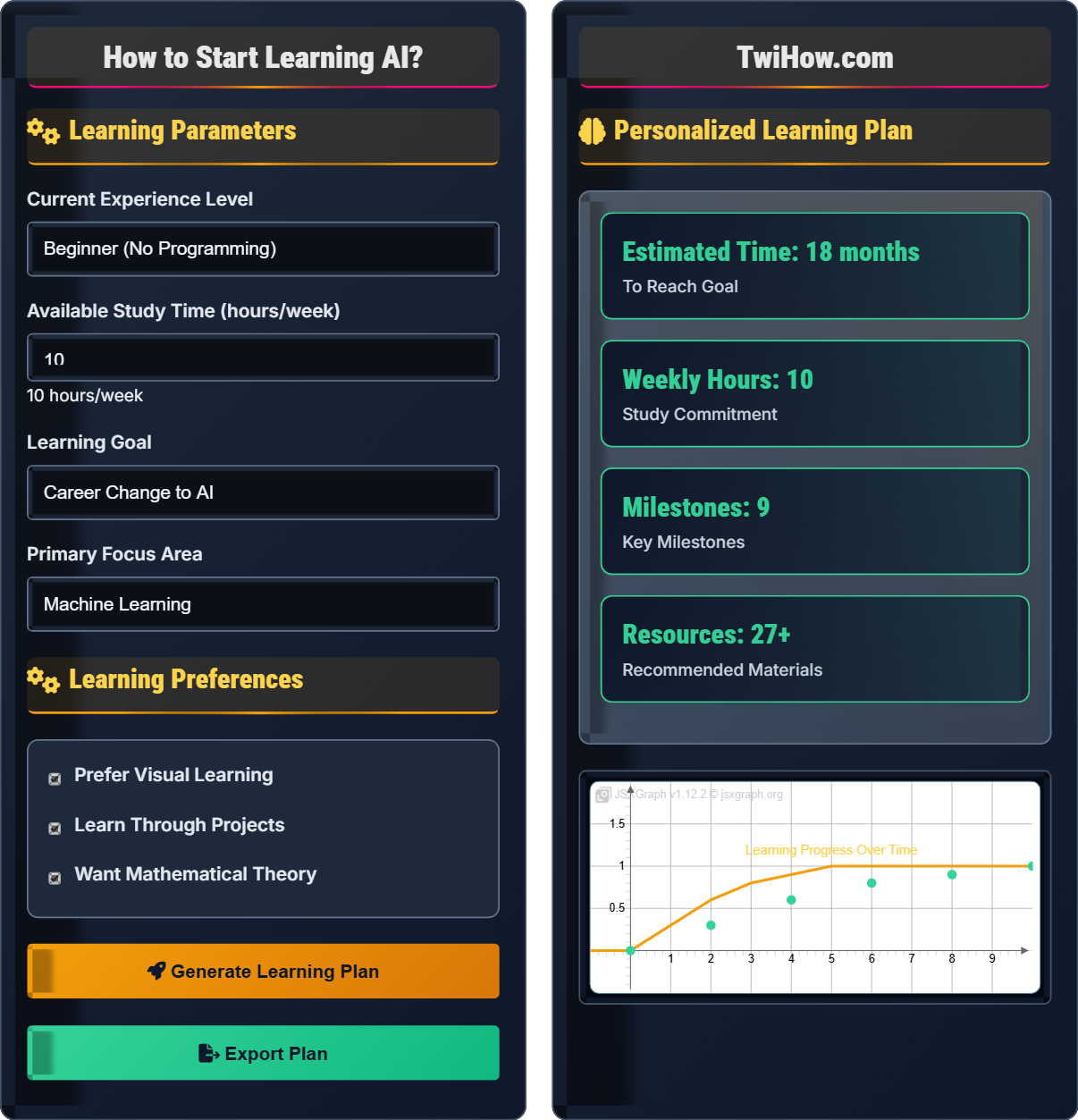
Personalized Learning Plan
Foundation (Months 1-2)
Math basics, Python programming, data manipulation with NumPy/Pandas
Machine Learning Basics (Months 3-4)
Supervised learning, unsupervised learning, model evaluation
Deep Learning Intro (Months 5-6)
Neural networks, TensorFlow/PyTorch, backpropagation
Specialization (Months 7-9)
Focus area expertise, advanced techniques
Portfolio Building (Months 10-12)
Real projects, GitHub contributions, portfolio showcase
Comprehensive introduction to ML concepts and algorithms
Master NumPy, Pandas, and data manipulation
Advanced deep learning concepts and implementations
Practical deep learning for coders
Complete AI Learning Roadmap
Artificial Intelligence is transforming industries and creating unprecedented opportunities. Learning AI opens doors to exciting careers, enables innovation, and provides tools to solve complex real-world problems. The field offers diverse specializations from computer vision to natural language processing.
Mathematics
Linear Algebra, Calculus, Statistics
Programming
Python, Data Structures
Data Skills
Analysis, Visualization
Logic
Problem Solving
These foundational skills provide the necessary background for understanding AI concepts and implementing solutions effectively.
Study Time Calculator
Essential Skills
Mathematics, programming, statistics, problem-solving, critical thinking, data analysis.
- Start with fundamentals
- Practice regularly
- Build projects
- Learn from failures
- Stay updated
- Consistency beats intensity
- Hands-on practice is crucial
- Build a strong foundation
- Learn by doing projects
Project Ideas
Predictive models, image classification, chatbots, recommendation systems.
Regression model using housing data to predict prices
Neural network for handwritten digit classification
NLP model to analyze text sentiment
- Start simple, increase complexity
- Document your process
- Share on GitHub
- Deploy for public access
AI Learning Assessment
What should be the first priority when starting to learn AI as a complete beginner?
Building a strong mathematical foundation is crucial when starting with AI. Understanding linear algebra, calculus, probability, and statistics provides the necessary tools to comprehend how algorithms work, debug issues, and optimize performance. Without this foundation, learners often struggle to progress beyond surface-level understanding.
The answer is B) Build a strong mathematical foundation.
Mathematical foundations serve as the language of AI. Linear algebra is essential for understanding neural networks and transformations, calculus is crucial for optimization algorithms, and statistics is fundamental for model evaluation and interpretation. Establishing these concepts early prevents confusion and frustration later in the learning journey.
Linear Algebra: Mathematics of vectors, matrices, and linear transformations
Calculus: Mathematics of change, essential for optimization
Statistics: Methods for data analysis and inference
• Foundation precedes advanced topics
• Understanding beats memorization
• Practice reinforces theory
• Use Khan Academy for math refreshers
• Apply math concepts immediately
• Don't rush to skip fundamentals
• Skipping math prerequisites
• Jumping to advanced tools too quickly
• Focusing only on code without understanding
Why is Python the recommended programming language for beginners learning AI, and what are the key libraries that make it suitable?
Python Advantages: Python is the dominant language in AI due to its simplicity, readability, and extensive ecosystem of scientific libraries. Its syntax is close to mathematical notation, making it easier to implement algorithms.
Key Libraries:
• NumPy: Numerical computing with arrays and matrices
• Pandas: Data manipulation and analysis
• Matplotlib/Seaborn: Data visualization
• Scikit-learn: Machine learning algorithms
• TensorFlow/PyTorch: Deep learning frameworks
• Keras: High-level neural network API
These libraries provide pre-built functions for complex operations, allowing beginners to focus on learning concepts rather than implementation details.
Python's design philosophy emphasizes code readability, which is crucial when learning complex concepts. The language's extensive documentation and community support make it ideal for beginners. The rich ecosystem of AI-specific libraries means beginners can implement sophisticated algorithms with minimal code, providing immediate gratification and motivation to continue learning.
NumPy: Library for numerical computing with multi-dimensional arrays
Scikit-learn: Machine learning library with pre-built algorithms
TensorFlow: Open-source platform for machine learning
• Choose widely-supported languages
• Leverage existing libraries
• Focus on concepts, not implementation
• Install Anaconda for easy package management
• Use Jupyter notebooks for experimentation
• Practice with toy datasets first
• Choosing languages without AI ecosystem
• Reimplementing existing functions
• Not using virtual environments
You have 15 hours per week to dedicate to AI learning. Design an optimal weekly schedule that balances theoretical learning, hands-on practice, and project work. How should you allocate your time across different learning activities?
Optimal Weekly Schedule (15 hours):
• Theoretical Learning (5 hours): Watch lectures, read papers, study concepts
• Hands-on Practice (6 hours): Code along with tutorials, experiment with algorithms
• Project Work (3 hours): Work on personal projects, implement ideas
• Review & Planning (1 hour): Assess progress, plan next steps, review notes
Rationale: Hands-on practice should receive the most time since AI is skill-based. Theoretical learning provides necessary concepts, while projects consolidate knowledge and build portfolio pieces. The schedule maintains a 40-40-20 split favoring practical application.
This allocation ensures comprehensive skill development while maintaining engagement and momentum.
Effective learning requires balance between different activities. Pure theory leads to forgetting, while pure practice without understanding leads to poor implementation. The optimal schedule ensures concepts are reinforced through practice, and practical skills are grounded in theory. Regular review prevents knowledge decay and maintains motivation.
Theoretical Learning: Understanding concepts, principles, and mathematics
Hands-on Practice: Implementing algorithms and experimenting
Project Work: Applying skills to solve real problems
• Practice should exceed theory
• Projects consolidate learning
• Consistent schedule beats sporadic effort
• Set specific daily goals
• Track time spent on activities
• Adjust ratios based on progress
• Spending all time on theory
• Not practicing enough
• No structured schedule
You're a beginner with limited budget who wants to learn AI. Rank these learning resources in order of priority: online courses, books, YouTube videos, coding bootcamps, university courses, and free tutorials. Justify your ranking and explain why.
Priority Ranking (1=highest priority):
1. Free Tutorials: Abundant, accessible, and cover basics comprehensively
2. YouTube Videos: Visual explanations, free, diverse perspectives
3. Online Courses: Structured learning, certificates, guided progression
4. Books: Comprehensive coverage, deep understanding, reference material
5. Coding Bootcamps: Intensive, expensive, but effective for career change
6. University Courses: Most comprehensive but time-intensive and expensive
Justification: Start with free resources to validate interest and build foundation. YouTube provides visual explanations for complex concepts. Online courses offer structure. Books provide depth. Bootcamps accelerate career transition. University provides comprehensive education but requires major commitment.
The learning journey should begin with low-commitment, free resources to gauge interest and build confidence. As skills develop, gradually invest in higher-quality resources. The progression from free to paid materials allows for natural filtering based on genuine interest and progress. Each resource type serves different learning styles and needs at various stages of the journey.
Free Tutorials: Online guides and documentation (Kaggle, Medium, etc.)
Online Courses: Structured learning platforms (Coursera, Udemy, edX)
Coding Bootcamps: Intensive, career-focused programs
• Start with free resources
• Match resources to learning style
• Invest as you progress
• Use free trials before purchasing courses
• Read reviews and syllabi carefully
• Combine multiple resource types
• Buying expensive courses without trying free options
• Not matching resources to skill level
• Relying on single resource type
Which of the following is the MOST common mistake made by beginners learning AI?
The most common mistake is jumping to advanced topics without building a proper foundation. Beginners often get excited by impressive demos of deep learning models and try to implement them without understanding the underlying mathematics and basic machine learning concepts. This leads to confusion, frustration, and inability to debug or improve models.
The answer is B) Jumping to advanced topics without foundation.
AI learning requires a solid foundation in mathematics, programming, and basic concepts before advancing to complex topics. Without understanding linear regression, it's difficult to grasp neural networks. Without knowing how basic algorithms work, implementing deep learning models becomes a matter of copying code without comprehension. The foundation provides the mental framework needed to understand and adapt advanced concepts.
Foundation: Basic knowledge and skills that support advanced learning
Advanced Topics: Complex subjects requiring prerequisite knowledge
Conceptual Understanding: Deep knowledge of how things work
• Build in correct order
• Master before moving on
• Foundations enable growth
• Follow structured learning paths
• Verify understanding before advancing
• Return to basics when confused
• Impatience to reach advanced topics
• Copying code without understanding
FAQ
Q: I have no programming experience. Is it still possible to learn AI?
A: Absolutely! Many successful AI practitioners started with no programming experience. The key is to approach learning systematically:
1. Start with Python basics: Learn variables, loops, functions, and data structures
2. Practice daily: Even 30 minutes of coding daily builds muscle memory
3. Use beginner-friendly resources: Codecademy, freeCodeCamp, or Python Crash Course
4. Build simple projects: Calculator, to-do list, then gradually more complex projects
5. Join communities: Stack Overflow, Reddit r/learnpython, Discord servers
Programming is a skill that develops with practice. Once comfortable with basics, AI concepts become much more accessible.
Q: How long does it typically take to become proficient in AI/ML?
A: The timeline varies significantly based on background and dedication:
Complete Beginner (10-15 hours/week): 12-18 months for basic proficiency
Programmer with Math Background: 6-9 months for basic proficiency
Advanced Practitioner: 2-3 years for research-level understanding
However, AI is continuously evolving. Proficiency is a journey, not a destination. The key milestones are:
• Month 3: Basic ML models and evaluation
• Month 6: Neural networks and deep learning
• Month 9: Specialized applications
• Month 12+: Portfolio projects and job readiness
Continuous learning is essential as the field advances rapidly.