How to Train an AI Model?
Complete AI Training guide • Step-by-step explanations
AI Training Fundamentals:
Show Training SimulatorTraining an AI model involves preparing data, designing an appropriate architecture, optimizing hyperparameters, and validating performance. The process transforms raw data into an intelligent system capable of making predictions or decisions.
Effective AI training requires careful attention to data quality, model architecture, and evaluation metrics. Success depends on the iterative refinement of these components to achieve optimal performance for specific tasks.
Key Training Concepts:
- Data Preparation: Cleaning, normalizing, and splitting datasets
- Model Architecture: Designing network structure and layers
- Hyperparameter Tuning: Optimizing training parameters
- Training Loop: Forward pass, loss calculation, backpropagation
- Evaluation: Measuring performance on unseen data
Modern AI training leverages techniques like transfer learning, data augmentation, and distributed computing to accelerate development and improve results.
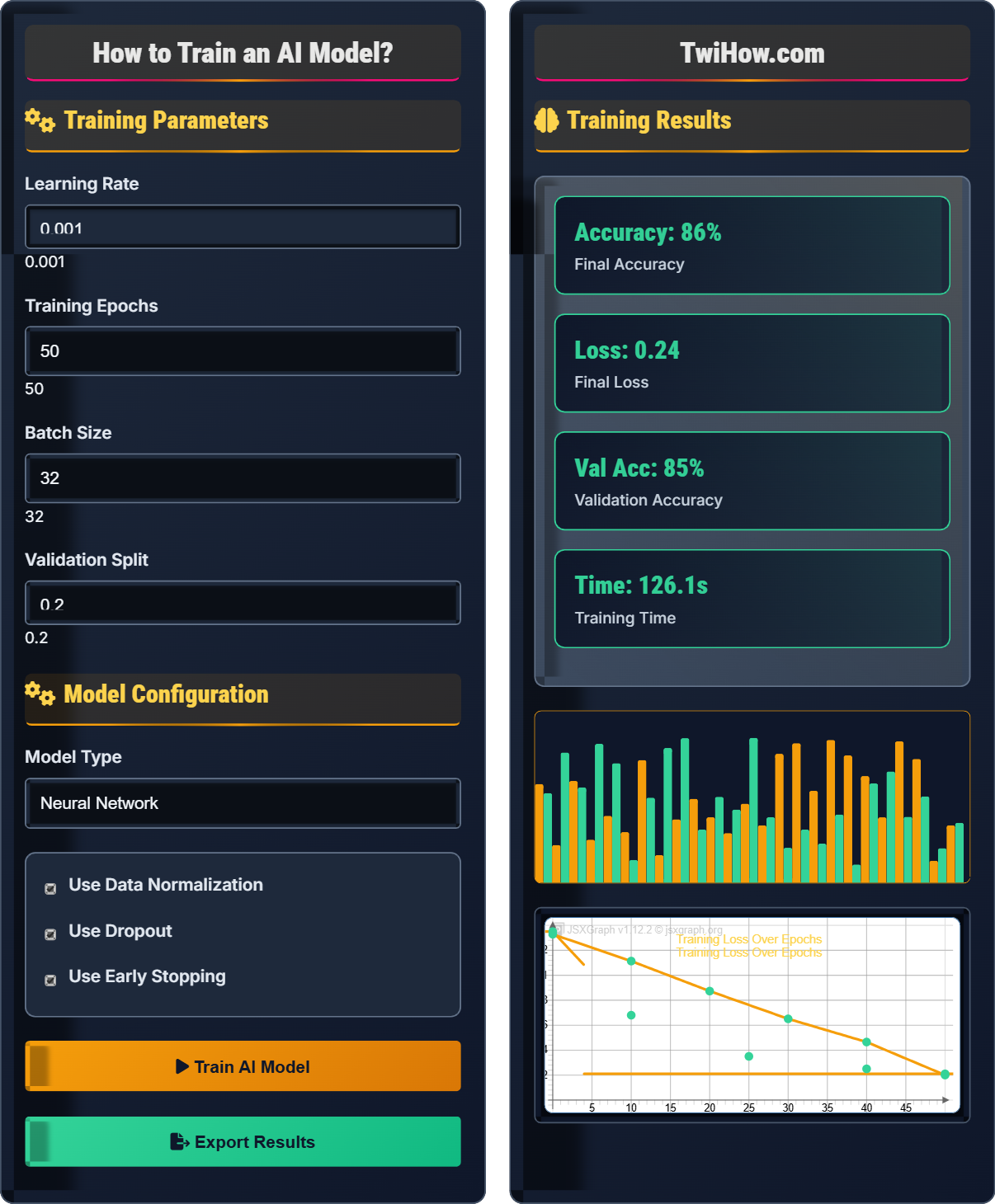
Training Parameters
Model Configuration
Training Results
| Epoch | Loss | Accuracy | Val Loss | Val Acc |
|---|---|---|---|---|
| 1 | 1.35 | 45% | 1.32 | 47% |
| 10 | 0.68 | 76% | 0.65 | 78% |
| 25 | 0.35 | 84% | 0.38 | 83% |
| 40 | 0.25 | 88% | 0.27 | 86% |
| 50 | 0.21 | 89% | 0.23 | 87% |
How to Train an AI Model: Complete Guide
Training an AI model is the process of teaching a machine learning system to make accurate predictions or decisions by exposing it to data. This involves iteratively adjusting the model's parameters to minimize prediction errors. The training process transforms raw data into actionable intelligence.
- Data Quality: Ensure clean, representative, and balanced datasets
- Validation Strategy: Use proper train/validation/test splits
- Regularization: Implement dropout, batch norm, or L2 to prevent overfitting
- Monitoring: Track loss curves and performance metrics
- Early Stopping: Prevent overfitting by stopping at optimal point
- Transfer Learning: Leverage pre-trained models when possible
Data Preparation
Check for missing values, outliers, class imbalance, and feature correlations. Clean data significantly impacts model performance.
- Represent the problem domain accurately
- Balance classes when possible
- Remove irrelevant features
- Normalize numerical features
- Encode categorical variables
Model Architecture
Select layers, neurons, and activation functions based on problem complexity and data characteristics. More complex problems may require deeper architectures.
- Start simple and increase complexity
- Match architecture to problem type
- Consider computational constraints
- Use proven architectures when possible
- Apply regularization appropriately
Training Monitoring
Track loss curves, accuracy, precision, recall, and F1-score during training. Monitor for signs of overfitting or underfitting.
When training accuracy continues to improve while validation accuracy plateaus or decreases, the model is overfitting to training data.
- Plot training and validation metrics together
- Watch for divergence in curves
- Implement early stopping
- Use learning rate scheduling
- Monitor gradient flow
Model Deployment
- Model Serialization: Save trained model weights and architecture
- Environment Setup: Prepare production environment with dependencies
- API Development: Create interface for model inference
- Performance Testing: Validate model in production conditions
- Monitoring Setup: Implement performance and drift monitoring
- Scaling: Configure for expected load and usage patterns
Consider cloud platforms, containerization (Docker), orchestration (Kubernetes), and CI/CD pipelines for reliable deployment and updates.
- Validate model performance in production
- Implement rollback mechanisms
- Monitor for data drift
- Plan for model updates
- Ensure security and privacy
AI Training Learning Quiz
Why is data normalization important in AI model training?
Data normalization scales features to similar ranges (e.g., 0-1 or standardized), preventing features with larger magnitudes from dominating the learning process. Without normalization, features with larger scales can disproportionately influence model weights, leading to suboptimal performance.
The answer is B) To ensure all features contribute equally to learning.
Imagine one feature ranges from 0-1 (like probability) while another ranges from 0-1000 (like population count). The population feature would dominate simply due to its scale, not its actual importance. Normalization ensures each feature has equal opportunity to influence the model.
Normalization: Scaling data to standard range
Standardization: Scaling to mean=0, std=1
Feature Scaling: Equalizing feature contributions
• Normalize before training
• Apply same scaling to test data
• Neural networks benefit significantly
• Min-max scaling for bounded data
• Z-score for normally distributed data
• Robust scaling for outliers
• Not normalizing at all
• Different scaling for train/test
• Forgetting to inverse transform outputs
Explain what overfitting is in AI model training and describe at least four techniques to prevent it. Why is preventing overfitting crucial for model success?
Overfitting: A model learns the training data too well, including noise and specific details that don't generalize to new data. The model performs excellently on training data but poorly on unseen data.
Prevention Techniques:
1. Data Augmentation: Increase dataset size with variations of existing data
2. Regularization: Add penalties to model complexity (L1/L2)
3. Dropout: Randomly disable neurons during training
4. Early Stopping: Monitor validation performance and stop at optimal point
Preventing overfitting is crucial because the goal is good performance on new, unseen data, not just memorizing training examples.
Think of overfitting like a student who memorizes answers for a test but can't apply concepts to new problems. The model becomes too specialized to the training data and loses its ability to generalize. Effective training requires balancing between learning patterns and avoiding memorization.
Overfitting: Poor generalization to new data
Underfitting: Model too simple to capture patterns
Generalization: Performance on unseen data
• Always validate on unseen data
• Monitor training vs validation metrics
• Balance model complexity with data size
• Use k-fold cross-validation
• Implement learning rate scheduling
• Monitor gradient flow in deep networks
• Evaluating only on training data
A company wants to train an AI model to predict customer churn based on behavioral data. They have 100,000 customers with 50 features but only 5,000 churned customers (5% positive rate). Describe the training approach they should take, including data handling, model selection, and evaluation metrics.
Data Handling: Address class imbalance using SMOTE oversampling, undersampling, or weighted loss functions. Split data preserving the original distribution.
Model Selection: Use algorithms robust to imbalanced data (Random Forest, XGBoost) or neural networks with appropriate loss functions.
Evaluation Metrics: Focus on precision, recall, F1-score, and AUC-ROC rather than accuracy. Use stratified sampling for validation.
Approach: Data preprocessing → Handle imbalance → Model training → Evaluation on test set → Threshold optimization for business requirements.
Imbalanced datasets are common in real-world scenarios (fraud detection, medical diagnosis, etc.). Standard accuracy can be misleading - a model predicting "no churn" for everyone would achieve 95% accuracy but be useless. Special techniques are needed for such problems.
Class Imbalance: Unequal distribution of target classes
SMOTE: Synthetic Minority Oversampling Technique
Stratified Sampling: Preserves class distribution
• Don't use accuracy for imbalanced data
• Address imbalance before training
• Consider business cost of errors
• Use precision-recall curves
• Implement threshold tuning
• Consider ensemble methods
• Using accuracy on imbalanced data
• Not handling class imbalance
• Ignoring business costs
A data scientist is training a neural network and notices the training loss decreases slowly and the model doesn't converge. The current learning rate is 0.0001. Explain what might be happening and suggest a systematic approach to optimize hyperparameters.
What's Happening: The learning rate is likely too low, causing extremely slow convergence. The model takes tiny steps toward the minimum, requiring excessive training time or getting stuck in local minima.
Systematic Approach:
1. Learning Rate Search: Try rates like 0.001, 0.01, 0.1 to find optimal range
2. Grid Search: Systematically try combinations of LR, batch size, and epochs
3. Random Search: Sample hyperparameters randomly for efficiency
4. Bayesian Optimization: Use probabilistic models to guide search
Start with learning rate 0.01 and adjust based on training curves.
Hyperparameter tuning is critical for model performance. Learning rate controls how big steps the optimizer takes. Too high causes oscillation around minimum, too low causes slow convergence. Finding the right balance is essential.
Hyperparameters: Configurable parameters set before training
Convergence: Reaching stable solution
Optimization Landscape: Error surface being minimized
• Start with recommended defaults
• Tune one parameter at a time initially
• Use validation data for tuning
• Use learning rate schedules
• Monitor training curves
• Consider automated tools (Optuna, Hyperopt)
• Exhaustive grid search
• Not validating hyperparameters
• Tuning too many parameters at once
Which evaluation metric is most appropriate for a binary classification problem where false positives are much more costly than false negatives?
When false positives are more costly, precision is the most important metric. Precision measures the proportion of positive predictions that are actually correct, minimizing false positives. High precision means when the model predicts positive, it's usually right.
The answer is C) Precision.
Different metrics emphasize different aspects of performance. In medical diagnosis, spam detection, or fraud detection, false positives can have serious consequences. Precision focuses on minimizing these costly errors, while recall focuses on catching all positive cases.
Precision: TP/(TP + FP) - Minimize false positives
Recall: TP/(TP + FN) - Minimize false negatives
Accuracy: Overall correctness
• Choose metrics based on business cost
• Consider trade-offs between precision/recall
• Use appropriate baseline for comparison
• Use ROC/AUC for threshold-independent evaluation
• Consider business-specific metrics
• Validate on diverse test sets
• Using accuracy for imbalanced problems
• Ignoring business costs
• Not considering threshold optimization
FAQ
Q: How long does it typically take to train an AI model?
A: Training time varies widely depending on model complexity, dataset size, and hardware. Simple models might train in minutes, while large neural networks can take days or weeks. Factors include: data size, model architecture, hardware (CPU/GPU), hyperparameters, and desired accuracy. Transfer learning can significantly reduce training time.
Q: What's the difference between training, validation, and test sets?
A: Training set is used to teach the model (adjust parameters). Validation set is used during training to tune hyperparameters and prevent overfitting. Test set is used after training to evaluate final model performance on completely unseen data. Typically split as 70% train, 15% validation, 15% test.